





Getty
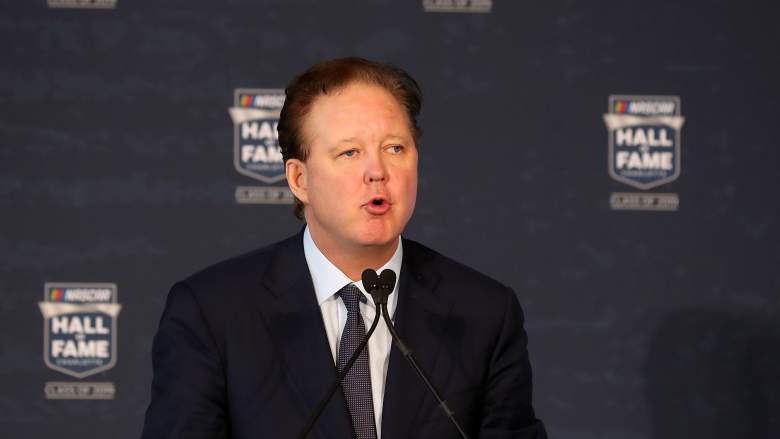
Former NASCAR CEO and Chairman Brian France speaks during NASCAR Hall of Fame Voting Day in Charlotte. France led the sport through a period of major change in the 2000s.
Leadership turnover is constant in most major sports.
Not in NASCAR.
Since its founding in 1948, the sanctioning body has had just five CEOs — a level of stability that’s virtually unmatched across American sports. Each transition didn’t just mark a new leader. It defined a new era.
With Steve O’Donnell stepping into the role in 2026, NASCAR enters its latest chapter. But to understand where the sport is going, you have to understand how each CEO helped shape it.
Everything in NASCAR traces back to Bill France Sr.
When he founded NASCAR in 1948, stock car racing was fragmented and inconsistent. France brought structure, rules, and — most importantly — a long-term vision.
The first “Strictly Stock” season followed in 1949, but France’s impact went far beyond the track. He built the business side of the sport, helped establish Daytona as its centerpiece, and later pushed forward the development of Talladega Superspeedway.
More than anything, France Sr. created a centralized model of leadership — one that would define NASCAR for decades.
If France Sr. built NASCAR, Bill France Jr. scaled it.
Taking over in the 1970s, he transformed a regional sport into a national one. The inflection point came in 1979, when the Daytona 500 aired live flag-to-flag — a broadcast that is still widely viewed as NASCAR’s breakthrough moment.
From there, growth accelerated.
Major sponsors entered the sport. The schedule expanded. Television deals grew in value and reach. NASCAR moved from its Southern roots into a nationwide phenomenon.
By the early 2000s, it wasn’t just popular — it was one of the most powerful sports properties in the country.
Brian France stepped into leadership at a far more complicated time.
NASCAR was at its peak — but also at the beginning of a long-term shift in fan behavior, media consumption, and competition for attention.
His tenure was defined by attempts to modernize the sport. The introduction of the playoff system reshaped how championships were decided. Efforts were made to broaden NASCAR’s reach and evolve its presentation.
But the era also brought challenges. As the sports landscape changed, NASCAR faced increasing pressure to adapt — and not every move landed cleanly with its core audience.
It was a period of both innovation and instability.
When Jim France took over in 2018, stability became the priority.
His leadership came during one of the most unpredictable stretches in modern sports, including the COVID-19 pandemic. NASCAR navigated that period more smoothly than many expected, maintaining its schedule and keeping the sport moving.
At the same time, the Next Gen car debuted in 2022 — one of the most significant competition shifts in years, aimed at improving parity and controlling costs.
Jim France’s tenure wasn’t about radical change. It was about keeping NASCAR grounded while positioning it for the future.
Steve O’Donnell’s move into the CEO role marks more than just another transition.
It’s the first time the position shifts to someone who isn’t part of the France family’s core leadership lineage, even as the family remains firmly in control of the sport’s broader direction.
O’Donnell has been deeply involved in NASCAR’s operations for years, particularly on the competition side. His promotion signals continuity — but also evolution in how leadership is structured at the top.
Five CEOs. Nearly 80 years.
That level of continuity is rare — and it has shaped NASCAR in ways that set it apart from other leagues.
While other sports cycle through commissioners and executives, NASCAR has relied on long-term vision and centralized control. That consistency has helped preserve the sport’s identity, even as it’s adapted across generations.
Now, with O’Donnell stepping in, NASCAR enters its next phase — one built on the same foundation, but facing a very different future.
Maggie MacKenzie Maggie MacKenzie covers NASCAR for Heavy.com. She previously worked for NASCAR.com, where she reported, wrote, and edited race-weekend coverage and traveled to key events throughout the season. She has more than ten years of experience in sports media and is based in Boston, Massachusetts. More about Maggie MacKenzie
此内容由惯性聚合(RSS阅读器)自动聚合整理,仅供阅读参考。 原文来自 — 版权归原作者所有。