


Getty
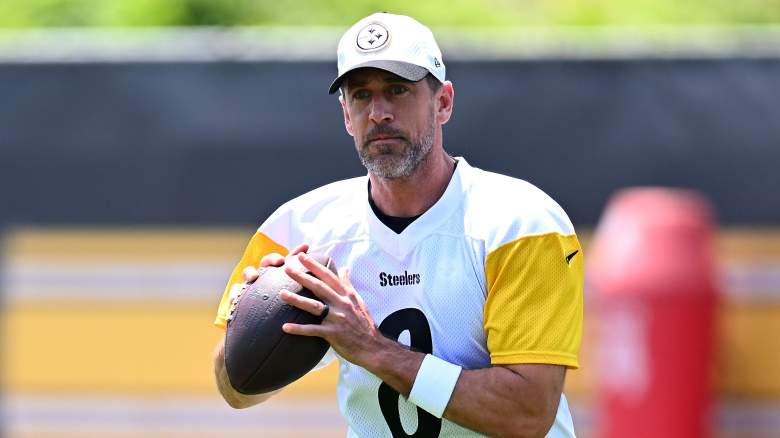
The Pittsburgh Steelers' Aaron Rodgers turns 43 before the 2026 season.
After waiting through most of May, Aaron Rodgers finally announced his decision that he would return to play for the Pittsburgh Steelers in 2026. However, the veteran quarterback also noted that this would be his final NFL season.
“Yes. This is it,” Rodgers told reporters on May 20 when asked if 2026 would be his final NFL season.
While there may be renewed excitement around the organization now that Pittsburgh no longer has to worry about its quarterback situation heading into the season, analysts such as ESPN’s Bill Barnwell still question the entire process.
Barnwell has called not only the signing of Rodgers, but the Steelers’ overall handling of the quarterback position, one of the worst moves of the offseason.
Pittsburgh arguably had opportunities to pursue other veteran quarterbacks such as Kyler Murray, Kirk Cousins, Joe Flacco or even Tua Tagovailoa, all of whom could potentially project better than Rodgers in 2026. After all, Rodgers has experienced significant declines in QBR since 2021.
“At 42, the chances are far more likely that Rodgers is worse in 2026 than of any sort of dramatic improvement,” Barnwell wrote. “It would be one thing if the Steelers were waiting on peak Rodgers to return, but the entire organization was left on hold as a below-average starter spent months deciding whether he wanted to continue playing. And though Rodgers is obviously familiar with new head coach Mike McCarthy, it’s worth remembering that Rodgers’ performance improved dramatically in Green Bay after McCarthy left and was replaced by Matt LaFleur.”
Rodgers posted career-best numbers under LaFleur, including a 70.7 completion percentage and 48 touchdown passes during the 2020 season.
What is interesting about the McCarthy connection is Rodgers revealed he personally suggested McCarthy as a coaching candidate to Steelers general manager Omar Khan after Mike Tomlin stepped down.
“When he said he was stepping away, that was an emotional moment just because we all love him so much and care about him, and I thought that was probably it for me in Pittsburgh,” Rodgers said. “But when the decision was made to hire Mike, I started opening my mind back up to coming back.”
As mentioned, Barnwell didn’t just criticize the signing of Rodgers, but also the Steelers’ approach with young quarterbacks Will Howard and Drew Allar.
“Is there a quarterback of the future on this roster?” Barnwell asked. “The Steelers have taken a couple of low-likelihood shots. Will Howard was drafted in the sixth round last year, and though there’s optimism about the former Ohio State product, he hasn’t taken even a preseason snap as a pro because of injuries, let alone one in the regular season. The decision to draft Drew Allar in the third round this year hints at the organization’s real feelings about Howard, but the track record for quarterbacks with ideal NFL size and arm strength who aren’t good enough to actually go in the first round of the draft is treacherous.
“It’s possible that the Steelers unlock something in Allar, but I worry that we’re going to be facing this exact same conundrum at quarterback in Pittsburgh next offseason.”
Rodgers is not the only reason to keep an eye on the Steelers in 2026. If he were to suffer an injury, Pittsburgh could get its first real look at either Howard or Allar.
In a way, Rodgers’ health could both help and hurt the organization. If he stays healthy, he likely keeps the Steelers competitive. But if he doesn’t, Pittsburgh may finally learn whether it has a legitimate long-term answer already on the roster.
Shane Shoemaker Shane Shoemaker is a sports journalist covering college football and the NFL for Heavy.com. His work has also appeared in The Sporting News, Athlon Sports, USA TODAY, and ClutchPoints, along with high school sports coverage for the Marion Tribune. More about Shane Shoemaker
此内容由惯性聚合(RSS阅读器)自动聚合整理,仅供阅读参考。 原文来自 — 版权归原作者所有。