









Getty
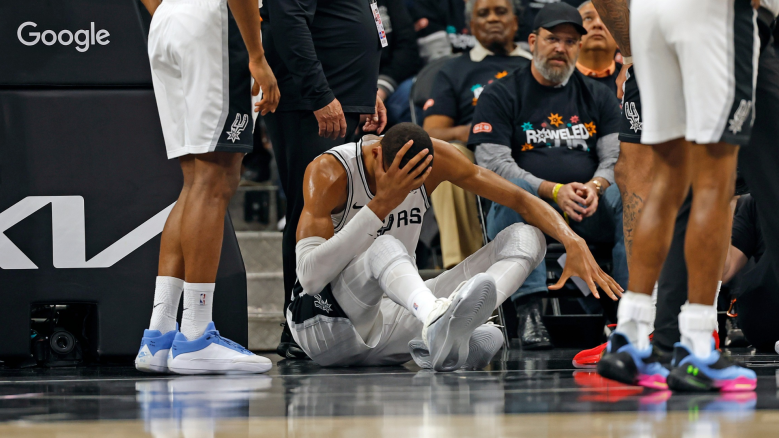
Victor Wembanyama #1 of the San Antonio Spurs holds his head after falling to the court against the Portland Trailblazers in the first half of Game Two of the Western Conference First Round NBA Playoffs at Frost Bank Center on April 21, 2026 in San Antonio, Texas.
Victor Wembanyama had just been named the NBA’s Defensive Player of the Year, the first unanimous winner ever, and less than 24 hours later, he was in the locker room after a scary fall. The San Antonio Spurs and their fans are now waiting on answers.
In a video published on the KENS 5 YouTube channel, Dr. Ali Seifi, Director of the Neurointensive Care Unit at University Health in San Antonio, sat down to break down what happened to the 22-year-old and what it could mean for the rest of the series.
Wembanyama went down hard in the second quarter of Game 2 against Portland, played just 12 minutes, and was placed in the concussion protocol. The Spurs lost 106-103, evening the series at 1-1. Dr. Seifi reviewed the fall on video and said the first thing that stood out was that Wembanyama did not lose consciousness, which he called a good sign.
“So what I saw yesterday at the video is like a mild concussion. And the good thing was that when he hit his face on the floor, he didn’t lose his consciousness. So he was conscious, awake, and say something. So this is a good sign.”
Still, Dr. Seifi was not ready to wave it off completely. He saw something in the way Wembanyama tried to get up that gave him pause.
“Immediately it seemed like he hit his chin first… and then he started to wake up, and then he could wobbly after maybe a few seconds, which tell me maybe he had some foggy feeling. So those are concerning.”
That foggy feeling has a straightforward medical explanation. Dr. Seifi described the brain as soft tissue, like jello, sitting inside a hard bony skull. A hard fall shakes that jello. That shaking is what doctors call a concussion, and the symptoms do not always show up right away.
“It’s like something soft inside something harder, like a bone skull, start to shake. And that’s why, because the neurones are very soft, and when they get like some falling on the floor or getting kind of trauma, that jello inside the skull gonna start to shake, and we call that concussion.”
Dr. Seifi also cleared up something a lot of people get wrong. Keeping someone with a concussion awake through the night is not actually helpful, and the brain does not need that kind of pressure on it.
“So that’s actually a wrong thing. So the best thing for the brain when a concussion happen is a rest. So we advise even they don’t look into the phone or watch TV or not to be engaging any of the, you know, with other people.”
Under NBA guidelines, a player diagnosed with a concussion cannot return to full participation for 48 hours after the injury. After that, it is a gradual process monitored by both the team doctor and the league’s concussion medical director, and there is no fixed date.
Dr. Seifi explained that the timeline is fluid on purpose, because every concussion is different. Some players have mild ones, some have severe ones, and the doctors need to see how the patient responds before making any call.
“So at that time, they’re gonna talk to each other, examine the patient, and then make a conclusion should he go back. And we wish the best. Hopefully he go back.”
Dr. Seifi put the odds in Wembanyama’s favor. He said more than 90% of concussions resolve fully without anything serious. The warning signs to watch over the next 48 hours are severe headaches, seizures, or any weakness in the arms.
Game 3 is in Portland on Friday, and the Spurs need clarity on Wembanyama before tip-off. He dropped 35 points in Game 1 and was already making his presence felt in Game 2 before the fall. As Dr. Seifi made clear, the only people who can make that call are the doctors in the room with him.
Jayesh Pagar Jayesh Pagar is a writer at Heavy Sports, covering the New York Knicks and other NBA teams. He brings four years of experience across digital sports media, including NBA, WNBA, college basketball, and college football. He covered as the Knicks beat writer for ONSI and has written for PFSN, Sporting News, and ClutchPoints. More about Jayesh Pagar
此内容由惯性聚合(RSS阅读器)自动聚合整理,仅供阅读参考。 原文来自 — 版权归原作者所有。