


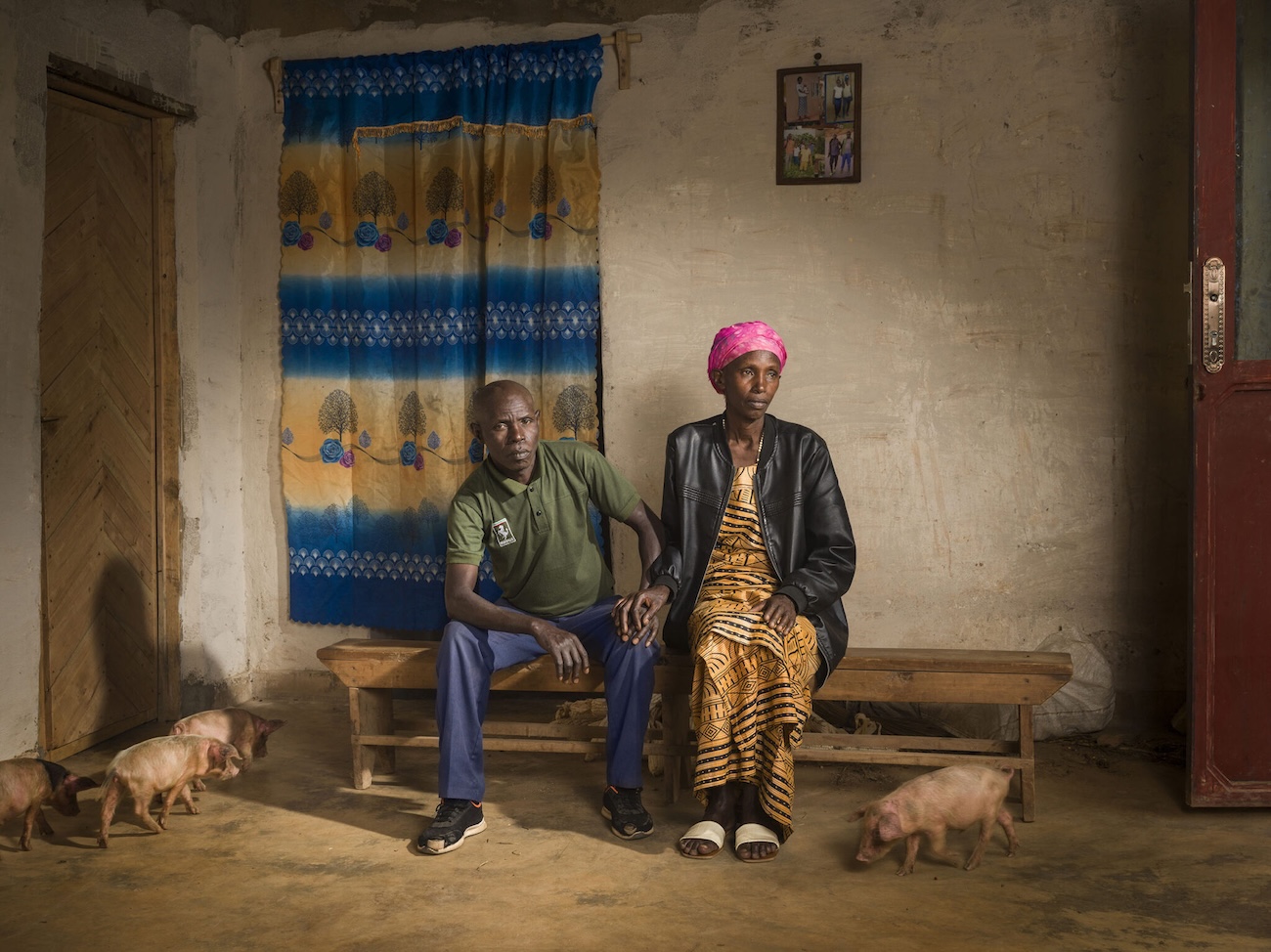
When the genocide began, Marianna fled with her family to a church where most of them were slaughtered. She and a sister survived by hiding among the bodies, and later escaped to Bisesero, where many Tutsis died after being abandoned by French peacekeeping forces. In a sociotherapy group in 2018, she encountered Marc, who killed her sister and looted their home. During therapy, she forgave him.
What does it mean to forgive someone? How is reconciliation possible when a person commits the worst acts imaginable? These are just two of the questions that surface from Dutch photographer Jan Banning’s series Blood Bonds: Reconciliation in Post-Genocide Rwanda. The collection, in which Banning’s photographs are paired with text from writer Dick Wittenberg, shows the unexpected: perpetrators and survivors of the Rwandan genocide posing together in solemn, restrained portraits.
In 1994, Rwanda experienced one of history’s fastest and most brutal genocides; Hutu extremists massacred many in the Tutsi minority. An estimated 500,000 to 800,000 Tutsis and moderate Hutus were killed over roughly 100 days. The attacks were carried out mostly by machete, at places like churches, schools, and at roadblocks, and were often neighbors against neighbors.
Because the attacks happened within communities, those who survived had to live alongside people who had harmed them and their families. Sometimes, the two opposing sides lived next door. But many, miraculously, have found a way to move forward. Since 2005, more than 115,000 survivors and perpetrators have participated in sociotherapy groups, where those who harmed express contrition and ask for forgiveness. They may also reveal the location of the victims’ graves, which allows family members to bury their loved ones properly. It’s a true testament to how healing is possible even in the darkest of circumstances.
Blood Bonds features 18 portraits of perpetrators and survivors, alongside Wittenberg’s writing that provides context for each image. But in looking at the image first—without reading the text—Banning does something extraordinary through his portraits. He presents ambiguity. Who was the perpetrator sitting here? It’s often unclear, and speaks to the haunting fact that the attacks came from people known to the survivor.
“In different circumstances,” Banning tells My Modern Met, “could the perpetrators have been the victims? And also, I myself, what am I? Am I good or bad?”
My Modern Met spoke with Banning about Blood Bonds, including how the project came about and what he’s learned about forgiveness. Scroll down to read the interview, which has been edited for length and clarity.
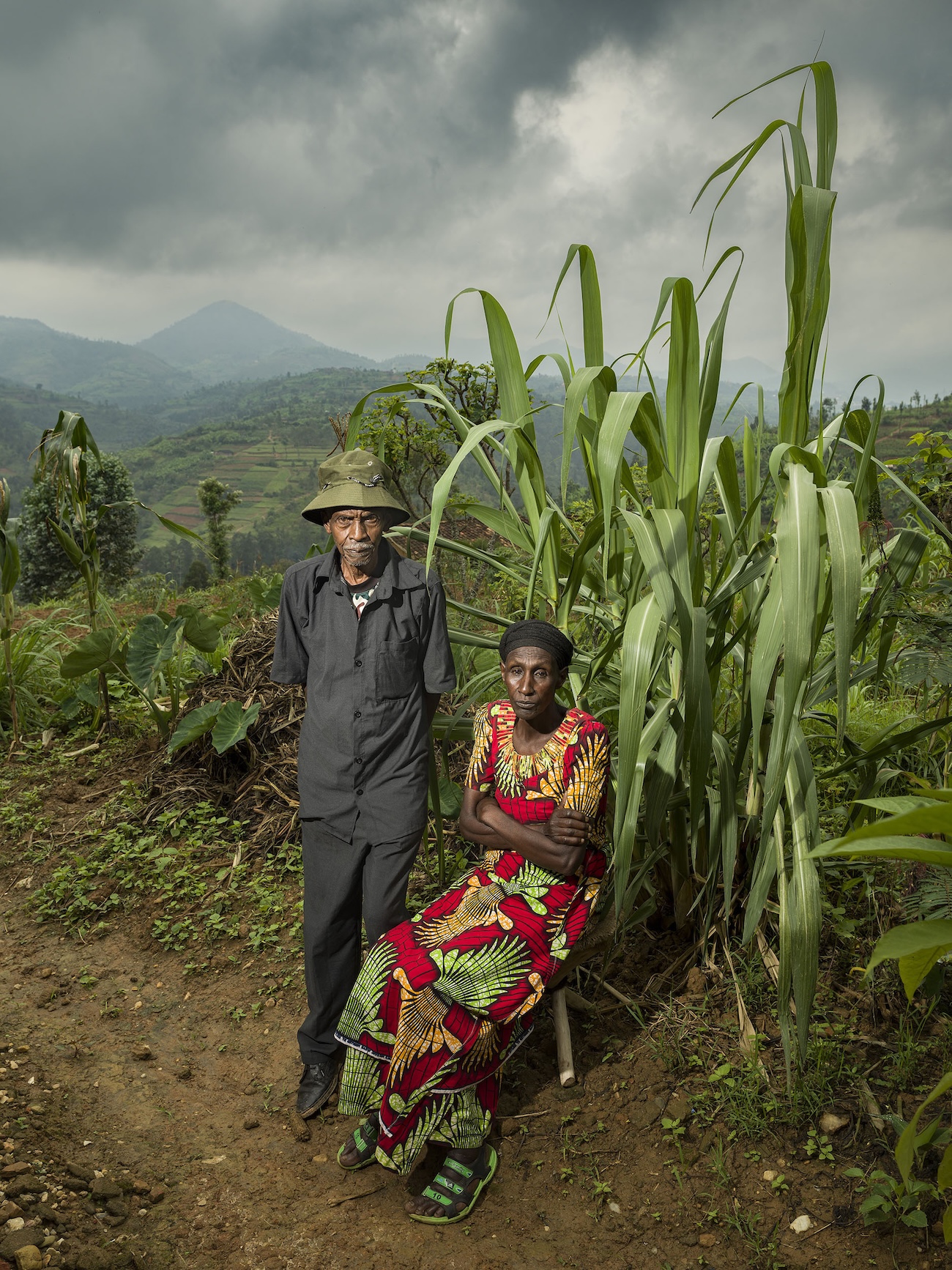
Liberatha lost three of her 11 children, including twins murdered by men who attacked her house at the start of the genocide. Her entire family was also killed. After the genocide, she (in her own words) was “insane” and consumed by anger for years. In a sociotherapy group, she met Alphonse Ranyemera, who served 15 years in prison. He was part of the group that killed her twins, apologized and asked for forgiveness.
How did the idea for Blood Bonds come about?
I was in Rwanda for an assignment. I very rarely do an assignment, but this one I did accept. It was 2023, I think, and I was photographing female construction workers. One evening, I went out with a member of the [Dutch] trade union and the Rwandan trade union, their counterpart.
He told me that both his parents had been killed during the genocide, and that his mother had been killed by their neighbor, whom they had always considered a very good friend, which is more or less the pattern as it happened at the time. But to my amazement, he said that the guy, the killer, had been taken to court and then had been very remorseful and had asked for forgiveness from Jack, that was the trade union guy, and his family.
After some deliberations, they had decided: yes, okay, we’ll forgive him. Then, the body of the mother was found in a mass grave, and they were taking it out and giving her a ceremonial reburial. They invited some friends and family members, and among the people invited was the killer of the mother.
And I said, what, this is unheard of, and surprised. Yeah, well, oh, apparently I didn’t know that. This happens in Rwanda. Obviously, not everyone is reconciling, but no, it’s not an unusual thing in Rwanda. I thought this was just so incredibly important. I have to go and document it and make this known to the rest of the world.
There was also a personal aspect because up until about that time, for several years, I had been working on a previous project, which was called The Verdict: The Christina Boyer Case. That was about a wrongfully incarcerated woman in the U.S., in Georgia, who, by the way, is still incarcerated. That whole research confronted me with the brutality and the unforgiveness and the radical nature, and let’s say, focused on retaliation and revenge of the U.S. criminal justice system. It was a source of huge frustration for me, and then to hear about this completely different approach to absolutely horrible crimes was good for my soul, I guess. So there was also this private reason to delve into it.
That’s two different ends of a spectrum. What draws you to these stories?
I think a sense of justice and the feeling that something has to be worth delving into. Once I tend to really delve into things and get immersed in them, but it has to be worth it. I’m not much interested in doing the umptieth series about something that has been done by 10 or 100 other photographers or other artists or whatever. I need the sense of relevance, I need the sense of urgency, and the sense of justice, I guess, or at least it’s related to justice, either about justice or injustice.
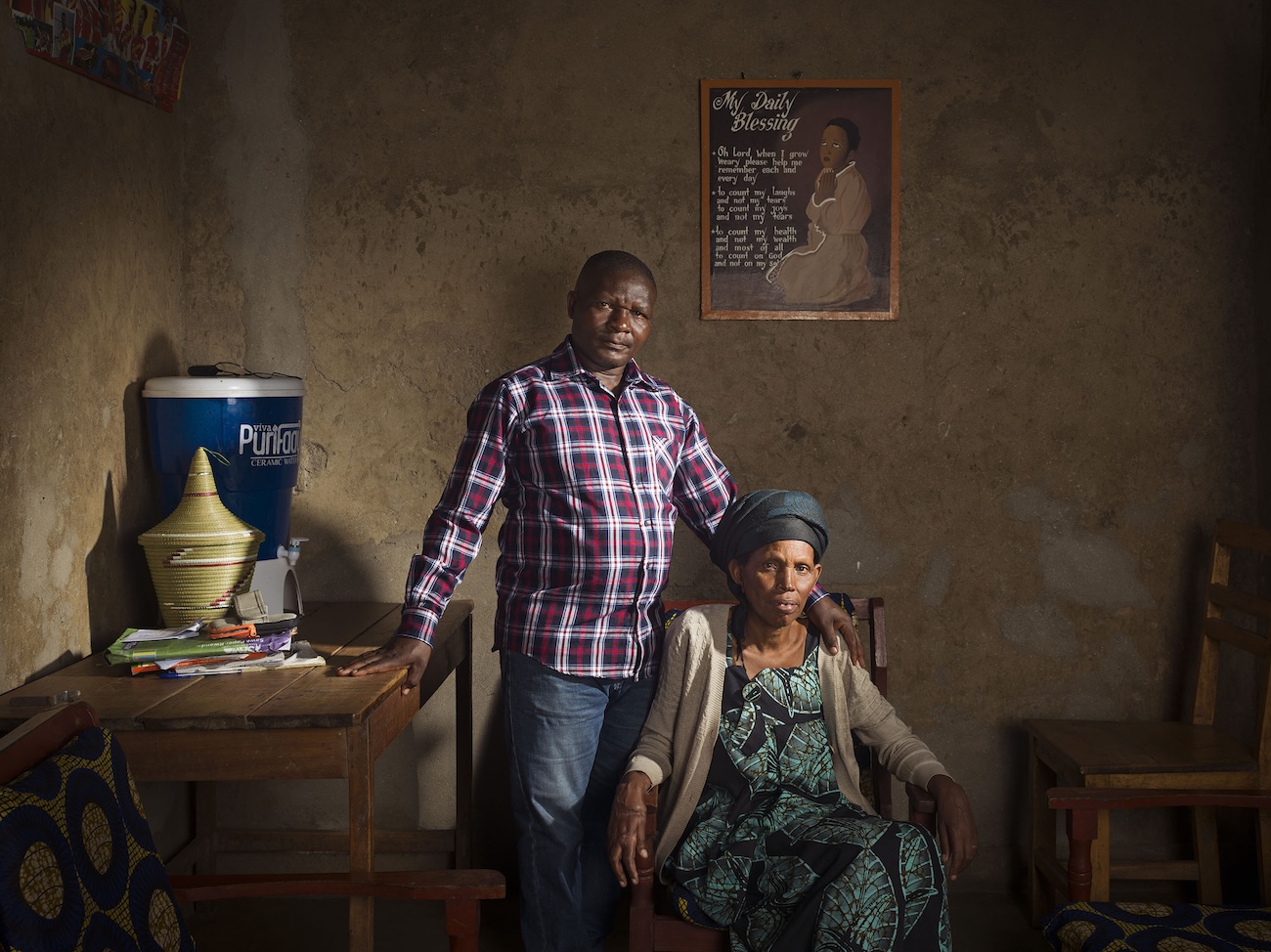
Rose lost her two eldest children and nearly her entire family during the genocide. Among the attackers was Ezechiel, who brutally killed her baby and sister-in-law, leaving Rose gravely injured. The scars on her right hand are a constant reminder of that horrifying day. In 2014, Rose joined CBS Rwanda’s sociotherapy group. During the sessions, Ezechiel expressed his deep remorse for taking her baby’s life, and, over time, Rose found the strength to forgive him.
How did you find the subjects of Blood Bonds, and how did you approach them to share their stories?
I knew that the Rwandan government had a program of reconciliation, but as we know, the Rwandan government is not exactly an example of democracy, transparency, humanity, etc. I was very hesitant to get on board with the Rwandan government for fear of being lured into a program of propaganda. But I needed their permission. I think the good thing was that I never presented myself as a journalist, if we look at it from an economic point of view. I live off print sales, not based on the media. I think that helped in getting the permission. But of course, that still left open the question now, how am I going to find [the subjects]? And then a very fortunate thing was that I got in touch with the Dutch embassy, and they told me that a Dutch woman was working for a Rwandan organization [called CBS], which was actually set up by another Dutch woman a couple of decades ago.
CBS stands for community-based social therapy, and they had the contacts. And not only that, but the good thing was that they’re not aiming for reconciliation. Of course, they don’t object to it. But basically, what they are aiming for is something much more modest—which they would not use that expression—but I think in principle it is sort of helping people to overcome at least part of their trauma, the trauma both as a victim and as a perpetrator, with the attached feelings of shame, embarrassment, etc.
They were willing to bring me into contact with people who had followed their, let’s say, group therapy and who had actually reconciled. So, that was wonderful. There was no reason to think that we could be part of a propaganda project.
I asked writer Dick Wittenberg to join me because I have combined text and photography in other projects, but in this case, I thought this was going to be so emotional.
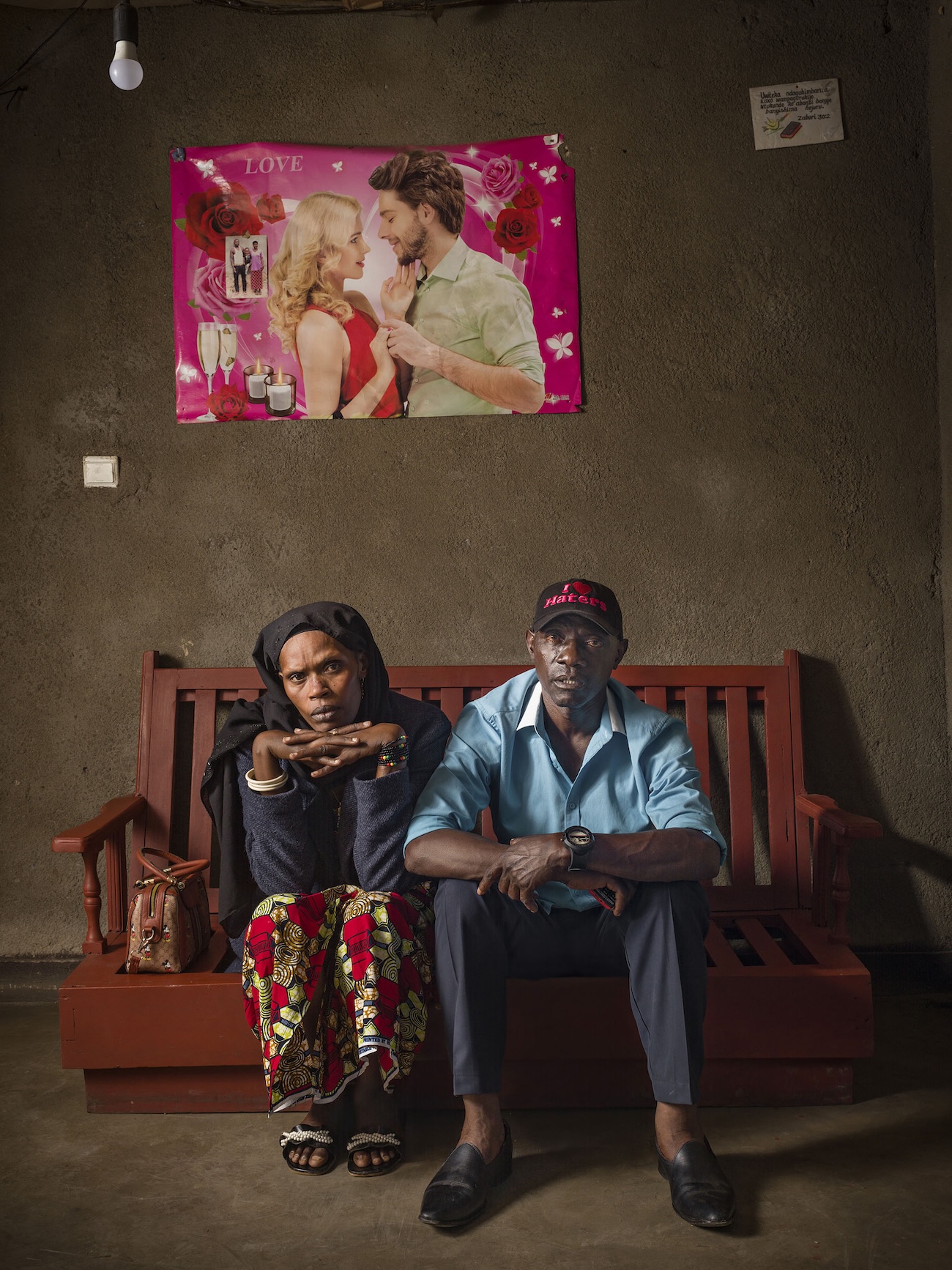
Epiphanie lost eight siblings, both parents, and nearly her own life in the genocide. On the first day of the killings, a mob including Jean Baptiste set fire to her grandmother’s house, where her family had sought refuge. At just 6 years old, she also survived a brutal attempt at rape. Years later, through a sociotherapy group, Epiphanie crossed paths with Jean Baptiste, who had served 12 years in prison for his crimes. After hearing his heartfelt apology, she found the strength to forgive, and they reconciled.
Can you talk about the setup for the portraits?
Before I even started, before I went to Rwanda, I was, as I usually do, experimenting in my studio with light. And, for me, an important aspect of my work is, how do I visualize it? I try to conceptualize things, start with a concept, and not just be completely spontaneous. Also, I have to decide what equipment to bring. In this case, I was carrying 60 kilos (132 pounds) of equipment, so that’s quite a bit.
So I thought, what is this? What is this about? What is the topic? Well, clearly, the topic, extremely simplified, is about good and bad.
But could it also have happened the other way around? I mean, in different circumstances, could the perpetrators have been the victims? And also, I myself, what am I? Am I good or bad? I have become convinced that most people, or maybe all people, until the opposite is proven, have both in them. Meaning that this is about moral ambiguity. So, what kind of style, what kind of lighting would express moral ambiguity at best?
I concluded that that was film noir, which is all about moral ambiguity. I started to experiment with lights in my studio, asked friends to stand in as models, or use myself as a model, and then came to the conclusion that, well, I had to take this, this, this as equipment, several lights, and so on.
So, I had an idea of how to approach it at the aesthetic level. Another important thing for me was that I should leave space for the people whom I was going to photograph to decide on where they were going to sit or stand, because I thought the whole body language and the position they chose was most likely part of the expression of the relationship between the two. So I shouldn’t interfere too much in that, given that they were willing to be photographed together.
I was trying to stay away from the casual photography as much as possible; that was not the feeling I wanted to transfer to them. This is not what you know about photography. This is more like me building a statue. This is an important moment. You and I are going to try to make something special. We are going to try to express what is going on, the reason why I’m here.
So, your contact, your relationship, the lights and everything, all of that helps. It raises it above the level of the snapshot, and I think it contributes to how they pose. As you see in the photography, there are differences. Sometimes there’s quite a gap between the people. And in other cases, there is a woman who puts her hand on the hand of the killer. Whoa, the thought would never cross my mind to even ask them. I would consider that to be completely immoral. But of course, I was very moved when I saw her do that and thought, whoa, yeah, I guess we can say this is really close to reconciliation if that’s what you do.
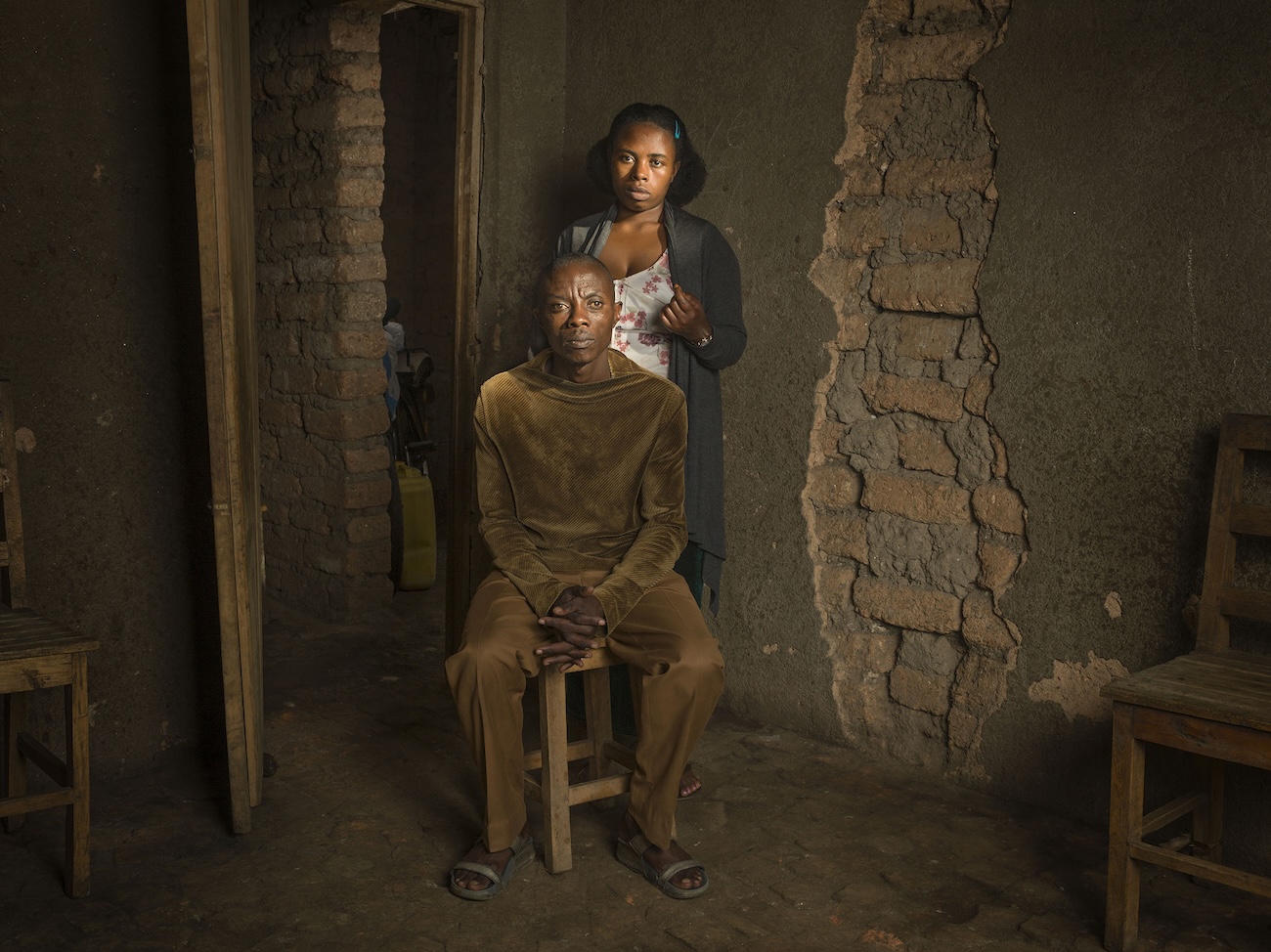
Solange struggled with shame and anxiety over her father’s role in the murder of Elie’s father—especially when she saw his face reflected in her own. Elie, once consumed by a desire for revenge against all Hutus, began to change after hearing Solange’s story of guilt and fear. When her father also came forward to ask for forgiveness, Elie found the strength to reconcile with both him and Solange.
Was there anything that changed how you look at, or anything that you learned about, forgiveness through the project?
Basically, yes, I think it did, though I’m not sure that I can put it into practice. I have never been somebody who’s afraid of confrontations. This is how I grew up, and I’m perfectly comfortable with having a confrontation, and then it’s over. Okay. But of course, it doesn’t work like that for everyone else. So I do get into fights, not physical fights, I mean, but confrontations. I have an incredible admiration for these people, who are able to forgive a person and reconcile with someone who killed their children or their parents.
[What] I would try to put into practice is to cool myself down a bit, and be somewhat less confrontational. I mean, if people whose child or parents have been killed can forgive the killer, who am I to fight with?
It really puts things into perspective.
Yeah, yeah.
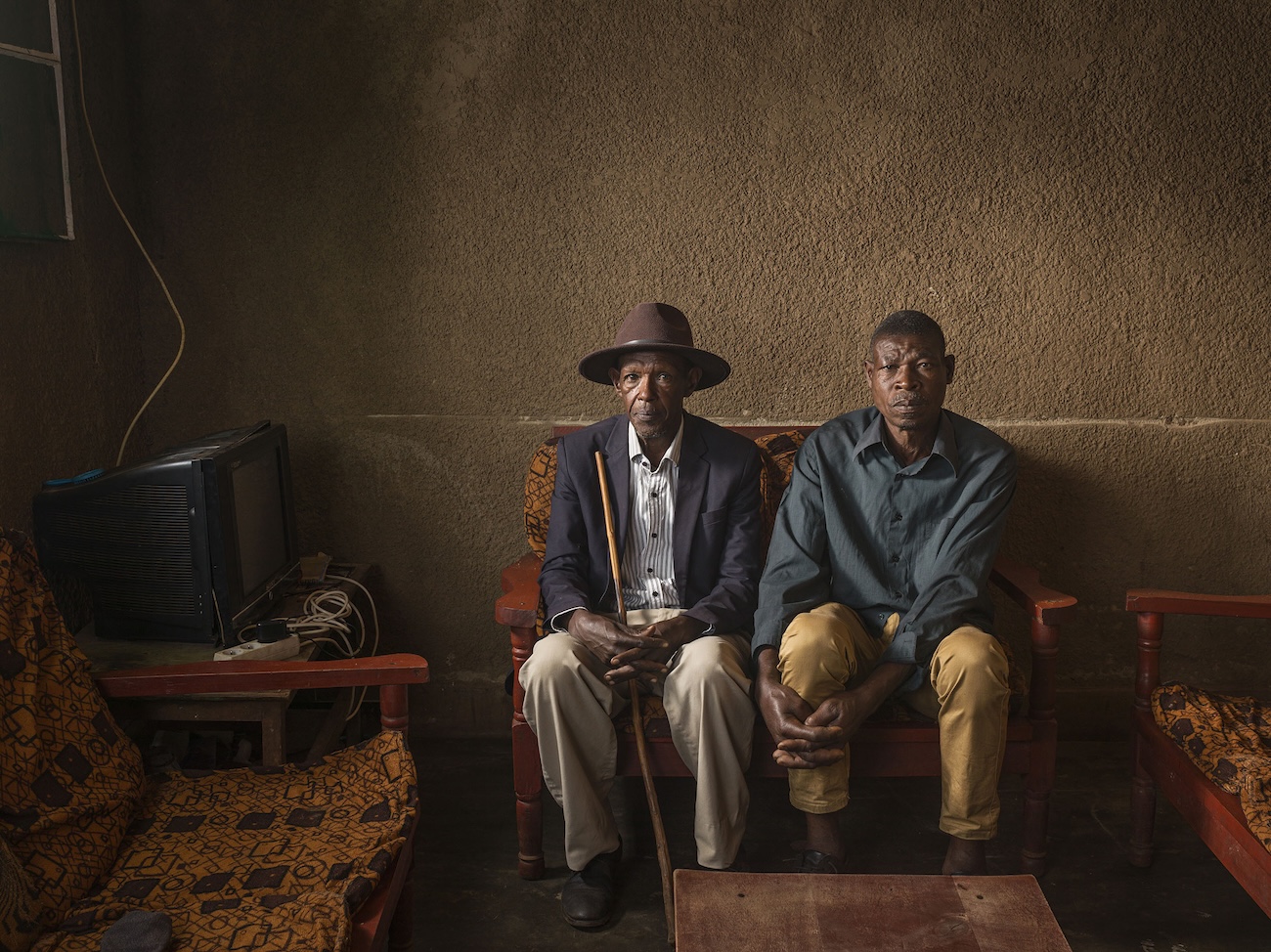
Celestin Kayijuka (left) lost four of his seven children and 17 relatives in the genocide. He bears many scars and a limp from a brutal attack while fleeing. Jean Marie murdered Celestin’s father, served 10 years in prison and confessed during a gacaca trial. He later apologized personally to Celestin and his brothers, leading to reconciliation. “At parties, we now dance together,” Celestin says.
Is there anything about the project that we haven’t covered that you think is important for people to know?
Well, as with other projects, but definitely also with this one, I have a very strong urge to show it in public, to let it be part of the public debate. I think it is not just relevant for Rwanda; look at the times we’re living now. This is such an important issue.
I do know that, on the one hand, I shouldn’t complain. Blood Bonds has been published quite widely. But as far as the museum world is concerned, it hasn’t been easy. Yes, it has been shown, but I’m under the impression, and I think that’s probably a broader topic, that a lot of curators are hesitant to present such intense projects, which have such a strong social-political component. And so I’m fighting with that.
One of the big ironies for me is that although a Belgian magazine published it beautifully, I haven’t found any Belgian museum that wants to show it, which I think is quite shocking. They were [Rwanda’s] old colonial power. If it should be shown anywhere, it’s in Belgium.
Basically, what I’m saying is, come on, curators, come on.
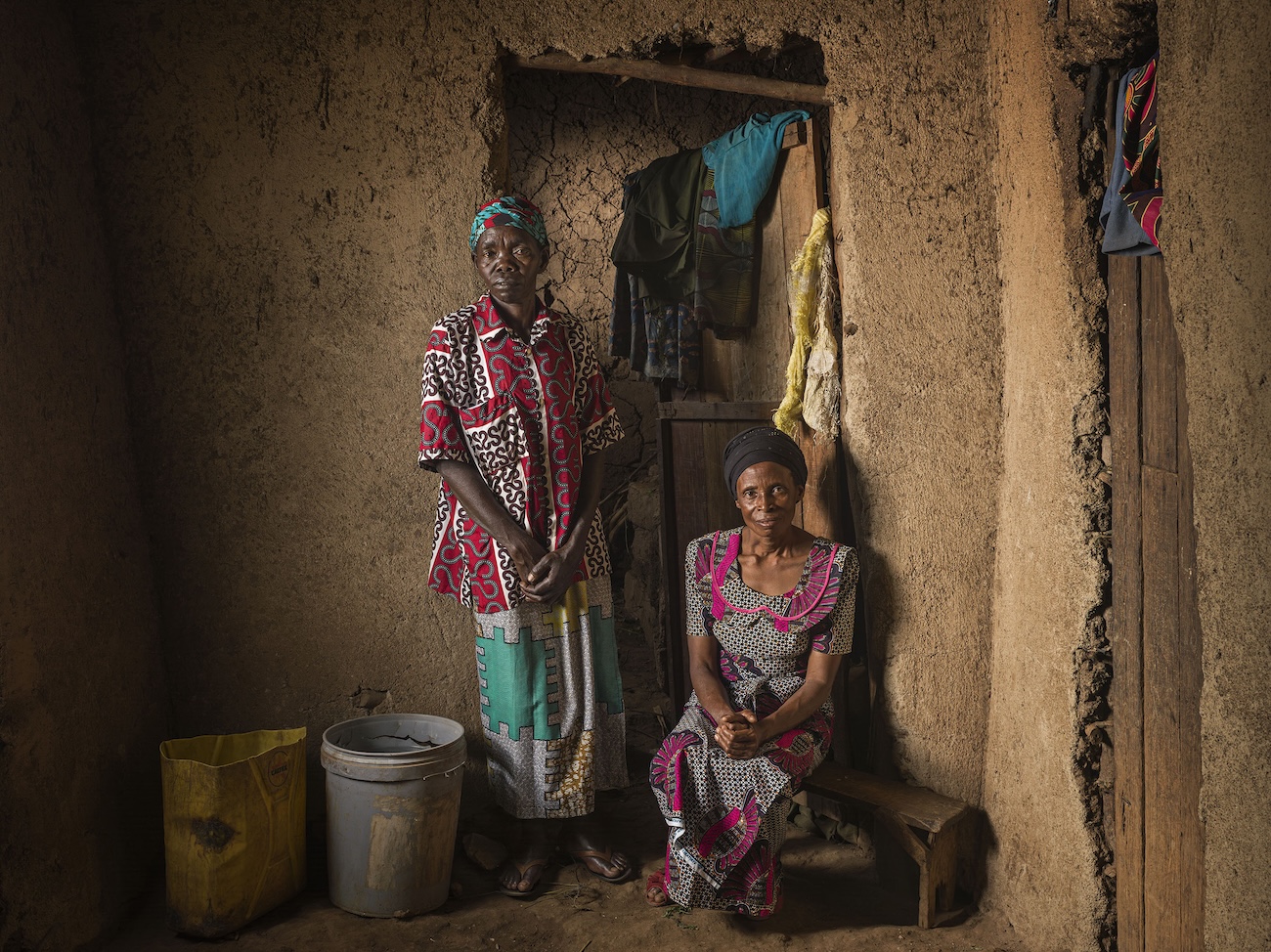
Rwanda, Gasabo district, 2024/02/08. Ancile Unabagira (57, right) lost her husband, parents, and two siblings during the genocide. She fled with her three young children, surviving with help from kind Hutus. Ancile Nyiramimani (52), who betrayed four relatives of Unabagira's husband, later joined the same CBS Rwanda socio-therapy group. There, Unabagira learned of Nyiramimani's extreme poverty, including having barely any clothes and only banana leaves as a mattress. Moved by her story, the two embraced, finding reconciliation.