


If you’re a website or app owner pondering how to write a privacy policy, you’re already on the right track to safeguarding your business and respecting user data. Crafting a privacy policy that adheres to privacy policy requirements is not just about compliance; it’s about building trust with your users.
This guide will walk you through the essential steps to create your privacy policy. Whether you’re running a website, an app, or an e-commerce platform, we’ll cover everything you need to know about drafting a policy that is clear and trustworthy.
At a Glance ⬇️
- Why Your Website or App Needs a Privacy Policy
- Essential Elements of a Privacy Policy
- How to write a Privacy Policy Step by Step
- 1. Understand the Data You Collect
- 2. How the Data Is Collected
- 3. Why the Data Is Collected (Purpose)
- 4. How the Data Is Shared (Third Parties)
- 5. User Rights
- 6. Cookies and Tracking Technologies
- 7. Security Measures
- 8. Cross-Border Data Transfers
- 9. Children’s Privacy
- Test and Publish Your Privacy Policy
- Regular Updates
- Frequently Asked Questions
- How to Write a Privacy Policy Checklist
Why Does My Website or App Require a Privacy Policy?
Every website or app that collects personal information, from email addresses to browsing behavior, must have a clear and accessible privacy policy. This is not only a legal requirement under laws like the GDPR in the European Union and the CCPA in California but also a crucial step in demonstrating your commitment to privacy.
As concerns about data privacy are increasing, a privacy policy is essential to demonstrate to your users that you respect their privacy rights and that you have the proper steps in place to protect their personal information.
In addition, many countries and regions around the world enforce laws that require website owners to have a privacy policy, including the European Union’s General Data Protection Regulation (GDPR) and the California Privacy Rights Act (CPRA).
💡 Main Laws That May Affect You
The privacy policy landscape is shaped by significant regulations, including the GDPR for EU users, the CCPA for California residents, and Brazil’s LGPD. Understanding these laws is essential for drafting a policy that meets global standards.
Let’s take a look at some of the most important regulations and laws around the world:
🇬🇧 🇪🇺 General Data Protection Regulation (GDPR):
This law, which applies to businesses that collect data from users in the European Union (EU), requires a privacy policy to disclose how personal data is collected, processed, and stored, as well as how users can control their data.
🇺🇸 California Consumer Privacy Act (CCPA):
This law applies to businesses that collect data from California residents and requires a privacy policy to disclose what categories of personal information are collected, how it’s used, and with whom it’s shared, among other things.
🇧🇷 The LGPD, or Lei Geral de Proteção de Dados:
This law applies to all businesses that process personal data in Brazil, regardless of where the business is based, and sets out rules for how businesses must handle personal data, including how it’s collected, used, processed, and shared.
What Does a Privacy Policy Need to Include?
An effective privacy policy covers:
- Types of personal information collected
- How is that data being collected
- Purposes of data collection
- Sharing of personal information
- Cookies and tracking technologies
- User rights
- Data security measures
- Contact information
- Details relating to cross-border/overseas data transfer, if applicable
- The process for notifying users of changes or updates to the privacy policy
- Effective date of the privacy policy
💡 Remember that the specific content required of a privacy policy differs according to applicable laws and regulations and may need to be addressed according to jurisdictional and geographic boundaries.
How To Write a Privacy Policy Step by Step
If you’re ready, let’s start bringing everything together!
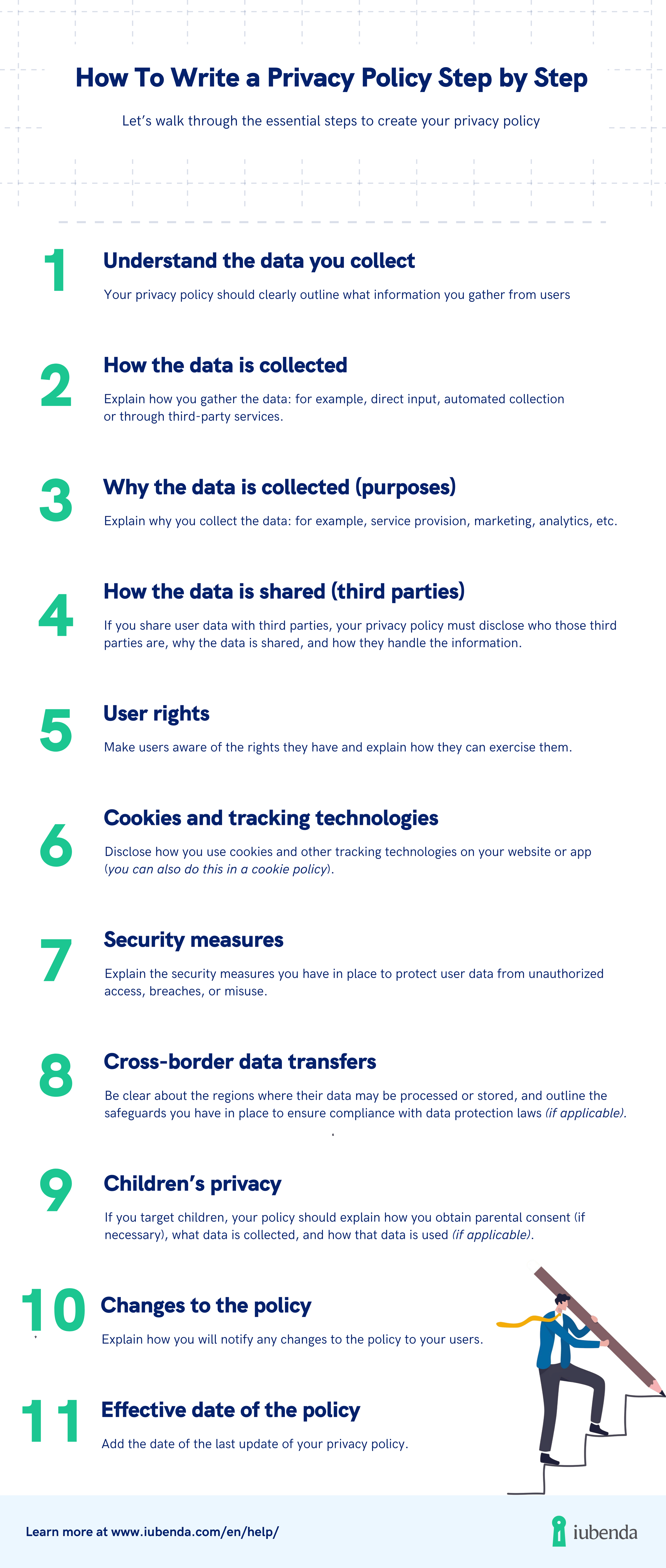
1. Understand the Data You Collect
Once you’ve assessed the laws that apply to you, it’s essential to understand the types of data your website or app collects. This is a critical step, as your privacy policy should clearly outline what information you gather from users, how it’s collected, and for what purpose.
The types of data you collect can vary depending on your business model and the functionality of your website or app. For example, you may collect:
- personal information, such as names, email addresses, phone numbers;
- demographic information, like age, gender, and geographic location;
- usage data, to understand how users interact with your site or app (pages visited, time spent on the site, or the links clicked)
- device information, data regarding the device users are accessing your site or app with, including IP addresses, browser types, and operating systems;
- and more.
By understanding the full scope of the data you collect, you can ensure that your privacy policy accurately reflects your practices. This will also be the first section of your policy, after the details about the site or app owner.
2. How the Data Is Collected
The next step is to explain how you gather the data. There are several ways that you can use to collect data:
- Direct Input: This is when users actively provide their information, such as filling out a contact form, signing up for an account, or making a purchase.
- Automated Collection: Many websites and apps collect data automatically through tools like cookies and tracking pixels.
- Third-Party Services: You could also rely on third-party services for data collection. For example, analytics tools like Google Analytics collect data on how users interact with your website. Third-party services can also include advertising platforms, social media integrations, and payment processors, all of which may collect data on your behalf.
3. Why the Data Is Collected (Purpose)
Now it’s time to explain why you collect this information in the first place.
Data collection should always be tied to specific purposes, and you should only keep the data until these purposes are fulfilled. The purposes may vary depending on your business model, but here are some common reasons businesses collect data:
- Service provision: The primary reason for collecting data is often to provide the core services of your website or app. For example, if a user creates an account or makes a purchase, you need their data to process the transaction, fulfill orders, or deliver personalized services.
- Personalization: You can collect data to enhance the user experience, too. By understanding user preferences, behaviors, and previous interactions, you can tailor content, recommendations, and features to individual users.
- Marketing: Many businesses use data to market their products or services more effectively. This may include sending newsletters, promotional emails, or targeted advertisements.
- Analytics: Collecting data for analytics purposes is another common practice. By tracking user behavior on your website or app, you can gather valuable insights into how users interact with your content. This data helps you improve site performance, optimize content, and refine your overall user experience.
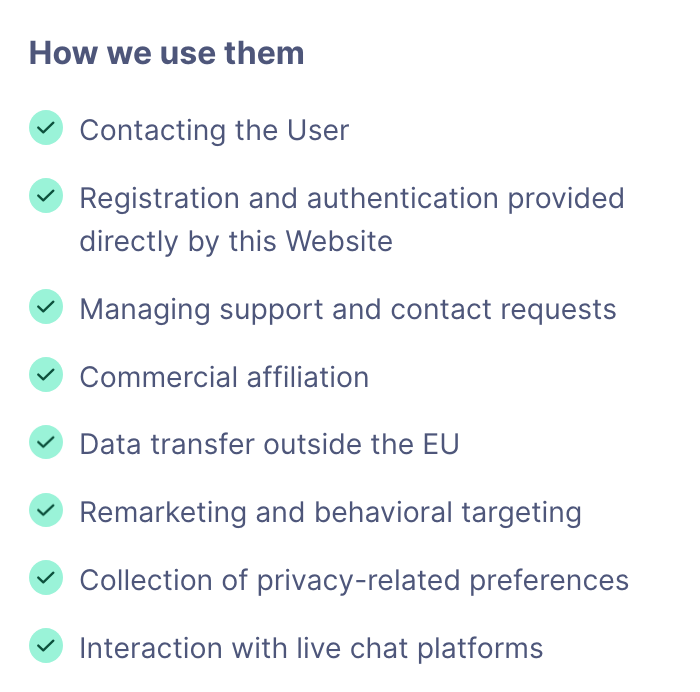
iubenda’s Privacy and Cookie Policy Generator
4. How the Data Is Shared (Third Parties)
In addition to explaining what data you collect and why, it’s equally important to clarify how that data is shared. If you share user data with third parties, your privacy policy must disclose who those third parties are, why the data is shared, and how they handle the information.
Many businesses rely on third-party service providers to help run their operations. For example, a payment processor requires users’ payment details to complete transactions. However, third parties may also collect personal data through widgets (e.g., social buttons) and integrations (e.g., Facebook Connect). Make sure to specify that.
5. User Rights
A fundamental aspect of any privacy policy is outlining the rights users have regarding their personal data. Privacy laws such as the GDPR and CCPA grant users specific rights over the information you collect about them. It’s important to make users aware of these rights and explain how they can exercise them.
Here are the key rights that users typically have under data protection laws:
- Access: Users have the right to request access to the personal data you hold about them.
- Correction: Users have the right to correct any inaccuracies in their personal data.
- Deletion (Right to be Forgotten): Under laws like the GDPR, users can request the deletion of their personal data, provided there is no legal reason for retaining it.
- Restriction of Processing: Users can also request that you restrict the processing of their personal data.
- Portability: Users have the right to receive their personal data in a structured, commonly used, and machine-readable format. They can also request that their data be transferred to another data controller, provided it is technically feasible.
- Objection: Users can object to the processing of their data for specific purposes, such as direct marketing.
6. Cookies and Tracking Technologies
As part of your data collection process, it’s essential to disclose how you use cookies and other tracking technologies on your website or app. Cookies are small text files that are stored on a user’s device when they visit your site, and they serve various purposes. Transparency in how cookies are used ensures that users are informed and in control of their data.
Here you can either choose to add a section of your privacy policy related to cookies or to create a standalone document, the cookie policy.
👉 Learn more about cookie policies here
7. Security Measures
One of the key concerns for users is the security of their personal data. To address this, your privacy policy should explain the security measures you have in place to protect user data from unauthorized access, breaches, or misuse. This might include physical, technical, and administrative safeguards such as encryption, secure servers, access controls, and regular security audits.
8. Cross-Border Data Transfers
If your website or app transfers user data across borders, you must inform users of this practice. Data protection laws vary by jurisdiction, and users may be concerned about how their information is handled outside of their country.
Be clear about the regions where their data may be processed or stored, and outline the safeguards you have in place to ensure compliance with data protection laws. For example, under the GDPR, businesses transferring data outside the EU must ensure that appropriate measures are taken, such as using Standard Contractual Clauses.
9. Children’s Privacy
If your website or app targets children or collects data from children, you must include specific protections in your privacy policy. Many jurisdictions, including the US under the Children’s Online Privacy Protection Act (COPPA), require additional safeguards for data collected from minors.
Your policy should explain how you obtain parental consent (if necessary), what data is collected, and how that data is used.
If your site is not directed at children, it’s important to state that as well, along with a disclaimer that you do not knowingly collect data from individuals under a certain age.
The final section of your privacy policy should be its effective date.
Test and Publish Your Privacy Policy
Once you’ve finalized your privacy notice, it’s time to publish it. A good practice is to add it to the footer of your website, to make it accessible from every page.
Moreover, you should also add a link to your privacy policy when you are collecting users’ data: sign-up forms, checkout pages, or any other place where personal information is collected. It’s a good idea to include a checkbox indicating that users have read and agree to the privacy policy.
Regular Updates
A privacy policy is not a document you can simply create once and forget about. It’s crucial to update your privacy policy regularly to ensure it remains accurate and compliant with evolving laws, business practices, and user expectations. As your website or app grows, your data collection practices may change, and new legal requirements may be introduced. Keeping your privacy policy up to date ensures that your users are always informed about how their data is being handled.
Don’t forget that any changes to your privacy policy should be communicated to your users.
Frequently Asked Questions
Can I write my own privacy policy?
While you can write your own privacy policy – also with the help of a privacy policy template – it’s often advisable to use a privacy policy generator or consult a legal expert. Privacy laws are complex and vary by region, so ensuring your policy is fully compliant can be challenging. A generator or legal advice ensures you cover all necessary aspects and stay up to date with regulations.
What should be included in a privacy policy?
A privacy policy should include details about the types of data you collect, how it’s collected, the purposes of data collection, how data is shared, and users’ rights regarding their data. It’s also important to disclose your data security measures and how users can manage their privacy preferences.
How often should I update my privacy policy?
It’s recommended to review and update your privacy policy at least annually, or whenever there are significant changes to your data collection practices or relevant laws. Keeping your policy current ensures compliance and maintains transparency with your users.
How to Write a Privacy Policy Checklist
Now let’s recap all the essential steps of writing a privacy policy:
I’ve added the details about the website or app owner (name and contact details)
I’ve listed the data I collect, how I collect it, and why.
I’ve explained how the data is shared and who the third parties involved are.
I’ve informed my users of their rights and how they can exercise them.
I’ve disclosed that my website uses cookies and for what purposes.
I’ve explained the security measures that I took to protect the data.
I’ve informed my users of cross-border data transfers (if applicable).
I’ve included details regarding children’s privacy (if applicable).
I’ve explained how I will notify any changes to the policy.
I’ve added the effective date.
Does it look too difficult?
Creating a privacy policy can seem like a daunting task, especially when you need to ensure that it complies with various legal requirements and accurately reflects your data practices. While drafting your privacy policy manually is always an option, many businesses opt to use a privacy policy generator to simplify the process.
We can help you with that!
Our Privacy and Cookie Policy Generator was designed to make privacy policies intuitive and easy to create. We know that creating legal documents for your website may seem extremely complicated – that’s why we’ve streamlined the process to make it as easy as possible.
Here’s how our Generator works:
✅ Scan your website: Our Site Scanner will identify all the services that are active on your site and suggest the best configuration for your document.
✅ Create your policy: You can either stick with the configuration suggested by the scan, or customize your privacy policy to your needs. Choose from a library of +2,400 pre-drafted clauses.
✅ Copy and paste to add it to your website: Once the configuration is complete, all you need to do is copy the code we provide and paste it on your website. Your privacy policy is ready!
Curious to try it yourself?
About us

The solution to generate your Privacy Policy. Customizable from 1700+ clauses, available in 9 languages and self-updating