


In short
Want to protect your business by setting your Terms of Use? Looking for a template? You’re in the right place. A Terms of Use Agreement defines guidelines and rules your users must agree to follow to use your service or product. It can save you a lot of trouble!
In this guide, we explain everything you need to know about website terms of use: what it is, why it matters, what to include, and how to enforce it. We also include a free terms of use template you can use as a starting point.
Jump to
- What do you mean by terms of use?
- Are terms of use a contract?
- Is terms of use necessary?
- Where do you put terms of use?
- What is terms of use vs terms and conditions?
- Is privacy policy and terms of use the same?
- What to include in your Terms of Use agreement
- Terms of Use Template
- Terms of use examples: what good looks like
- How to enforce your Terms of Use
- Summary of Terms of Use for website
- Get started now with our Terms of Use Generator
Do you really need Terms of Use?

Find out now, it takes 30 seconds!
Everything you should know about Terms of Use agreement
What do you mean by terms of use?
Terms of Use are the guidelines and rules set by a website or service provider that users must agree to follow in order to use the service. These terms outline specific aspects like acceptable behavior, disclaimers, or limitations of liability, ensuring users understand their rights and responsibilities while using the website or service.
In practice, you can outline rules regarding the use of your content, the suspension of online accounts, or the age limit for purchasing your products.
You may have heard about Terms of Use under other names like “Terms and Conditions”, “Terms of Service” or “End User License Agreement” (EULA).
Are terms of use a contract?
Yes, Terms of Use are a contract between you, the provider of a service, and your users. When users agree to the terms, typically when using the website, buying your products or clicking an “Accept” button, they enter into a contractual agreement with you. This contract binds the user to the terms specified, and violations can lead to termination of service or legal consequences.
This contract is formed within applicable law. Some specific requirements are set by consumer laws of different regions in the world, and you should comply with them. As an example, under EU consumer law, consumers have an unconditional right to withdraw (called “cooling-off period”) of 14 days.
Is terms of use necessary?
A Terms of Use Agreement is not a legal necessity, unlike the privacy policy, which is often mandated by law. That said, it’s an important document for any business.
Terms of Use protect you and your business:
- They establish legal safeguards for the provider and set clear expectations for users.
- They help you anticipate and reduce legal risk before issues arise.
- Without them, it might be challenging for your business to defend itself effectively in legal disputes concerning your products or services.
For these reasons, Terms of Use are considered standard practice and remain an essential document for every business, from individual blog owners to large-scale e-commerce companies.
TERMS OF USE GENERATOR
Generate your Terms of Use
Simple templates are often not enough to protect your business and intellectual property.
Terms of Use are legally binding documents, so having a customizable, professional document is important.
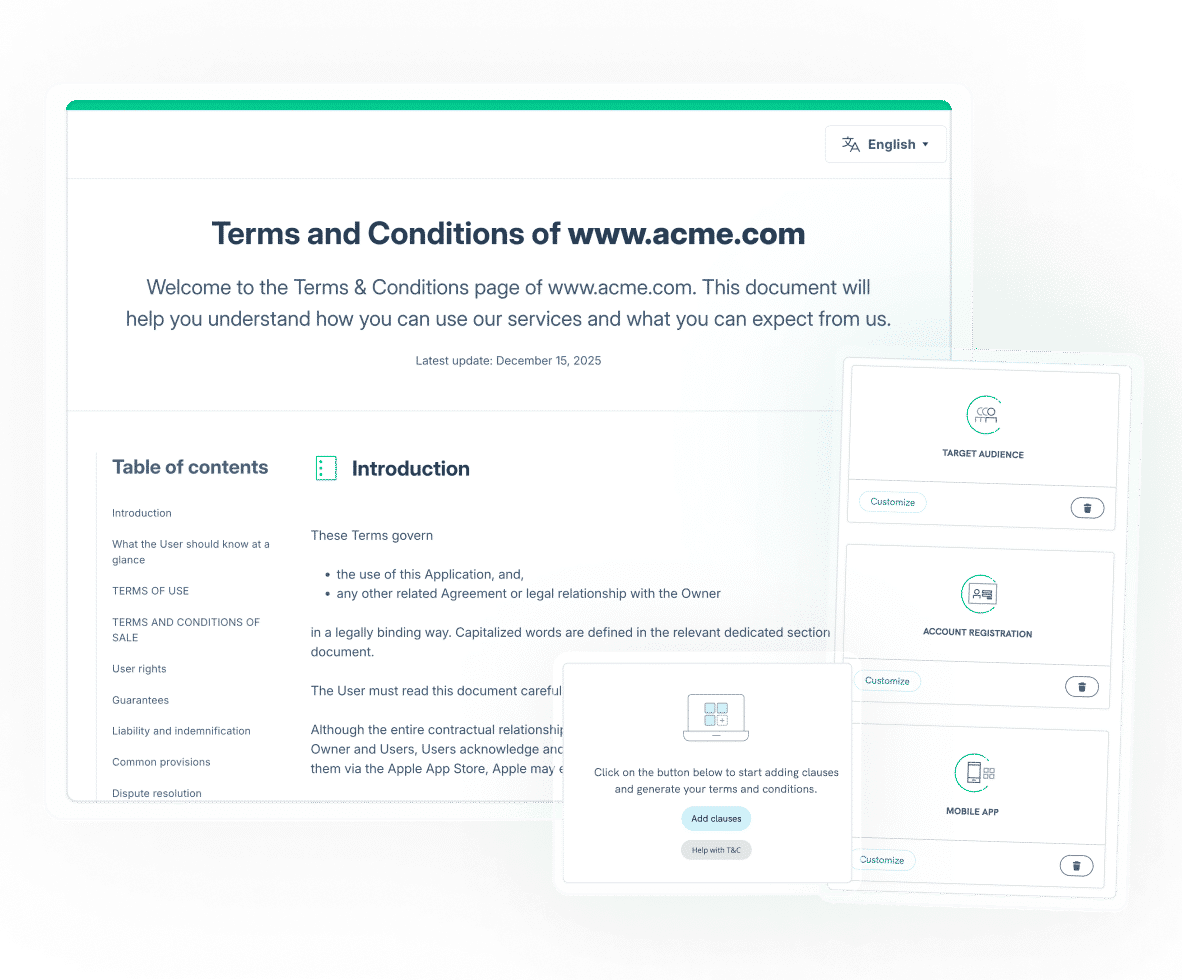
Try our generator with our 14-day money-back guarantee
Where do you put terms of use?
You generally put a Terms of Use Agreement on your website, usually in a clearly accessible area. They are often linked at the bottom of the homepage or in the website’s footer. The latter is the recommended practice, since it ensures the document is easy to find and always visible from any page of the site in case users need to refer to it.
You can also find the document linked in a menu (that’s usually the case for mobile apps, under sections like “About” or “Legal”), or in the account creation/checkout forms.
What is terms of use vs terms and conditions?
Terms of Use vs. Terms and Conditions are basically the same thing and refer to the same document. They are used interchangeably, along with other names used to define this type of agreement, like “Terms of Service” or “User Agreement”. They can be used in different contexts but serve the same purpose.
Is privacy policy and terms of use the same?
A Terms of Use Agreement and a Privacy Policy have very different purposes. Terms of Use outline the rules and conditions for using your website or service, whereas the Privacy Policy describes how personal data is collected, used, and stored. Both are typically linked in the footer of a website, but they refer to unrelated matters.
Also, unlike Terms of Use, a Privacy Policy is a legal requirement under many data privacy laws like the EU’s General Data Protection Regulation (GDPR).
What to include in your Terms of Use agreement
Introduction and effective date
This section should succinctly introduce the purpose of the terms, providing a clear overview of what the document entails. This includes specifying what the terms apply to, as well as the effective date of the document.
The introduction might also give a brief insight into the nature of the company or service provider.
The aim here is to orient the reader to the document and its relevance to their interaction with the service or product.
Acceptance of terms
Here, you should emphasize that by accessing or using the service or product, users are agreeing to the terms outlined in the document. This section forms a contractual basis between the user and the service provider.
It often includes a statement that if the user does not agree to these terms, they should refrain from using the service. This part may also mention the legal implications of agreeing to the terms and might advise users to read the document thoroughly before consenting.
Reference to other policies
Here, you should reference to other legal agreements and policies that your company has. For example, your Privacy and Cookie Policy, directing users to review how their personal data is managed.
Accounts: registration, termination, security
Explain the process and requirements for users to create and maintain an account with the service. It should include guidelines on choosing secure passwords, maintaining account confidentiality, and updating account information.
Additionally, this part addresses the circumstances under which a user’s account may be suspended or deleted, such as violation of terms, fraudulent activity, or extended inactivity. The section can also explain the process of account termination, both voluntary (by the user) and involuntary (by the service provider).
Intellectual property rights
This segment clarifies the ownership and use rights of all content and intellectual property (trademarks, copyrighted material) associated with the service or product. It can state that you retain all rights to their content, including text, graphics, logos, and software, with phrases like “All Rights Reserved.”
User-generated content
In this part you should outline the guidelines and rules for any content that users create, upload, or share on the platform. You should detail what is considered acceptable content and what is prohibited (e.g., offensive, illegal content in comments). You might also reserve the right to remove or modify user content that violates these guidelines.
The section may also include stipulations about how the service can use or redistribute user-generated content.
Acceptable use and user restrictions
Here, it’s important to specify acceptable and unacceptable behaviors and activities on the service and website. It includes rules against misconduct such as scraping data from the service, unauthorized copying and pasting of content, and other forms of misuse.
The document should clearly articulate the consequences of such misconduct, which could range from warning to legal action.
This part is crucial in setting the behavioral standards on the platform and ensuring a safe and respectful environment for all users. It acts as a deterrent against abuse and misuse of the service, safeguarding both the users and your company.
Purchasing and billing
This section should detail the pricing structure, including any taxes or additional fees. It should clearly state any available offers or discounts, and the conditions under which they apply. It must outline accepted methods of payment, and any security measures in place to protect financial information. It should also address billing errors, and the process for disputing charges.
Delivery and shipping
This part should specify the expected timeframe for delivery and any shipping costs. It should include any terms related to the condition of goods upon delivery, for example the “as is” clause, which indicates that items are accepted by the user in their current state without warranty. It must also outline the carrier’s responsibilities and any limitations of liability for delayed or damaged goods.
If you run an e-commerce business, a Terms of Use document is especially important. It covers legally required disclosures on conditions of sale, payment methods, shipping, delivery, returns, and withdrawals. See what to include for e-commerce.
Cancellation and return
This section must clearly define the procedure for returning a product, including time limits and condition requirements. It should specify who bears the cost of returns and the method of refund or credit. The process for canceling orders should be detailed, including any applicable time frame and charges or penalties for cancellation. Take a look at our No Return No Refund Policy Template & Guide!
User rights
Here you should articulate the rights of the user, particularly the right of withdrawal, which allows them to cancel a service or return a product within a specific period. It must be compliant with applicable consumer laws, detailing the process for exercising these rights.
Disclaimers of warranties
This section should specify the guarantees or exclusions of implied warranties provided, particularly regarding conformity with advertised features, quality standards, and functionality. It can disclaim certain warranties, indicating that the service or product is provided “as is” and without warranties regarding its performance, reliability, or suitability for a particular purpose.
It must detail the remedies like indemnification or compensation against claims, damages, losses, liabilities, or expenses arising from the user’s misuse of the service or violation of the terms.
Limitations of liability
In this crucial section, you should explain the limits to your liability in cases of issues like damages or losses incurred by the user in connection with the service. It typically includes limitations on the type of recoverable damages and may cap the amount of compensation.
The two sections above are essential for limiting your liability in case of issues arising from using your products, services or website.
Dispute resolution
Here, detail the specific process for resolving disputes between the user and your company. It may include mandatory arbitration clauses, specify the applicable law, and identify the jurisdiction under which disputes will be settled. Online, you can use the Online Dispute resolution (ODR) platform provided by the European Commission.
Changes to the terms
Describe the procedure for modifying these terms, including how changes will be communicated to users, and whether users have the option to terminate their agreement if they do not accept the new terms.
Contact information
Provides your main contact details, including physical address, email, and phone number. It helps users to make inquiries, lodge complaints, or seek support.
Download our sample Terms of Use template for your website
Using a basic template is not wrong by default, but it can come with significant risk to you and your business. Should conflict arise or if a lawsuit is filed by a user, your Terms of Use document will be your first line of defense. Terms of Use are complex legal documents that cover multiple legal scenarios (e.g., commercial law, copyright laws, liabilities, etc.), jurisdictions, and must apply to your specific business practices. This is difficult to achieve with a basic template. And this is why we recommend using a higher-quality solution like an online generator.
How to use the template
- Download the Template: Get our free Terms of Use template in Word Doc or copy and paste the HTML directly into your website.
- Fill in Business and Contact Details: Before you publish it, fill in all the [brackets] with your business info and contact details.
- Customize Sale and Service Clauses: The template covers selling physical goods and includes sections for both business-to-business (B2B) and business-to-consumer (B2C) sales, with some clauses addressing only consumers. Make sure these sections match what your business offers.
- Tailor to Legal Jurisdictions: The template includes parts relevant to the EU, the UK, and the US. Some sections are specific to certain areas, so make sure they comply with the laws where your customers are.
Terms of Use template (HTML text)
Copy and paste the Terms of Use Template HTML directly into your website.
<h1>Terms of Use of [website name]</h1>
<p>This document governs:</p>
<ul>
<li>the use of our website, and</li>
<li>any other related agreement or legal relationship with us</li>
</ul>
<p>in a legally binding way. You must read this document carefully.</p>
<p>Our website is provided by:<br>
[name/company and full address]<br>
Contact email: [email address]</p>
<h2>TERMS OF USE</h2>
<p>Unless stated otherwise, the terms in this section apply generally when using our website. Specific or additional conditions may apply in certain situations and are noted in this document.</p>
<p>By using our website, you confirm the following:</p>
<ul>
<li>you are older than [number of years of age];</li>
<li>you are not in a country subject to a government embargo, or that has been designated as a “terrorist-supporting” country;</li>
<li>you are not listed on any government list of prohibited or restricted parties.</li>
</ul>
<p><em><strong>Note:</strong> Add any other conditions for use here — for example, rules for account registration, acceptable use, intellectual property rights, and access to third-party content. The correct wording will depend on what your website or service offers.</em></p>
<h2>LIABILITY AND INDEMNIFICATION</h2>
<p><em><strong>Note:</strong> This section covers the limits of your liability, your disclaimer of warranties, and the circumstances under which users agree to indemnify you. The correct wording varies significantly between the EU, the UK, and the US — each jurisdiction has its own requirements, and a clause written for one may not be valid in another. Tailor this section to the jurisdictions where your business operates and where your customers are based.</em></p>
<h2>TERMS AND CONDITIONS OF SALE</h2>
<p><em><strong>Note:</strong> Include this section if you sell products or services. At minimum, cover your prices, accepted payment methods, delivery terms, and the customer’s right of withdrawal. EU and UK consumer law sets specific requirements — including a 14-day withdrawal right and a 2-year legal guarantee on physical goods — that differ from US rules. If you sell across multiple markets, this section will need to reflect each one.</em></p>
<h2>COMMON PROVISIONS</h2>
<h3>No waiver</h3>
<p>Our failure to assert any right or provision under these terms does not waive that right or provision. No waiver will constitute a continuing waiver of such term or any other term.</p>
<h3>Service interruption</h3>
<p>To maintain the best service level, we reserve the right to interrupt the service for maintenance, updates, or other changes, with appropriate notification.</p>
<p>We may suspend or discontinue the service within legal limits. If discontinued, we will assist you in withdrawing personal data and respect your rights regarding continued product use and compensation under applicable law.</p>
<p>The service may be unavailable due to events beyond our reasonable control, such as infrastructure breakdowns or blackouts.</p>
<h3>Service reselling</h3>
<p>You may not reproduce, duplicate, copy, sell, or exploit any part of our website or its service without our express written permission, granted either directly or through a legitimate reselling program.</p>
<h3>Privacy policy</h3>
<p>For information on the use of personal data, you can refer to our website’s privacy policy.</p>
<h3>Changes to the terms</h3>
<p>We reserve the right to modify these terms at any time, informing you of any changes.</p>
<p>Such changes will only affect the relationship with you from the date communicated onwards.</p>
<p>Your continued use of the service will signify your acceptance of the revised terms. If you do not wish to be bound by the changes, you must stop using the service and terminate the agreement.</p>
<p>The applicable previous version will govern the relationship prior to your acceptance. You can obtain any previous version from us.</p>
<p>If legally required, we will notify you in advance of when the modified terms will take effect.</p>
<h3>Governing law and jurisdiction</h3>
<p><em><strong>Note:</strong> Specify the country or state whose law governs these terms, and the courts that will have jurisdiction over any disputes. If you serve consumers in the EU or UK, note that mandatory consumer protection rules in their country of residence may still apply regardless of your chosen governing law.</em></p>
<h2>DISPUTE RESOLUTION</h2>
<p><em><strong>Note:</strong> If you serve European consumers, include a reference to the EU’s online dispute resolution platform (https://ec.europa.eu/consumers/odr). You may also want to specify whether disputes will be resolved through arbitration, mediation, or litigation, and in which jurisdiction.</em></p>
<h2>CONTACT</h2>
<p>All communications regarding the use of our website must be sent using the contact information provided in this document:<br>
[name/company and full address]<br>
[email address]</p>Terms of Use template (Word DOCX)
Terms of Use template (PDF)
Terms of use examples: what good looks like
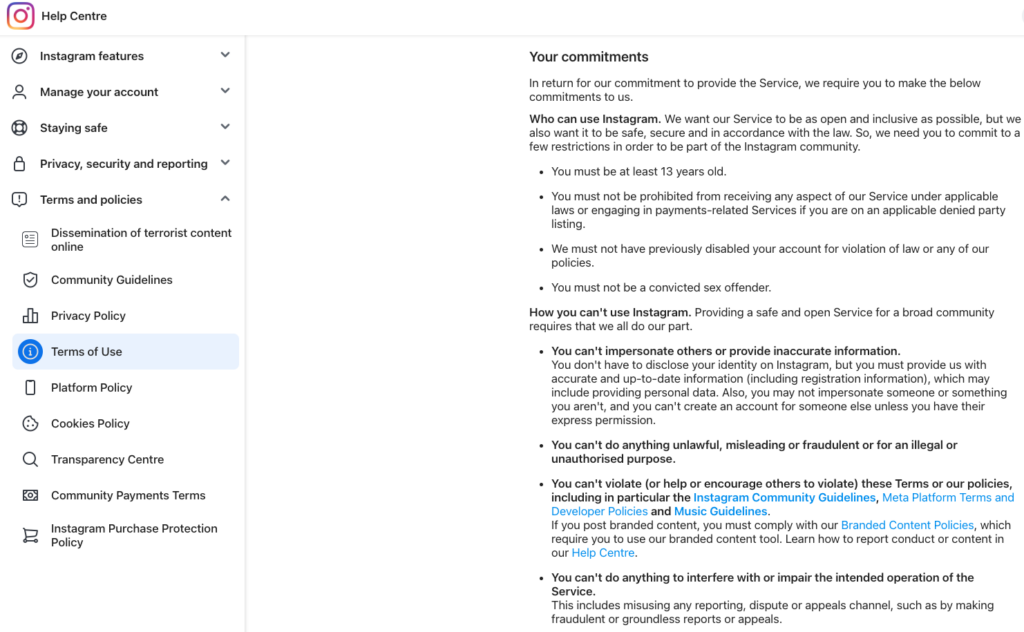
#1 Instagram terms of use example
Instagram’s Terms of Use is a strong example of how a content platform handles user-generated content. The document clearly defines what users can post, what rights they grant Instagram over that content, and the conditions under which accounts can be suspended or removed. If your website allows users to upload or share content, this section is worth studying closely.
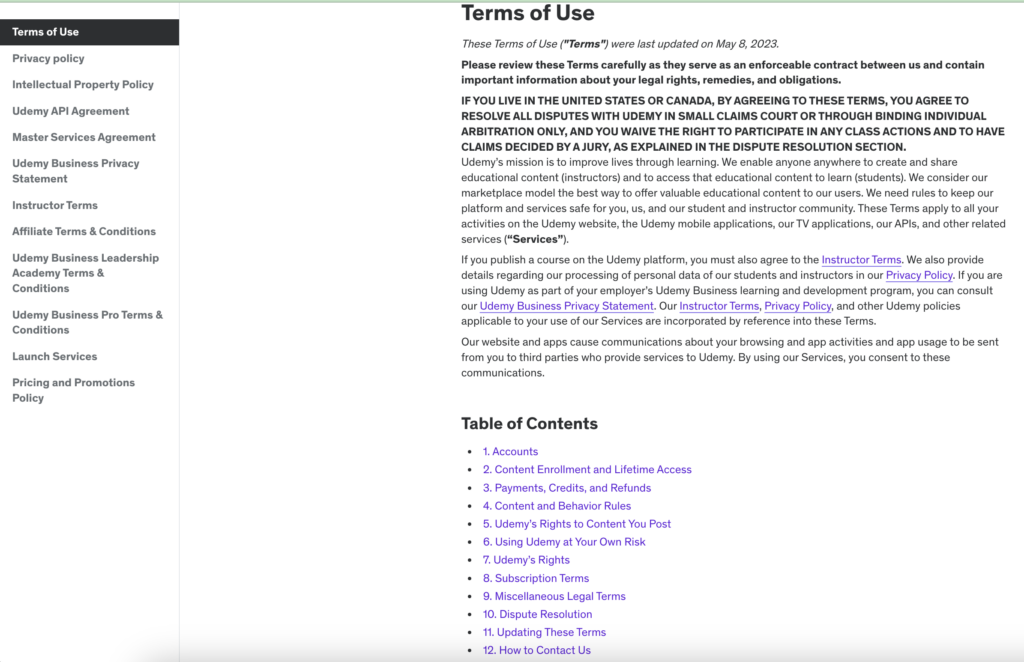
#2 Udemy terms of use example
Udemy’s Terms of Use covers the full lifecycle of a transaction on a marketplace: purchases, refunds, how course content can be accessed, and the responsibilities of both instructors and students. It’s a useful reference if you run an e-commerce site or a platform with multiple user roles.
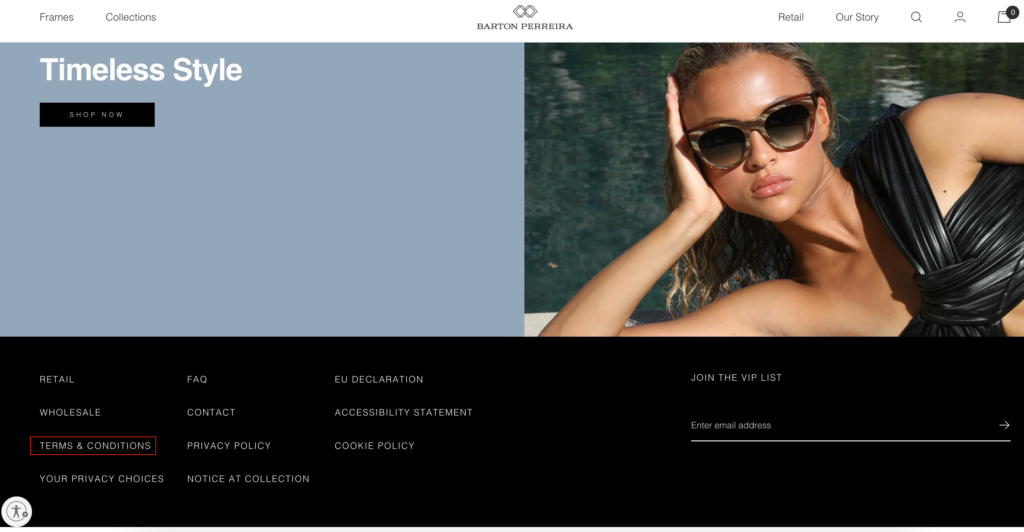
#3 Barton Perreira iubenda-generated terms
Eyewear brand Barton Perreira uses a Terms and Conditions agreement generated with iubenda’s Terms and Conditions Generator, placed in the footer. It’s a practical example of how a small to mid-size e-commerce business can have a professional, legally grounded document without writing it from scratch.
How to enforce your Terms of Use
The best way to enforce your Terms of Use Agreement is using a method called clickwrap. The goal is to make sure your users clearly agree to the document, which is important if you ever need to enforce these terms legally.
Follow this best practice to enforce your document:
- When a user is signing up or making a purchase on your website, display your Terms of Use. This is often done by putting a link to the document where it’s easy to see.
- Make sure the user performs an affirmative action to show they agree to the Terms of Use. This is where clickwrap comes in. You can have a checkbox next to a statement like “I agree to the Terms of Use,” and the user has to check this box.
- Arrange it so that the user can’t complete their sign-up or purchase without agreeing to your Terms. This means they can’t proceed unless they check the box.
- Make sure the statement next to the checkbox is straightforward and easy to understand. Avoid legal jargon here.
- When a user agrees to your Terms, keep a record of this. Note down the date and which version of the Terms they agreed to.
- If you update your document, let your users know. You might need them to agree to the new terms, especially if the changes are significant.
- Always have your legal documents easily accessible on your website, so users can read them whenever they want.
Summary of Terms of Use for website
These points cover the key things to understand and consider when drafting a Terms of Use document:
- Terms of Use (also commonly called Terms and Conditions) are a set of rules and guidelines users must agree to follow when using a website or service. They are crucial for establishing legal safeguards, setting clear expectations, and protecting your business in legal disputes.
- These Terms form a legally-binding contract between you and the user, that’s why it’s important to draft them very carefully. They should comply with consumer laws in relevant regions.
- Place your Terms of Use Agreement in an easily accessible area on your website, commonly in the footer.
- Clearly define the rights and rules regarding content on your platform, including user-generated content and intellectual property rights.
- Specify what constitutes acceptable use of your service and the consequences of violations, ensuring a safe and respectful environment for all users.
- Include detailed sections on purchasing, billing, delivery, shipping, and return policies to inform users about the procedures and their rights related to transactions.
- Use disclaimers and clearly state the limits of your liability in various scenarios, to protect yourself from legal issues arising from your website, services, or products.
- Get explicit consent with the clickwrap method by having users agree to your Terms, by checking a box during checkout, for example.
- Know the risk when using a basic template. It probably doesn’t contain all necessary clauses. Terms and Conditions are a legally-binding document that should be well-written, detailed, and customized to your specific business situation.
- Writing a thorough legal document takes time. Solutions backed by lawyers, like our Terms of Use Generator, help you create a professional document quickly.
TERMS OF USE GENERATOR
Easily create your document in minutes
- Pick from hundreds of scenario-specific clauses, pre-crafted by lawyers
- Forget the static template. Add, customize, remove clauses whenever you want
- A quick, easy and cost-effective way to install professional Terms of Use on your website
Try the generator with our 14-day money-back guarantee