

惯性聚合 高效追踪和阅读你感兴趣的博客、新闻、科技资讯
阅读原文 在惯性聚合中打开

推荐订阅源

H
Hackread – Cybersecurity News, Data Breaches, AI and More
博客园 - 三生石上(FineUI控件)
让小产品的独立变现更简单 - ezindie.com
Threat Intelligence Blog | Flashpoint
B
Blog
D
DataBreaches.Net
cs.AI updates on arXiv.org
V
Vulnerabilities – Threatpost
Jina AI
Jina AI
T
Threat Research - Cisco Blogs
The Hacker News
The Hacker News
Latest news
Latest news
博客园_首页
T
Tenable Blog
cs.CL updates on arXiv.org
酷 壳 – CoolShell
酷 壳 – CoolShell
Apple Machine Learning Research
Spread Privacy
Spread Privacy
Martin Fowler
Martin Fowler
Y
Y Combinator Blog
P
Privacy & Cybersecurity Law Blog
C
Cisco Blogs
I
InfoQ
The Cloudflare Blog
J
Java Code Geeks
C
Cybersecurity and Infrastructure Security Agency CISA
量子位
P
Proofpoint News Feed
C
Cyber Attacks, Cyber Crime and Cyber Security
Last Week in AI
Last Week in AI
T
Tailwind CSS Blog
AWS News Blog
AWS News Blog
Stack Overflow Blog
Stack Overflow Blog
Hugging Face - Blog
Hugging Face - Blog
The Register - Security
M
MIT News - Artificial intelligence
G
Google Developers Blog
Simon Willison's Weblog
CTFtime.org: upcoming CTF events
T
The Exploit Database - CXSecurity.com
A
Arctic Wolf
D
Darknet – Hacking Tools, Hacker News & Cyber Security
钛媒体:引领未来商业与生活新知
钛媒体:引领未来商业与生活新知
V
Visual Studio Blog
Project Zero
Project Zero
P
Privacy International News Feed
Engineering at Meta
Engineering at Meta
G
GRAHAM CLULEY
博客园 - Franky
C
CERT Recently Published Vulnerability Notes

Google Developers Blog

Scaling Agentic RL: High-Throughput Agentic Training with Tunix- Google Developers Blog Run Ray on TPU, Part 1: The foundations- Google Developers Blog Expanding Choice in Gemini Enterprise Agent Platform: Introducing Grounding with Parallel Web Search- Google Developers Blog Building scalable AI agents with modular prompt transpilation- Google Developers Blog Evolving Spec-Driven Development: Conductor Now Supports Antigravity- Google Developers Blog Systems Engineering Playbook: Optimizing Qwen 3.5-397B MoE on Ironwood (TPU7x)- Google Developers Blog Unlocking the Next Era of On-Device AI with Google Tensor and Pixel- Google Developers Blog LiteRT.js, Google's high performance Web AI Inference- Google Developers Blog Bridging the Domain Gap: AI Race Coach built with Antigravity and Gemini- Google Developers Blog We terminated a TPU mid-training and it recovered in seconds: Introduction to elastic training with MaxText- Google Developers Blog ML Development in VS Code with Google Cloud Power: Workbench Extension Now Available- Google Developers Blog Why we built ADK 2.0- Google Developers Blog Build agentic full-stack apps with Genkit- Google Developers Blog Driving the Agent Quality Flywheel from Your Coding Agent- Google Developers Blog Build reliable multi-agent applications with ADK Go 2.0. Discover our new graph-based workflow engine, built-in human-in-the-loop, and dynamic orchestration- Google Developers Blog Measuring What Matters with Jules- Google Developers Blog Build Cross-Language Multi-Agent Team with Google’s Agent Development Kit and A2A- Google Developers Blog How A2A is Building a World of Collaborative Agents- Google Developers Blog A2UI + MCP Apps: Combining the best of declarative and custom agentic UIs- Google Developers Blog Announcing the Agentic Resource Discovery specification- Google Developers Blog Enhance Security and Trust: New Session Metadata in Sign in with Google- Google Developers Blog Unlocking the Power of the TPU Stack: Introducing our new Developer Hub- Google Developers Blog DiffusionGemma: The Developer Guide Introducing the Google Colab CLI Gemma 4 12B: The Developer Guide Bringing Gemma 4 12B to your Laptop: Unlocking Local, Agentic Workflows with Google AI Edge Supercharge your integration workflow with the Google Pay & Wallet Developer MCP server How the community trained Gemma to "Think" with Tunix and TPUs Enhancing Android Checkout with Dynamic Callbacks in Google Pay Empowering Service Providers and Hardware Partners with Gemini for Home Announcing ADK for Kotlin and ADK for Android 0.1.0: Building AI Agents on Android and Beyond Blazing fast on-device GenAI with LiteRT-LM One Year of Innovation: Celebrating 100k Members in the Google Cloud x NVIDIA Developer Community All the news from the Google I/O 2026 Developer keynote A Smarter Google AI Edge Gallery: MCP integration, notifications, and session continuity Google Tensor SDK Beta with LiteRT An important update: Transitioning Gemini CLI to Antigravity CLI Accelerating on-device AI: A look at Arm and Google AI Edge optimization Announcing Genkit Middleware: Intercept, extend, and harden your agentic apps Build Long-running AI agents that pause, resume, and never lose context with ADK Supercharging LLM inference on Google TPUs: Achieving 3X speedups with diffusion-style speculative decoding Building with Gemini Embedding 2: Agentic multimodal RAG and beyond Speeding Up AI: Bringing Google Colossus to PyTorch via GCSFS and Rapid Bucket Building real-world on-device AI with LiteRT and NPU Agents CLI in Agent Platform: create to production in one CLI
The latest updates to Google Pay
Dominik Mengelt, Kushagra Patel · 2026-05-27 · via Google Developers Blog

At Google I/O, we explored how Google Pay is evolving for the era of agentic commerce. We shared a variety of powerful new capabilities for the Google Pay developer platform, designed to facilitate commerce, streamline your checkout funnel, and deliver exceptional user experiences.

Read on for a summary of what we covered during the event, focusing on the latest tools designed to help you optimize your checkout experiences and reach your business goals or check out the recording of our session on YouTube:

What's new in Google Pay and Google Wallet

Preparing for Agentic Commerce

We know the value of the work you’ve already put into your payment stack. To help you transition into the era of AI-powered shopping, your existing Google Pay backend and current Merchant ID are now fully compatible with the new Universal Commerce Protocol (UCP). This means you can power new, agentic commerce experiences using the same Google Pay infrastructure and payment service provider (PSP) relationships you use today, extending your reach without rebuilding your core payment logic. To further superpower your AI agents, we also unveiled the Google Pay & Wallet Developer MCP server. It integrates directly into your preferred development environment, enabling your AI agents to help manage integrations, troubleshoot errors, analyze trends, and generate code. Available today in Public Preview, the MCP server simplifies integration workflows to accelerate your time to the first transaction, and it will graduate to general availability later this year.

Get started at: goo.gle/pay-wallet-mcp

mcp-server-prompt (1)

figure A sample prompt handled by the Google Pay and Wallet Developer MCP Server

Streamlining the Android Checkout Experience

We are committed to removing friction from the buyer's journey, which is why we are bringing the power of the onPaymentAuthorized and onPaymentDataChanged callbacks to Android, achieving parity with our web platform. With these dynamic callbacks, you can move the Google Pay button upstream—such as directly on Product Detail or Cart pages—to offer a true 1-click Express checkout experience. As users interact with the payment sheet, you can dynamically present shipping options and total prices (including taxes) based on their address. Furthermore, you can authorize transactions, handle retries, and deliver instant feedback without closing the payment sheet, helping you improve authorization rates and conversions.

Get started at: goo.gle/pay-android-dpu

Expanding Reach to Social Apps

Following our introduction of Google Pay support for Android WebViews last year, we are advancing our capabilities by extending support to social apps. With a single integration, you can now enable seamless payment experiences across native Android apps, the mobile web, desktop environments, and major social platforms.

WebView integration guide: goo.gle/pay-webview

Google Pay availability within social apps

Optimizing Checkout Experience

Managing processing costs is a top priority for growing businesses. We are introducing new tools to give you more transparency and control over transaction routing:
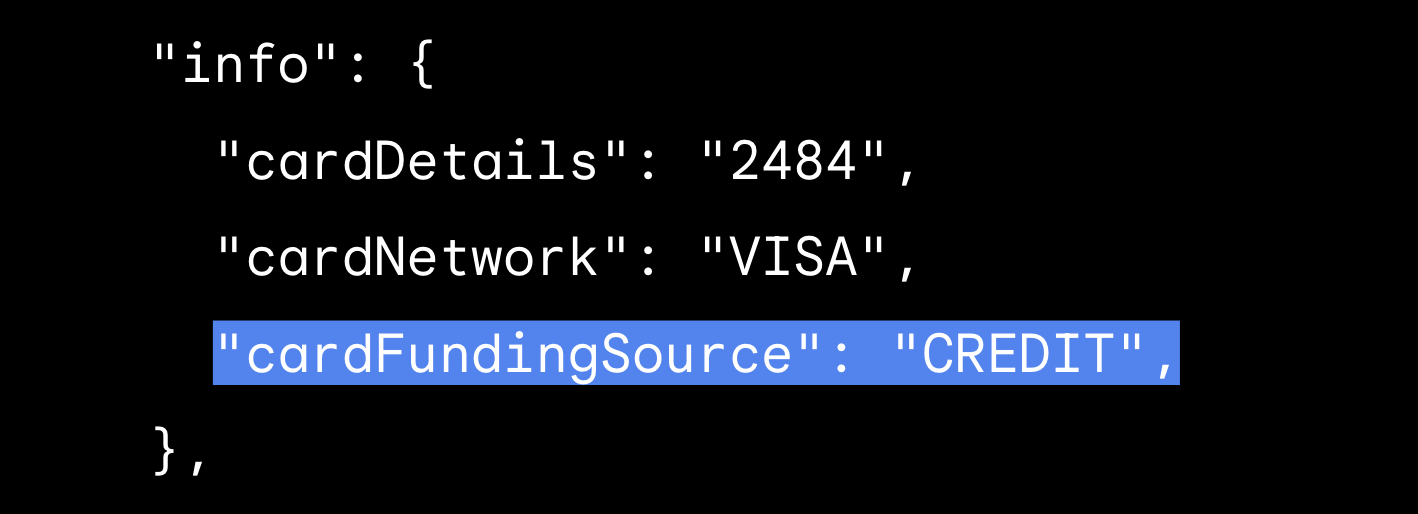
  • Card Funding Source Signal: The Google Pay API response now includes a cardFundingSource signal, which indicates whether the card used is Credit, Debit, or Prepaid. This allows you to implement sophisticated business logic, such as instantly applying discounts or adding surcharges on the confirmation screen based on the card type and its associated costs.

card-funding-source

The new cardFundingSource response parameter for the Google Pay API

  • Eftpos Routing in Australia: For developers and merchants operating in Australia, we are officially bringing the eftpos domestic payment network to the Google Pay API. By utilizing the new merchantPreferredCobadgedCardNetworks parameter, you can explicitly prioritize the local network and dynamically route transactions to eftpos without heavy backend lifting.

Seamless Continuity for Recurring Billing

To better support Merchant-Initiated Transactions (MITs), you or your PSP can now receive lifecycle notifications for Google Pay payment tokens when underlying credentials change. These notifications include the updated state of the token, enabling you to proactively contact customers to update their payment methods before the next billing cycle and ensuring continuity for recurring transactions.

Get started at: goo.gle/pay-mit-lcm
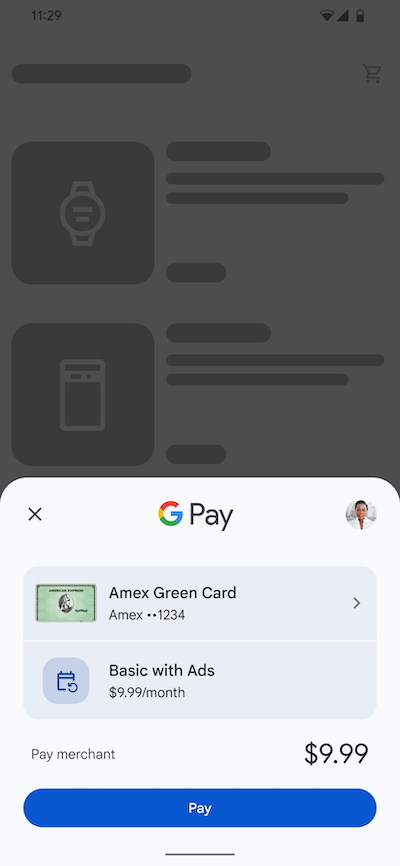
mit (1)

Example on how to trigger a merchant initiated transaction

Cross-Device Authentication

Desktop remains a critical surface where friction—particularly from Multi-Factor Authentication (MFA) mandates—can lead to cart abandonment. To help solve this, we are introducing Cross-Device Authentication, a capability that moves high-friction desktop checkouts into a secure, mobile-first authentication flow.

For qualifying transactions on your desktop site, users are prompted to authenticate on their phone via a secure notification or QR code. Customers can then approve the payment using a familiar biometric unlock or PIN on their trusted Android device, as a simpler alternative to SMS OTPs or clunky redirects. This provides built-in MFA compliance support, helps increase conversion rates, and uses Google Pay's secure, tokenized credentials to support your ability to achieve fraud liability shifts.
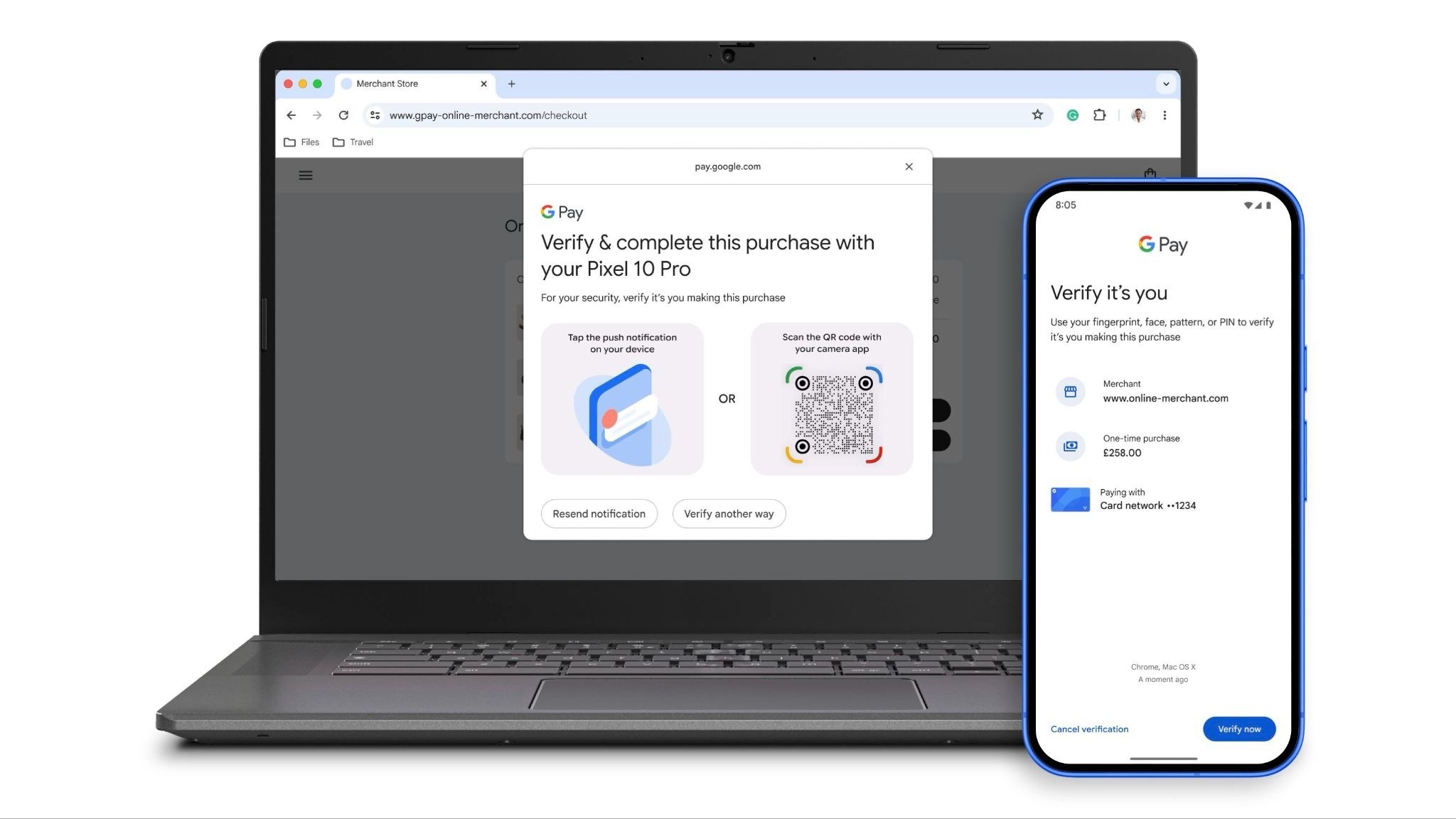
x-device (1)

Cross-Device authentication flow for Google Pay

Get started with Google Pay

It's been a highly productive year, and we look forward to seeing what you build next. Take a look at our developer documentation and get started with your Google Pay integration today to set up your platform for future agentic experiences

Follow @GooglePayDevs on X for future updates.

Explore this announcement and all Google I/O 2026 updates on io.google.