










WASHINGTON (AP) — President Donald Trump has turned to naval blockades to pressure the governments of Venezuela, Cuba and now Iran to meet his demands, but his preferred tactic is confronting a very different reality in the Middle East than in the Caribbean.
Unlike Cuba or Venezuela, Iran choked off a crucial trade route for energy shipments, meaning the longer the standoff persists, the more the global economy will suffer. Tehran also poses a greater military threat than those two adversaries in America's own hemisphere and requires a sustained military presence far from U.S. shores.
Iran's leverage over the Strait of Hormuz gives it power during a shaky ceasefire because the widening economic risks, especially higher U.S. gas prices in an election year, could force the Republican president to end the blockade on Iran's ports and coastline, experts say.
"It's really a question now of which country, the U.S. or Iran, has a greater pain tolerance," said Max Boot, a military historian and senior fellow for national security studies at the Council on Foreign Relations.
The effectiveness of Trump's use of the world's most powerful navy to block the trade of Iran's sanctioned oil and other goods is very much up for debate. But it certainly appears to be intensifying as the war grinds on.
The U.S. military on Thursday announced the seizure of another tanker associated with the smuggling of Iranian oil, a day after Iran's paramilitary Revolutionary Guards took control of two vessels in the crucial waterway.
Trump also announced he has ordered the U.S. military to "shoot and kill" Iranian small boats laying sea mines in the strait.
But the situation in Iran is not exactly analogous to what is playing out with the U.S. operations in Venezuela and Cuba.
Some experts say Trump's success in Venezuela likely had more to do with the U.S. military raid that captured leader Nicolás Maduro than American warships seizing sanctioned oil tankers to enforce U.S. control over the South American country.
A U.S. oil embargo on Cuba, meanwhile, has caused the island's most severe economic crisis in decades. While U.S. and Cuban officials have met recently on the island for rare talks, the financial strangulation has failed to produce the Trump administration's stated goal of leadership change.
"I do think that the success of the Maduro mission in Venezuela has probably emboldened the president," said Todd Huntley, director of Georgetown University's National Security Law Program.
That does not make the situations in Venezuela and Iran similar — geographically, militarily or politically. "There are some major differences," said Huntley, a retired Navy captain and judge advocate general.
WATCH: Iran targets ships in Strait of Hormuz as U.S. talks remain uncertain
While the blockade against Iran has delivered a severe blow to its economy, including stopping freighters from importing various supplies, the country has still been able to move some of its sanctioned oil, ship tracking companies say.
Iran has rejected Trump's demands to reopen the strait, where 20% of the world's oil normally flows, and it has been firing on ships again this week. Stalled shipments through the strait have sent gasoline prices skyrocketing far beyond the region and raised the cost of food and a wide array of other products, creating a political problem for Trump before the November's elections.
"Blockades are usually just one tool of a mechanism used in a conflict," said Salvatore Mercogliano, a maritime history professor at Campbell University in North Carolina. "They can be important. But it's only one element. And I don't think it's going to be enough to convince the Iranians."
Adm. Brad Cooper, head of U.S. Central Command, claimed last week that "no ship has evaded U.S. forces." The command overseeing the Middle East said it has directed 31 ships to turn around or return to port as of Wednesday.
Merchant shipping groups are skeptical.
Lloyd's List Intelligence said "a steady flow of shadow fleet traffic" has passed in and out of the Persian Gulf, including 11 tankers with Iranian cargo that have left the Gulf of Oman outside the strait since April 13.
The maritime intelligence firm Windward said this week that Iranian traffic continues to flow "via deception."
Iranian ships have several ways to sneak through the blockade, including spoofing their location tracking data or traveling through Pakistani territorial waters, Mercogliano said. He also noted that the sheer volume of shipping traffic the military needs to screen is a challenging task.
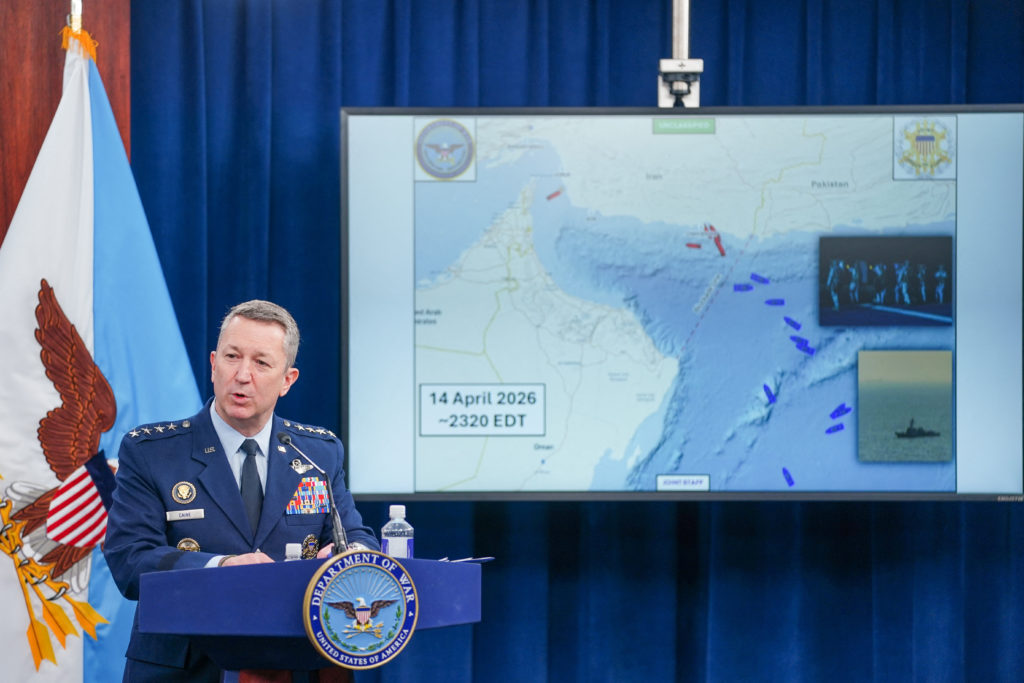
Chairman of the Joint Chiefs of Staff General Dan Caine speaks next to a map showing a blockade line on the Strait of Hormuz, during a briefing April 16 on the Iran war at the Pentagon in Washington, D.C. Photo by Nathan Howard/Reuters.
The last time the U.S. mounted a blockade similar to the one focused on Iranian ships was during the Kennedy administration in the early 1960s, against Cuba, Huntley said.
"And it wasn't even called a blockade," he said. "We called it quarantine."
Some naval blockades over the course of history have had an impact, such as Britain's blockade on Germany during World War I. "But they tend to be very long-term impacts, whereas Trump is looking for short-term, quick results," according to Boot, the military historian.
WATCH: Retired admiral breaks down U.S. strategy behind naval blockade
He said Trump probably saw the blockade on sanctioned oil tankers tied to Venezuela as playing a large role in the success of leadership changes in that country. But Boot said it had more to do with the U.S. ousting Maduro and the subsequent cooperation from his vice president, Delcy Rodríguez, who is now the acting president.
"There is no Delcy Rodríguez in Cuba or Iran," Boot said. "I think his success in Venezuela led him astray, thinking that this was a template that could be replicated elsewhere. He sees it as a huge success at little cost. And, in fact, it turns out to be a unique set of circumstances."
此内容由惯性聚合(RSS阅读器)自动聚合整理,仅供阅读参考。 原文来自 — 版权归原作者所有。