



Want to catch up on who has testified in the House Oversight investigation? Learn what we know about depositions from former Epstein assistant Sarah Kellen, prison guard Tova Noel and Commerce Secretary Howard Lutnick.
Former Attorney General Pam Bondi sat for a closed-door interview May 29 over her handling of the federal government's investigation into the late, convicted sex offender Jeffrey Epstein and his former girlfriend, Ghislaine Maxwell.
Several of Epstein's survivors stood outside the office where lawmakers spoke with Bondi. The survivors asked Rep. James Comer, R-Ky., the committee's chair, to question Bondi about the files' redaction process, which often revealed personal information and images of survivors.
As head of the Justice Department, Bondi faced intense criticism over the agency's release of a trove of documents pertaining to Epstein.
In a transcript released June 4 by the committee of Bondi's interview, the former Attorney General pointed to Todd Blanche, the current acting Attorney General, as being in charge of the Justice Department's handling and release of files related to Epstein. That included the redaction process, she said. Blanche was Deputy Attorney General when the Epstein Files Transparency Act, which required the Department of justice to release materials related to its investigation into Epstein, was passed in November.
Read the transcript of Bondi's interview by clicking the document below.
![read-full new [Recovered] Bondi 6-4-2026-01](https://d3i6fh83elv35t.cloudfront.net/static/2026/05/read-full-new-Recovered-Bondi-6-4-2026-01-791x1024.png)
Bondi also refused to answer questions related to President Donald Trump's involvement in the administration's handling of the files. Committee members asked Bondi when she and Trump first discussed Epstein investigations, how Trump responded when Bondi mentioned he was named in the files and whether Trump told her he had friends who could be exposed as abusers.
Bondi said the Justice Department owed survivors apologies for releasing their names.
"We absolutely owe an apology to any victim's name any time it's inadvertently released," she said, adding later in the interview that members of Congress should also feel responsible for the redaction errors "because you were pressing us to get 3 million pages out in 30 days, and that was virtually impossible."
Bondi's appearance before the House Oversight Committee came weeks after Trump fired her in April. She told CNN on May 27that she was diagnosed with thyroid cancer shortly after her exit from the DOJ.
READ MORE: Who is Howard Lutnick and what's his connection to Jeffrey Epstein?
Bondi spoke to the committee in a voluntary interview and was not sworn under oath. Democrats noted their disagreement with the decision.
"Well, if you lie to Congress, it's a felony," Comer told reporters and survivors who asked him about the decision to not swear Bondi in.
Watch the clip in the player above.
Bondi's recollection is one of several sought by the Republican-controlled House committee. Other notable figures who have provided testimony include former President Bill Clinton, former Secretary of State Hillary Clinton, Commerce Secretary Howard Lutnick, Epstein's former assistant and a former prison guard who was working the night before the financier was found dead in his cell.
From across the political spectrum and the worlds of finance, entertainment and beyond, a number of powerful figures have emerged in the Epstein documents, pictures and emails released by the DOJ. Inclusion in the files does not necessarily indicate wrongdoing, but the fallout has led to some high-profile resignations and calls for more accountability.
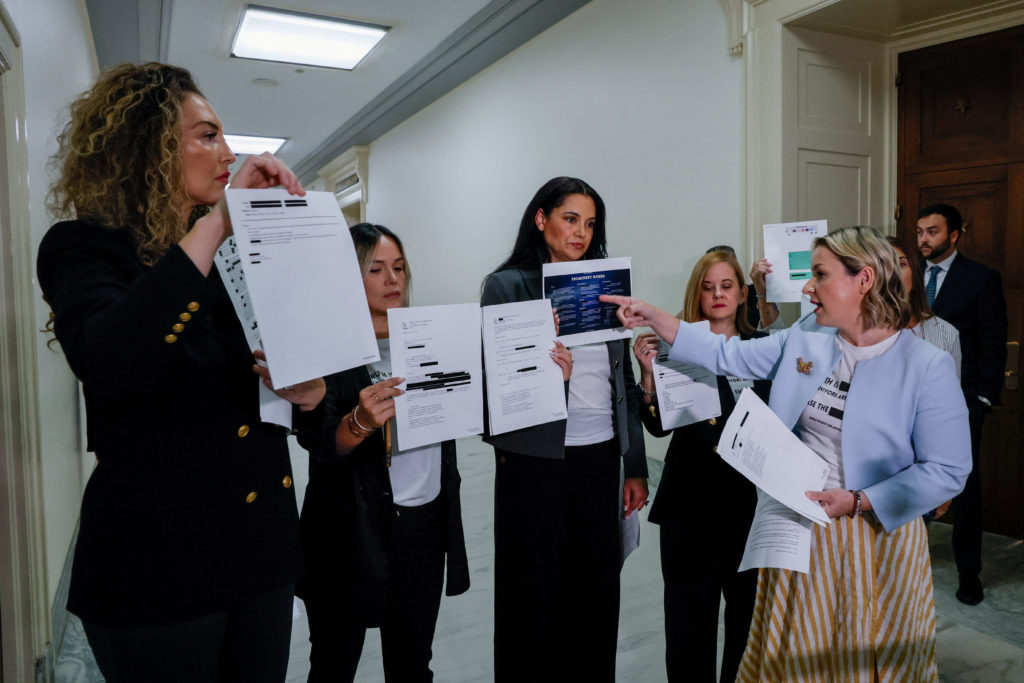
Survivor of Jeffrey Epstein Danielle Bensky speaks as other survivors show documents to members of the media, on May 29, 2026, the day of a House Oversight and Government Reform Committee interview with former Attorney General Pam Bondi as part of the committee's ongoing probe into the Justice Department's handling of the Jeffrey Epstein files, on Capitol Hill in Washington, D.C. Photo by Kylie Cooper/Reuters
In a bipartisan move, the committee voted in March to subpoena Bondi as the DOJ endured mounting pressure, even from conservative Trump supporters, to provide more information about its sex-trafficking investigation into Epstein.
The committee told the attorney general she possessed "valuable insight" into the agency's release of the files, legally mandated by the Epstein Files Transparency Act. The law established a deadline the agency failed to fully meet.
When Bondi declined to appear for her April 14 deposition, Democrats on the panel filed contempt charges, saying she was obligated to testify despite no longer being the nation's top prosecutor.
More than 120 lawyers filed an ethics complaint against Bondi days before her scheduled May interview with the committee, saying she violated Florida Bar rules in multiple ways, including "her failure to supervise subordinate officers" in the DOJ's review and release of the Epstein files.
The start of the government's investigation into Epstein's crimes far predates Bondi's tenure as attorney general. But after candidate Trump promised to release the files, Bondi was met with growing frustration over her handling of and public statements about the probe.
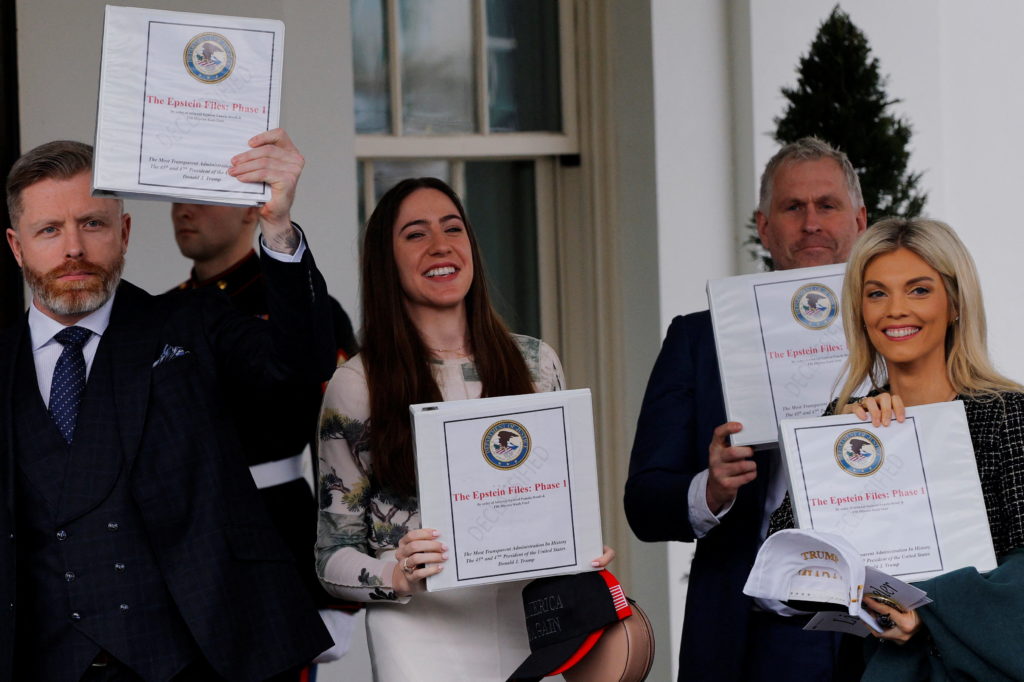
A group walks out of the West Wing on Feb. 27, 2025, holding up binders labelled, "The Epstein Files: Phase 1," at the White House in Washington, D.C. Photo by Brian Snyder/Reuters
Watch the clip in the player above.
此内容由惯性聚合(RSS阅读器)自动聚合整理,仅供阅读参考。 原文来自 — 版权归原作者所有。