





Correction: This story was updated to correct Kevin Dixon's age.
Six in 10 Americans disapprove of the way President Donald Trump is handling his war in Iran, including more than one in five Republicans, according to a new PBS News/NPR/Marist poll.
As Trump announced late Tuesday that the U.S. mission he launched a day earlier to escort commercial ships through the Strait of Hormuz was paused "for a short period of time," at the request of Pakistan and other countries, more than 60% of Americans believe the president has weakened the nation's standing on the world stage.
Hundreds of Iranians have been killed and thousands injured in strikes since late February, and at least 13 U.S. service members have died in action. Oil and gas prices have skyrocketed and shipping disruptions have complicated supply chains, driving up prices for food, fertilizer and other goods.
In a Truth Social post about the decision Tuesday, Trump claimed "great progress" toward a deal to end the war, after weeks of a fragile ceasefire and largely stalled talks.
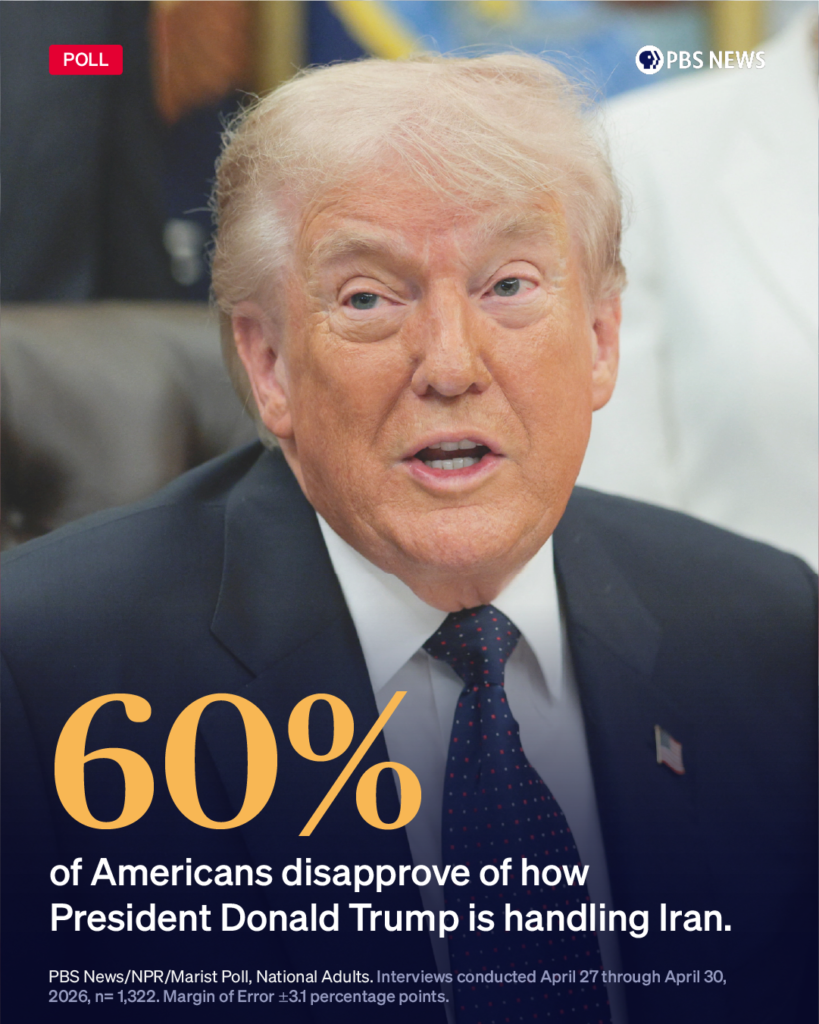
Six in 10 Americans disapprove of the way President Donald Trump is handling his war in Iran, including more than one in five Republicans, according to a new PBS News/NPR/Marist poll. Graphic by Steff Staples/PBS News.
In the U.S., 63% of Americans now blame the president for high gas prices, according to this latest poll. This frustration with Trump and unease with the economy could make it tougher for Republicans to hold on to seats in Congress this November, said Amy Walter, editor of The Cook Political Report with Amy Walter.
"You get angry people showing up who are no longer just anti-Trump Democrats, they're also frustrated independents, really driven in large part by the economy," Walter said. "And then these same economic woes are what are depressing Republican turnout. So you put that whole math together and that is a really dangerous place" for the GOP.
That's especially true in the context of a midterm election, said Lee Miringoff, director of the Marist Institute for Public Opinion, who noted that midterms in the last two decades have tended to be a referendum on an unpopular White House incumbent. Democrats have also done well in recent general and special elections.
The economy, the nation's international standing and the war are "things that I assume the Republicans are not eager to face voters with in November," Miringoff said. "They're all pointed in the wrong direction right now."
Sixty percent of Americans disapprove of Trump's handling of Iran, up six points from 54% in March.
Seventy-two percent of Republicans either strongly approve or approve of his actions in Iran so far. But messaging for the broader public has been a key problem for the Trump administration, said Holly Dagres, senior fellow at the Washington Institute. About 61 percent of Americans think U.S. military action in Iran has done more harm than good, the poll found.
"They keep changing the goalposts of what this war is and the reason for it," said Dagres, who also curates the Substack newsletter The Iranist. Initially, the administration offered regime change and the threat of the country's nuclear program as reasons for attacking.
WATCH: U.S. and Iran truce tested over the Strait of Hormuz, threatening to reignite conflict
Now, Dagres said, the war has pivoted to focusing on the Strait of Hormuz "because it's also impacting people at the gas pump" — though Defense Secretary Pete Hegseth said during a briefing Tuesday that the operation to reopen the passageway is "separate and distinct" from the war.
The growing dissatisfaction with the administration's actions is true across the political spectrum, with 22% of Republicans disapproving, up from 15% in March, and 64% of independent voters disapproving, up from 59% in March (though the increase among independents is within the poll's margin of error).
For Republicans, that uptick might be driven by Trump going back on a campaign promise, and, in the view of isolationists, starting "a forever war," she said. "It's not been forever, but it's been months and that in itself is scary, and it goes against this notion of 'America first.'"
Sixty-two percent of Americans said Trump has weakened the country's role on the world stage, the highest number Marist has recorded on this question since August 2017. That includes 22% of Republicans.
Independent voter Kevin Dixon, 61, said he believes Trump's efforts in Iran were "something that needed to be done."
In addition to changing the Iranian government, Dixon said he thinks Trump is trying to work toward peace in the Middle East.
"If he can actually accomplish his mission, I believe the world would be a better place," Dixon said.
Dixon, who said he doesn't want to see a prolonged war, doesn't think Trump intends to stay in Iran long.
But Jack Clay, 23 and an independent voter, sees the president's efforts in Iran as "not our war to fight." He believes Trump has done more harm than good.
"Whenever we started this conflict, we had the Strait of Hormuz open, we were at least in a negotiating position with Iran. Now, all these weeks later, we're begging to be in the same position. We're considering it a victory that we're back to square one. And I just think that's embarrassing," Clay said.
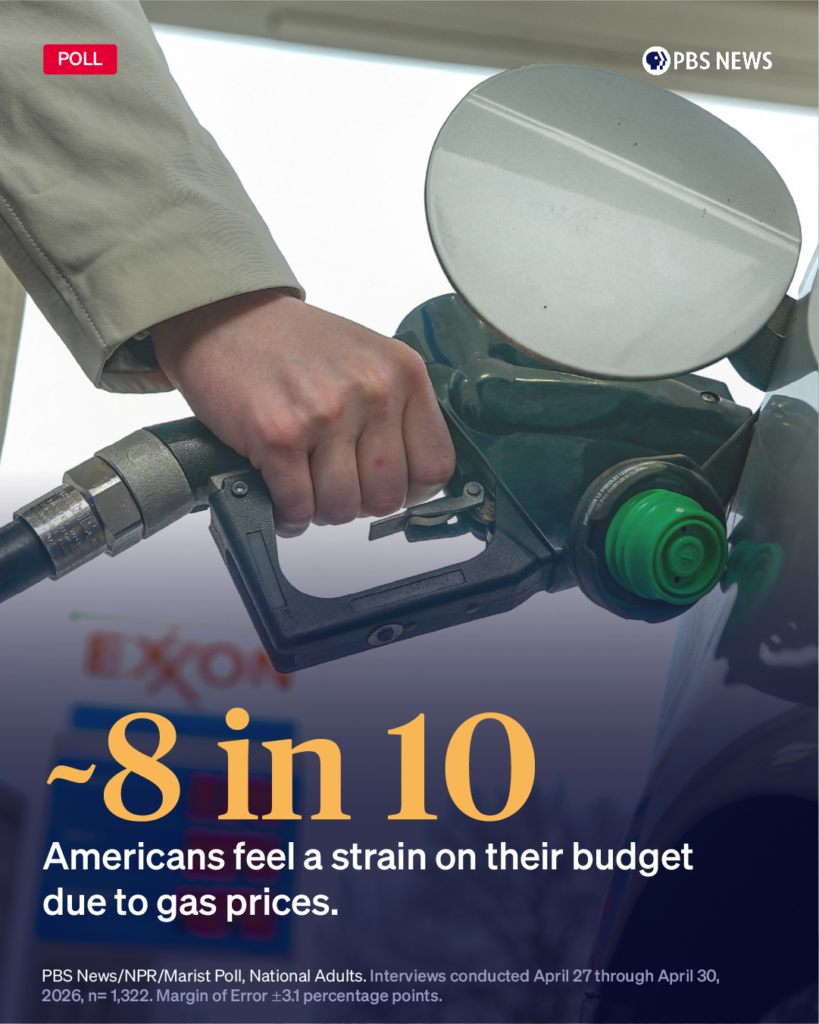
More than 80% of Americans say gas prices are putting a strain on their budget, according to the latest PBS News/NPR/Marist poll. Graphic by Steff Staples/PBS News.
The war in Iran has put a stranglehold on global oil and gas exports, and Americans are feeling the effects at the pumps. Gas prices have reached an average of $4.48 per gallon, up from $3.17 a year ago, and 63% of Americans – including the same percentage of independents – blame Trump for that rise. Nearly half of all independents say the president is to blame "a great deal" for the increase.
READ MORE: U.S. gasoline prices rise 50% since the start of the Iran war
"That's something people see, like the cost of milk and the cost of bread," Miringoff said.
"More than some kind of economic indicator, these are the things that people react to and they see it. I guess it's the old Marx Brothers like: 'What are you going to believe, me or your own eyes?' And in this case, people are experiencing it directly."
Meanwhile, 32% of Republicans and 26% of people who voted for Trump in 2024 blame the president "a good amount" or "a great deal" for high gas prices.
Americans' wallets are feeling the pinch from gas prices. In this latest poll, one-third of U.S. adults say gas prices are putting a "major strain" on their budgets -- a consistent sentiment across the political spectrum (36% of Democrats, 28% of Republicans and 33% of independents).
Overall, 63% of Americans do not feel the economy is working well for them. That percentage has ticked up slightly since December, and has risen about six percentage points from a year ago.
Disapproval of Trump's handling of the economy has hit a new high, including during his predecessor former President Joe Biden's term.
Even after he lost the 2020 election, more Americans approved of how Trump handled the economy (50%) than disapproved (45%). Today, only 35% of Americans approve, while 61% disapprove.
"That's very closely tied to the gas prices. There's no more visible reminder of not only where we are right now, but what the Republicans were pointing out of Joe Biden when he was in office, and that has come around full circle to them," Miringoff said.
Overall, Trump's approval rating remains low; 37% of Americans approve of the job Trump is doing as president, while 59% disapprove -- relatively unchanged from March.
That many Americans view Trump's handling of the economy as poor may be a warning sign for the GOP come this fall, Walter said.
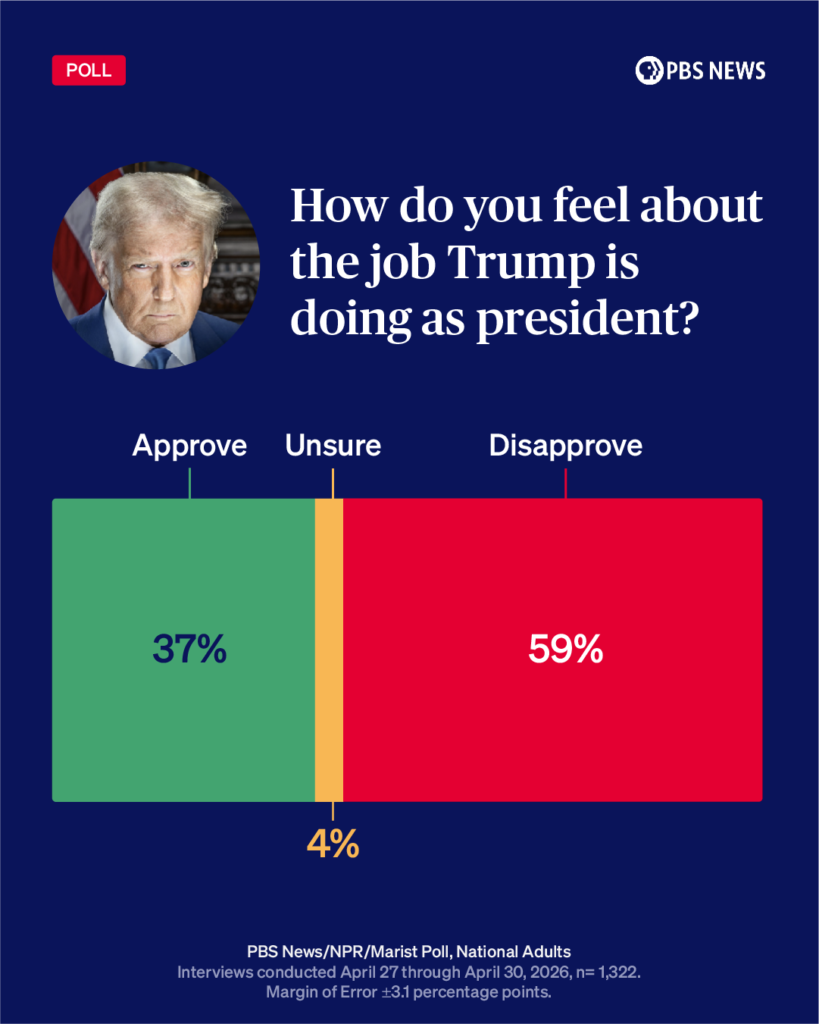
Thirty-seven percent of Americans approve of the job Trump is doing as president, while 59% disapprove -- relatively unchanged from March, according to the latest PBS News/NPR/Marist poll. Graphic by Steff Staples/PBS News.
"It's hard not to connect all those dots to say that the reason his job approval is slumping is because frustration about inflation is rising, and you're seeing it across all groups of voters now," she said.
The GOP is still sticking with him, she noted, with 81% of Republicans saying they approve of the job Trump is doing as president. But among white Americans who are not college graduates, 52% say they disapprove.
"That is a core constituency of his, and I would have to believe that it is driven as much by the frustration over inflation as anything else," Walter said.
If the midterm elections were held today, 52% of registered voters said they would be more likely to vote for the Democratic candidate in their district, compared with 42% who said they would be more likely to vote for the Republican candidate. A plurality of independent voters also said they'd vote for the Democrat (49%) over the Republican (37%).
"The question is how many of them turn out. And the reality is that the angriest ones are probably going to turn out, and they're going to turn out and vote for Democrats," Walter said.
"Some of those independents who are disappointed are just not going to show up, but also that's not great for Republicans either."
WATCH: Tamara Keith and Amy Walter on redrawing congressional maps and testing Trump's power
Around 8 in 10 partisan voters said they were either "very enthusiastic" or "somewhat enthusiastic" about voting in November, but Democrats were more likely to say they were "very enthusiastic."
Among Democrats, 61% said they were "very enthusiastic" about voting, compared with 53% of Republicans.
"Its not as if these [Republican voters] are going to show up and vote for Democrats," Walter said. "But them not showing up is almost as bad for Republicans."
Miringoff said he sees some "soft Republican enthusiasm," primarily driven by concern about Democrats. But the more telling numbers are among people who voted for former Vice President Kamala Harris versus those who voted for Trump in 2024, he said.
While 61% of Harris voters said they're very enthusiastic about voting in the midterms, only 47% of Trump voters said the same.
"That's a big gap, and that's the kind of thing that has to give pause for Republicans right now, because that's not what you want to be doing in November," Miringoff said.
PBS News, NPR and Marist Poll conducted a survey from April 27-30, 2026, that polled 1,322 U.S. adults by phone, text and online with a margin of error of 3.1 percentage points, and 1,155 registered voters with a margin of error of 3.3 percentage points. For Democrats, the margin of error is 5.6 percentage points; Republicans, 5.7 percentage points; independents, 5.9 percentage points.
此内容由惯性聚合(RSS阅读器)自动聚合整理,仅供阅读参考。 原文来自 — 版权归原作者所有。