


By

Jon LaPook
Chief Medical Correspondent
Jon LaPook, M.D. is the award-winning chief medical correspondent for CBS News. Since joining CBS News in 2006, LaPook has delivered more than 1,500 reports on a wide variety of breaking news and trending stories in the health and medical fields, as well as feature stories on music, lifestyle and profiles of entertainment stars.
/ CBS News
This is an updated version of a story first published on Sept. 21, 2025. The original video can be viewed here.
Biologist Charles Darwin began crafting his theory of evolution on a trip to the Galapagos Islands, where he discovered animals had developed unique traits that varied from island to island. Nearly two centuries later, on a different island, scientists aren't just observing evolution, they now have the technology to shape it. We met a team of modern-day Darwins on Nantucket, where, as we first told you last fall, they're hoping to use genetic engineering to reduce the transmission of Lyme disease - a tick-borne illness found primarily in the Northeast and Upper Midwest, but also throughout the United States. The scientists' target may surprise you. It's not the deer often associated with the disease, or even the ticks, but wild mice - the main carriers of Lyme. With the rate of emergency room visits for tick bites at a record high in some regions, this could be the summer Americans consider a new strategy to fight disease: sculpting evolution.
Thirty miles off the coast of Cape Cod, Massachusetts, is the island of Nantucket: a 14-mile-long, 3-mile-wide oasis known for its natural beauty, pristine shorelines, and protected landscape.
But hidden is a scourge that's afflicted 15% of its residents.
Kevin Esvelt: The natural disaster in our area is not hurricanes, or tornadoes, or earthquakes; it is Lyme disease. It is the one plague that might be severe enough that communities might want to engineer a wild organism in order to get rid of it, or, at least, reduce the level, a lot.
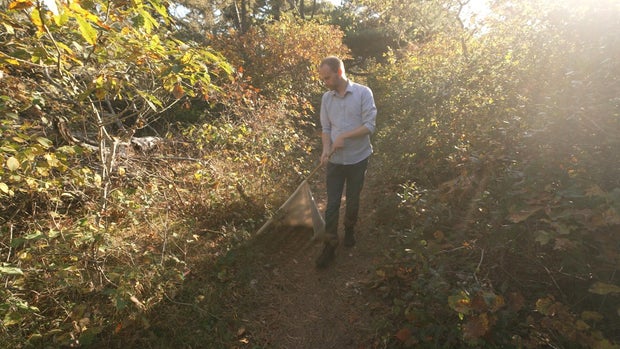
Deep in the island's brush, in 2024, we found MIT associate professor Kevin Esvelt, a pioneer in genetic engineering, waving a white flag in search of ticks.
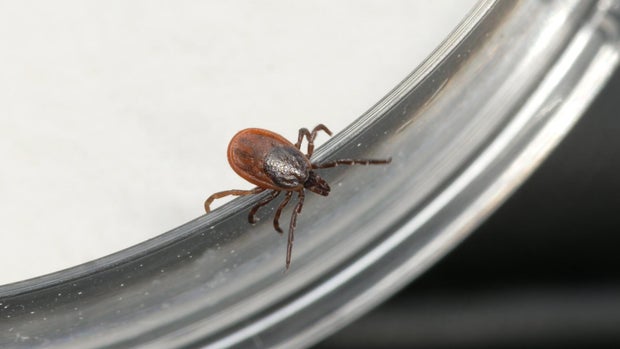
These tiny vectors of Lyme disease were not hard to find.
Kevin Esvelt: These are the big ones because these are largely adults.
Jon LaPook: If the adults are this small, imagine the tiny, tiny what are they called, nymphs?
Kevin Esvelt: Nymphs, yeah. We often think of poppy-seed sized.
Esvelt's collaborator is Sam Telford:, an epidemiologist at Tufts University who's been studying ticks on Nantucket for the last 41 years.
Sam Telford: There's a 50% chance, maybe more, that this is actually carrying Lyme disease.
Jon LaPook: But you're not afraid because it has to be embedded–
Sam Telford: It has to be attached--
Jon LaPook: --and attached–
Sam Telford: --for-- for more than 24 hours.
Jon LaPook: Right, to-- to infect you.
Sam Telford: That's correct.
Sam Telford: These guys will swell up 50 to 100 times that size with blood. You know, it becomes that-- that big.
Jon LaPook: And that's how you know when they're engorged you know that they've been feeding on you.
Sam Telford: If you see it that big, then you're in trouble.
The scientists aren't here just to collect ticks; they're interested in this critter.
Jon LaPook: This is a wild mouse?
Sam Telford: This is a wild white-footed mouse.
Jon LaPook: And you've tagged it?
Sam Telford: I've tagged it. So when I come back in April or May of next year, we get an idea of what over-wintering success is.
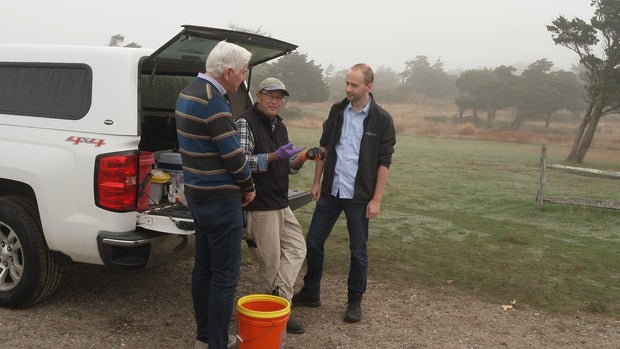
Telford is tracking the mouse population on Nantucket as part of a novel project. The scientists want to use genetic engineering to interrupt a cycle of infection necessary for Lyme disease to flourish.
White-footed mice are the main host of Lyme bacteria. When an uninfected tick bites an infected mouse, the bacteria transfer to the tick. When that infected tick then bites an uninfected mouse, the cycle continues.
Deer don't get infected but they help spread the disease because ticks embed on them to feed, then reproduce, with a single female tick laying as many as 2,000 eggs.
Here's Esvelt and Telford's big idea: change the genetic makeup of the mice so they're immune to Lyme. That way, the ticks that bite them won't get infected.
Jon LaPook: You don't have to kill the mouse in order to interrupt the cycle?
Sam Telford: It'd be so much more economical and straightforward to just go out and poison all the mice, right, get rid of the mice. But then there's a whole food chain that might depend on these mice that would be impacted.
Kevin Esvelt: The dream is that we can use new technologies to ensure that wild creatures can live in peace, playing their normal ecological role, but without causing disease that make people suffer.
If Esvelt's dream becomes a reality, 80-year-old Dr. Timothy Lepore might finally be able to retire.
Over the past 40 years, he's been the island's emergency room head, sole surgeon, even its medical examiner. Today, Dr. Lepore runs the only private practice on Nantucket, where he treats dozens of patients with Lyme disease each year.
And yes, that's a giant tick in his waiting room.
Dr. Timothy Lepore: Being in private practice, it is-- while not well-paid-- it's--
Jon LaPook: You get paid in, like, what, chickens and doughnuts and--
Dr. Timothy Lepore: We prefer lobsters, actually--
Jon LaPook: Lobsters.
Dr. Timothy Lepore: Lobsters, clams--
Jon LaPook: B--
Dr. Timothy Lepore: --and scallops.
Jon LaPook: But you'll take-- you'll take anything, right?
Dr. Timothy Lepore: I will take anything.

Lyme disease can be treated with antibiotics, but if left untreated, the infection can spread to the heart, joints, and nervous system, as it did for 33-year old Shauna Asplint.
Shauna Asplint: My body hurts all the time.
Dr. Timothy Lepore: Okay.
Shauna Asplint: I don't know if that's from my Lyme's disease, or what. My neck is stiff, my ankles are sore, and my hips.
Asplint was first diagnosed with Lyme when she was 10 years old. A few years later, the left side of her face stopped moving, a residual effect from the disease is still noticeable today.
Dr. Timothy Lepore: Let's see you smile.
Shauna Asplint: It's a little off, and then if--
Dr. Timothy Lepore: Yeah, no. It's very nice.
Shauna Asplint: --raise my eyebrows, it just doesn't move.
Dr. Timothy Lepore: We see people with facial palsies. We see little kids with swollen knees. We see people with Lyme rashes. So it alters people's behavior and activities.
The problem on Nantucket can be traced back to 1926, when locals voted to import two female deer to the island to give a lone buck company. As the deer population grew, so did the ticks'.
On top of that, by the 1950s, half the land on the island was put into conservation. The untamed brush and wild grasslands create an ideal ecosystem for Lyme's hosts to thrive.
Kevin Esvelt: We have a problem with tick-borne disease because we engineered the environment to maximize the number of ticks and maximize the number of mice that are the best hosts of Lyme disease. And it came back and bit us, literally.
A trip at age 11 to the Galapagos Islands sparked Esvelt's lifelong obsession with evolution. In 2013, he was the first to propose that CRISPR, a revolutionary technology that enables scientists to edit DNA, could be used to change a species' genetics in perpetuity, hacking the laws of inheritance.
This idea led to the project they call "Mice Against Ticks" in the Sculpting Evolution lab Esvelt runs at MIT.
For the last 10 years, he and researcher Joanna Buchthal have been studying whether they could add a gene for an antibody that prevents Lyme infection to a mouse embryo that, as we see here, has progressed into two cells.
Jon LaPook: Is it gonna be into one of those cells or both of them?
Joanna Buchthal: So our technique involves injecting both cells to maximize the likelihood that we get the antibody gene in their DNA.
Buchthal and embryologist Zach Hill showed us how they genetically engineer lab mice.
Joanna Buchthal: He's gonna actually inject through the plasma membrane, and into the nucleus for both of these cells.
Jon LaPook: How are you at darts?
Zach Hill: Not very good.
Jon LaPook: But you're gonna hit the--the center of this…
Zach Hill: A lot better at this, yeah--
Zach Hill: Okay. So I already have an embryo set up on the-- on the dish here.
Zach Hill: So I'm just trying to find the nucleus here
Jon LaPook: It is amazing to see this.
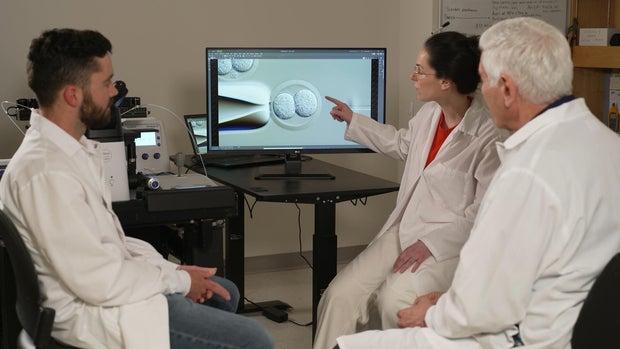
Joanna Buchthal: So that little burst that you can see in the nucleus in-- is when he's actually injecting the genome engineering tools directly into the nucleus where the DNA is.
The injection mix contains both the antibody gene and CRISPR, which acts like molecular scissors. After CRISPR finds and cuts the targeted area of DNA, the cell inserts the gene into the mouse's genetic code. When this mouse is born, it will be immune to Lyme disease, and so will its children.
Jon LaPook: If I get a polio vaccine my kids aren't gonna be immune to polio unless they get the vaccine too.
Joanna Buchthal: That's exactly right. So this is a heritable immunization.
Jon LaPook: What do you mean by that?
Joanna Buchthal: What we're actually doing is we're encoding immunity so that that immunity is passed on generationally. And every mouse that gets the antibody gene is actually immune.
Jon LaPook: Typical, standard evolution happened very slowly, right, over thousands // maybe millions of years. Are you speeding up evolution here?
Kevin Esvelt We are absolutely speeding up evolution. And that's precisely why we have to be careful, because we are doing things that couldn't happen naturally.
The plan is to release thousands of engineered mice on Nantucket over time, starting during the winter months, when the native mouse population is low. But first, Esvelt needs community buy-in.
He chose Nantucket, not only for its high rate of Lyme, but also for its tight-knit, well-educated community, with a tradition of town hall democracy.
We saw this in action in October 2024 when, for the 10th time, the scientists presented their latest findings to locals…
Joanna Buchthal: So it appears that we have, indeed, produced the first heritably Lyme-immune laboratory mice capable of breaking the disease transmission cycle.
…followed by a public Q&A.
Resident 1: We have a huge population of field mice here. Shall we expect a larger population?
Resident 2: Having had Lyme disease twice, I thought "what a cool idea." But mice are kinda the foundation of the food chain. So tinkering with the food chain makes me a little cautious.
Resident 3: How long before it's actually gonna take effect and keep me from getting Lyme disease again?
Jon LaPook: When you're in these meetings//what's that been like?
Kevin Esvelt: Some people are really gung ho about this. Some people have deep reservations. But what I found heartening about this and Nantucket, in particular, is that pretty much everyone agrees that this is how we should go about developing these kinds of technologies, that it should not just be scientists in their laboratories get a clever idea and then, boom, it's there.
Dr. Timothy Lepore says he's supportive of the proposal. But as an avid falconer, he wants more testing to be done to ensure there won't be unintended consequences to the island's ecosystem.
Jon LaPook: Could a change in-- in the field mouse lead to a change in the hawk?
Dr. Timothy Lepore: Well, that's the question. I don't think so.
Jon LaPook: But we don't know--
Dr. Timothy Lepore: But I think that has to be shown.
Jon LaPook: Do you worry about fooling around with mother nature?
Kevin Esvelt: Absolutely. But, on the other hand, I'm not terribly fond of mother nature, if she's gonna give my kids disease. All of technology is saying to mother nature, "You're beautiful. And we appreciate you very much and we need to conserve you. But we're not always happy with the way things work, naturally. And so we're going to change it."
Jon LaPook: But in this case, you're changing the environment for everybody.
Kevin Esvelt: This is, I agree, different because it's hard for individuals to opt out. And I think that means we need to do the science differently because we need to ensure that people have a voice, early enough, to actually influence the direction that the technology is developed.
If federal and state regulators agree, the team plans to first release the engineered mice in a small field trial on a private island, so they can better understand the ecological impacts before any potential experiments on Nantucket.
Jon LaPook: What is the home run for you?
Kevin Esvelt: I think it's a field trial that works, it's something that allows us to dramatically reduce the-- the fraction of ticks that are infected, that doesn't have anything obviously go wrong with the ecosystem. And then the community has a good discussion and then they decide. And I think there's benefits as we discussed even if they say no. And then we walk away.
Produced by Katie Brennan and Denise Schrier Cetta. Associate producer, Grace Conley. Edited by Aisha Crespo.
In: