

惯性聚合 高效追踪和阅读你感兴趣的博客、新闻、科技资讯
阅读原文 在惯性聚合中打开

推荐订阅源

T
Troy Hunt's Blog
Blog — PlanetScale
Blog — PlanetScale
Engineering at Meta
Engineering at Meta
F
Full Disclosure
Recorded Future
Recorded Future
The GitHub Blog
The GitHub Blog
Microsoft Security Blog
GbyAI
GbyAI
博客园_首页
博客园 - 叶小钗
MongoDB | Blog
MongoDB | Blog
Exploit-DB.com RSS Feed
Recent Commits to openclaw:main
H
Hacker News: Front Page
人人都是产品经理
人人都是产品经理
The Cloudflare Blog
博客园 - 司徒正美
Webroot Blog
Webroot Blog
Google DeepMind News
Help Net Security
Help Net Security
Cloudbric
Cloudbric
PCI Perspectives
PCI Perspectives
有赞技术团队
有赞技术团队
K
KPMG report finds enterprise disconnect between AI and its ROI | CIO
TaoSecurity Blog
TaoSecurity Blog
L
Lohrmann on Cybersecurity
量子位
Threat Intelligence Blog | Flashpoint
T
Tailwind CSS Blog
Hacker News - Newest:
Hacker News - Newest: "LLM"
B
Blog RSS Feed
Apple Machine Learning Research
大猫的无限游戏
大猫的无限游戏
P
Proofpoint News Feed
N
News and Events Feed by Topic
罗磊的独立博客
T
Threat Research - Cisco Blogs
Schneier on Security
T
Tor Project blog
IT之家
IT之家
M
MIT News - Artificial intelligence
S
Security @ Cisco Blogs
O
OpenAI News
AI
AI
S
Securelist
Simon Willison's Weblog
The Last Watchdog
The Last Watchdog
月光博客
月光博客
Security Archives - TechRepublic
L
LINUX DO - 热门话题

Home - CBSNews.com

"48 Hours" schedule: Live, DVR, and on demand Rory McIlroy wins second straight Masters Tournament Brian Hooker sent friends maps that he says show where his wife went missing in Bahamas Iran's parliament speaker says U.S. will be "nostalgic" for $4 gas as oil prices fuel inflation Democratic Rep. Eric Swalwell ends bid for California governor as he faces sexual assault allegations Trump says U.S. will blockade Strait of Hormuz after Iran peace talks collapse DHS looking into allegations Rep. Eric Swalwell hired nanny not authorized to work in U.S. Fallout from Eric Swalwell scandal grows as lawmakers eye House expulsion votes How wildlife photographer Chris Fallows captures the natural world Rory McIlroy claims second straight Masters title Brian Hooker shared maps he says show where his wife went missing in the Bahamas Manhattan DA investigating sexual assault allegations against Rep. Eric Swalwell Extended interview: Sen. Dave McCormick on AI Trump says U.S. will blockade Strait of Hormuz and intercept ships that paid tolls to Iran Few see U.S. goals being met in Iran yet; Americans voice worry and stress in CBS News poll Hungarian Prime Minister Viktor Orbán concedes defeat in key election, ending 16 years in power Ukraine, Russia accuse each other of violating Putin's Orthodox Easter ceasefire Kimberly Langwell's Hidden Grave Decades after a Texas mom's disappearance, a tip leads to the location of her secret grave Kids, adults alike watch Artemis II crew's splashdown in San Diego JD Vance says U.S. and Iran did not come to a deal after marathon session Artemis II astronauts welcomed home to Houston after historic moonshot Artemis II crew returns to Houston after successful mission Artemis II astronauts speak publicly for first time since successful moon mission Federal appeals court sends White House ballroom construction lawsuit back to lower court Pope Leo criticizes "idolatry of self" in latest rebuke of Iran conflict: "Enough with war!" Iran reportedly proposes tolls for ships crossing Strait of Hormuz How Persian Gulf nations are reacting to the U.S. and Iran's temporary ceasefire U.S. naval destroyers have crossed the Strait of Hormuz, CENTCOM says Trump says U.S. is "clearing out" the Strait of Hormuz as U.S., Iranian officials meet in Pakistan Risk on the Road | Sunday on 60 Minutes Military expert warns of "economic catastrophe" if Strait of Hormuz is not opened shortly JD Vance meets with Iranian and Pakistani officials for direct talks Inside the unique traditions at the Masters Tournament Swedish candy's global takeover The Santa Barbara restaurant rethinking omakase U.K. authorities seize 5 tons of cocaine worth over $500 million from banana, red wine shipments U.S. detains family of Iranian regime propagandist "Screaming Mary" ahead of deportation Journalist helped defeat New York City's pinball ban Chess master Levy Rozman on bringing his favorite game to the masses Breaking down U.S. News & World Report's best graduate schools Man with machete fatally shot at NYC's Grand Central after slashing attack, NYPD says Saturday Sessions: Theo Lawrence performs "Dear Pillow" Saturday Sessions: Theo Lawrence performs "California Poppy" Saturday Sessions: Theo Lawrence performs "Lonely Too Long" Tesla owners approved to use self-driving features in Netherlands, a first for Europe The Uplift: Michael Jordan Latest details in disappearance of American woman in Bahamas after husband's arrest 2 dead in Russian drone strikes in Ukraine ahead of ceasefire for Orthodox Easter Inflation skyrockets as Iran war impacts U.S. economy U.S. and Iran negotiations underway in Pakistan as fragile ceasefire holds 04/11: Saturday Morning The Root Beer Float Murder | Post Mortem What's next for space exploration after successful Artemis II mission Artemis II crew successfully splashes down in Pacific, ending historic moon mission Eye Opener: Artemis II crew back on Earth after safe splashdown A teen athlete's painful headache wouldn't go away. It took over a year to find a cure. Boy in France kept in locked utility van for nearly 2 years before being rescued this week National Action Network Convention offers first glimpse of 2028 Democratic field Is strongman leader and MAGA darling Viktor Orbán about to be ousted? What to know ahead of Hungary's elections DHS investigates deadly hammer attack of Florida gas station clerk Anthropic's Mythos AI can spot weaknesses in almost every computer on Earth. Uh-oh. Trump proposes covering executive office building's gray stone facade with white paint NASA holds press conference after Artemis II splashdown Artemis II crew splashes down near San Diego after historic moon mission U.S. will begin blockading ships in Strait of Hormuz on Monday after Iran talks yield no deal House Democrats call on Eric Swalwell to drop out of California governor race amid sexual assault allegations At age 102, a New York man is still striving for perfection, through pottery Watch: Artemis II astronauts airlifted out of ocean after splashdown NASA astronauts exit Orion capsule after successful Artemis II mission NASA astronaut describes watching "picture perfect" Artemis II splashdown with crew's families What's next for Artemis II astronauts after splashdown Watch Artemis II crew return to Earth in successful splashdown 9 highlights from Artemis II's epic journey around the moon 9 highlights from Artemis II's historic journey around the moon What Happened to the Great White Sharks? | Sunday on 60 Minutes Watch: Artemis II Orion capsule splashing down off California Planned "Arc de Trump" would be over twice as high as Lincoln Memorial Melania Trump denies relationship with Epstein, urges Congress to hold hearing with survivors Watch: Artemis II capsule reenters Earth's atmosphere, begins communication blackout period Pope Leo's Church | Sunday on 60 Minutes Justice Dept. argues D.C. pipe bomb defendant not covered by Trump's Jan. 6 pardons 102-year-old New York man strives for perfection through pottery New audio emerges of husband's call to friend after woman's disappearance in the Bahamas How an 8-year-old designed a zero-gravity indicator for Artemis II New drawings show proposed "Arc de Trump" Melania Trump's surprise statement on Epstein raises new questions Afrika Bambaataa, hip-hop pioneer and founder of Universal Zulu Nation, dies at 68 4/10: CBS Evening News This week on "Sunday Morning": The Money Issue (April 12) Kamala Harris says she might run for president in 2028: "I'm thinking about it" 4/10: The Takeout with Major Garrett CPI report shows inflation surged in March as Iran war drove up energy costs The U.S. faces an air traffic controller shortage. It's turning to gamers for help. See the messages Brian Hooker sent his friend after wife's disappearance in the Bahamas: "The wind blew me away" Sneak peek: Kimberly Langwell's Hidden Grave Katie Porter and influencer behind Swalwell allegations "don't have a relationship to speak of," campaign says The upper middle class is now the largest income group in the U.S., study finds Read full episode transcripts of "Face the Nation with Margaret Brennan" from 2026 Arc de Trump? President shows off model of Independence Arch, says "it's going to be really beautiful"
As Artemis II heads back to Earth, crew stakes their lives on the heat shield
2026-04-10 · via Home - CBSNews.com

By

/ CBS News

Add CBS News on Google

Update: The Artemis II crew splashed down to end its mission successfully on Friday, April 10. Follow the latest here.

When the Artemis II Orion crew capsule returns to Earth on Friday after flying around the moon, it will hit the discernible atmosphere some 75 miles above the Pacific Ocean at a blistering 24,000 mph — fast enough to fly from Los Angeles to New York in about 6 minutes.  

Within seconds, temperatures across its 16.5-foot-wide heat shield will climb to some 5,000 degrees — half as hot as the visible surface of the sun — as the ship rapidly slows in an electrically charged fireball of atmospheric friction. 

The four astronauts on board — commander Reid Wiseman, Victor Glover, Christina Koch and Canadian astronaut Jeremy Hansen — are counting on the heat shield to keep them safe, in a comfortable environment, all the way through the peak heating zone to a parachute-assisted splashdown in the Pacific off the coast of California. 

"We have high confidence in the system, in the heat shield and the parachutes and the recovery systems we put together," Amit Kshatriya, NASA's associate administrator, said Thursday. "The engineering supports it, the Artemis I flight data supports it. All of our ground tests support it, our analysis supports it, and tomorrow the crew is going to put their lives behind that confidence."
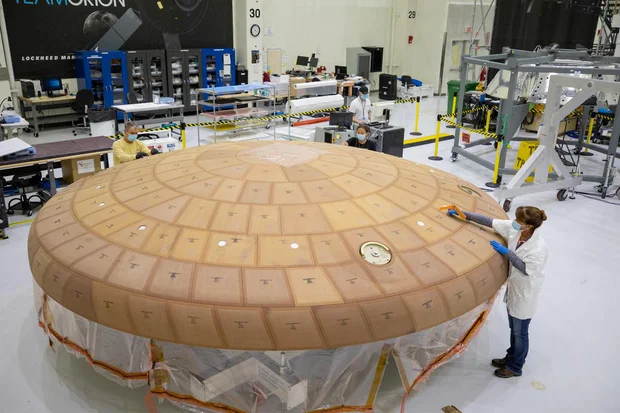
heat-shield-assembly.jpg
The Artemis II heat shield during its assembly. The 16.5-foot-wide heat shield is required to protect the Orion capsule and its crew from the 5,000-degree heat of the ship's high-speed plunge back into the atmosphere. NASA

The crew and mission managers are confident, they say, despite major problems with the heat shield that was used during the unpiloted Artemis I test flight in 2022, when the Avcoat material making up the shield developed sub-surface cracks and gas pockets that blew away chunks of the protective barrier's outer "char" layer. 

Based on nearly two years of tests and analysis, engineers were surprised to discover the damage was most likely caused by the Avcoat material's lack of permeability during a specific phase of the reentry when the shield was experiencing lower external temperatures while internal layers were still extremely high, generating gas that could not escape.

Agency managers decided to order a different heat shield design for downstream Artemis missions. But the heat shield for the Artemis II flight, identical to the one used with Artemis I, was already installed. Replacing it with a new design would have delayed the mission by 18 months or more. 
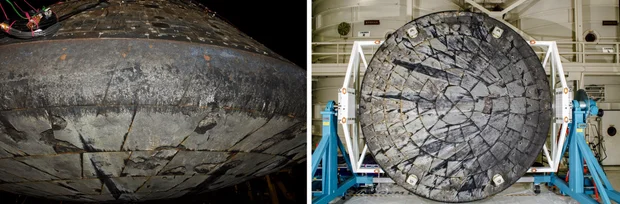
heat-shield-damage.jpg
The 16.5-foot-wide heat shield protecting the Orion capsule during an unpiloted test flight in 2022 was seriously damaged during reentry. NASA

Instead, NASA managers opted to launch Artemis II "as is" based on test data and an exhaustive analysis that indicated the shield would work properly if the reentry trajectory was modified to eliminate the temperature and pressure swings that contributed to the damage seen after the Artemis I flight. 

"They did a tremendous amount of research, a lot of groundbreaking research in some facilities that we had not used before, and they discovered the root cause," Wiseman said.

"They did wind tunnel testing and laser testing and hyper-velocity testing, and they determined that if we come in with this lofted profile ... that this heat shield will be safe for us to go fly.

"So I think all that points in the direction of goodness," he said. "And I think if you, as a human being who was about to board this rocket, had sat in the meetings that we sat in and listened to the experts and gone through the data with them, you would have the same comfort."

What went wrong with Artemis I?

During the Artemis I mission, the unpiloted capsule followed a planned "skip" trajectory, similar in concept to skipping a flat stone across still water. After an initial dip into the upper atmosphere, the Artemis I capsule skipped back out again before making its final descent to splashdown. The skip reentry helps reduce the spacecraft's velocity while offering NASA a wider range of splashdown options in case bad weather makes a targeted landing site problematic.
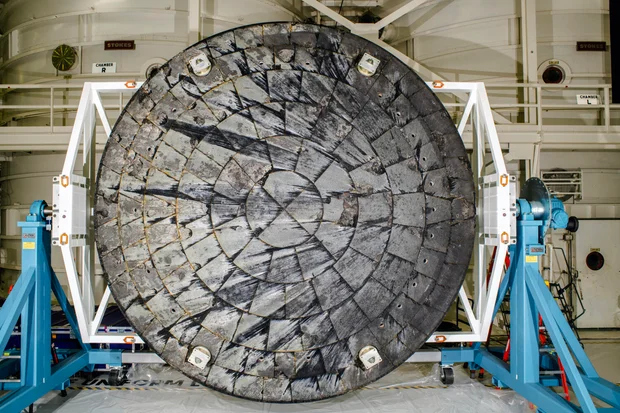
heat-shield-1.jpg
The Artemis I heat shield after its return to Earth in 2022. Regions of the shield suffered unexpected damage that did not match computer modeling, kicking off months of detailed tests and analysis. NASA

Despite the heat shield damage seen after the flight, the Artemis I reentry was successful. The capsule landed on target, and officials said that had any astronauts been aboard, they would have had no problems. But the damage triggered alarm at NASA. 

"NASA identified more than 100 locations where ablative thermal protective material from Orion's heat shield wore away differently than expected during reentry into Earth's atmosphere," NASA's Office of Inspector General wrote. 

"While the heat shield successfully protected the Crew Module and its systems during the Artemis I mission, upon inspection after Orion's recovery, engineers noted unexpected variations in the appearance of the heat shield Avcoat — the ablative material that helps protect the capsule from the heat of reentry.

"Specifically, portions of the char layer wore away differently than NASA engineers predicted, cracking and breaking off the spacecraft in fragments that created a trail of debris rather than melting away as designed," the office said. "The unexpected behavior of the Avcoat creates a risk that the heat shield may not sufficiently protect the capsule's systems and crew from the extreme heat of reentry on future missions." 
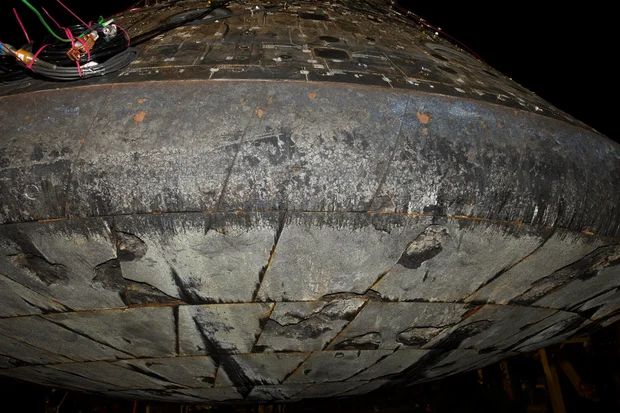
heat-shield-2.jpg
Another look at the Artemis I heat shield showing areas where major damage was observed. NASA

Testing revealed the damage was related to the heat shield's permeability, or rather, its lack thereof. After the initial, relatively deep dive into the atmosphere, the Avcoat material making up the shield was unable to properly dissipate the heat that remained in its lower layers during the skip back out of the atmosphere. 

Entry heating is what makes the Avcoat's outer char layer permeable enough to allow gas to escape. The Artemis I heat shield worked normally during its initial descent into the atmosphere. But when it climbed back out, reentry heating eased and the outer char layer became much less permeable. 

The underlying material was still extremely hot, undergoing a process known as pyrolysis — combustion without oxygen — and generating gas that had no way to escape. Those buildups eventually blew chunks of the heat shield's outer layers away.

"They go back up from that first entry, they're still hot, they're still off-gassing," said an engineer familiar with the investigation. "The fact that the material itself isn't permeable enough is causing that gas pressure to build up now, very rapidly, because they're still hot. But the char layer has paused."
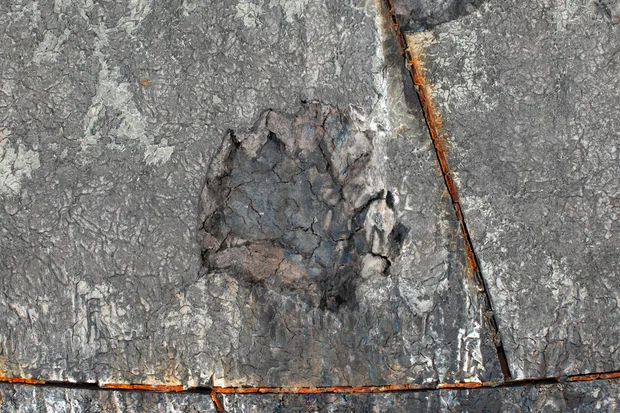
heat-shield-char-loss-2-foia.jpg
A closeup of the Artemis I heat shield shows an area where a chunk of the outer layer was blown off during entry in 2022. NASA

The outer char layer is "the only part of the Artemis I and Artemis II heat shield that actually allows it to breathe, or allows it to off-gas. So once it stops, now there's no mechanism in the deeper parts of the heat shield for that gas to escape," he said.

"So the pressure built up, and as the capsule came back down and started reheating, the pressure was already there.

"All those cracks, the pockets had already formed. And now, bang, bang, bang, pop. Avcoat started sloughing off during that second entry," the engineer said. 

A modified reentry trajectory should solve the problem

Engineers verified in lab tests that a modified skip-entry trajectory — one with an initial dip into the upper atmosphere followed by a shorter-duration climb back out — would allow the Avcoat to "breathe" throughout, preventing the formation of cracks and trapped gas. An independent review team agreed with those conclusions.
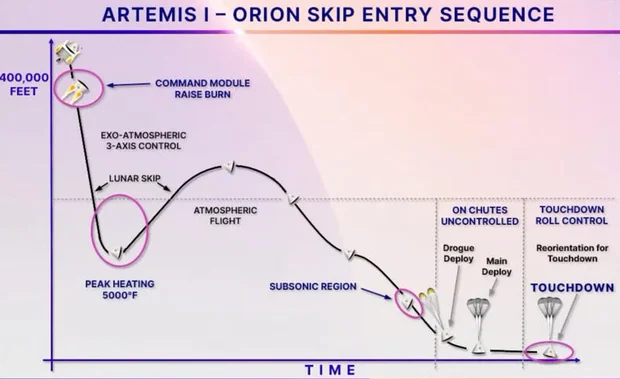
skip-entry.jpg
The unpiloted Artemis I flight used a "skip" reentry trajectory in which the Orion crew capsule dipped into the atmosphere, skipped back up, and then made its final descent. NASA

Interestingly, Apollo engineers were aware of the Avcoat permeability issue and designed that program's heat shields accordingly. Apollo capsules also used skip reentry trajectories and had no problems. But the Avcoat used in the Artemis heat shields was reformulated slightly, and that ended up affecting its permeability. 

In any case, the downside to the modified reentry trajectory for Artemis II will reduce the distance the Orion capsule can fly to avoid bad weather in the planned splashdown zone. It will also result in higher sustained heating during the descent, but engineers say that is exactly what is needed to maintain permeability in the outer char layer and ensure good performance. 

Former astronaut Charles Camarda disagreed, strongly criticizing the "fly as is" decision. He argues that engineers do not fully understand the root cause of the Artemis I heat shield damage and cannot accurately predict how the Artemis II heat shield will perform or whether the revised entry trajectory might have unintended consequences. 

In a letter to the NASA administrator, Camarda wrote that "history shows accidents occur when organizations convince themselves they understand problems they do not." 

Like Wiseman, Glover says he trusts the analysis of the Artemis I problem, saying critics "haven't been in these meetings from day one and met the team and looked them in the eye and shook their hands at the ends of these meetings."

That said, he added, "I don't want to discount the things that they've said. Any time you talk about fire, any time you talk about entry and heat shields, talk about parachutes, these are high-risk things that ... don't have fault tolerance built in. They have to work."

"And so I appreciate all of that nudging and poking and prodding that they've caused," Glover said. "They have made us sharpen our pencils and put more due diligence, more vigilance into that process. But I think we've done that. And so I think the crew is comfortable because of that team."

In: