








It's a fairly safe bet that most kids taking piano lessons don't like them. That was certainly my experience; I took piano from age 5-12 before quitting in frustration. The scales and sheet music and strict teacher just got the best of me.
Now along comes a piano teacher named Payam Khastkhodaei. The 32-year-old son of Iranian immigrants says he's come up with a new method of teaching that has students loving their piano lessons.
What makes this near-unknown worth a 60 Minutes story? Well, his students are sweeping national competitions. He's won over a legendary tech innovator and an Oscar-winning composer. They'll both tell you why they've joined his musical revolution, but we think you ought to hear from Payam first.
Payam Khastkhodaei: Piano's not supposed to be fun. It's supposed to be strict, it's supposed to be stressful, it's supposed to be, like, this very intense instrument you're learning. And we're like, "Why? Like, why can't it be fun? Why can't we actually enjoy the songs we're learning? Our students don't just learn piano, they love piano. And that's one of the biggest keys to it.
Payam Khastkhodaei: Can you play a little bit for me right there? Same spot. Now, can you play a little game? Can you show us how you can play without looking? You wanna look up? Yeah? Let's look up and play.
In nearly every room of a converted home in the Seattle suburb of Bothell, Washington, Payam and his team of young teachers – all former students of his – are giving piano lessons, and having fun.
Students are charged between $75 and $100 per lesson, and range from pre-school beginners to high school talents.
Bill Whitaker: Wow.
Payam Khastkhodaei: High five. Amazing.
Bill Whitaker: Wow.
Bill Whitaker: How long have you been practicing that?
Curterney Wong: I think for four-ish weeks–
Bill Whitaker: Four weeks?
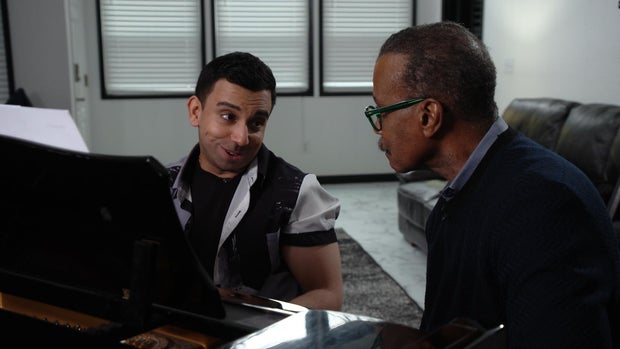
Payam Khastkhodaei: In piano we have this thing called the diploma which is sort of like the black belt of the musical world. Traditionally, about 1% to 2% of students reach diploma level, and it takes them about 12 years. In our school, 96% reached it and it takes them about four years.
Bill Whitaker: I can hear the traditionalists saying, "Hold on a minute. It can't be that easy. It can't be that fun. I mean, in order to be a really good pianist, you've gotta have discipline, you've gotta have hard work, you've gotta have rigor." Are they wrong?
Payam Khastkhodaei: I agree and disagree. Of course nobody will become phenomenal at anything unless they actually put in the time and energy. But when you actually enjoy what you're doing, you don't realize that you're putting in the time for that.
Bill Whitaker: So they love it first.
Payam Khastkhodaei: They love it first.
The Payam Method begins not with sheet music but with ABC's and 123's, and with actually writing numbers on piano keys.
Payam Khastkhodaei: This is a song I would teach my three-year-old student that would come into class one day. And we understand this is one, this is five. They're not reading notes. They're not even sometimes looking at sheet music. We're playing a game. And it's fun for them. Because they'll go one, two, three. And then I'll say, "Good job. Let's go one, one, two, five." And then they'll think and they'll go. And what they're doing is building this coordination.
…And using tools they already know – numbers and letters – to learn a new language — the language of music.
Payam Khastkhodaei: For example, I really want to learn Chinese. If somebody put a book in front of me that was in Chinese, my brain would just--
Bill Whitaker: Lock up.
Payam Khastkhodaei: Exactly.
Bill Whitaker: Like mine would.
Payam Khastkhodaei: And I'd have no idea what I'm doing. But if they taught me using a language I know, which is ABCs and one, two, threes, it would make sense. I'd be like, "Oh, I learned it. And then I'm just mapping it out."
And just as students of Chinese eventually learn Chinese characters, Payam's students do shift to sheet music as they move through the 18 levels of his curriculum.
Bill Whitaker: How long does it take to go from this to this?
Payam Khastkhodaei: This is our level two. This is our level 13. This would take about a year and a half to two years for students. And during all that time, you're learning songs that you actually enjoy.
Hans Zimmer: The operative word in music is, after all, play. So be playful.
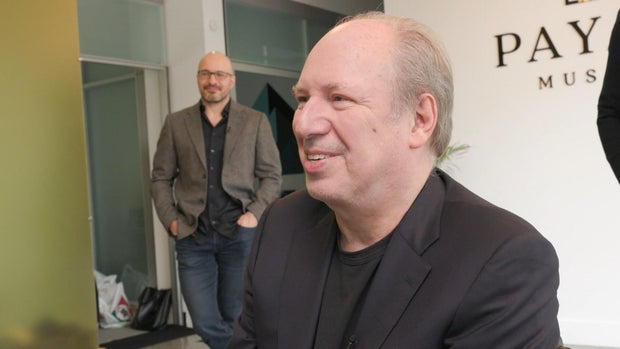
Hans Zimmer has written the musical scores for more than 150 films. He's been nominated for 12 Oscars and won two, including for his score for the "Lion King." But before he was a renowned composer and performer, he was a frustrated music student.
Bill Whitaker: You had an unconventional-- music education. Is--
Hans Zimmer: I had an unconventional education to say the least. Eight schools-- asked me to leave. I left with pleasure.
Bill Whitaker: Is that the-- the-- the playfulness, the unconventionality of-- of the education, is that what drew you to Payam and his method?
Hans Zimmer: Yes, absolutely. I mean, you know, it-- it's exactly what I wish I could've had.
Most of Payam's students don't aspire to be concert pianists, and his playful approach seems to have them loving their lessons. But what really sets him apart is that he's also teaching them to compose their own original songs at very young ages. Delara is just 12.
Payam Khastkhodaei: This is your third composition you've written?
Delara Rahmatian: Yeah.
Bill Whitaker: This is your composition?
Delara Rahmatian: Yeah--
Bill Whitaker: Oh, that's excellent.
Payam wrote this, his first original song, when he was 9-years-old, as a gift for his newborn sister.
At age 11, he entered a different original composition into an arts competition sponsored by the National PTA.
Payam Khastkhodaei: The first composition competition I ever entered was the PTA Reflections program. And I won.
Bill Whitaker: So you have students now--
Payam Khastkhodaei: Yes. Many.
Bill Whitaker: --who perform and write for this very same competition.
Payam Khastkhodaei: Exactly.
Bill Whitaker: How have they done?
Payam Khastkhodaei: Phenomenal. The best I ever did in the competition was win second place at state. And I thought that was the biggest achievement in the world. In 2024, we submitted 41 of our students to compete in the Reflections competition. There was 300,000 nationwide. So we made up a very, very small portion of them. But we won 13 out of 15 district winners, we won five out of five Washington State first place winners. And then those five students went on to compete nationally and four of them won four of the 14 national medals that were awarded.
Bill Whitaker: Wow.
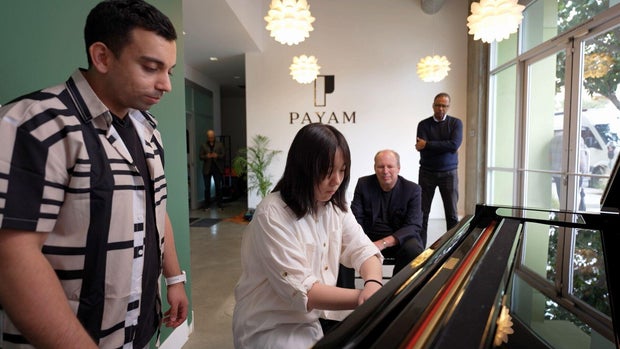
Even when they're learning other peoples' compositions, Payam's students are encouraged to play around with tempo and style and mood.
Bill Whitaker: That is not how I learned piano at all--
Payam Khastkhodaei: It's not how I learned it either--
Bill Whitaker: There's a certain way to do it. You better do it that way.
Payam Khastkhodaei: Exactly. That's what we're trying to change about the musical world.
Hadi Partovi: On day one, I said, "I want to help scale this thing."
Hadi Partovi met Payam when his then-12-year-old son Darius enrolled in piano lessons. Partovi is the co-founder and CEO of code.org, a nonprofit that has a free online platform that millions of teachers have used to teach the basics of computer coding to hundreds of millions of kids.
Hadi Partovi: There's a lot of parallels between Payam Music and Code.org. One is, we don't teach coding with ones and zeros or, you know, angle brackets and semicolons. We teach it with blocks and dragging and dropping to make it easier. Similarly, Payam Music teaches music starting with ABCs and 123s before you learn the code of how music is written.
So Hadi Partovi is now CEO of Payam Music, with the goal of taking this tiny school – now with just a few hundred students – national.
Bill Whitaker: So the plan is to open Payam schools all across the country?
Hadi Partovi: That's correct.
Partovi has raised money to fund the expansion from an impressive list of investors, including film composer Hans Zimmer.
Bill Whitaker: What made you decide to not just-- recognize Payam's method and what he's doing, but to actually invest in it?
Hans Zimmer: To this day, I just remember these piano lessons as being horrible. And here's a man who figured out a way of giving children this opportunity to have absolute happiness, you know? To love music and love themselves.
Zimmer visited Payam's first new location, in Santa Monica, California, and listened to star pupils play their compositions, including Hadi Partovi's son Darius, now 19.
Hans Zimmer: I'd love to hear the piece slightly slower. Just breathe with it more.
Hadi Partovi: With my son-- I didn't even realize-- that he was writing music until one day I was like, "Oh, w-- whose piece are you playing?" And he was like, "I'm just making it up as I go." And I was like, "What?
Bill Whitaker: Do you have to, or how do you convince the music establishment, music school instructors that what you've got here is something special?
Hadi Partovi: Over time we'll be able to convince the music establishment that this new way of teaching is better. But right now, we just need to convince parents. And the easiest way to convince parents is when they watch their son or daughter fall in love with music.
Shahrzad Salestani: Best decision I-- I-- I made.
Bill Whitaker: The best decision you made–
Shahrzad Salestani: The best decision I made.
Saswati Sanyal: Yes.
Shahrzad Salestani: Definitely.
Shahrzad Salestani's daughter Eilee is 9. Saswati Sanyal's daughter Aaniya is 15, and Julia Ying's son Jonathan is away at college after years of lessons at Payam Music.
Julia Ying: It is life-changing for Jonathan.
Bill Whitaker: In what way?
Julia Ying: In the way that learning can be fun.
Saswati Sanyal: So I see my daughter, Aaniya, to be more confident. And you feel good about yourself. So that is really different about this school.
Bill Whitaker: So they're all having fun.
Shahrzad Salestani: But they're learning.
Saswati Sanyal: But they're learning.
Bill Whitaker: They want to work hard at the piano?
Shahrzad Salestani: It's contagious.
Payam Khastkhodaei: Gimme high five dude.
Bill Whitaker: Wow.
Payam Khastkhodaei: Amazing.
Bill Whitaker: Wow. That was fantastic.
Bill Whitaker: So to the skeptics you say?
Payam Khastkhodaei: Try it once and you'll understand.
We couldn't resist a piano lesson, 50 years after my last one.
Bill Whitaker: Back up here?
Payam Khastkhodaei: Exactly. Perfect. And then last one. You did it. That was it, finished level two. Amazing.
Bill Whitaker: How about that?
Produced by Rome Hartman. Associate producer, Matthew Riley. Broadcast associate, Mariah Johnson. Edited by Sean Kelly.
In: