


/ CBS News
We may receive an affiliate commission from anything you buy from this article.
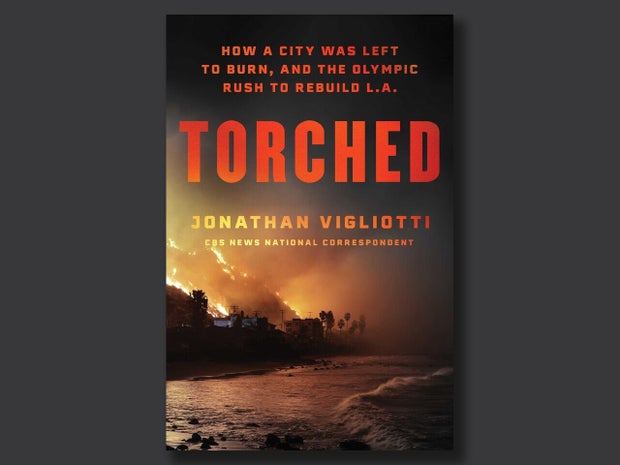
In his new book, "Torched: How a City Was Left to Burn, and the Olympic Rush to Rebuild L.A." (to be published May 12 by One Signal/Atria Books), CBS News national correspondent Jonathan Vigliotti, who covered last year's catastrophic wildfires that destroyed thousands of homes and businesses in Southern California, writes of the warning posed by the inadequate response – to the fires, as well as to the daunting task of rebuilding.
Read an excerpt below, and don't miss Jonathan Vigliotti discuss the rebuilding of Los Angeles on "CBS Sunday Morning" May 10!
"Torched" by Jonathan Vigliotti
Prefer to listen? Audible has a 30-day free trial available right now.
Optical Illusion
The mahogany-colored sandstone and shale cliffs that tower over the Pacific Ocean resemble a wall of massive tree trunks, chiseled by thousands of years of wind, rain, and surf. The optical illusion reminded early settlers of the blockades of wooden stakes, or palisades, built around forts to ward off threats. It was the perfect name for a new town that would test the limits of American ingenuity against some of the most extreme environmental conditions in the West.
Pacific Palisades first broke ground on its clifftop perch in the early 1900s. Developers advertised the rugged mesa, framed by the Santa Monica Mountains to the east and the ocean to the west, as an escape from the dust and noise of the growing city of Los Angeles. A paradise "where the mountains meet the sea." Though the Palisades was just eighteen miles from Downtown Los Angeles, reaching it in those days was an all-day journey with horse-drawn carriages navigating rough dirt and gravel roads. From the beginning, the Palisades, with its Mediterranean climate and jagged coastline, lured the most adventurous of settlers, each generation reshaping it in its own image.
First, it was a Hollywood frontier, with a studio executive turning the jagged mountains into the home of a pioneering movie studio that filmed America's first Westerns. Then came the Methodists, seeking a utopia shielded from the excesses of the Roaring Twenties. They gave the Palisades its name and built the town's first modest bungalows in 1922. In the 1940s, it became a sanctuary for intellectuals and artists fleeing the Nazis. And by the turn of the twenty-first century, most of those tiny bungalows had been replaced by sprawling estates—fortresses for the entertainment elite, where Oscar trophies adorned mantels and wealth guarded from disaster.
The Palisades was proof man could tame America's wildest land and nature would obey. But that too, like the wooden stakes the town was named after, was all just an illusion.
January 7, 2025, marked the reckoning.
The first plume of smoke snaked into the sky over the Santa Monica Mountains before 10:29 a.m. "Resources are responding to a vegetation fire with smoke visible in Temescal Canyon," a voice crackled over emergency radios. Residents, phones in hand, filmed flames licking up the hillside. The site was achingly familiar: A blackened patch of chaparral, scarred by fireworks one week prior, now harboring a renegade ember that for days smoldered in secret. A silent assassin. A light breeze found it, fanned it, and soon the air tasted of ash.
Fire crews didn't arrive fast enough. That was the first domino. Without a line in the hills, the fire ran downslope and jumped to homes unchecked through the cul-de-sacs below. It advanced into Floresta Place, Bienveneda Avenue, and La Puerta del Sol — streets the Los Angeles Fire Department had long deemed non-defensible if flames breached and gained hold. With no guidance from officials, residents self-evacuated. Sunset Boulevard seized in gridlock as cars stacked nose to tail. When fire engines finally came, they couldn't get through.
"Civilians abandoning cars are impeding firefighting operations. Shelter in place at the top of Palisades Drive," a radio call pleaded. Panic had already set in. Sunset and the other arteries became metal chokepoints; engines were rerouted or turned back. With each blocked road, another neighborhood went unreachable. The Palisades was on its own.
Residents who stood their ground held back forty-foot flames armed with only garden hoses. "Where are the firefighters?" they yelled as the inferno fed on dry chaparral and eucalyptus — vegetation so flammable it might as well have been soaked in gasoline. By nightfall, 100-mile-per-hour winds howled through the canyons.
What began as a brush fire fused into a single, town-eating front. A midnight plume visible from space rolled and heaved above it. At its peak, the fire chewed through five football fields a minute. For three full days, the fire tore through the heart of town before sufficient backup arrived to drive it into the hills, where it smoldered and flared for weeks.
When the smoke lifted, the disaster left a ledger — four in five structures lost; neighborhoods and the business core pressed flat into a grid of ash and mangled steel. The Palisades, its homes, and its overwhelmed defenses had been built for a climate that no longer exists. Nearly half of American houses predate 1980, before today's era of megafires, floods, and hurricanes. Yet even modern building codes lag behind the pace of warming. Leaders still permit and subsidize construction in the riskiest places, while first responders are left to hold the line with aging engines, thin crews, and tactics designed for a milder past.
"As hard as rebuilding housing is, real change — real lasting, structural change — that's even harder. And it takes courage to experiment with new ideas and change the old ways of doing things. That takes time," said President Barack Obama in New Orleans on the tenth anniversary of Hurricane Katrina.
No such words were ever spoken following the fire in Pacific Palisades. In fact, while winds still howled and the fire still burned, officials faced the cameras and blamed the wind and the drought. They said nothing about the dozens of homeowners who held the lines on their own, or the private crews that stopped flames where public engines never arrived. Owning that would have exposed the city's mistakes — and the chain reaction they set off.
The truth is, much could have been done to stop this fire and much must be done before the next one arrives. I know this because I was there. Not after the fact. Not once it was safe. My team and I were among the first journalists on the ground after the fire started, and one of the only ones who stayed through the critical first four days — watching, recording, pulling dogs from burning homes because no one else was there to do it.
I saw what the cameras didn't. The failures at every stage of the disaster response, from before the first spark to long after containment. The officials who hesitated. The resources that never came. The bureaucracy that burned right alongside the town. I bore witness to one of the costliest natural disasters in U.S. history — and to a recovery sustainability experts call deeply flawed and dangerously fast-tracked.
In the wake of the Palisades Fire, political archrivals tasked with the rebuild became strange bedfellows, tethered to the same torch. It looked like bipartisanship. It wasn't. The unity came not in service of public safety, but at its expense. Personal legacy prevailed.
This book exists because the Palisades could have been saved and there are actions communities still standing can take right now to fight off a similar fate. If there is any hope of preventing the next catastrophe, we must learn from this one.
Pacific Palisades isn't just a California disaster. It's a global warning. A parable of what happens when we fail to adapt to a changing world — and when the leaders in charge rewrite history. Or worse — cover it up.
"The short memories of American voters is what keeps our politicians in office," once wrote Will Rogers — actor, social critic, and longtime resident of Pacific Palisades. One can only imagine what he would've said about the political theater that unfolded in the ashes where his home once stood, a historic landmark for more than a century, before the flames arrived.
Copyright © 2026 by Jonathan Vigliotti. From "Torched" by Jonathan Vigliotti, published by One Signal/Atria Books, an imprint of Simon & Schuster, Inc. Reprinted by permission.
Get the book here:
"Torched" by Jonathan Vigliotti
Buy locally from Bookshop.org
For more info:
- "Torched: How a City Was Left to Burn, and the Olympic Rush to Rebuild L.A." by Jonathan Vigliotti (Atria/One Signal), in Hardcover, Large Print Trade Paperback, eBook and Audio formats, available May 12
In: