


/ CBS News
You've no doubt heard by now that Elon Musk has been tasked with slashing the federal budget. His symbolic weapon of choice: a very large chainsaw. An early target: The U.S. Agency for International Development (or USAID). Charging waste, fraud and abuse at the agency, the world's richest man is leading a campaign that will cut assistance to some of the world's poorest people. "USAID is a criminal organization. Time for it to die," Musk wrote on X.
That theme comes from the top. On Feb. 11, 2025, President Trump said, "The USAID is really corrupt, I'll tell you. It's corrupt. It's incompetent and it's really corrupt."
And White House press secretary Karoline Leavitt told reporters, "I don't know about you, but as an American taxpayer, I don't want my dollars going towards this crap."
No worries: the administration is effectively dissolving the agency, cutting thousands of staff and billions in aid, and merging what remains with the State Department. Changes are still underway, but the message is clear: the U.S. has new priorities.
David Miliband was British foreign secretary and a Member of Parliament. For the past 12 years he's been president and CEO of the International Rescue Committee. The IRC delivers humanitarian aid to some of the most vulnerable people in the world. So far, says Miliband, the cuts have affected about 40% of their international programs. "We're hearing two very different things from the administration," said Miliband. "One is that there are some areas of aid they're definitely going to cut. Education, out. Climate resilience, out.
"The second thing we're hearing is they want to review all aid that is life-saving, and they'll come back to us with conclusions about the future of the international aid program," he said.
Albert Einstein helped found the IRC in the 1930s to assist refugees from Nazi Germany. During the Cold War, they were looking for ways to pierce the Iron Curtain. It distributed a million pounds of butter to East Germans. Humanitarian aid? Certainly. But with a giant dollop of propaganda.
Seventy-odd years ago, it was butter in Berlin. These days, it's a life-saving paste for malnourished children provided at the five stabilization centers the IRC runs in Nigeria. The program's grant was initially terminated, then it received a waiver. But the grant ends in May, with no word about what's next.
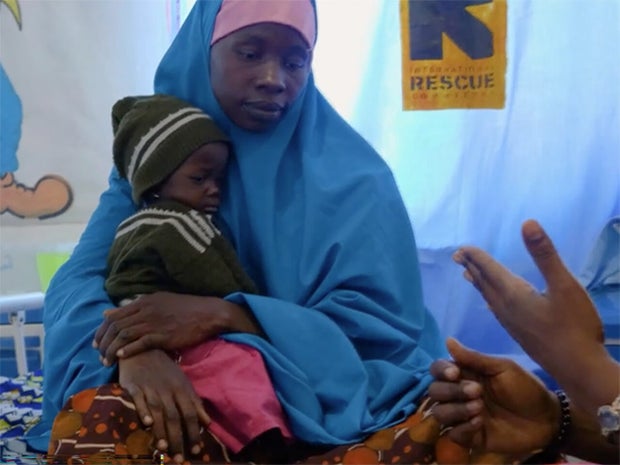
Cutting funding for a children's clinic like this one, program manager Dr. Okechi Ogueji told me, means that babies will die. "It will be catastrophic," he said. "We need every support from everywhere."
The IRC's stockpile of treatments in Nigeria is dwindling from an already-disrupted U.S. aid supply chain.
Miliband said, "I think people are scratching their heads, because they wonder: where is the American heart? And they wonder: how is that going to show itself in government policy?"
In the Afghan village of Bati Kot, outside Jalalabad, U.S. government policy comes sweeping in on alternating waves of good news and bad news. Dr. Shafiq Hashimi is the head of the clinic in Bati Kot, one of 22 clinics run by the IRC in Afghanistan, but significantly funded by USAID.
"Today alone, I registered five cases of measles, which is highly contagious," Hashimi said. "I see around 130 patients a day. I only pause for lunch and prayer."
Over the past few weeks, the U.S. grants for the clinics have been defunded, re-funded, and defunded again.
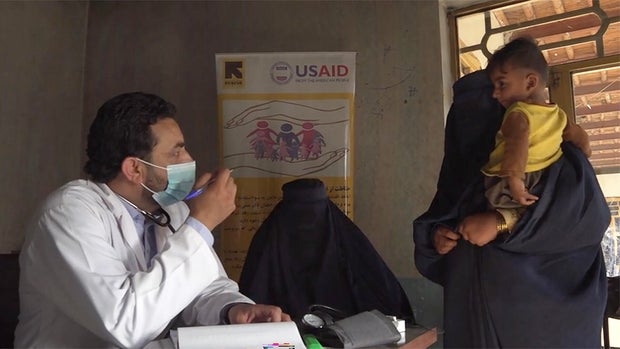
"The situation in Afghanistan ever since the stop-work orders from the U.S. government has created a sense of confusion amongst operational humanitarian organizations," said Sherine Ibrahim, the IRC's Afghanistan director in Kabul. "It has also set panic within communities that have relied on humanitarian support for many years. And it has compromised our relationships with the authorities that exist today in Afghanistan. It has compromised our ability to ensure acceptance within communities who ask us, 'Why is this happening?'"
One woman told us, "If this support is stopped, the condition of poor people like us will worsen, possibly even leading to death. Your support has changed our lives."
On Jan. 27, in a speech to the Congressional Institute, President Trump said, "We get tired of giving massive amounts of money to countries that hate us, don't we?"
The State Department made that position official, telling "CBS Sunday Morning": "The Afghanistan grants have been terminated based on credible concerns that U.S. money was benefitting the Taliban."
[See below for more of the State Department's statement.]
I asked Ibrahim, "The question is being reframed by the American government: Why help people who are our declared enemies? Why do that?"
"I believe that it is in the interests of the global community to stabilize countries," she replied, "to ensure that their populations are living in dignity, and that people do not seek a dignified living elsewhere."
"I want to make sure that people fully understand what you just said: I know there are many people in the United States who say, 'All these illegal aliens, we've gotta find a way to stop the flood.' And you're saying part of the answer is to make things livable in the countries from which they come?"
"Absolutely," Ibrahim replied. "And not just livable, but in places where people can thrive. And I do believe that there is a benefit to the United States, and to the global community, for us to continue that investment."
That is not the Trump administration's position.
Earlier this month, Secretary of State Marco Rubio told a press conference at NATO headquarters in Brussels, "We're not the government of the world. No, we'll provide humanitarian assistance, just like everybody else does, and we will do it the best we can. But we also have other needs we have to balance that against."
I asked Miliband, "The idea that we have a lot of suffering going on in this country, a lot of poverty, a lot of illness – why not take care of our own first?"
"I think that the administration definitely believes that charity begins at home, and I don't argue with that," Miliband said. "My argument is: Charity shouldn't end at home. And international aid is 0.2% of the U.S. economy, not 25% of federal spending. It's a strategic investment, it's a moral investment, and it's an impactful investment."
Because? "If you've got people in need, and you can help them and you don't, it's a sin," Miliband said. "But also, when you don't help people in need, instability follows. We know that as much as night follows day. And problems that start in a faraway part of the world don't stay in a faraway part of the world. It's been true throughout history for the movement of people. Today it's true for health insecurities. We learned that in the pandemic. If we think that we can only solve our own problems without solving other people's problems, we're gonna run into trouble."
State Department Comment
The following statement was provided to "CBS Sunday Morning" by a senior State Department official:
Under President Trump and Secretary Rubio, U.S. foreign assistance will be transformed into a short-term, targeted, and transactional force that fiercely prioritizes America's interests, delivers undeniable benefits to our nation, empowers self-reliance, and builds strategic partnerships to advance our national security and global influence.
The Department of State and USAID take their role as stewards of taxpayer dollars very seriously. The implementation of President Trump's Executive Order on Reevaluating and Realigning United States Foreign Aid and the Secretary's direction furthers that mission. As Secretary of State Marco Rubio has said, "Every dollar we spend, every program we fund, and every policy we pursue must be justified with the answer to three simple questions: Does it make America safer? Does it make America stronger? Does it make America more prosperous?"
Consistent with Secretary Rubio's statements, USAID's continuing programs advance the core national interests of the United States. For example, USAID continues to support the U.S.- coordinated, interagency response to the Ebola outbreak in Uganda; to provide lifesaving HIV care and treatment services; to provide emergency assistance in conflict zones; and to support key American strategic partners.
Ensuring we have the right mix of programs to support U.S. national security and other core national interests of the United States requires an agile approach. We will continue to make changes as needed.
Life-saving Humanitarian Aid Continues
As Secretary Rubio said, "We are reorienting our foreign assistance programs to align directly with what is best for the United States and our citizens. We are continuing essential life-saving programs and making strategic investments that strengthen our partners and our own country."
This transition is focused on improving accountability and strategic coordination – not eliminating our commitment to vulnerable populations and allies. Critical, life-saving programs have continued uninterrupted as we strengthen how, where, and why we deliver humanitarian aid to ensure it serves those who need it most.
For example, USAID has multiple active contracts for ready-to-use therapeutic food (RUTF) production and several shipments pending routine checks with the interagency, including nearly $300 million in active humanitarian assistance related awards in Nigeria at this time. Additionally, USAID has previously purchased RUTFs, and is making determinations on where to ship.
PEPFAR Continues
PEPFAR's care, treatment, and PMTCT services are operational for 85% of beneficiaries. We resolved the critical bottleneck in our commodity program by completing payments to our central procurement and distribution implementing partner. For the remaining 15% of beneficiaries, State and USAID are working to rebalance awards, discontinuing non-priority activities to focus on core life-saving services. We are enhancing service delivery efficiency and advancing PEPFAR partner countries toward self-reliance, with notable progress in the last two months.
Support for the World Food Program Continues, while Funds Benefiting Terrorist Groups Ends
USAID has terminated less than 15% of WFP awards, maintaining over 100 active programs with WFP, a key partner. Terminations, including programs in Yemen and Afghanistan, were due to credible, longstanding concerns about funds benefiting terrorist groups like the Houthis and Taliban, or because they did not align with America First priorities.
Additional awards in Afghanistan, including awards targeting healthcare, were terminated based on longstanding and credible concerns that U.S. foreign assistance funding was benefiting the Taliban, a Foreign Terrorist Organization.
Communication With and Support for USAID Personnel Continues
Like any restructuring, there will inevitably be disruptions. From Secretary Rubio down, we are committed to ensuring that USAID personnel remain safe and that the Agency's ongoing life-saving aid programs remain both intact and operational.
State and USAID leadership are focused on providing the smoothest transitions possible to minimize disruption and ensure the continued safety and wellness of our personnel, and the orderly repatriation of colleagues posted overseas.
All overseas personnel will receive a USAID-funded return PCS, with a departure date that will be considered as the employee's end-of-tour date. No employee benefits, including pension or retirement benefits, have been impacted during this period, nor will they be affected through the point of separation.
There is a process in place to request reasonable and medical accommodations, which employees have already been doing. This process has been spelled out in communications to employees, as well as follow up notices and documents.
The Secretary of State has taken extraordinary action to ensure that USAID personnel and their family members on medical evacuation status (including for obstetric care) can complete that medical evacuation before being separated. For expectant mothers, the regulations allow for 45 days before the expected delivery date and end 45 days after delivery, or potentially longer when there is a documented neo-natal or maternal complication (or other medical need).
While overseas, USAID personnel will remain under Chief of Mission authority, and will retain full access to the Medical Unit, DPO/Pouch, and Post-provided housing until their official departure date.
Reduction in Force (RIF) letters outlined a process for correcting potential errors, acknowledging the possibility of inaccuracies. Letters noted that the information reflects what is currently on file and encouraged employees to report any inaccuracies. Benefits will be based on official personnel records, not the letter, once updates are made.
Story produced by Dustin Stephens. Editor: Ed Givnish.
In: