









A federal judge must reconsider the possible national security implications of halting construction of President Trump's $400 million White House ballroom, a federal appeals court ruled on Saturday.
A three-judge panel from the U.S. Court of Appeals for the District of Columbia Circuit said it did not have enough information to decide how much of the project can be suspended without jeopardizing the safety of the president, his family or the White House staff.
The case was returned to the trial judge, who, in a March 31 ruling, barred work from proceeding without congressional approval, but suspended enforcement of that order for 14 days. The appeals court extended that for three days, to April 17, to allow the Trump administration to seek Supreme Court review.
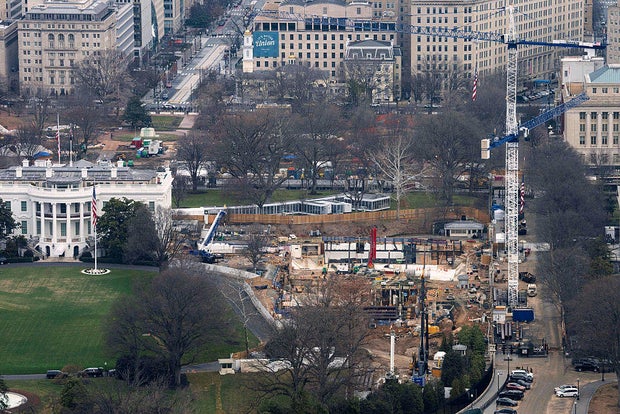
The panel instructed U.S. District Judge Richard Leon to clarify whether — and how — his injunction interferes with the administration's plans for safety and security.
Government lawyers had argued that the project includes critical security features to guard against a range of possible threats, such as drones, ballistic missiles and biohazards, and that holding up construction "would imperil the President and others who live and work in the White House."
Leon, in issuing the temporary pause, concluded that the preservationist group behind the legal challenge was likely to succeed because the president lacks the authority to build the ballroom without approval from Congress.
Leon exempted any construction work necessary to ensure the safety and security of the White House, but said he reviewed material the government privately submitted before determining that a halt would not jeopardize national security.
The Republican administration's appeal cited materials that would be installed to make a "heavily fortified" facility and said construction included bomb shelters, military installations and a medical facility underneath the ballroom.
The appeals panel noted that much of the government's concerns focused on that below-ground security work, which the White House argued was "distinct from construction of the ballroom itself and could proceed independently."
Now, however, the White House seems to suggest those security upgrades are "inseparable" from the project as a whole, the appeals court said, making it unclear "whether and to what extent" moving forward with certain aspects of the ballroom is necessary for the safety and security of those upgrades.
Carol Quillen, president and CEO of the National Trust for Historic Preservation, said in a statement that the organization awaited further clarification from the district court. She said the group was committed "to honoring the historic significance of the White House, advocating for our collective role as stewards, and demonstrating how broad consultation, including with the American people, results in a better overall outcome."
The organization sued in December, a week after the White House finished demolishing the East Wing for a 90,000-square-foot (8,400-square-meter) ballroom that Trump said would fit 999 people. The administration said aboveground construction on the ballroom would begin in April.
Leon concluded last month that the lawsuit was likely to succeed because "no statute comes close to giving the President the authority he claims to have."
"The President of the United States is the steward of the White House for future generations of First Families. He is not, however, the owner!" wrote Leon, who was nominated by President George W. Bush, a Republican.
Two days after Leon's ruling, the ballroom project won final approval from a key agency that Mr. Trump had stocked with allies. Another oversight entity constituted with Trump loyalists had approved the project earlier this year. But the president had proceeded with the biggest structural change to the White House in more than 70 years before seeking input from the commissions.
Mr. Trump says the project is funded by private donations, although public money is paying for the construction of underground bunkers and security upgrades.
The three-judge appeals court panel was made up of Patricia Millett, Neomi Rao and Bradley Garcia. Millett was nominated by President Barack Obama, a Democrat. Rao was nominated by Mr. Trump. Garcia was nominated by President Joe Biden, a Democrat.
Rao wrote a dissenting opinion, which cited a statute that allows the president to undertake improvements to the White House.
"Importantly, the government has presented credible evidence of ongoing security vulnerabilities at the White House that would be prolonged by halting construction," Rao wrote, adding that such concerns outweigh the "generalized aesthetic harms" presented in the lawsuit.
In: