
惯性聚合 高效追踪和阅读你感兴趣的博客、新闻、科技资讯
阅读原文 在惯性聚合中打开

推荐订阅源

WordPress大学
WordPress大学
Vercel News
Vercel News
博客园_首页
Y
Y Combinator Blog
美团技术团队
Cyber Security Advisories - MS-ISAC
阮一峰的网络日志
阮一峰的网络日志
aimingoo的专栏
aimingoo的专栏
H
Hackread – Cybersecurity News, Data Breaches, AI and More
MyScale Blog
MyScale Blog
GbyAI
GbyAI
人人都是产品经理
人人都是产品经理
T
Tailwind CSS Blog
MongoDB | Blog
MongoDB | Blog
D
DataBreaches.Net
博客园 - Franky
Engineering at Meta
Engineering at Meta
量子位
The GitHub Blog
The GitHub Blog
F
Fortinet All Blogs
freeCodeCamp Programming Tutorials: Python, JavaScript, Git & More
钛媒体:引领未来商业与生活新知
钛媒体:引领未来商业与生活新知
酷 壳 – CoolShell
酷 壳 – CoolShell
N
Netflix TechBlog - Medium

Home - CBSNews.com

"48 Hours" schedule: Live, DVR, and on demand Rory McIlroy wins second straight Masters Tournament Brian Hooker sent friends maps that he says show where his wife went missing in Bahamas Iran's parliament speaker says U.S. will be "nostalgic" for $4 gas as oil prices fuel inflation Democratic Rep. Eric Swalwell ends bid for California governor as he faces sexual assault allegations Trump says U.S. will blockade Strait of Hormuz after Iran peace talks collapse DHS looking into allegations Rep. Eric Swalwell hired nanny not authorized to work in U.S. Fallout from Eric Swalwell scandal grows as lawmakers eye House expulsion votes Rory McIlroy claims second straight Masters title Brian Hooker shared maps he says show where his wife went missing in the Bahamas Manhattan DA investigating sexual assault allegations against Rep. Eric Swalwell Extended interview: Sen. Dave McCormick on AI Trump says U.S. will blockade Strait of Hormuz and intercept ships that paid tolls to Iran Few see U.S. goals being met in Iran yet; Americans voice worry and stress in CBS News poll Hungarian Prime Minister Viktor Orbán concedes defeat in key election, ending 16 years in power Ukraine, Russia accuse each other of violating Putin's Orthodox Easter ceasefire Kimberly Langwell's Hidden Grave Decades after a Texas mom's disappearance, a tip leads to the location of her secret grave Kids, adults alike watch Artemis II crew's splashdown in San Diego JD Vance says U.S. and Iran did not come to a deal after marathon session Artemis II astronauts welcomed home to Houston after historic moonshot Artemis II crew returns to Houston after successful mission Artemis II astronauts speak publicly for first time since successful moon mission Federal appeals court sends White House ballroom construction lawsuit back to lower court Pope Leo criticizes "idolatry of self" in latest rebuke of Iran conflict: "Enough with war!" Iran reportedly proposes tolls for ships crossing Strait of Hormuz How Persian Gulf nations are reacting to the U.S. and Iran's temporary ceasefire U.S. naval destroyers have crossed the Strait of Hormuz, CENTCOM says Trump says U.S. is "clearing out" the Strait of Hormuz as U.S., Iranian officials meet in Pakistan Risk on the Road | Sunday on 60 Minutes
NASA spacecraft to fly past Mars this week, on voyage to ...
Emily Mae Czachor · 2026-05-14 · via Home - CBSNews.com

By

Emily Mae Czachor

News Editor

Emily Mae Czachor is a reporter and news editor at CBSNews.com. She typically covers breaking news, extreme weather and climate. Emily Mae previously wrote for outlets like the Los Angeles Times, BuzzFeed and Newsweek.

Read Full Bio

/ CBS News

Add CBS News on Google

A NASA spacecraft headed toward the asteroid belt will fly past Mars on Friday, aiming to get a boost from the planet's gravitational field and save some of the propellant it needs to complete the second half of a six-year voyage.

The spacecraft, called Psyche after the rare asteroid it will explore, launched in October 2023. At the time, it set out on a 2.2-billion-mile journey to the metal-rich celestial rock, which scientists believe may hold clues about how the cores of planets like Earth initially formed.

Psyche will travel quite close to Mars, coming within just 2,800 miles of the red planet's surface at its nearest point, according to NASA. Slingshotting past at about 12,333 miles per hour, the spacecraft "will harness the planet's gravitational pull to speed up and adjust its trajectory" toward the asteroid, the agency said.

The asteroid that scientists have described as a "metal world" and "one of the more unusual objects in our solar system" sits in the asteroid belt between Mars and Jupiter. NASA's explorer is expected to approach and begin orbiting the ultimate target of its mission at the end of 2029.

But the spacecraft will take advantage of the opportunity to observe Mars in the meantime. The team operating it has already released an image of the planet from about 3 million miles away.
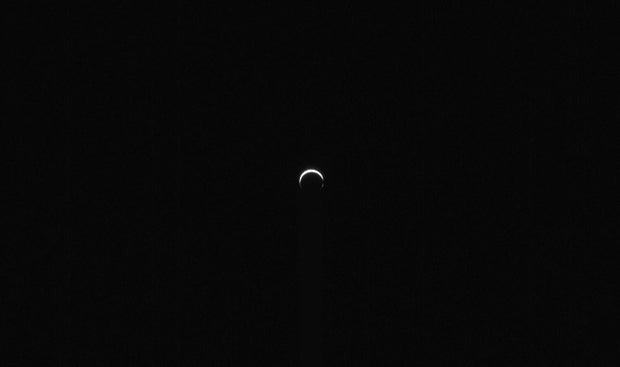
psyche-mars.jpg
This image of Mars was captured by NASA's Psyche mission on May 3, 2026, about 3 million miles from the planet. NASA/JPL-Caltech/ASU

NASA said the operators plan to use the observations taken during Friday's flyby to compile a time-lapse of the encounter. One of them, Jim Bell of Arizona State University, said in a statement that Mars may not have its characteristic reddish hue in some of the images, although he still anticipates they'll be "just plain beautiful."

The spacecraft will also be able to test a satellite feature that it could eventually use to search for objects in the asteroid Psyche's orbit.

"Ultimately, though, the only reason for this flyby is to get a little help from Mars to speed us up and tilt our trajectory in the direction of the asteroid Psyche," said Lindy Elkins-Tanton, a lead investigator on the spacecraft's operations teams, in another statement. "But if all our instruments are powered up, and we can do important testing and calibration of the science instruments, that would be the icing on the cake."

Only a small portion of the objects floating in the asteroid belt are believed to be rich in metal like the asteroid Psyche, which scientists believe contains nickel and iron. They suspect it may be the exposed core of a rocky planet, potentially offering insights the formations and evolutions of planets like our own, according to NASA's mission overview.

Once in the asteroid's orbit, NASA's spacecraft is slated to take pictures of the asteroid's surface and shed light on its composition, over the course of about two years.

William Harwood contributed to this report.

In: