





/ CBS News
When wildlife photographer Chris Fallows first ventured into the waters of False Bay, in Cape Town, South Africa, he saw a thriving community of great white sharks.
They would hunt the tens of thousands of seals that lived on a nearby rock called Seal Island. A decade ago, Fallows saw 250 to 300 different great white sharks a year there.
And with a little luck, you could see one of these majestic predators jumping out of the water, snatching its prey in its jaws while flying through the air.
Fallows' photographs of this behavior in great white sharks, called "breaching," are some of the most breathtaking of the natural world, capturing them in mid-flight, suspended above the water.
"To see a 1,000-kilogram great white shark come flying out the water, well, that's something very few people get to see, and certainly I never got tired of it," Fallows told 60 Minutes Overtime.
But about 10 years ago, the great white shark population began to mysteriously disappear. Sightings dwindled, and tourists stopped coming. Scientists and conservationists disagree over who, or what, the culprit is. But they all agree the sharks that once cruised those waters are now gone.
"It really showed to me just how fragile our planet is," Fallows told 60 Minutes Overtime. "It affected me very deeply, but it was also a catalyst to doing what I do today, to try and showcase what I've been so privileged to see."
Fallows spoke with 60 Minutes Overtime from his home in Cape Town about his renewed determination to protect and document the natural world after the great whites' disappearance, and shared the stories behind his remarkable images of wildlife.
Fallows' most well-known photograph is "Air Jaws": a dramatic black-and-white shot of a great white shark breaching, its jaws wide open, displaying razor-sharp teeth.
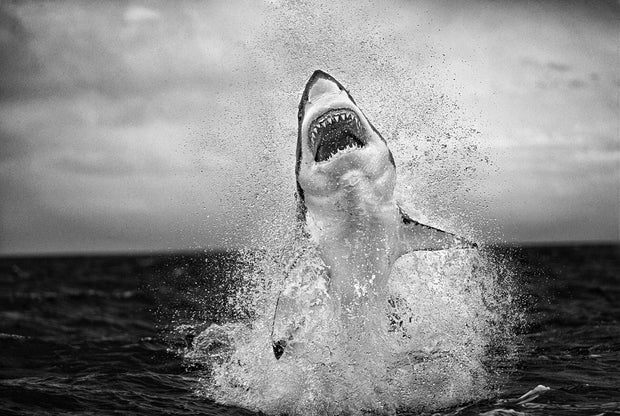
In 2001, Fallows took a boat out into the waters near Seal Island to try to capture a great white breaching.
"We'd been towing a [seal-shaped] decoy for around about an hour already, not having much success. But just something said to me, just keep your concentration and keep focused," the photographer told Overtime.
Suddenly, a great white shark leapt out of the water. Fallows' shutter clicked away. It was all over in about seven seconds. "And it was in the days of film. [I couldn't] look on the back of the camera and see if I'd nailed it."
"I waited the whole weekend, not knowing whether I'd kind of over-imagined this incredible image, whether it was going to be sharp… [on Monday] I walked into the lab, everybody was clapping," he told Overtime.
The photo was life-changing for Fallows. It was published in newspapers and magazines around the world, earning him global recognition and giving him a career shooting photographs of animals in the wild.
"It was a photograph that changed my life, and it gave me a fantastic start with my photography. And it… epitomizes the power and, I guess, predatory prowess of this incredible animal," he told Overtime.
Fallows would go on to take more photographs of great whites in the waters off Cape Town's coastline, diving into the waters without a shark cage to take photographs underneath the great white sharks as they swam by.
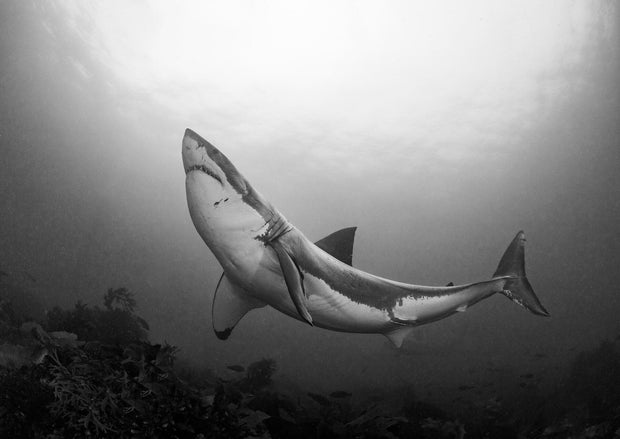
Fallows told Overtime that his wife, Monique, is a critical part of ensuring that he is safe while working with animals in their environment. To photograph great white sharks and other species, he typically dives without a cage.
"I'm incredibly privileged to… have an amazing partner in my incredible wife," he told Overtime, "[She] understands those animals' behavior, making what I do a little bit safer, but also best allows me to be in the right position to take a great shot."
Fallows said great white sharks, while feared by many people, are misunderstood. He says he's learned a lot by observing them up close.
"One of the most important educators and teachers for me was the great white shark, an animal that many people fear but I learned to love over the years," he told Overtime.
"I can truly say that I've never felt that the animals, you know, have been openly acting aggressively towards me… it's the tolerance of those animals to allow me in their space," he explained.
Fallows told 60 Minutes Overtime the story behind another image: a herd of elephants crossing a dried-up lake led by a large-tusked female.
"Sadly, we've got very few elephants with huge ivory [tusks] left. One of the places to see them is Amboseli National Park in Kenya," Fallows told Overtime. "I was very lucky to be in the right position at the right time, from a very low angle, very close to her."
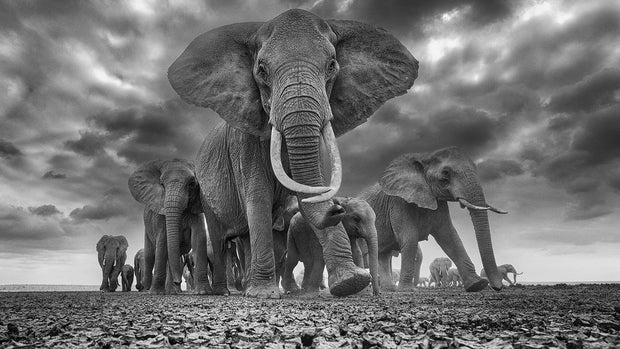
The photograph, named "Defiance," captures what he called a "tusker," or long-tusked elephant, a rare sight because elephants with tusks that long are often poached for their ivory.
"This incredible matriarch… defied the poacher's snare or the hunter's gun," Fallows told 60 Minutes Overtime. "And has somehow managed to keep her herd… both safe and sustained with food and water."
While the loss of great white sharks in coastal waters around Cape Town was "tragic," Fallows told Overtime the rebound of humpback whales gives him "hope."
Since a moratorium on commercial whaling by the International Whaling Commission went into effect in 1985, the global population of humpback whales has grown significantly.
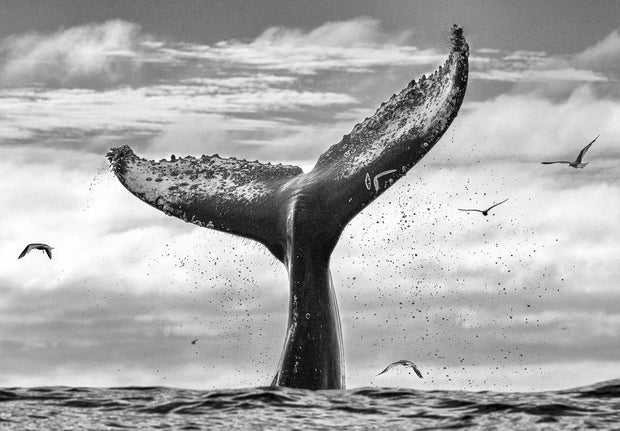
Fallows has seen the effects of this rebound himself off the coast of South Africa. "We now see groups of 150 or 200 together," Fallows said.
"And there can probably be no more sensorial experience than photographing [them]… you smell them, you see them, you hear them, you feel the whale breath on you," Fallows told 60 Minutes Overtime. "They touch you very deeply… It's truly incredible to be in the company of the largest creatures on the planet."
Chris and Monique Fallows have used profits from sales of Chris' photographs to finance conservation efforts, including their own.
In 2017, they purchased 61 acres in Cape Infanta, on South Africa's south coast, for habitat restoration. They're now in the process of purchasing a 26,500-acre property in Namibia for habitat restoration and to help increase the scale of wildlife corridors in the area.
Fallows told 60 Minutes Overtime that people can "tread more carefully" on the environment and create productive biodiversity areas by taking care of their "own little patch" of the world. One easy rule to follow: "Don't throw plastic in the water… I can't tell you how many times I've seen animals wrapped in plastic."
"All life depends on another form of life," Fallows told 60 Minutes Overtime.
"Great white sharks, elephants, lions, penguins, they all have their own little families and ecosystems in which they live… treat them with respect."
The video above was produced by Will Croxton. It was edited by Nelson Ryland. Jane Greeley was the broadcast associate.
Photos and videos courtesy of Chris Fallows, Jono Allen, Marisa Denton, and Warner Bros. Discovery.
In: