





/ CBS News
Rome — Pope Leo XIV issued a major document Monday focused largely on the implications of the rise of artificial intelligence for humanity, warning the technology could make civilization itself "less human."
Pope Leo, who has repeatedly clashed with the Trump administration over the Iran war and some U.S. officials' religious justification for it, also appeared to dismiss the argument that the conflict was a necessary preemptive measure for American safety.
"Today, more than ever, without prejudice to the right to self-defense in the strictest sense, it is important to reaffirm that the 'just war' theory, which has all too often been used to justify any kind of war, is now outdated," he wrote in his Magnifica Humanitas (Magnificent Humanity), an 82-page teaching known as an encyclical.
Leo also issued a first-ever apology for the Vatican's role in facilitating and justifying the transatlantic slave trade, calling it "a wound in Christian memory."
"For this, in the name of the Church, I sincerely ask for pardon," he wrote.
But the vast majority of the encyclical was devoted to what Leo clearly sees as humanity's risk-laden embrace of AI.
Pope Leo warns AI could make civilization "less human"
When the world's first U.S.-born pope chose his name last year, Leo deliberately invoked the last pope to bear it: Pope Leo XIII, whose landmark 1891 encyclical Rerum Novarum helped guide the Catholic Church through the upheaval of the Industrial Revolution.
More than a century later, the Chicago native attempted something similarly ambitious for the AI Revolution.
In the Magnifica Humanitas, the leader of the world's roughly 1.4 billion Catholics warned that artificial intelligence risked making civilization "less human," hollowing out work, concentrating wealth and reducing people to systems driven by data and efficiency rather than dignity and morality.
"The pressing duty," Leo wrote, is "to remain profoundly human."
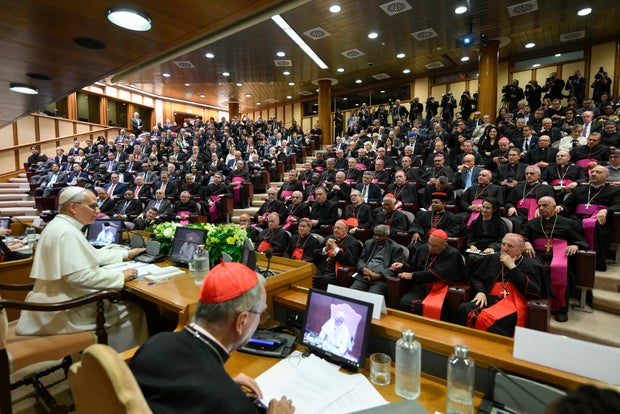
Leo called for the "disarming" of AI, warning that the technology could fuel "a race for ever more powerful algorithms and larger datasets, driven by the desire to secure geopolitical or commercial dominance."
The document marks the first major papal encyclical written in the era of generative artificial intelligence, and it frames the current technological revolution not merely as an economic challenge, but as what the pope calls an "anthropological" one — a crisis touching the meaning and purpose of humanity.
"Please note that the encyclical is not about AI," Cardinal Michael Czerny, one of the Vatican officials who helped present the document, told CBS News. "It's about the human condition during the time of AI."
In unusually direct language for a Vatican document, Leo — who holds a degree in mathematics — warned of the growing power of IT companies, with influence that can rival that of governments.
At the same time, the pope stressed that technology itself is not inherently evil.
"Artificial intelligence is a great human achievement," Cardinal Czerny said. "We have a lot to admire and a lot to be thankful for … But we can't renounce responsibility."
The Vatican's concerns extend well beyond Silicon Valley. The encyclical repeatedly echoes broad societal concerns that AI could hollow out the middle class; eliminate vast numbers of jobs; deepen inequality; fuel social fragmentation; and normalize AI-driven warfare.
"There exists no algorithm capable of making war morally acceptable," the encyclical states.
"Constraints that can sometimes conflict with doing the right thing"
That warning arrives as militaries around the world rapidly integrate AI into weapons systems. CBS News recently observed U.S. forces conducting exercises in Morocco and saw first-hand the growing use of AI-assisted targeting systems and autonomous technologies, including systems linked to Maven, the Pentagon's AI platform.
One of the more striking aspects of the Vatican's rollout of Leo's encyclical was the inclusion of Christopher Olah, a co-founder of the AI company Anthropic, who was there in person alongside senior church officials on Monday.
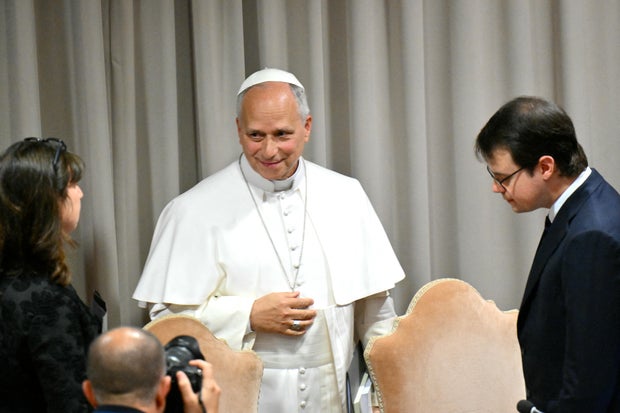
Olah said AI companies work "inside a set of incentives and constraints that can sometimes conflict with doing the right thing," and he welcomed input from outside, including from the Catholic Church, to "push events in a better direction."
"The questions raised by AI are bigger than the AI research community," he said.
Leo said he had accepted an invitation from Olah, "to walk together, to listen and to speak and together to find the way for humanity," and he was confident that, "together, we can discern the major questions of our time, and so, the future of humanity."
While Anthropic has often presented itself as a safety-conscious, "human-first" AI company, the Trump administration recently listed it as a supply-chain risk over its refusal to let the Pentagon use its technology in automated lethal systems or mass domestic surveillance.
Its models remain integrated in military and intelligence applications, however, as CBS News has witnessed.
When asked whether Anthropic's reputation as a human-centered AI company had influenced the Vatican's decision to engage with it, Czerny replied: "I'm sure it did."
He stressed, however, that dialogue with AI companies should not be mistaken for Vatican endorsement.
"We dialogue with anyone," Czerny said. "We don't endorse."
The encyclical repeatedly returns to the idea that the dangers posed by AI are not simply technological, but spiritual and existential paralysis.
"We're overwhelmed," the cardinal told CBS News. "We feel like we actually have nothing to say … and this paralyzes us."
Asked whether the pope worried that people were beginning to treat AI as a substitute for God, Czerny answered: "Yes … many things become substitutes for God and we call them idols."
Just as the Industrial Revolution transformed labor and capital, the AI revolution is transforming humanity itself, the pope cautioned in his remarks.
In: