


/ CBS News
Despite a spectacular launch pad explosion last week, Jeff Bezos's rocket company Blue Origin said Tuesday the damage was not as severe as initially feared and that the company plans to resume New Glenn rocket launches by the end of the year.
Blue Origin CEO Dave Limp, in a post on the social media platform X, said propellant tanks at launch pad 36 at the Cape Canaveral Space Force Station made it through the blast in good shape, as did a nearby processing hangar. The main support gantry, while damaged, can be repaired in place.
"Now that we've had access to the pad and integration facility we can share a bit of good news," Limp said. "The propellant farm, oxygen, liquid hydrogen and LNG [cryogenic methane] tanks are all in good shape. This is good luck because these are very long lead items.
"The water tower is also good. The big support tower is damaged, but it can be repaired in place rather than torn down and replaced."
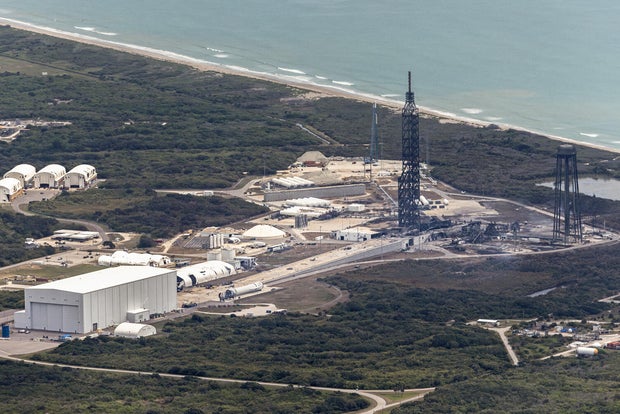
The New Glenn rocket that blew up on pad 36 last Thursday was destroyed along with its transporter-erector, used to move the rocket to the pad surface and then rotate it to vertical. But Limp said another New Glenn first stage booster and three upper stages housed in a large hangar-like "integration facility" at the base of the pad "look good."
"We had already been working for some time on eliminating our transporter-erector in favor of an alternative vertical (rocket assembly capability), and we'll now go directly to that; so we don't need a new transporter-erector," he said.
There's been no word yet on what might have caused the explosion, but Limp closed his post by declaring: "We will fly again before the end of this year. Gradatim Ferociter." The Latin expression, Blue Origin's motto, means "step by step, ferociously."
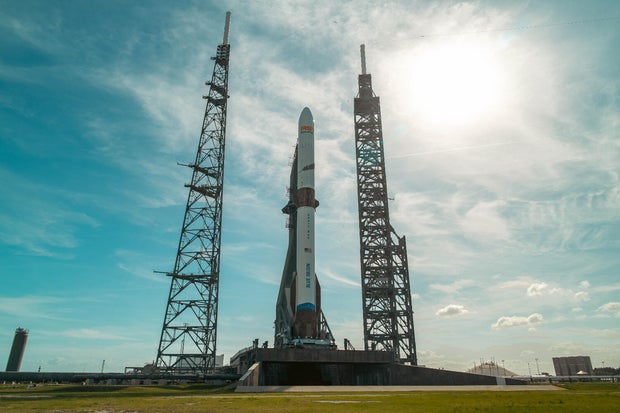
Blue Origin was preparing to launch its third New Glenn later this month to put a batch of Amazon Leo internet satellites into orbit. Last Thursday, engineers loaded both stages with supercold liquid methane and oxygen for a first stage engine test firing to verify its readiness for flight. The Leo satellites were not aboard.
Such "hot-fire" tests are fairly routine in the rocket industry, giving engineers a chance to test launch-day fueling procedures, a booster's propulsion system and critical ground and flight software while the rocket remains securely bolted to its launch pad.
But it was far from routine last Thursday.
As the New Glenn's seven BE-4 engines began igniting and throttling up, a fire broke out at the base of the booster and moments later, the rocket exploded in a tremendous fireball, shaking the ground for miles around in a conflagration visible all the way across the Florida peninsula.

Footage captured by photo journalists from a helicopter the next day showed the rocket and its transporter-erector had been destroyed, at least some support beams at the base of the main gantry were either bent or blown away and a separate lightning tower had collapsed in a tangle of debris.
Unlike rival SpaceX, which has two operation pads in Florida and one in California, Blue Origin only has pad 36. The company already had plans to build a second pad at the Cape and another at Vandenberg Space Force Base in California. But in the near term, New Glenns cannot fly until pad 36 is repaired.
That's a problem for NASA's Artemis moon program and the agency's drive to beat the Chinese to the lunar surface. Chinese officials have said they plan to land their own "taikonauts" on the moon by the end of the decade.
To win this self-declared "space race," NASA is relying on both SpaceX and Blue Origin to launch new moon landers into Earth orbit next yet for rendezvous and docking tests with Artemis astronauts in an Orion capsule.
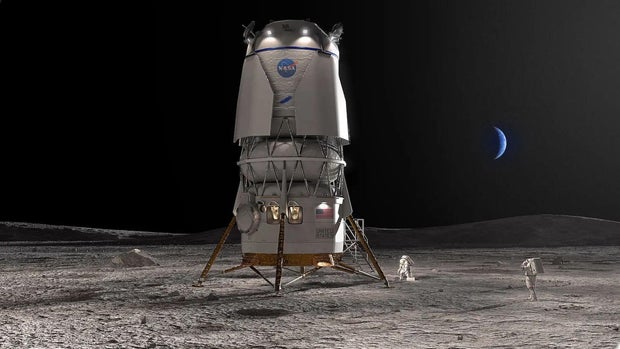
If those tests go well, NASA hopes to launch one, and possibly two, astronaut moon landing missions in 2028, soon followed by two flights per year thereafter before beginning assembly of a moon base near the lunar south pole where astronauts can live and work for months at a time.
Blue Origin's lander would give NASA an alternative to SpaceX's, a variant of the company's Starship rocket. SpaceX has had its own problems perfecting the Super Heavy-Starship rocket needed to launch its lander, and it's not yet clear if they will be ready for the Artemis III Earth-orbit test flight next year as currently planned.
Blue Origin's New Glenn also is needed to launch prototype rovers and other science experiments to the moon aboard an unpiloted cargo lander under contracts announced two days before last week's explosion.
NASA Administrator Jared Isaacman remains optimistic about landing Artemis astronauts on the moon in 2028 using whatever landing craft is available.
"Blue Origin leadership has responded incredibly quickly, and NASA will do all we can to help with root cause analysis and accelerate pad recovery timeframes while staying extremely focused on progressing the lander," he said on X.
Kennedy Space Center Director Brian Hughes, appointed to the post just last month, told the Space Florida board of directors Tuesday that NASA is "doubling down on the lunar lander."
"We'll be working with Blue and X lunar lander technology, and all of that is designed to keep us on path, meet the President's goal, which is to have American boots back on the moon before the end of 2028," he said. "Again, that's not just something to tout, it's an important demonstration of our nation's abilities."
Limp's promise to resume flights by the end of the year might imply the "root cause" of the explosion was not an engine problem that would take months to correct and then test. Or at least, not a major design flaw.
That would be good news for United Launch Alliance, a partnership between Boeing and Lockheed Martin. ULA uses Blue Origin's BE-4 engines in the first stage of its new Vulcan rocket. A drawn-out engine failure investigation would be a setback for ULA, but the BE-4s have not yet been blamed for the New Glenn mishap.
In: