惯性聚合 高效追踪和阅读你感兴趣的博客、新闻、科技资讯
阅读原文 在惯性聚合中打开

推荐订阅源

有赞技术团队
有赞技术团队
cs.CV updates on arXiv.org
P
Palo Alto Networks Blog
C
Cisco Blogs
The Hacker News
The Hacker News
T
Threatpost
S
Schneier on Security
K
Kaspersky official blog
Spread Privacy
Spread Privacy
博客园_首页
钛媒体:引领未来商业与生活新知
钛媒体:引领未来商业与生活新知
NISL@THU
NISL@THU
量子位
cs.CL updates on arXiv.org
Google DeepMind News
Security Latest
Security Latest
博客园 - 司徒正美
云风的 BLOG
云风的 BLOG
博客园 - 叶小钗
H
Hackread – Cybersecurity News, Data Breaches, AI and More
N
News and Events Feed by Topic
爱范儿
爱范儿
P
Proofpoint News Feed
C
CERT Recently Published Vulnerability Notes
Project Zero
Project Zero
Application and Cybersecurity Blog
Cisco Talos Blog
Cisco Talos Blog
GbyAI
GbyAI
cs.AI updates on arXiv.org
Apple Machine Learning Research
T
Tenable Blog
Threat Intelligence Blog | Flashpoint
V
Vulnerabilities – Threatpost
Forbes - Security
Forbes - Security
博客园 - 三生石上(FineUI控件)
C
Cyber Attacks, Cyber Crime and Cyber Security
N
News and Events Feed by Topic
V
V2EX
Webroot Blog
Webroot Blog
The Register - Security
OSCHINA 社区最新新闻
OSCHINA 社区最新新闻
阮一峰的网络日志
阮一峰的网络日志
freeCodeCamp Programming Tutorials: Python, JavaScript, Git & More
Blog — PlanetScale
Blog — PlanetScale
M
MIT News - Artificial intelligence
Scott Helme
Scott Helme
Simon Willison's Weblog
L
LangChain Blog
W
WeLiveSecurity
Cloudbric
Cloudbric

Salesforce

How We Protect Our Data as Customer Zero Scale Your MRR: Subscription Management For Small Business Streamlining Commerce Media Ad Inventory Management 12 AI Sales Strategies for Startups That Actually Work Sell Smarter: Ecommerce Metrics To Track For Your Small Business Shop Apply the Orchestration Density Framework to Your Next Automation Decision Wait, Black Friday Planning In Spring? It’s Time to Start Holiday Promotions AI-First Operations, One Process at a Time How BCU Is Transforming Banking Service with Agentforce Salesforce Headless 360: What the Agent Consumer Means for Your Integration Architecture Meet Customers Where They Are: Agentforce Contact Center Now Offers WhatsApp Voice 11 Free Lead Generation Tips for Small and Growing Businesses SFR-VibeTrain: The Agent That Trains Agents Why Technical Accuracy is the Wrong Metric for Agent Success Strengthening Salesforce Security Against AI-Driven Threats Join Us in the Community Hub at Connections 2026 The Best Way To Build AI Agents That Customers Trust 5 Ways AI is Changing the Communication Game For Startups Trust in the Era of Agents: Highlights from the 2nd Annual Trusted AI Impact Report You Can Be an Agentic Enterprise No Matter What Size Business How to Make Your Email Marketing Accessible for Everyone What is Headless? Don’t Lose Your Head, SMBs: It’s a Good Thing Architect the Future UI: Slack as Your Agentic Surface Point of Sale Innovations to Modernize the Shopper Experience Governing the Agentic Enterprise at Scale with MuleSoft Omni Gateway How to Cut Service Time with Case Routing Automation 5 Tips for Marketers to Get Started with Salesforce Flow No One is Vibe Coding Trade Promotion Management 7th Edition State of Sales Report: 3 Growth Trends for Startups and SMBs How the Architect Vista Brought Architectural Thinking to Life at TDX 2026 5 Steps to Develop an Architect Mindset With AI Why AI Isn’t Replacing Developers, It’s Empowering Them 10 Ways to Make Your AI Agent a Better Communicator AI in Design 2025: What Real Use Taught Us. How Salesforce Personalization Learns Which Offers Drive Revenue The 4-Step Guide to Salesforce Agent and Application Development Get Ready for Connections 2026: Top Sessions and New Reveals 8 Ways AI Agents Are Evolving in 2026 4 Principles to Make the Right Salesforce UI Decisions Apprentice Journey Shines a Light on Talent Pathways at Salesforce Agent Script: The Control Plane for Agentic Decisions Scaling the Agentforce Life Sciences Ecosystem to Drive the Future of Pharma and MedTech Unlocking Unstructured Data: Building AI-Powered Support Triage with Data 360 Asking For a Friend: What Are Rich Communication Services (RCS)? 5 Slack Shortcuts For Small Teams 195% ROI In Field Service? Here’s How They Did It Submit Your Architect Session: The Dreamforce 2026 Call for Participation Is Open What Is an AI Assistant for Small Business? B2C Commerce April release: Transforming the B2C developer experience with agents Meet Your 24/7 Prospecting Partner — And 5 More Stand-Out Features In Our April Release 11+ Small Business YouTube Channels You Need to Follow Today Stop Treating Disputes Management Like IT Tickets Limitless Service: A New Operating Model for Growth in the Agentic Era What is Transactional Reconciliation in Email and SMS Marketing? How to Prepare for National Small Business Week (2026) How to Design a High-Scale Multi-Cloud Incident Journey 10 Ways An AI CRM Can Amplify Your Startup Vibe Code Better Agents with Agentforce Free vs. Paid CRM: Which is Right for Your Business? Salesforce Customer Success Awards 2026: Lead Era of the Agentic Enterprise 12 Free Webinars for Small Business Owners (2026) The Agentforce Life Sciences Consultant Certification Maximize Growth: The Power of Partnerships for SMBs Salesforce AI Research at ICLR 2026 Data Protection For Small Business: How To Safeguard Yourself Beyond 100K Tokens: Evaluating AI Agents in Long-Context Software Engineering Top 32 Small Business Tools To Try Today 6 New Innovations Redefining Salesforce Development How to Win the Battle for Attention in the Agentic Email Inbox Mastering the Eisenhower Matrix: Prioritize Like a Pro 10 Signs It’s Time To Upgrade Your CRM and How To Get Started (2026) Celebrating 10 Years of Financial Services Innovation How SMBs Can Gain An Edge With Agentic AI: Key Trends From Our Marketing Report How MAN Truck & Bus is Shaping the Future of Sales with Salesfive Introducing the Future of Salesforce Data Protection: Backup & Recover Next Stop Making AI Slop – Build a Foundation for Authentic AI Content Data Sharing: Is it Safe? Is it Secure? Everything You Need to Know Small Business Week Readiness: 4 Things to Do Before May (2026) How Salesforce Employees Make an Impact During Earth Month AI Agents Are Advancing Rapidly… Is Your Testing Strategy Keeping Up? What Is Microproductivity and Why Is It Helping So Many Teams? TDX 2026 Roundup: Agentforce Edition 3 Ways Salesforce Connections Has Boosted My Career AI Agents Don’t Just Answer‌ — ‌They Act. Do You Have a Governance Strategy? The Future of MedTech Field Execution is Agentic 5 Steps to Prepare Your Data For an AI CRM From Break/Fix to Profit Engine: Aftermarket Service for Robot OEMs Building Trusted Human-Agent Collaboration: A Practical Framework ISV Strategy for the Salesforce Summer ’26 Release 5 Email Marketing Tips for Small Business Commerce Shops Should You Give Your AI Agent a Human Name? Creating Pathways into AI for People with Disabilities The Organized Chaos of Upfronts: 3 Hurdles Impacting Your Yield Trying to Scale Beyond ‘One-Off’ AI Tasks? You’re Probably Using the Wrong Interface What is Cost Per Lead (CPL)? The Case for Unified CCaaS and CRM — And Why the Data Makes It Clear In the New Era of AI, You Need to Win Over Both Humans and Agents What Is SPIN Selling? A Way to Build Trust With Your Customers G2 Crowns Salesforce as Best Financial Services Software Hidden Insights: The Guide to Tableau For Small Business Owners
5 Tips to Help Marketers Navigate AI Email Summaries
Michael Wrig · 2026-04-17 · via Salesforce

While advancements in AI have been front and center in the headlines for the last couple of years, the impact on the email space has only recently started to be seen. From proofing a marketer’s content to generating brand new campaigns to prioritizing and classifying messaging in a subscriber’s inbox, there are many ways email is evolving.

The most recent shift is the introduction of AI email summaries directly in the subscriber’s inbox by major mailbox providers. While this innovation is designed to enhance the recipient’s experience by offering quick previews of content, it presents significant challenges for marketers.

The traditional engagement model — relying on opens and click-throughs — is evolving, and the potential for lost brand voice or misinterpreted content is high. This blog post will help you navigate these changes, providing five actionable recommendations to ensure your email campaigns remain successful in the age of the AI-powered inbox. For Salesforce’s view on this topic, check out my colleague Urvashi Jain’s blog here.

Connections 26 is coming!

The blueprint for marketers has changed. Learn how you can incorporate agentic capabilities for your brand this June 3-4 in Chicago.


How AI email summaries have changed the inbox

Many companies have gone all-in on AI with varying degrees of success. Generative Pre-trained Transformer (GPT) models have taken huge leaps forward and are now being positioned as solutions to help marketers create better, more targeted emails. Largely, these AI capabilities are ecosystem specific. For example, Microsoft’s Copilot is baked directly into Outlook for this purpose. 

When we’re talking about marketing emails that need to deliver an engaging and personalized design, can AI really be relied on to deliver? 

It’s worth keeping in mind that AI is entirely data-driven, meaning outcomes of AI-generated content or messages can only ever be as good as the data that supplies it. Generative AI can certainly help speed up the content creation process for most marketers, especially in areas like subject line testing and image generation, but ensuring the design elements stay on brand still requires that human touch. AI tools are known to miss the mark on considerations for things like Dark Mode, accessible code and the multiple different rendering outcomes based on things like OS, browser, screen size and email client.

The most exciting use case for AI in email may be machine learning and predictive analytics, which will play an increasingly important role in personalization. Your AI strategy should be connected to your data and customer engagement strategy for optimal results. How AI impacts your subscriber’s inbox experience also has to be taken into consideration to ensure your future campaigns will be successful.

It’s important to understand that mailbox providers are also taking advantage of AI tools to improve the inbox experience for their users. AI email summaries are probably the biggest change to the AI-powered inbox – a subscriber doesn’t even have to open the message to see what the sender has to offer them. Gmail (Gemini Summaries), Yahoo (Catch Up), Microsoft (Copilot) and Apple Mail (Apple Intelligence Summaries) have all introduced AI summaries to the inbox with varying degrees of accuracy.
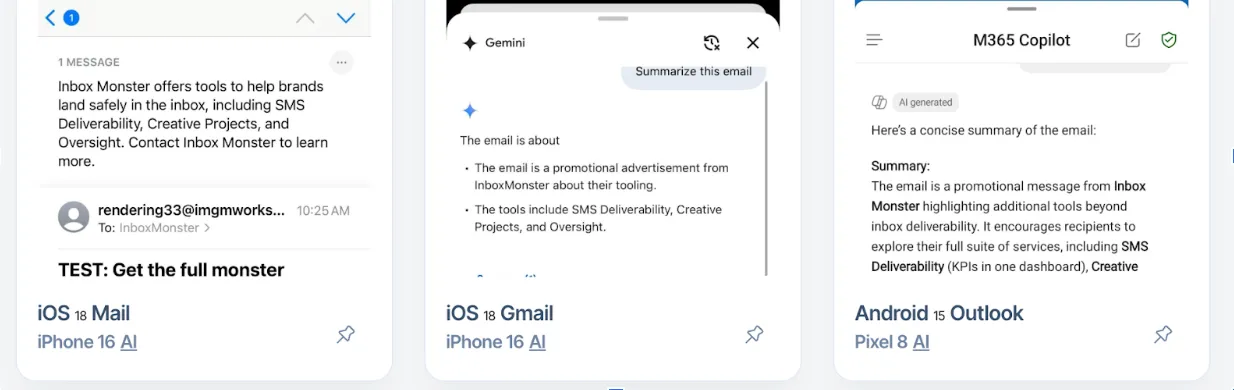
(This image shows an AI preview test from Inbox Monster for an email that contains live text in the body as well as alt text for the images which allows the AI summaries a more thorough understanding of the content.)

Our partners at Inbox Monster have some great insights on the impact of AI changes in this blog:

Inbox AI is rewriting your emails whether you like it or not. Apple, Gmail and Yahoo are pulling snippets, summaries and discount codes into inbox previews — sometimes making you look brilliant, other times making you look like you’re running a “100% off” sale. And the latest news from Gmail is that it will roll out the “AI Inbox” in 2026, bringing Gemini further into the fold with personalized summaries and to-dos of high-stakes items.

  • The risks: lost brand voice, skewed engagement signals and tracking chaos.
  • The fixes: prioritize live text, front-load key content, use schema and annotations and preview everything before you send.

Despite Apple Mail ignoring preheaders in favor of their AI email summaries feature, the preheader (also known as preview text) remains a popular way for marketers to engage their customers and can help drive engagement. The subject line may not offer you enough real estate to hook the reader into engaging with your messaging.

Using your preheader to effectively sell the value of how your company can help solve a problem is key to driving further engagement. Remember to always test, as a cleverly crafted preheader may not translate well in AI summaries, and be sure your subject line is clear and concise.

How AI summaries are impacting image-only emails

Image-only emails have never been considered an email best practice. A lack of live text creates accessibility issues and you run the risk of images being blocked by default in certain email clients.

Now, AI email summaries factor into the discussion as a lack of live text can mean that Apple may present a “too short to summarize” message in the inbox, and there are reports that Android AI will pull in footer text when the email body lacks live text. This would mean the Android summary would include the sender contact information and unsubscribe link, creating a poor recipient inbox experience.

Inbox Monster did some extensive testing on this front and found that Gemini consistently outperformed Apple Intelligence when it came to interpreting image-only emails for summaries. Here are the same three AI summaries shared above but this time run as image-only emails with no alt or live text included. You can see the value proposition of the subscriber engaging the message drastically declines for image only content.
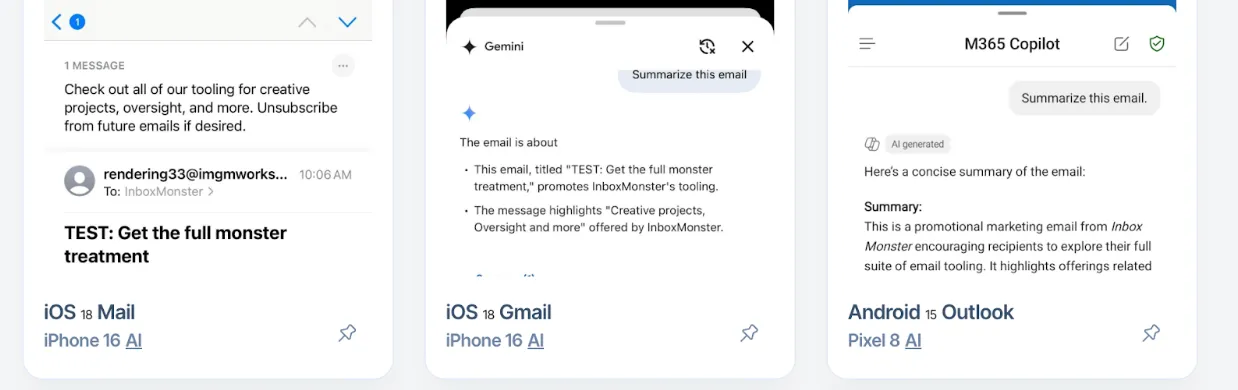
This image shows an AI preview test from Inbox Monster for an email that contains a hero image only with no live text or alt text to help with the summary. The subscriber experience varies from a suggestion to unsubscribe to a repeat of the subject line.

What will be AI’s-term impact on engagement?

The Inbox Monster team says AI summaries pose new challenges for marketers:

The catch: even if summaries are accurate, they change engagement. If subscribers can get what they need from a summary, they may never click through. That means skewed metrics and lost opportunities.

So what does this mean for the email marketer? According to Inbox Monster:

Don’t assume opens and clicks mean what they used to. AI summaries mean someone might read your email without technically opening it. Or they might click on an extracted discount code in a preview, bypassing your tracked CTA.

That means inflated or misleading engagement data. The fix: look beyond vanity metrics and double down on downstream conversions (site visits, purchases, sign-ups) to gauge performance.

Inbox Monster’s preview tools can show you how Apple and Gmail actually display your emails. Use that intel to A/B test copy placement, schema markup and design balance. The more you test, the more you’ll understand what AI is likely to surface and how to work with it instead of fighting it.

5 tips for tackling AI email summaries

  1. Get to the point in the first 20 characters of your subject line. The days of vague “baity” subject lines are behind us. Get to your value prop in the first 100 characters of your email body. Use clear and straight-froward language in these known AI summary zones.
  2. Make sure key points are in live text as opposed to images. This helps AI email summaries to be more clear and useful to your subscribers. Plus, if images are blocked, it helps you still deliver engaging content.
  3. Keep your message on point. According to Inbox Monster:

    It’s tempting to try to get your email to do everything — talk about new products, invite customers to follow you on social media and ask recipients for a review. But just like humans, AI can get confused and misinterpret your email if there’s too much going on. Instead, focus on one core theme or goal for your email to avoid confusion from humans and bots alike.

  4. Open rates are likely to decline across the industry in the coming years. This doesn’t necessarily mean your content isn’t being seen. However, subscribers are likely to adapt to summarized inboxes and only engage further when something catches their interest. Adjust your tracking and reporting to focus on active signals from your subscribers, including click-through and conversion rates.
  5. AI is still evolving, which makes testing more critical than ever before. Understand your customers’ experience and plan accordingly. This is the time to be learning and adapting as more of your audience begins experiencing AI in their inbox in the coming years.

Take your email marketing up a notch

See how Agentforce Marketing gives you the tools to navigate AI inbox summaries and reach customers where they are.