


惯性聚合 高效追踪和阅读你感兴趣的博客、新闻、科技资讯
阅读原文 在惯性聚合中打开

推荐订阅源

Threat Intelligence Blog | Flashpoint
B
Blog RSS Feed
GbyAI
GbyAI
Google DeepMind News
B
Blog
博客园 - 司徒正美
Vercel News
Vercel News
A
About on SuperTechFans
Martin Fowler
Martin Fowler
WordPress大学
WordPress大学
Recent Announcements
S
SegmentFault 最新的问题
博客园_首页
Apple Machine Learning Research
Stack Overflow Blog
Stack Overflow Blog
L
LINUX DO - 热门话题
Y
Y Combinator Blog
F
Full Disclosure
月光博客
月光博客
C
Cyber Attacks, Cyber Crime and Cyber Security
MongoDB | Blog
MongoDB | Blog
The Cloudflare Blog
The Hacker News
The Hacker News
CTFtime.org: upcoming CTF events
A
Arctic Wolf
Scott Helme
Scott Helme
V
Visual Studio Blog
C
Cybersecurity and Infrastructure Security Agency CISA
T
Tor Project blog
P
Privacy International News Feed
Spread Privacy
Spread Privacy
G
GRAHAM CLULEY
Microsoft Security Blog
N
News and Events Feed by Topic
Exploit-DB.com RSS Feed
PCI Perspectives
PCI Perspectives
小众软件
小众软件
博客园 - 【当耐特】
Cloudbric
Cloudbric
S
Secure Thoughts
L
LINUX DO - 最新话题
Google Online Security Blog
T
Troy Hunt's Blog
Cyber Security Advisories - MS-ISAC
W
WeLiveSecurity
V
Vulnerabilities – Threatpost
人人都是产品经理
人人都是产品经理
酷 壳 – CoolShell
酷 壳 – CoolShell
钛媒体:引领未来商业与生活新知
钛媒体:引领未来商业与生活新知
量子位

Salesforce

Scale Your MRR: Subscription Management For Small Business Streamlining Commerce Media Ad Inventory Management 12 AI Sales Strategies for Startups That Actually Work Sell Smarter: Ecommerce Metrics To Track For Your Small Business Shop Apply the Orchestration Density Framework to Your Next Automation Decision Wait, Black Friday Planning In Spring? It’s Time to Start Holiday Promotions AI-First Operations, One Process at a Time How BCU Is Transforming Banking Service with Agentforce Salesforce Headless 360: What the Agent Consumer Means for Your Integration Architecture Meet Customers Where They Are: Agentforce Contact Center Now Offers WhatsApp Voice 11 Free Lead Generation Tips for Small and Growing Businesses SFR-VibeTrain: The Agent That Trains Agents Why Technical Accuracy is the Wrong Metric for Agent Success Strengthening Salesforce Security Against AI-Driven Threats Join Us in the Community Hub at Connections 2026 The Best Way To Build AI Agents That Customers Trust 5 Ways AI is Changing the Communication Game For Startups Trust in the Era of Agents: Highlights from the 2nd Annual Trusted AI Impact Report You Can Be an Agentic Enterprise No Matter What Size Business How to Make Your Email Marketing Accessible for Everyone What is Headless? Don’t Lose Your Head, SMBs: It’s a Good Thing Architect the Future UI: Slack as Your Agentic Surface Point of Sale Innovations to Modernize the Shopper Experience Governing the Agentic Enterprise at Scale with MuleSoft Omni Gateway How to Cut Service Time with Case Routing Automation 5 Tips for Marketers to Get Started with Salesforce Flow No One is Vibe Coding Trade Promotion Management 7th Edition State of Sales Report: 3 Growth Trends for Startups and SMBs How the Architect Vista Brought Architectural Thinking to Life at TDX 2026 5 Steps to Develop an Architect Mindset With AI Why AI Isn’t Replacing Developers, It’s Empowering Them 10 Ways to Make Your AI Agent a Better Communicator AI in Design 2025: What Real Use Taught Us. How Salesforce Personalization Learns Which Offers Drive Revenue The 4-Step Guide to Salesforce Agent and Application Development Get Ready for Connections 2026: Top Sessions and New Reveals 8 Ways AI Agents Are Evolving in 2026 4 Principles to Make the Right Salesforce UI Decisions Apprentice Journey Shines a Light on Talent Pathways at Salesforce Agent Script: The Control Plane for Agentic Decisions Scaling the Agentforce Life Sciences Ecosystem to Drive the Future of Pharma and MedTech Unlocking Unstructured Data: Building AI-Powered Support Triage with Data 360 Asking For a Friend: What Are Rich Communication Services (RCS)? 5 Slack Shortcuts For Small Teams 195% ROI In Field Service? Here’s How They Did It Submit Your Architect Session: The Dreamforce 2026 Call for Participation Is Open What Is an AI Assistant for Small Business? B2C Commerce April release: Transforming the B2C developer experience with agents Meet Your 24/7 Prospecting Partner — And 5 More Stand-Out Features In Our April Release 11+ Small Business YouTube Channels You Need to Follow Today Stop Treating Disputes Management Like IT Tickets Limitless Service: A New Operating Model for Growth in the Agentic Era What is Transactional Reconciliation in Email and SMS Marketing? How to Prepare for National Small Business Week (2026) How to Design a High-Scale Multi-Cloud Incident Journey 10 Ways An AI CRM Can Amplify Your Startup Vibe Code Better Agents with Agentforce Free vs. Paid CRM: Which is Right for Your Business? Salesforce Customer Success Awards 2026: Lead Era of the Agentic Enterprise 12 Free Webinars for Small Business Owners (2026) The Agentforce Life Sciences Consultant Certification Maximize Growth: The Power of Partnerships for SMBs Salesforce AI Research at ICLR 2026 Data Protection For Small Business: How To Safeguard Yourself Beyond 100K Tokens: Evaluating AI Agents in Long-Context Software Engineering Top 32 Small Business Tools To Try Today 6 New Innovations Redefining Salesforce Development How to Win the Battle for Attention in the Agentic Email Inbox Mastering the Eisenhower Matrix: Prioritize Like a Pro 10 Signs It’s Time To Upgrade Your CRM and How To Get Started (2026) Celebrating 10 Years of Financial Services Innovation How SMBs Can Gain An Edge With Agentic AI: Key Trends From Our Marketing Report How MAN Truck & Bus is Shaping the Future of Sales with Salesfive Introducing the Future of Salesforce Data Protection: Backup & Recover Next Stop Making AI Slop – Build a Foundation for Authentic AI Content 5 Tips to Help Marketers Navigate AI Email Summaries Data Sharing: Is it Safe? Is it Secure? Everything You Need to Know Small Business Week Readiness: 4 Things to Do Before May (2026) How Salesforce Employees Make an Impact During Earth Month AI Agents Are Advancing Rapidly… Is Your Testing Strategy Keeping Up? What Is Microproductivity and Why Is It Helping So Many Teams? TDX 2026 Roundup: Agentforce Edition 3 Ways Salesforce Connections Has Boosted My Career AI Agents Don’t Just Answer‌ — ‌They Act. Do You Have a Governance Strategy? The Future of MedTech Field Execution is Agentic 5 Steps to Prepare Your Data For an AI CRM From Break/Fix to Profit Engine: Aftermarket Service for Robot OEMs Building Trusted Human-Agent Collaboration: A Practical Framework ISV Strategy for the Salesforce Summer ’26 Release 5 Email Marketing Tips for Small Business Commerce Shops Should You Give Your AI Agent a Human Name? Creating Pathways into AI for People with Disabilities The Organized Chaos of Upfronts: 3 Hurdles Impacting Your Yield Trying to Scale Beyond ‘One-Off’ AI Tasks? You’re Probably Using the Wrong Interface What is Cost Per Lead (CPL)? The Case for Unified CCaaS and CRM — And Why the Data Makes It Clear In the New Era of AI, You Need to Win Over Both Humans and Agents What Is SPIN Selling? A Way to Build Trust With Your Customers G2 Crowns Salesforce as Best Financial Services Software Hidden Insights: The Guide to Tableau For Small Business Owners
Trusted Agents at Scale: How Open Discovery Is Unifying the Agentic Enterprise
Vijay Pandiarajan · 2026-06-26 · via Salesforce

As teams across an organization spin up agents on different platforms, visibility disappears and IT leaders lose any real governance handle. Multiply that across hundreds of thousands of organizations, and the result is predictable: an agent built on one platform can’t discover or trust a tool built on another.

That’s the gap the new Agentic Resource Discovery (ARD) specification is designed to close. ARD gives agents a standard way to answer three questions at runtime: where does the right capability live, which one should I use, and is it safe to connect to.

Salesforce is proud to be a founding partner of ARD alongside Google and other industry leaders, helping shape a secure, open, decentralized agentic web. Here’s what ARD is, why it matters, and how we’re natively integrating it to help you scale safely.

ARD and Why It’s Important

ARD is an open, standards-based specification that gives any AI discovery service a unified way to catalog, index, and surface agent and tool information — a shared protocol for the agentic era, similar to how DNS provides shared rules no single company owns.

The mechanics are simple. An organization publishes a static ai-catalog.json manifest — either publicly on their own domain or privately within their own infrastructure — listing what’s available: agents, MCP servers, APIs, even nested catalogs. Domain ownership doubles as the root of trust. Registries crawl and index these manifests, letting any agent ask “what’s available for this task?” in plain language and get back ranked, verified results.

This solves two problems at once. First, trust and discovery across organizations: agents built on one platform have had no reliable way to find or verify tools built on another. ARD’s federated model fixes that — anyone can run a registry, and registries can reference each other, so the network grows without centralized control. Second, context-window scaling: instead of loading every tool description into the model, ARD moves selection into a dedicated search layer, so agents can draw on thousands of capabilities without the bloat.

What This Means for Agentforce

For Agentforce, Salesforce’s enterprise agent platform, ARD represents a significant step forward for external collaboration and actionability.

Agentforce allows your business teams to build, run, and optimize autonomous agents with deep Customer 360 context. Because Salesforce believes in open ecosystem interoperability, the ARD standard ensures that public Agentforce agents can be securely exposed and discovered by other partners and customers — allowing them to find, trust, and invoke Agentforce directly from their own platforms and workflows without custom integrations.

But the vision doesn’t stop there. By anchoring our strategy around standard registry endpoints, Salesforce’s roadmap includes future capabilities that will allow enterprise customers to curate and securely publish their own Agentforce agents externally. With the appropriate role-based access controls and corporate safeguards in place, you can make Agentforce agents discoverable to your public-facing partners and customers via ARD catalogs.

How Agent Fabric Supports ARD and Broader Discovery

Discovery has always been the prerequisite to everything else. Before an agent can act, orchestrate, or deliver value, it first has to find the right capability — and know it can trust what it found. As the agentic ecosystem scales, that prerequisite becomes the bottleneck.

Agentforce is Salesforce’s platform for building and deploying AI agents natively within the Salesforce ecosystem. Agent Fabric is the enterprise control plane for your full agentic network. It’s where organizations discover, govern, orchestrate, and observe AI agents and tools regardless of where they were built — whether that’s a homegrown agent, a third-party MCP server, or an agent running on Amazon Bedrock or Gemini Enterprise Agent Platform. It’s also where Agentforce agents can live alongside that broader ecosystem. Agent Fabric gives teams a single, governed view of their entire agent landscape — Agentforce and third-party agents registered, managed, and discoverable together.

That architecture maps directly onto what ARD standardizes at the web level. Agent Fabric is built on the same principles: agents should find and consume capabilities regardless of protocol — MCP, A2A, or traditional APIs. Identity and trust should be verifiable, not assumed. And governance controls should travel with agents as they cross organizational boundaries.
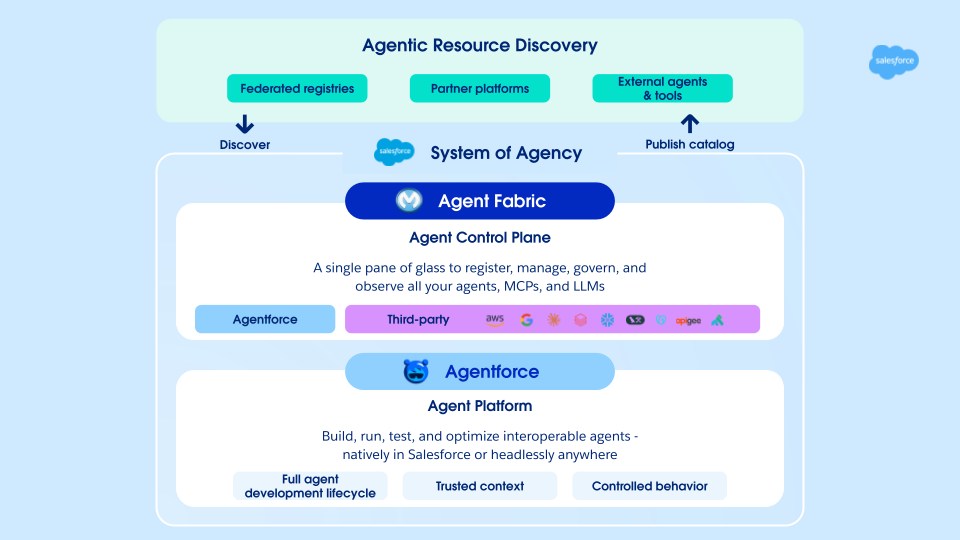
Future-state illustration of how Agentforce, Agent Fabric, and ARD work together to enhance discovery

ARD gives Agent Fabric a shared, open standard to build on. This means a new source of discoverable resources customers can tap into, and tooling to let organizations publish their own capabilities into the federated network — managing the manifests that make their agents and tools findable by anyone participating in the standard.

The broader point is this: the value of any agent is a function of what it can reach — and Agent Fabric has already been expanding that reach before ARD arrived. For example, Agent Fabric’s Scanners automatically discover agents, MCP servers, and APIs running across providers and catalog them into a unified registry. To govern this expanded reach, Agent Fabric manages secure, governed collaboration across protocols and models. And its trust and identity frameworks verifies agents before they’re invoked.

ARD makes all of this more discoverable. By publishing your agent network through ARD-compliant manifests, the capabilities you’ve already built and governed inside Agent Fabric become findable by any ARD-enabled agent or platform — inside your organization or across the broader agentic web. The foundation is already there. ARD is what opens the door to the rest of the ecosystem.

The Agentic Web Is Being Built Now

Standards that land early tend to stick. ARD is arriving while the ecosystem is still taking shape — which means the organizations that invest in discovery infrastructure now will have a compounding advantage as the network grows. Every capability you publish becomes findable. Every new tool that joins the standard becomes immediately accessible.

The promise of an open agentic web isn’t just better agents. It’s a better-connected enterprise. Salesforce is committed to helping you get there — with the open standards to make it possible and the enterprise platform to make it practical.

Ready to build and manage agents that can reach the full agentic web?