


In the early stages of building a company, every decision feels urgent. Founders move between product development, customer conversations, hiring, and growth strategies — all while trying to create something that stands out in a crowded market. The momentum is exciting, but scaling a business alone can quickly become overwhelming. Sustainable growth takes more than hard work and software; it requires guidance, proven playbooks, and experienced builders who understand what it takes to move from traction to success.
That’s exactly why Salesforce Launchpad was created. It’s a program designed specifically for venture-backed startups to bridge the gap between big ambition and flawless execution. By bringing together curated resources, exclusive product offers, and a powerful network, Launchpad helps you move with confidence at every stage of your journey.
To see this in action, look no further than the Salesforce Startup Summit. From scaling sales without budgets to implementing multi-agent workflows across your operations, this event offers a roadmap for founders and startup leaders ready to lead in the AI era.
The 2nd annual Startup Summit, hosted by Salesforce, brought together founders, CXOs, and top venture capital firms to explore how AI agents and digital labor are transforming how startups operate, scale, and go to market. We gathered visionaries from companies like Anthropic, Vercel, and Slack, among others, to unpack how the agentic enterprise is rewriting the playbooks for how startups build and scale. This event offered practical takeaways on how AI agents are rewiring the economics of building a company, as well as best practices for startups to scale faster and more efficiently.
Salesforce started this annual summit because we believe the next generation of great companies is being built right now, and this year’s sessions did not disappoint.
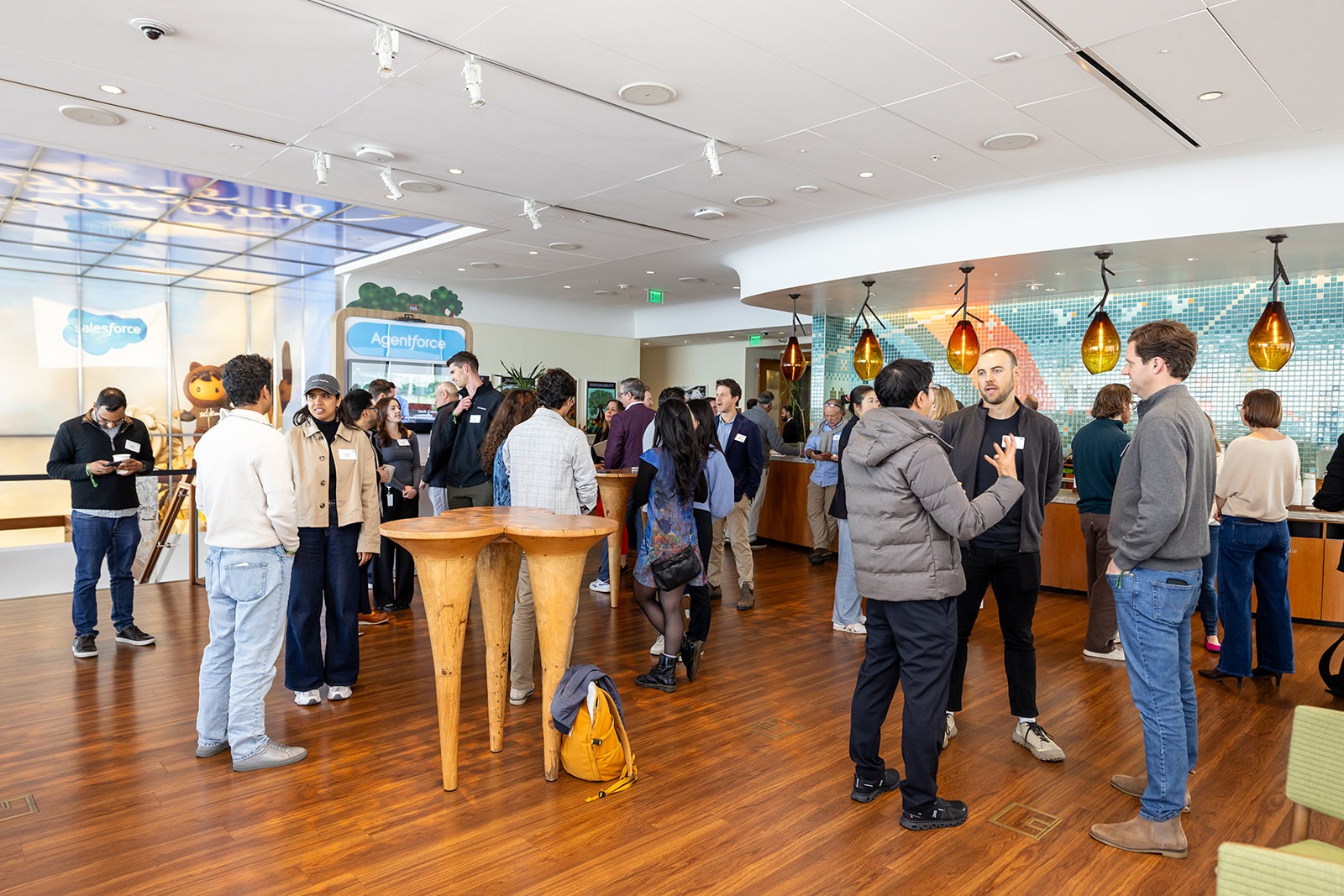
Kate Jensen, Head of Americas at Anthropic, and Kris Billmaier, EVP & GM, Agentforce Sales, Salesforce, discussed how company operating models are evolving as AI agents become more embedded across teams and shared learnings from their own growth journeys and integrating agents across on their teams.
Following Anthropic’s incredible growth from $1 billion to over $30 billion in revenue within 18 months, Jensen shared essential lessons on how a company experiencing hyper-growth manages its operational reality. The biggest takeaway? The need for deliberate focus on maintaining core principles and values as you scale. Beyond culture, the accelerating pace of AI innovation requires a high degree of adaptability, demanding that companies accept a degree of “messiness” and focus on remaining nimble.
As roles evolve and agents become more integrated into how teams work, Jensen and Billmaier agreed that core values are an essential north star for scaling quickly and intentionally.
Jensen also highlighted how this era of rapid change requires a shift toward multidisciplinary roles, where new hires must see the “bigger picture”. Jensen looks for new hires who can shift into multiple roles and maintain flexibility.
Billmaier echoed this sentiment and highlighted how Salesforce teams are driving more efficiency by adopting Agentforce internally and increasing account executives (AE) productivity. For instance, Salesforce AEs serve as “customer zero” for Agentforce for Sales, using it in their own workflows and providing direct feedback to product teams.
Key takeaways:
For humans and agents to work together seamlessly, the question becomes how you’re orchestrating them. Amelia Lerutte, Chief AI Officer, SaaStr, Kyle Norton, CRO, Owner.com, and Jevan Lenox, Chief People Officer, Writer shared the operational reality of integrating AI agents into their teams.
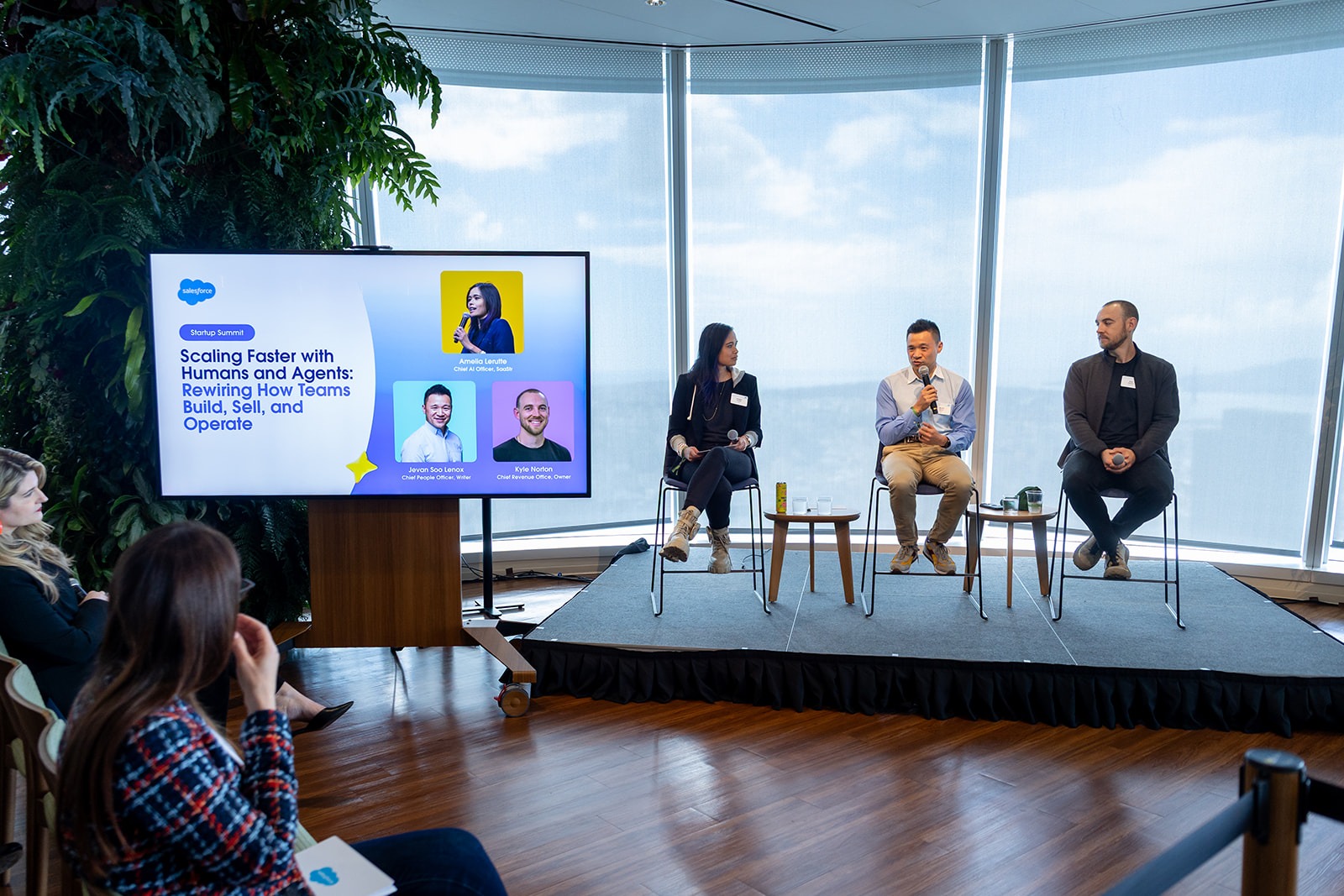
Lerutte kicked off with a compelling case study from SaaStr: After several human employees departed, the company scaled its workforce to three humans and 25 agents, all of which are built on Agentforce. The most impactful of these was a re-engagement agent that followed up with thousands of neglected leads, achieving a 70% email open rate by leveraging 10 years of historical customer data for hyper-personalization.
SaaStrr utilizes a headless model, performing tasks like closing deals through a chat agent that accesses real-time Salesforce data without ever logging into the full interface. Looking ahead, both agreed that agents will replace roles centered on moving information (administrative tasks), and that the new value creators will be “orchestrators” and systems builders who manage these agentic workforces.
Norton also highlighted how he’s set up his agents and human employees to seamlessly work together. For workflow integration, Owner.com centralizes AI tools by pushing them directly into Salesforce, allowing sales representatives to use them without changing their established processes.
Lenox also emphasized the importance of empowering teams across the company to lean into this orchestration and how they manage their agents: “Companies shouldn’t need an army of AI engineers to operationalize agents.”
Key takeaways:

For early-stage founders, the question isn’t just what you’re building — it’s how you get people to care, sometimes even before you’ve finished building it. Kristin Pierce, SVP, Global SMB Marketing at Salesforce, sat down with Amanda Zhu, COO & Co-Founder of Recall.ai, and Tim Glaser, CEO & Co-Founder of PostHog, to unpack the distribution playbooks that actually worked for them — and best practices founders can leverage right now.
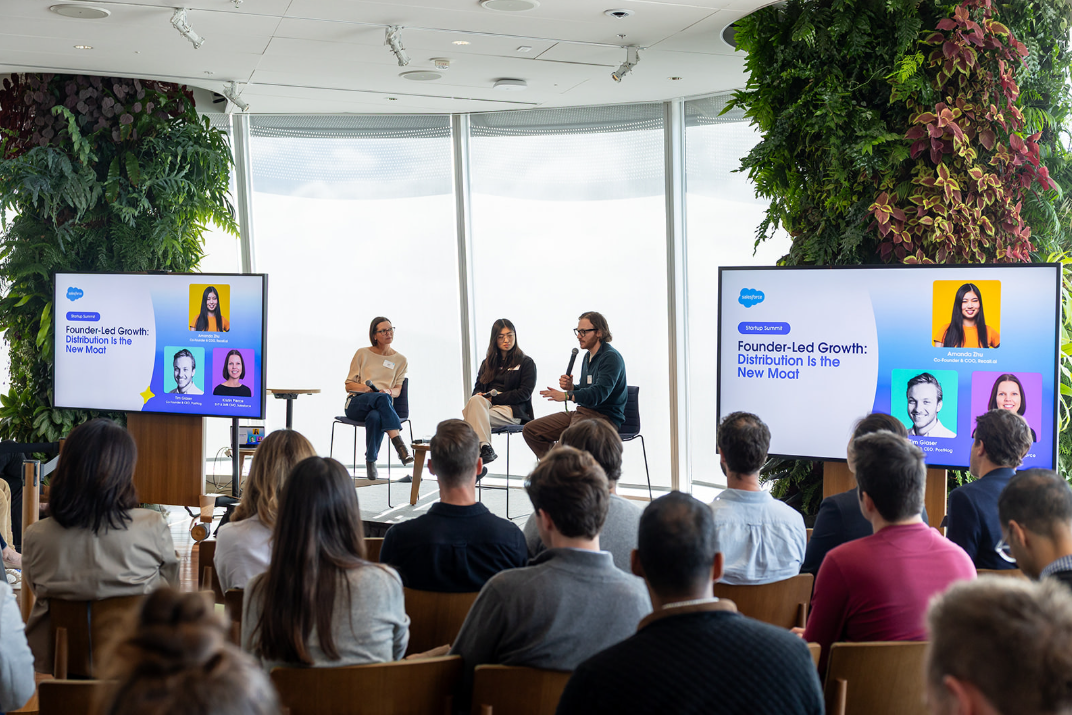
Pierce opened with the question every early-stage founder wrestles with: Which growth channels would you double down on? The answers were different, but the underlying principle was the same: Earn trust before you earn revenue.
For Zhu, that meant showing up on LinkedIn with radical transparency — sharing the journey of building new infrastructure before the product was fully launched. In a category with no established competitors to benchmark against, Recall.ai couldn’t rely on comparison reviews or analyst rankings. Instead, they built credibility through content, giving potential customers a front-row seat to the build. “You have to help your market understand why they need you before they’ll ever buy from you,” Zhu noted. It’s a harder road — but it creates buyers who are already believers.
Glaser took a product-led approach at PostHog, anchoring distribution in transparency and community. A public company handbook, open-source roots, and a deeply engaged developer community created a self-sustaining loop: Developers trusted PostHog because they could see everything, and that trust turned into advocacy, feedback, and organic viral growth into new technical teams. “Transparency builds trust — and trust becomes distribution,” Glaser stated. The challenge? Retaining customers as the organizations that champion you internally change over time. Glaser’s answer: Build trust early, turn users into advocates, and make the product indispensable.
Both founders represent exactly the kind of bold, category-defining ambition Salesforce Launchpad is designed to support — the founders who are moving fast, building something the market doesn’t fully understand yet, and figuring out distribution as they go.
Key takeaways:
Building out agentic teams and running them on a central operating system was the topic of conversation with Vercel and Slack. Jeanne DeWitt Grosser, COO of Vercel, and Rob Seaman, EVP & GM at Slack, discussed how Vercel, a leader in AI cloud infrastructure, uses Slack as its primary “Agentic Operating System.”
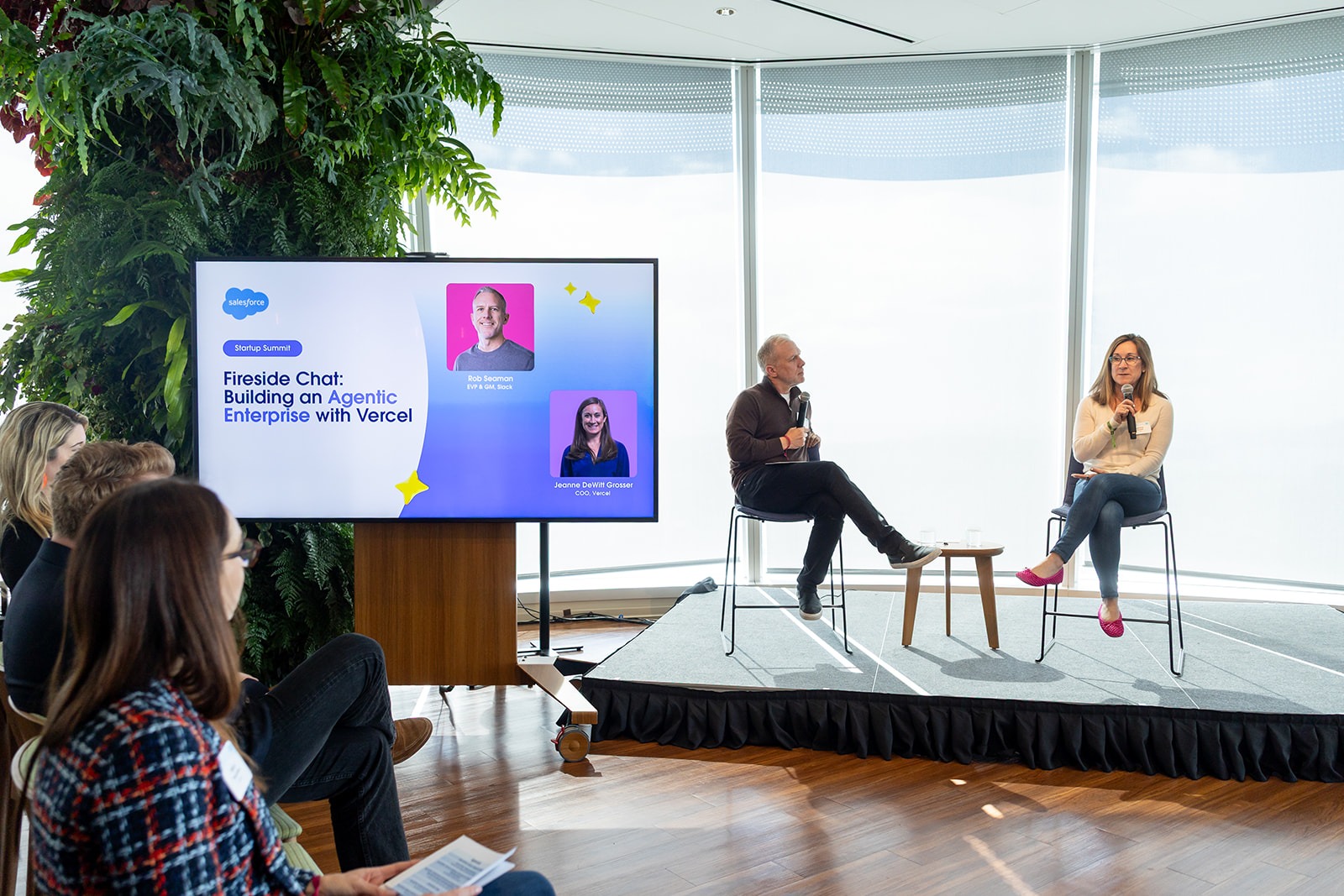
By moving all internal work to Slack and eliminating email, Vercel maintains high speed as they grow and allows agents to work together with human employees more seamlessly. “Every conversation becomes training data for smarter internal AI,” DeWitt Grosser shared. This “Slack-pilled” culture turns every conversation into valuable data used to build and train their own internal AI agents.
This setup allows Vercel to build tools directly where people work. For example, they integrated their AI app builder, v0, into Slack so anyone can create web interfaces just by typing prompts in a thread. They also use agents to handle big tasks like qualifying leads. In one case, an AI agent helped them scale their sales reach so effectively they could manage the same workload with a much smaller, more focused team. Seaman said it best here, “The future of work is humans and agents operating together in the same workflows.”
Key Takeaways:
Salesforce is making it easier for businesses to find, test, and deploy the specialized agents they need to automate complex workflows. The final session of the summit featured Tyler Carlson, SVP, Head of Product AgentExchange & Ecosystem, Salesforce, who introduced the Salesforce AgentExchange. This initiative aims to streamline the agent ecosystem by unifying several disparate marketplaces into a single, cohesive platform.
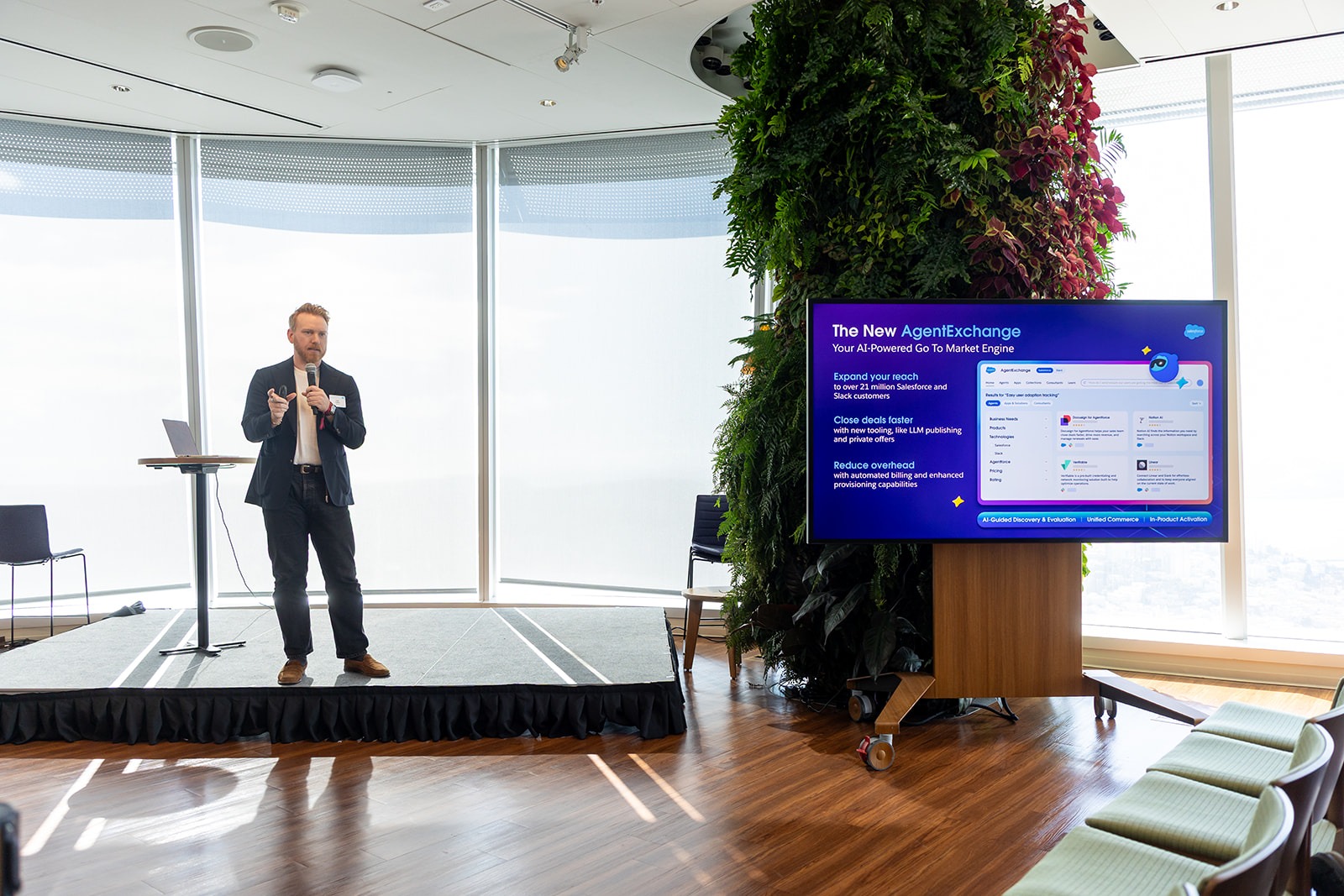
The AgentExchange is built on several key technological pillars. AI-Powered Discovery uses an AI search service optimized for LLM-powered discovery, helping users find the right tools more intuitively. Unified Commerce provides new tools for licensing, provisioning, and billing that support custom enterprise pricing and private offers. Finally, In-Product Discovery integrates the exchange directly into the Agent Builder and Slack, ensuring that users can discover new skills and actions without leaving their existing flow of work.
Carlson also announced the Builder Funding initiative. Salesforce has committed a $50 million fund to support developers and builders through co-innovation and lead funding programs. This underscores Salesforce’s commitment to building a powerful community of creators who will build the next generation of agentic solutions.
Takeaways from this session:
The message from this year’s Startup Summit was unmistakable: The founders who move boldly into the agentic era — who rethink their teams, their distribution, and their operating models — are the ones who will define the next decade of business.
AI agents aren’t a distant horizon. They’re here, and the most ambitious founders are already using them to do things that simply weren’t possible before: Scaling sales with a team of three, achieving 70% email open rates through hyper-personalization, and building infrastructure that entire developer communities rally around. The playbook is being written in real time — and this summit was a front-row seat to that moment.
As the playbooks are constantly evolving, Salesforce Launchpad is here to help you at every stage of growth. Whether you’re figuring out your first GTM motion or already in hypergrowth, Launchpad helps you move with speed and confidence at every stage.
Get a front-row seat to the summit and see these strategies in action with live demos of Agentforce and Slack, plus the unscripted founder Q&As.



Ready to build with us? Salesforce Launchpad is designed for VC-backed founders who are moving fast and thinking big — bringing together curated resources, events, free and discounted solutions, and direct access to the Salesforce ecosystem.
Want to learn more? Apply to Launchpad and see the possibilities.
AI supported the writers and editors who created this article.
此内容由惯性聚合(RSS阅读器)自动聚合整理,仅供阅读参考。 原文来自 — 版权归原作者所有。