惯性聚合 高效追踪和阅读你感兴趣的博客、新闻、科技资讯
阅读原文 在惯性聚合中打开

推荐订阅源

cs.AI updates on arXiv.org
L
LINUX DO - 最新话题
OSCHINA 社区最新新闻
OSCHINA 社区最新新闻
Forbes - Security
Forbes - Security
博客园 - 司徒正美
Hugging Face - Blog
Hugging Face - Blog
W
WeLiveSecurity
Jina AI
Jina AI
钛媒体:引领未来商业与生活新知
钛媒体:引领未来商业与生活新知
N
News and Events Feed by Topic
V
V2EX
Stack Overflow Blog
Stack Overflow Blog
Engineering at Meta
Engineering at Meta
PCI Perspectives
PCI Perspectives
Martin Fowler
Martin Fowler
T
The Exploit Database - CXSecurity.com
F
Full Disclosure
WordPress大学
WordPress大学
S
Security Affairs
K
KPMG report finds enterprise disconnect between AI and its ROI | CIO
S
SegmentFault 最新的问题
P
Privacy International News Feed
IT之家
IT之家
M
MIT News - Artificial intelligence
G
GRAHAM CLULEY
Hacker News: Ask HN
Hacker News: Ask HN
D
DataBreaches.Net
奇客Solidot–传递最新科技情报
奇客Solidot–传递最新科技情报
Google Online Security Blog
cs.CV updates on arXiv.org
C
Check Point Blog
美团技术团队
Security Latest
Security Latest
Cyberwarzone
Cyberwarzone
N
News and Events Feed by Topic
MyScale Blog
MyScale Blog
H
Help Net Security
宝玉的分享
宝玉的分享
The Hacker News
The Hacker News
The Last Watchdog
The Last Watchdog
The Cloudflare Blog
Cyber Security Advisories - MS-ISAC
爱范儿
爱范儿
cs.CL updates on arXiv.org
I
Intezer
Threat Intelligence Blog | Flashpoint
AI
AI
I
InfoQ
N
News | PayPal Newsroom
TaoSecurity Blog
TaoSecurity Blog

Salesforce

How We Protect Our Data as Customer Zero Scale Your MRR: Subscription Management For Small Business Streamlining Commerce Media Ad Inventory Management 12 AI Sales Strategies for Startups That Actually Work Sell Smarter: Ecommerce Metrics To Track For Your Small Business Shop Apply the Orchestration Density Framework to Your Next Automation Decision Wait, Black Friday Planning In Spring? It’s Time to Start Holiday Promotions AI-First Operations, One Process at a Time How BCU Is Transforming Banking Service with Agentforce Salesforce Headless 360: What the Agent Consumer Means for Your Integration Architecture Meet Customers Where They Are: Agentforce Contact Center Now Offers WhatsApp Voice 11 Free Lead Generation Tips for Small and Growing Businesses SFR-VibeTrain: The Agent That Trains Agents Why Technical Accuracy is the Wrong Metric for Agent Success Strengthening Salesforce Security Against AI-Driven Threats Join Us in the Community Hub at Connections 2026 The Best Way To Build AI Agents That Customers Trust 5 Ways AI is Changing the Communication Game For Startups Trust in the Era of Agents: Highlights from the 2nd Annual Trusted AI Impact Report You Can Be an Agentic Enterprise No Matter What Size Business How to Make Your Email Marketing Accessible for Everyone What is Headless? Don’t Lose Your Head, SMBs: It’s a Good Thing Architect the Future UI: Slack as Your Agentic Surface Point of Sale Innovations to Modernize the Shopper Experience Governing the Agentic Enterprise at Scale with MuleSoft Omni Gateway How to Cut Service Time with Case Routing Automation 5 Tips for Marketers to Get Started with Salesforce Flow No One is Vibe Coding Trade Promotion Management 7th Edition State of Sales Report: 3 Growth Trends for Startups and SMBs How the Architect Vista Brought Architectural Thinking to Life at TDX 2026 5 Steps to Develop an Architect Mindset With AI Why AI Isn’t Replacing Developers, It’s Empowering Them AI in Design 2025: What Real Use Taught Us. How Salesforce Personalization Learns Which Offers Drive Revenue The 4-Step Guide to Salesforce Agent and Application Development Get Ready for Connections 2026: Top Sessions and New Reveals 8 Ways AI Agents Are Evolving in 2026 4 Principles to Make the Right Salesforce UI Decisions Apprentice Journey Shines a Light on Talent Pathways at Salesforce Agent Script: The Control Plane for Agentic Decisions Scaling the Agentforce Life Sciences Ecosystem to Drive the Future of Pharma and MedTech Unlocking Unstructured Data: Building AI-Powered Support Triage with Data 360 Asking For a Friend: What Are Rich Communication Services (RCS)? 5 Slack Shortcuts For Small Teams 195% ROI In Field Service? Here’s How They Did It Submit Your Architect Session: The Dreamforce 2026 Call for Participation Is Open What Is an AI Assistant for Small Business? B2C Commerce April release: Transforming the B2C developer experience with agents Meet Your 24/7 Prospecting Partner — And 5 More Stand-Out Features In Our April Release 11+ Small Business YouTube Channels You Need to Follow Today Stop Treating Disputes Management Like IT Tickets Limitless Service: A New Operating Model for Growth in the Agentic Era What is Transactional Reconciliation in Email and SMS Marketing? How to Prepare for National Small Business Week (2026) How to Design a High-Scale Multi-Cloud Incident Journey 10 Ways An AI CRM Can Amplify Your Startup Vibe Code Better Agents with Agentforce Free vs. Paid CRM: Which is Right for Your Business? Salesforce Customer Success Awards 2026: Lead Era of the Agentic Enterprise 12 Free Webinars for Small Business Owners (2026) The Agentforce Life Sciences Consultant Certification Maximize Growth: The Power of Partnerships for SMBs Salesforce AI Research at ICLR 2026 Data Protection For Small Business: How To Safeguard Yourself Beyond 100K Tokens: Evaluating AI Agents in Long-Context Software Engineering Top 32 Small Business Tools To Try Today 6 New Innovations Redefining Salesforce Development How to Win the Battle for Attention in the Agentic Email Inbox Mastering the Eisenhower Matrix: Prioritize Like a Pro 10 Signs It’s Time To Upgrade Your CRM and How To Get Started (2026) Celebrating 10 Years of Financial Services Innovation How SMBs Can Gain An Edge With Agentic AI: Key Trends From Our Marketing Report How MAN Truck & Bus is Shaping the Future of Sales with Salesfive Introducing the Future of Salesforce Data Protection: Backup & Recover Next Stop Making AI Slop – Build a Foundation for Authentic AI Content 5 Tips to Help Marketers Navigate AI Email Summaries Data Sharing: Is it Safe? Is it Secure? Everything You Need to Know Small Business Week Readiness: 4 Things to Do Before May (2026) How Salesforce Employees Make an Impact During Earth Month AI Agents Are Advancing Rapidly… Is Your Testing Strategy Keeping Up? What Is Microproductivity and Why Is It Helping So Many Teams? TDX 2026 Roundup: Agentforce Edition 3 Ways Salesforce Connections Has Boosted My Career AI Agents Don’t Just Answer‌ — ‌They Act. Do You Have a Governance Strategy? The Future of MedTech Field Execution is Agentic 5 Steps to Prepare Your Data For an AI CRM From Break/Fix to Profit Engine: Aftermarket Service for Robot OEMs Building Trusted Human-Agent Collaboration: A Practical Framework ISV Strategy for the Salesforce Summer ’26 Release 5 Email Marketing Tips for Small Business Commerce Shops Should You Give Your AI Agent a Human Name? Creating Pathways into AI for People with Disabilities The Organized Chaos of Upfronts: 3 Hurdles Impacting Your Yield Trying to Scale Beyond ‘One-Off’ AI Tasks? You’re Probably Using the Wrong Interface What is Cost Per Lead (CPL)? The Case for Unified CCaaS and CRM — And Why the Data Makes It Clear In the New Era of AI, You Need to Win Over Both Humans and Agents What Is SPIN Selling? A Way to Build Trust With Your Customers G2 Crowns Salesforce as Best Financial Services Software Hidden Insights: The Guide to Tableau For Small Business Owners
10 Ways to Make Your AI Agent a Better Communicator
Hilary Hayes · 2026-05-05 · via Salesforce

When customers turn to an AI agent for help, they’re not just looking for information — they want to feel understood. An agent that delivers accurate answers but stumbles over tone, structure, or empathy isn’t fully serving the people who depend on it. Fortunately, building with proven conversation design principles can ensure that your agents are effective conversationalists that excel at solving real customer problems.

These 10 practices come from our own experience building the Agentforce on Help support agent at Salesforce. We’re sharing them because the same principles that made our agent more effective can help yours deliver better, more trustworthy experiences. 

1. Follow a Structured Response Framework

Customers want answers that are easy to scan and understand quickly. When an agent follows a predetermined template, you can ensure the most important details are prioritized, whether that’s the immediate solution, next steps, or additional resources.

  • How to Apply: Create a standardized library of response templates to ensure consistency and scalability. Each template should follow a clear structure, typically including 3 to 5 steps, a helpful link, and a contextual follow-up question.

2. Maintain Brand Voice Consistency

Customers are building a relationship with your brand through every agent interaction. A consistent voice makes customers feel like they’re talking to the same knowledgeable expert every time, which builds trust and familiarity.

  • How to Apply: Create a Voice and Tone guide tailored specifically for your agents. Voice reflects your brand’s personality; tone is how it speaks in a given moment. Include specific adjectives (for example, “friendly, but professional”) and examples of on-brand versus off-brand phrasing. If you have multiple agents, they can have varying tones depending on your use case and audience.

3. Handle Difficult Interactions Professionally

When a customer is frustrated, they want to feel heard, not lectured. It’s important to redirect agent responses toward solutions, without judgment, to de-escalate tension and get customers the help they came for.  

  • How to Apply: If abusive language is detected, the instructions for your agent should focus on reactively setting clear boundaries, staying calm, professional, and empathetic. Have your agent escalate to a human when it cannot solve the problem with its current capabilities or the solution requires human-level nuance.

4. Use Smart Disambiguation

No one wants to waste time with AI that consistently guesses wrong. When a customer’s question could mean multiple things, a well-designed agent asks targeted clarifying questions, not a generic “tell me more.”

  • How to Apply: Instruct your agent to clarify intent by asking only one question at a time, preferably open-ended, and ending with a prompt for the customer’s response. Ultimately, your agent should be a good conversationalist who shows curiosity and seeks understanding by asking questions, making the user feel heard.

5. Use Consistent Terminology

Customers shouldn’t have to decode unfamiliar terms or second-guess what the agent means. Consistent terminology reduces confusion and builds trust, making every future interaction feel smoother.

  • How to Apply: When writing agent instructions, including greetings and error messages, be sure to include language from your company’s brand guidelines. Defining key terms — including proprietary, common industry, and persona-specific language — ensures the agent is communicating with your customers in a relatable and understandable way. 

6. Structure Lists Effectively

When customers need to follow steps or choose between options, the information should be scannable at a glance. Well-structured lists help people quickly identify what’s relevant without reading through noise.

  • How to Apply: It’s okay to prioritize clarity over compression when needed. A short answer that leaves out important information won’t help your customer solve things faster. To keep things concise without eliminating necessary context, instruct the agent to group related steps to improve flow and ask clarifying questions before presenting a list to avoid unnecessary branching.

7. Be Strategic with Links

The right number of links helps customers get deeper support when they need it, without overwhelming them. Strategic linking means pointing to the most relevant resource for a specific situation, not a dump of generic articles.

  • How to Apply: Use links to keep replies concise. Have your agent surface the most relevant links in order of priority, using descriptive anchor text rather than just URLs.

8. Apply Thoughtful Apology Logic

Customers want acknowledgment when things genuinely go wrong, but excessive apologies make interactions feel hollow and scripted. An appropriate apology validates the experience and keeps focus on solving the problem, and that matters for trust.

  • How to Apply: Program your agent to express empathy and acknowledgment, but only apologize for actual errors. Avoid over-apologizing to keep the agent credible and the conversation moving forward.

9. Design Engagement Patterns Intentionally

Agentic conversations should feel natural and helpful, not robotic or pushy. Good engagement means greeting customers appropriately, offering proactive suggestions when they’re genuinely useful, and winding down conversations naturally.

  • How to Apply: Craft a greeting that makes a good first impression and demonstrates real value. Define what conditions should trigger proactive outreach versus waiting for the customer to lead. Use tapering to gradually reduce the formality and verbosity of your agent’s responses as users become more familiar with the system. (A formal introduction makes sense when meeting someone for the first time — but the same introduction on a second meeting would feel strange, like they don’t remember you.) Let conversations close naturally once a customer’s needs have been met.

10. Handle Off-Topic Moments Gracefully

Customers should be gently guided back to getting help without feeling shut down. Your agent can acknowledge a friendly question while steering the conversation back on track.

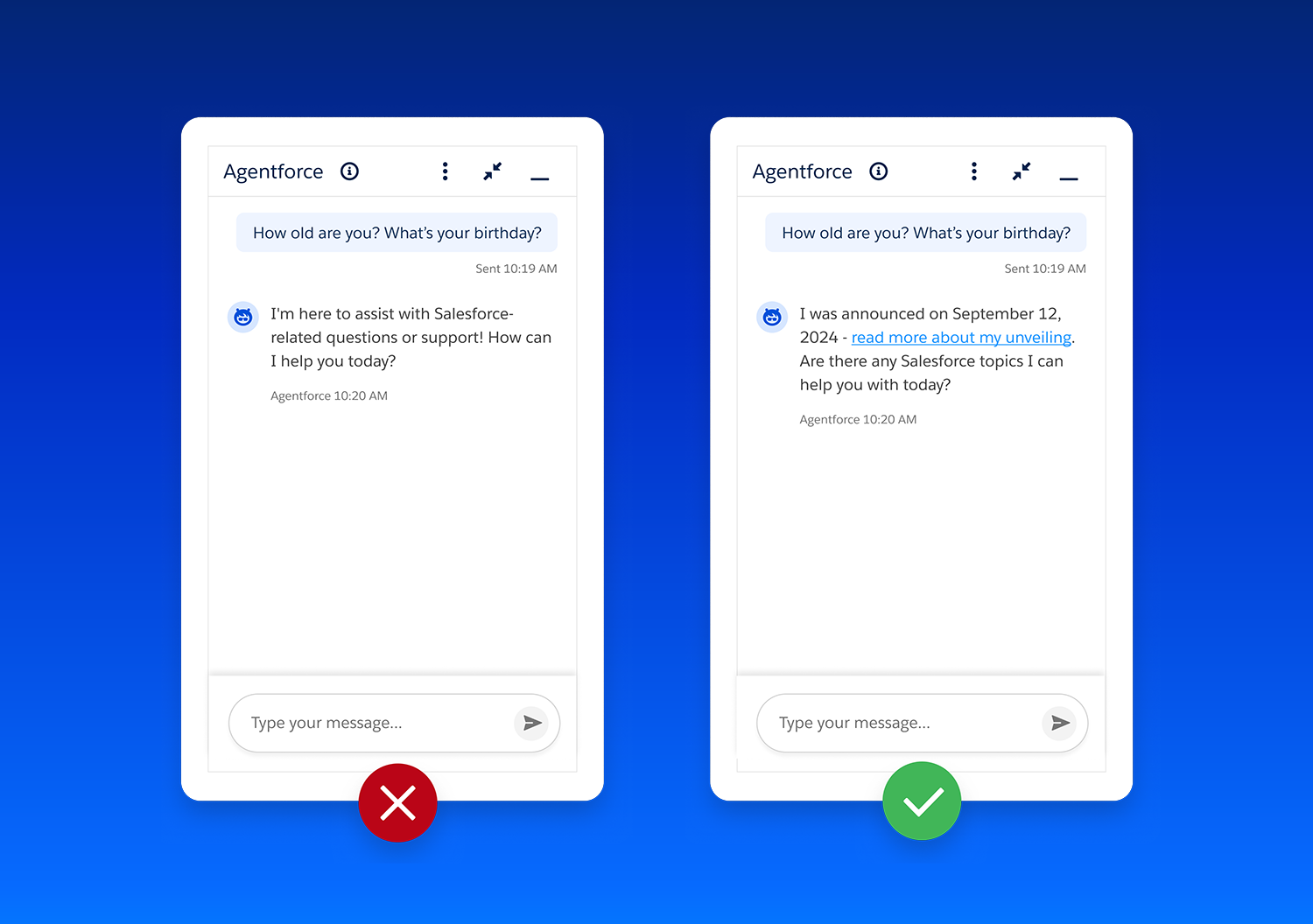
  • How to Apply: Map common off-topic or chit-chat queries to conversational, on-brand responses. Moments like “What’s your favorite color?” or “When is your birthday?” are opportunities to reinforce your brand’s personality. A well-handled off-topic exchange builds goodwill and trust, signaling that your agent is designed with care.
Image on the left has a red X to show "don't do this" and has user asking an agent what their birthday is. The agent ignores question and responds generically. To the right image has a green "do this" checkmark with the same user question but this time the agent shares the date it was launched, with a link to an announcement, then asks how it can help the customer today.
Reinforce your brand to create a consistent customer experience and build trust.

The Bottom Line

These principles work together to make customers feel like they’re getting help from a consistent, empathetic expert who understands both your product and how to communicate with people under stress. When your agent earns that trust through every interaction, your brand becomes something customers rely on and return to. 

Want to go deeper? Discover how conversation design empowers agentic AI.