
惯性聚合 高效追踪和阅读你感兴趣的博客、新闻、科技资讯
阅读原文 在惯性聚合中打开

推荐订阅源

B
Blog RSS Feed
Threat Intelligence Blog | Flashpoint
G
GRAHAM CLULEY
Hacker News - Newest:
Hacker News - Newest: "LLM"
C
Cybersecurity and Infrastructure Security Agency CISA
Simon Willison's Weblog
Latest news
Latest news
C
CERT Recently Published Vulnerability Notes
T
Threatpost
V
Vulnerabilities – Threatpost
AWS News Blog
AWS News Blog
Blog — PlanetScale
Blog — PlanetScale
C
Cisco Blogs
cs.AI updates on arXiv.org
U
Unit 42
The Register - Security
T
The Blog of Author Tim Ferriss
Stack Overflow Blog
Stack Overflow Blog
The Hacker News
The Hacker News
AI
AI
Project Zero
Project Zero
Scott Helme
Scott Helme
S
Securelist
Vercel News
Vercel News
GbyAI
GbyAI
S
Security @ Cisco Blogs
I
InfoQ
aimingoo的专栏
aimingoo的专栏
Cyber Security Advisories - MS-ISAC
C
Check Point Blog
Forbes - Security
Forbes - Security
Google Online Security Blog
W
WeLiveSecurity
CTFtime.org: upcoming CTF events
H
Heimdal Security Blog
G
Google Developers Blog
D
DataBreaches.Net
The Last Watchdog
The Last Watchdog
D
Docker
MyScale Blog
MyScale Blog
T
Tor Project blog
Cyberwarzone
Cyberwarzone
Recent Announcements
Microsoft Security Blog
T
Tenable Blog
T
Threat Research - Cisco Blogs
Cisco Talos Blog
Cisco Talos Blog
H
Hackread – Cybersecurity News, Data Breaches, AI and More
博客园 - 聂微东
月光博客
月光博客

Salesforce

How We Protect Our Data as Customer Zero Scale Your MRR: Subscription Management For Small Business Streamlining Commerce Media Ad Inventory Management 12 AI Sales Strategies for Startups That Actually Work Sell Smarter: Ecommerce Metrics To Track For Your Small Business Shop Apply the Orchestration Density Framework to Your Next Automation Decision Wait, Black Friday Planning In Spring? It’s Time to Start Holiday Promotions AI-First Operations, One Process at a Time How BCU Is Transforming Banking Service with Agentforce Salesforce Headless 360: What the Agent Consumer Means for Your Integration Architecture Meet Customers Where They Are: Agentforce Contact Center Now Offers WhatsApp Voice 11 Free Lead Generation Tips for Small and Growing Businesses SFR-VibeTrain: The Agent That Trains Agents Why Technical Accuracy is the Wrong Metric for Agent Success Strengthening Salesforce Security Against AI-Driven Threats Join Us in the Community Hub at Connections 2026 The Best Way To Build AI Agents That Customers Trust 5 Ways AI is Changing the Communication Game For Startups Trust in the Era of Agents: Highlights from the 2nd Annual Trusted AI Impact Report You Can Be an Agentic Enterprise No Matter What Size Business How to Make Your Email Marketing Accessible for Everyone What is Headless? Don’t Lose Your Head, SMBs: It’s a Good Thing Architect the Future UI: Slack as Your Agentic Surface Point of Sale Innovations to Modernize the Shopper Experience Governing the Agentic Enterprise at Scale with MuleSoft Omni Gateway How to Cut Service Time with Case Routing Automation 5 Tips for Marketers to Get Started with Salesforce Flow No One is Vibe Coding Trade Promotion Management 7th Edition State of Sales Report: 3 Growth Trends for Startups and SMBs How the Architect Vista Brought Architectural Thinking to Life at TDX 2026 5 Steps to Develop an Architect Mindset With AI Why AI Isn’t Replacing Developers, It’s Empowering Them 10 Ways to Make Your AI Agent a Better Communicator AI in Design 2025: What Real Use Taught Us. How Salesforce Personalization Learns Which Offers Drive Revenue The 4-Step Guide to Salesforce Agent and Application Development Get Ready for Connections 2026: Top Sessions and New Reveals 8 Ways AI Agents Are Evolving in 2026 4 Principles to Make the Right Salesforce UI Decisions Apprentice Journey Shines a Light on Talent Pathways at Salesforce Agent Script: The Control Plane for Agentic Decisions Scaling the Agentforce Life Sciences Ecosystem to Drive the Future of Pharma and MedTech Unlocking Unstructured Data: Building AI-Powered Support Triage with Data 360 Asking For a Friend: What Are Rich Communication Services (RCS)? 5 Slack Shortcuts For Small Teams 195% ROI In Field Service? Here’s How They Did It Submit Your Architect Session: The Dreamforce 2026 Call for Participation Is Open What Is an AI Assistant for Small Business? B2C Commerce April release: Transforming the B2C developer experience with agents Meet Your 24/7 Prospecting Partner — And 5 More Stand-Out Features In Our April Release 11+ Small Business YouTube Channels You Need to Follow Today Stop Treating Disputes Management Like IT Tickets Limitless Service: A New Operating Model for Growth in the Agentic Era What is Transactional Reconciliation in Email and SMS Marketing? How to Prepare for National Small Business Week (2026) How to Design a High-Scale Multi-Cloud Incident Journey 10 Ways An AI CRM Can Amplify Your Startup Vibe Code Better Agents with Agentforce Free vs. Paid CRM: Which is Right for Your Business? Salesforce Customer Success Awards 2026: Lead Era of the Agentic Enterprise 12 Free Webinars for Small Business Owners (2026) The Agentforce Life Sciences Consultant Certification Maximize Growth: The Power of Partnerships for SMBs Salesforce AI Research at ICLR 2026 Data Protection For Small Business: How To Safeguard Yourself Top 32 Small Business Tools To Try Today 6 New Innovations Redefining Salesforce Development How to Win the Battle for Attention in the Agentic Email Inbox Mastering the Eisenhower Matrix: Prioritize Like a Pro 10 Signs It’s Time To Upgrade Your CRM and How To Get Started (2026) Celebrating 10 Years of Financial Services Innovation How SMBs Can Gain An Edge With Agentic AI: Key Trends From Our Marketing Report How MAN Truck & Bus is Shaping the Future of Sales with Salesfive Introducing the Future of Salesforce Data Protection: Backup & Recover Next Stop Making AI Slop – Build a Foundation for Authentic AI Content 5 Tips to Help Marketers Navigate AI Email Summaries Data Sharing: Is it Safe? Is it Secure? Everything You Need to Know Small Business Week Readiness: 4 Things to Do Before May (2026) How Salesforce Employees Make an Impact During Earth Month AI Agents Are Advancing Rapidly… Is Your Testing Strategy Keeping Up? What Is Microproductivity and Why Is It Helping So Many Teams? TDX 2026 Roundup: Agentforce Edition 3 Ways Salesforce Connections Has Boosted My Career AI Agents Don’t Just Answer‌ — ‌They Act. Do You Have a Governance Strategy? The Future of MedTech Field Execution is Agentic 5 Steps to Prepare Your Data For an AI CRM From Break/Fix to Profit Engine: Aftermarket Service for Robot OEMs Building Trusted Human-Agent Collaboration: A Practical Framework ISV Strategy for the Salesforce Summer ’26 Release 5 Email Marketing Tips for Small Business Commerce Shops Should You Give Your AI Agent a Human Name? Creating Pathways into AI for People with Disabilities The Organized Chaos of Upfronts: 3 Hurdles Impacting Your Yield Trying to Scale Beyond ‘One-Off’ AI Tasks? You’re Probably Using the Wrong Interface What is Cost Per Lead (CPL)? The Case for Unified CCaaS and CRM — And Why the Data Makes It Clear In the New Era of AI, You Need to Win Over Both Humans and Agents What Is SPIN Selling? A Way to Build Trust With Your Customers G2 Crowns Salesforce as Best Financial Services Software Hidden Insights: The Guide to Tableau For Small Business Owners
Beyond 100K Tokens: Evaluating AI Agents in Long-Context Software Engineering
Jielin Qiu, · 2026-04-22 · via Salesforce

As codebases grow to millions of lines of code, can AI agents still understand, reason, and code effectively? LoCoBench-Agent delivers the answer: a comprehensive benchmark for evaluating AI coding assistants across contexts ranging from 10K to 1M tokens, a 100× increase in scale.

Introduction: The Scale Challenge in AI-Powered Development

Imagine asking your AI coding assistant to debug an authentication issue in a microservices architecture with 500,000 lines of code spread across 80 files. Or implementing a new feature that requires instant mastery of architectural patterns hidden within a  million-line enterprise codebase. 

These aren’t hypothetical scenarios, they are everyday realities in modern software development. Yet most AI benchmarks only test models on small, isolated tasks: write a single function, fix a bug in one file. Real software engineering operates at a massively different scale.

The critical question for enterprises: Do AI coding assistants maintain their effectiveness as codebase size scales 100×? At Salesforce AI Research, we built LoCoBench-Agent to put that to the test..

Why Long-Context Coding Matters for Enterprise

The reality is this:

– 10K tokens (~3,000 lines): A small Python service

– 100K tokens (~30,000 lines): A medium web application

– 500K tokens (~150,000 lines): A complex microservices system

– 1M tokens (~300,000 lines): An enterprise-scale codebase

As context grows, AI assistants face mounting challenges: surfacing relevant code from millions of tokens, focusing on critical patterns, and maintaining consistency across long-running conversations. . For businesses scaling their AI investment  understanding these limitations is critical.

The bottom line: If your AI assistant can’t scale with your codebase, it remains a toy rather than a tool.
Introducing LoCoBench-Agent: Testing AI at Enterprise Scale

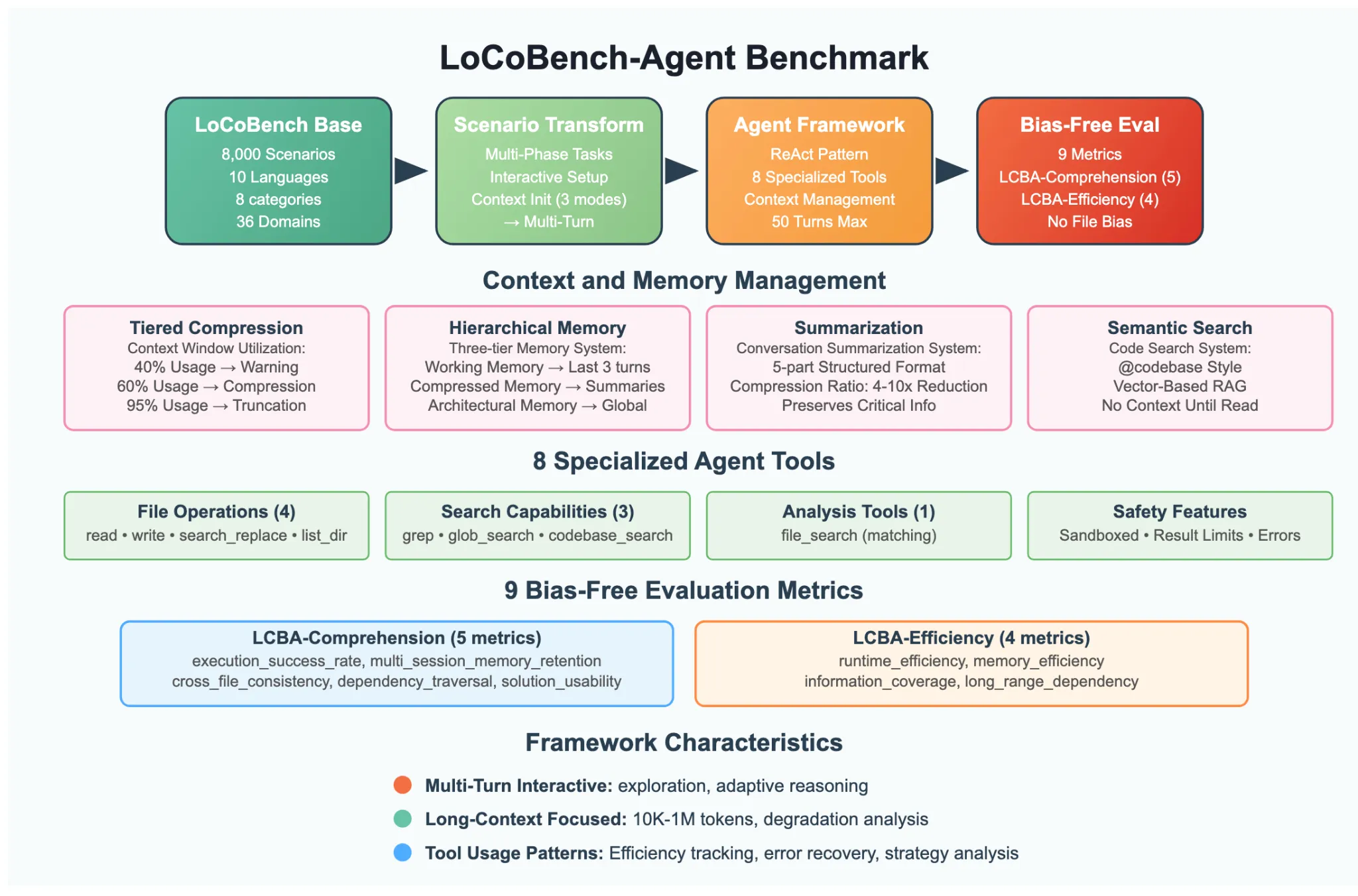
LoCoBench-Agent evaluates AI coding assistants on what matters most:realistic, long-context tasks:

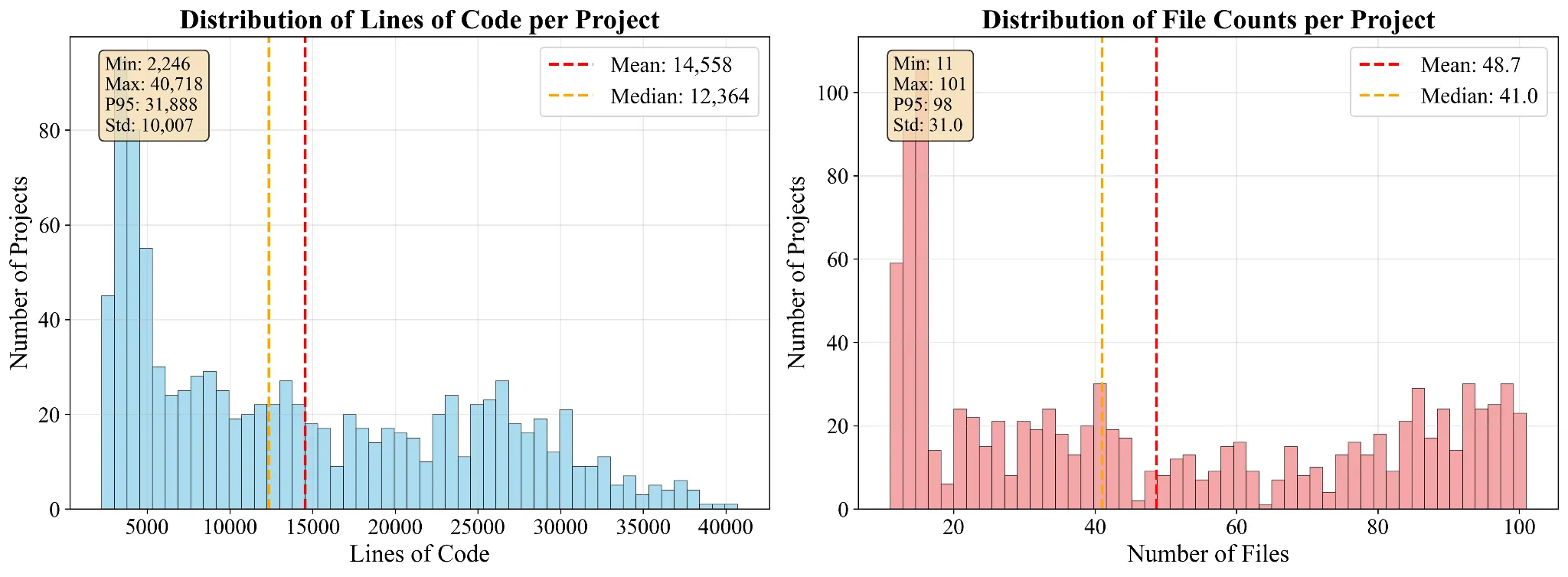
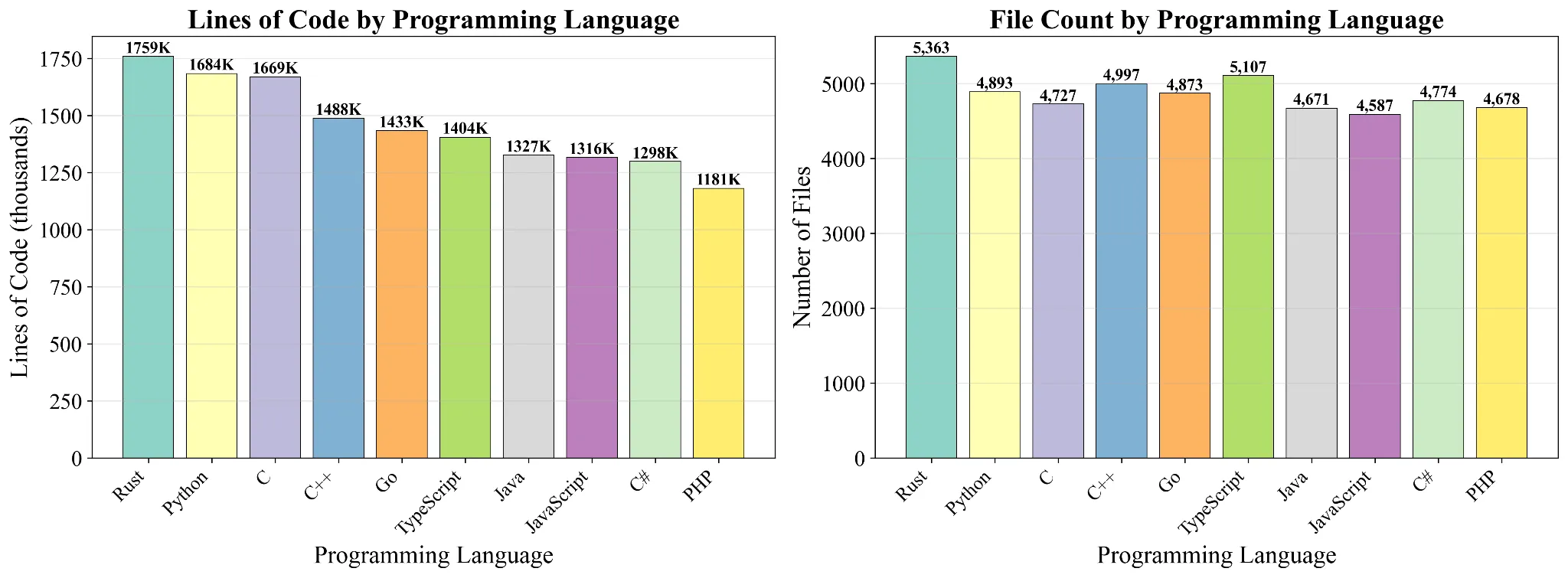
8,000 Long-Context Coding Scenarios Across 10 Languages

We test across 10 programming languages (Python, JavaScript, Java, C++, and more) on tasks developers actually do: debugging complex issues, implementing new features, refactoring code across multiple files, and conducting security audits. Every scenario requires understanding context spread across large codebases, not isolated functions.

Four Difficulty Levels = Four Context Scales

– Easy (10-50K tokens): Small services, focused tasks

– Medium (50-200K tokens): Multi-module applications

– Hard (200-500K tokens): Large systems, complex architectures  

– Expert (500K-1M tokens): Enterprise codebases with intricate dependencies

This systematic scaling reveals precisely how AI performance changes as codebases grow.
Multi-Turn Long-Context Conversations (Up to 50 Turns)

Real coding isn’t a single interaction. It’s exploration (turns 1-10), analysis (11-25), implementation (26-40), and validation (41-50). At each turn, we measure: Can the AI still remember context from earlier? Does it maintain understanding across the entire codebase?
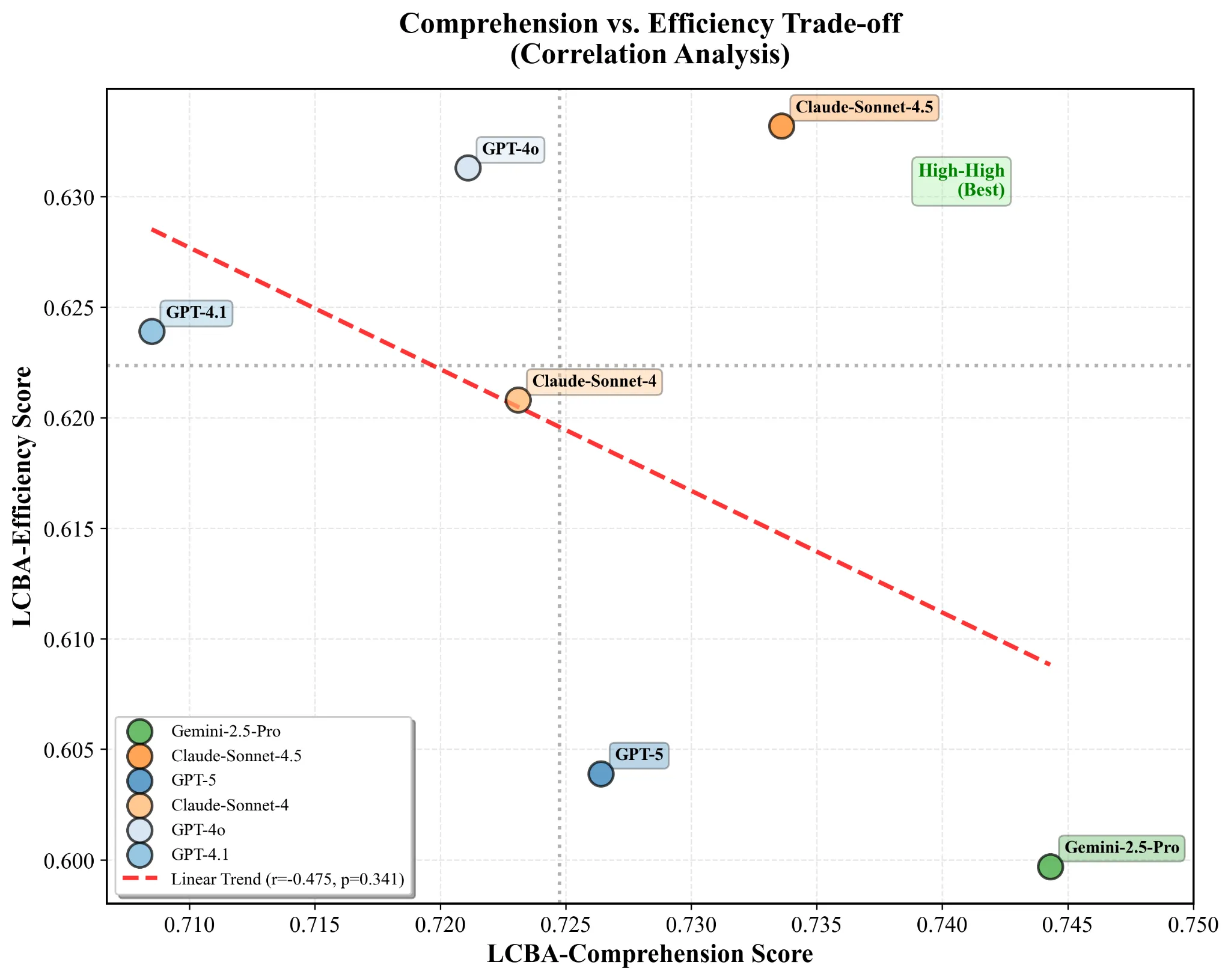
What We Learned: Insights for Enterprise Leaders

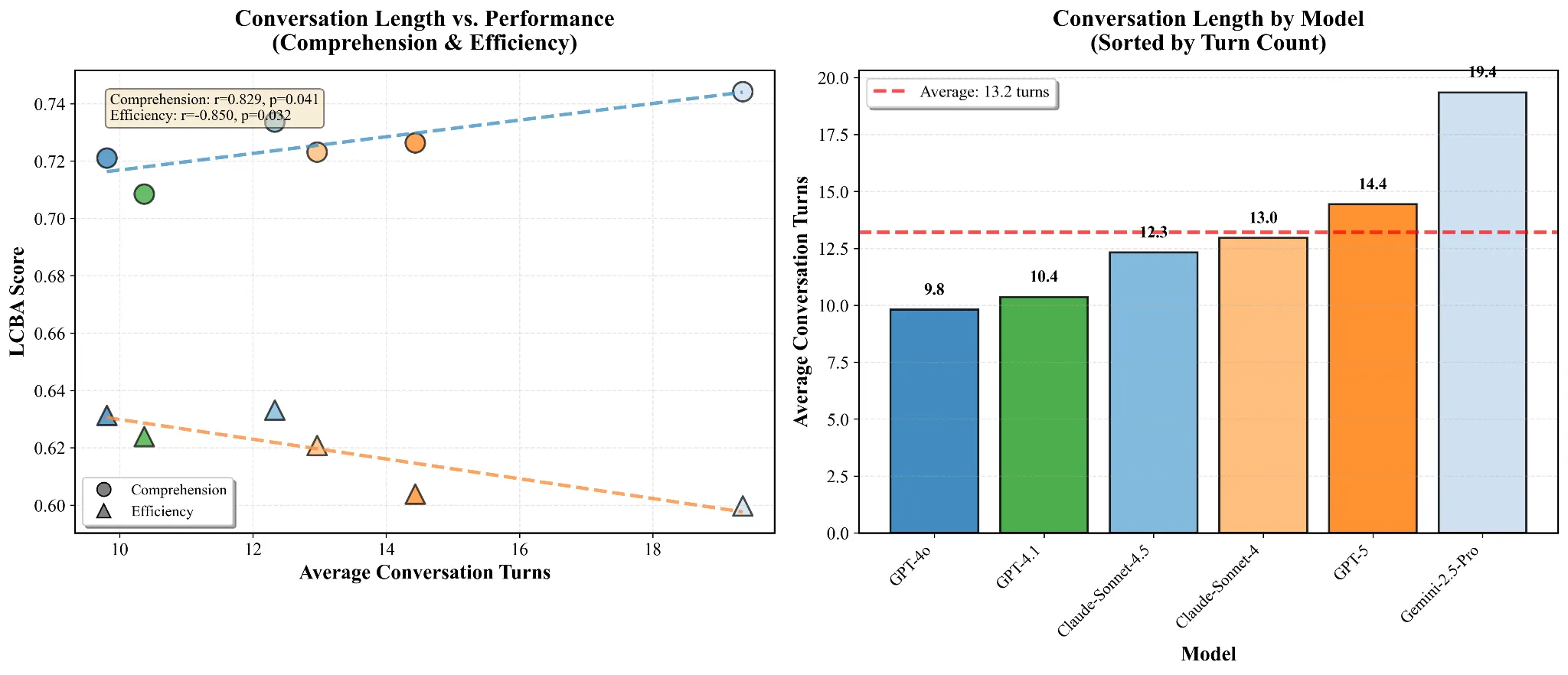
1. The Comprehension-Efficiency Trade-Off

We discovered a fundamental tension in large codebases: thorough understanding requires extensive exploration (reading many files, tracing dependencies), which takes time. But speed requires targeted, strategic work, risking missed context. 

Business impact: No current AI architecture resolves this trade-off. When evaluating AI coding tools, ask: Does your use case need deep understanding or fast execution? You may not get both.
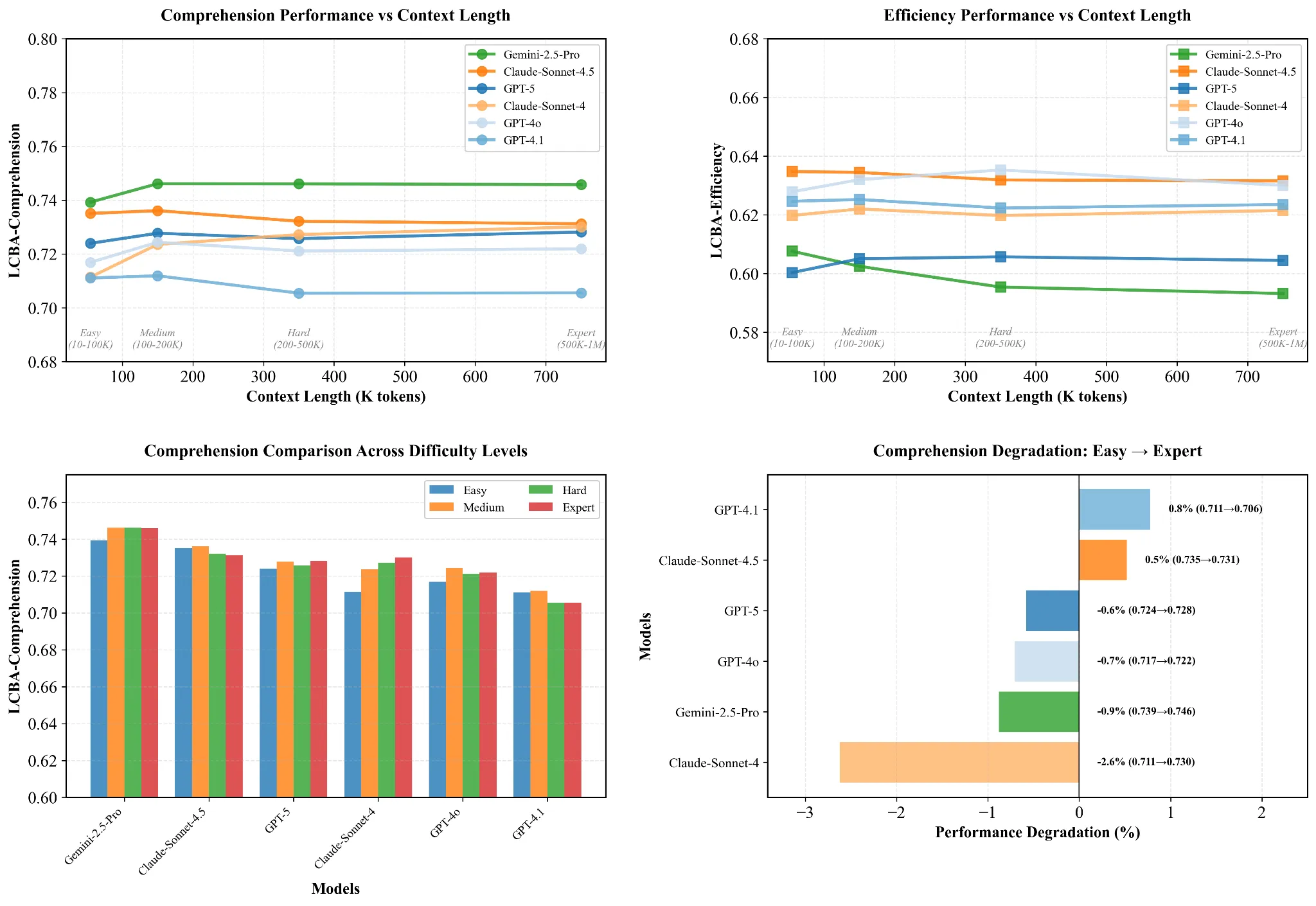
2. Context Window Size ≠ Coding Ability

Bigger context windows (1M tokens) don’t automatically mean better performance. A well-designed AI with intelligent memory management can outperform a larger model without it.

Business impact: Don’t just look at vendor specs. Architectural sophistication matters more than raw capacity. Some models with 128K windows outperform 1M-window models through smarter context management.
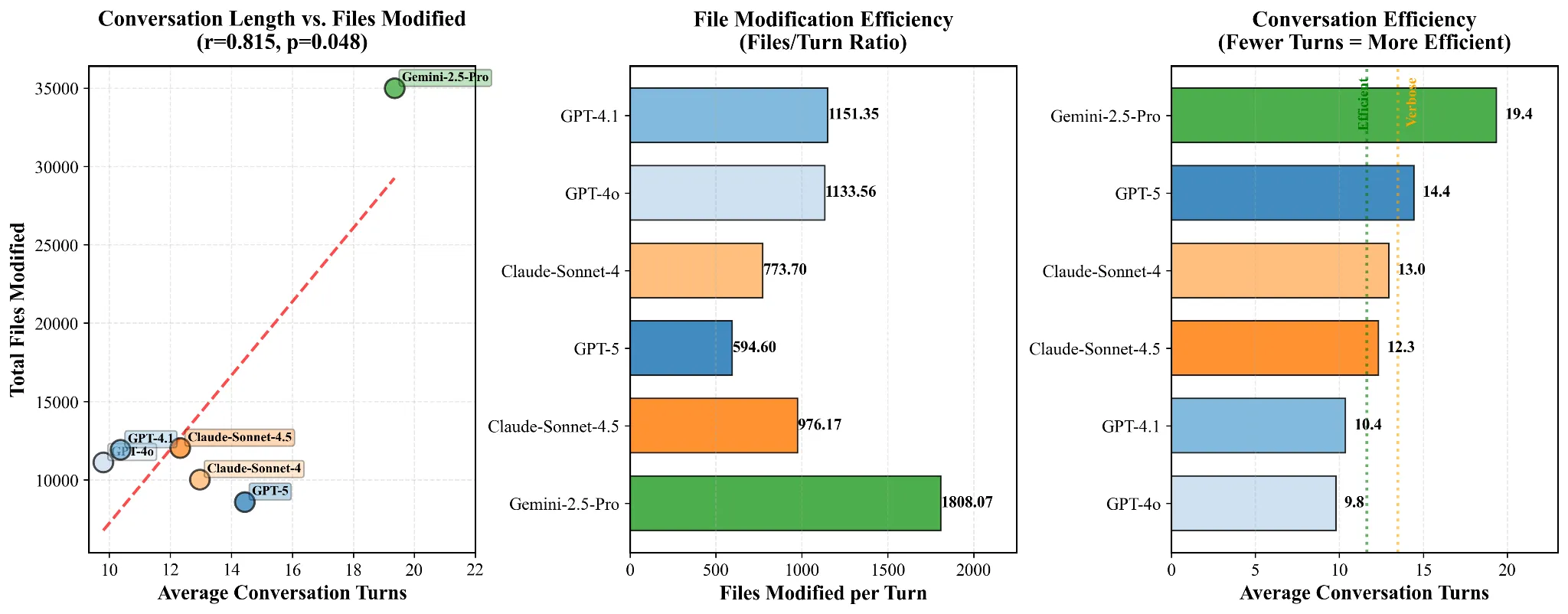
3. Strategic Exploration Beats Exhaustive Reading

Effective AIs use semantic search to identify relevant modules first, then selectively read critical files. Ineffective ones try to read everything upfront, impossible in 500K+ token codebases.

Business impact: When your codebase exceeds 100K tokens, AI exploration strategy determines success. Models using smart strategies achieve comparable understanding with 5-6% better efficiency, critical for large-scale deployments.

What This Means for Your Enterprise

As your codebases grow and AI coding assistants become critical infrastructure, understanding their limitations at scale is essential:

1. Evaluate at your scale: Test AI tools on codebases similar to yours in size and complexity. Performance on small benchmarks doesn’t predict enterprise performance.

2. Context management matters: Prioritize tools with intelligent memory management over those with just large context windows.

3. Monitor efficiency: Track conversation lengths and redundant operations. Efficient AI tools solve problems in fewer turns.

4. Plan for limitations: Current AI assistants struggle with multi-session development and massive codebases. Design your workflows accordingly.

5. Strategic over exhaustive: Choose AI tools that use semantic search and targeted exploration rather than brute-force file reading.

The Future of AI-Powered Development

As enterprises increasingly rely on AI coding assistants, the ability to understand and contribute to 100K, 500K, or 1M-line codebases becomes paramount. LoCoBench-Agent provides the rigorous evaluation framework needed to assess these capabilities, not just final outcomes, but how AI tools explore, reason, and maintain comprehension as context scales 100×.

The future of software engineering involves AI that can truly navigate massive enterprise codebases. With LoCoBench-Agent, we’re ensuring that the future is built on evidence, not assumptions.

Because when it comes to real-world software engineering, scale matters.

Get Started with LoCoBench-Agent

LoCoBench-Agent is open-source and ready for researchers and developers:📄 Read the Paper: https://arxiv.org/pdf/2511.13998
💻 Explore on GitHub: https://github.com/SalesforceAIResearch/LoCoBench-Agent