


惯性聚合 高效追踪和阅读你感兴趣的博客、新闻、科技资讯
阅读原文 在惯性聚合中打开

推荐订阅源

大猫的无限游戏
大猫的无限游戏
S
SegmentFault 最新的问题
量子位
A
Arctic Wolf
L
Lohrmann on Cybersecurity
钛媒体:引领未来商业与生活新知
钛媒体:引领未来商业与生活新知
WordPress大学
WordPress大学
V
Vulnerabilities – Threatpost
博客园 - Franky
C
Cyber Attacks, Cyber Crime and Cyber Security
The Cloudflare Blog
Last Week in AI
Last Week in AI
The Hacker News
The Hacker News
I
Intezer
J
Java Code Geeks
P
Privacy International News Feed
OSCHINA 社区最新新闻
OSCHINA 社区最新新闻
S
Secure Thoughts
Cisco Talos Blog
Cisco Talos Blog
阮一峰的网络日志
阮一峰的网络日志
S
Securelist
Security Latest
Security Latest
奇客Solidot–传递最新科技情报
奇客Solidot–传递最新科技情报
小众软件
小众软件
Jina AI
Jina AI
有赞技术团队
有赞技术团队
人人都是产品经理
人人都是产品经理
博客园_首页
酷 壳 – CoolShell
酷 壳 – CoolShell
T
The Exploit Database - CXSecurity.com
雷峰网
雷峰网
T
Tenable Blog
www.infosecurity-magazine.com
P
Privacy & Cybersecurity Law Blog
Simon Willison's Weblog
博客园 - 【当耐特】
T
Threat Research - Cisco Blogs
让小产品的独立变现更简单 - ezindie.com
MongoDB | Blog
MongoDB | Blog
D
DataBreaches.Net
N
News | PayPal Newsroom
Google Online Security Blog
K
Kaspersky official blog
H
Help Net Security
宝玉的分享
宝玉的分享
罗磊的独立博客
Webroot Blog
Webroot Blog
月光博客
月光博客
B
Blog RSS Feed
Recorded Future
Recorded Future

Salesforce

How We Protect Our Data as Customer Zero Scale Your MRR: Subscription Management For Small Business Streamlining Commerce Media Ad Inventory Management 12 AI Sales Strategies for Startups That Actually Work Sell Smarter: Ecommerce Metrics To Track For Your Small Business Shop Apply the Orchestration Density Framework to Your Next Automation Decision Wait, Black Friday Planning In Spring? It’s Time to Start Holiday Promotions AI-First Operations, One Process at a Time How BCU Is Transforming Banking Service with Agentforce Salesforce Headless 360: What the Agent Consumer Means for Your Integration Architecture Meet Customers Where They Are: Agentforce Contact Center Now Offers WhatsApp Voice 11 Free Lead Generation Tips for Small and Growing Businesses SFR-VibeTrain: The Agent That Trains Agents Why Technical Accuracy is the Wrong Metric for Agent Success Strengthening Salesforce Security Against AI-Driven Threats Join Us in the Community Hub at Connections 2026 The Best Way To Build AI Agents That Customers Trust 5 Ways AI is Changing the Communication Game For Startups Trust in the Era of Agents: Highlights from the 2nd Annual Trusted AI Impact Report You Can Be an Agentic Enterprise No Matter What Size Business How to Make Your Email Marketing Accessible for Everyone What is Headless? Don’t Lose Your Head, SMBs: It’s a Good Thing Architect the Future UI: Slack as Your Agentic Surface Point of Sale Innovations to Modernize the Shopper Experience Governing the Agentic Enterprise at Scale with MuleSoft Omni Gateway How to Cut Service Time with Case Routing Automation 5 Tips for Marketers to Get Started with Salesforce Flow No One is Vibe Coding Trade Promotion Management 7th Edition State of Sales Report: 3 Growth Trends for Startups and SMBs How the Architect Vista Brought Architectural Thinking to Life at TDX 2026 5 Steps to Develop an Architect Mindset With AI Why AI Isn’t Replacing Developers, It’s Empowering Them 10 Ways to Make Your AI Agent a Better Communicator AI in Design 2025: What Real Use Taught Us. How Salesforce Personalization Learns Which Offers Drive Revenue The 4-Step Guide to Salesforce Agent and Application Development Get Ready for Connections 2026: Top Sessions and New Reveals 8 Ways AI Agents Are Evolving in 2026 4 Principles to Make the Right Salesforce UI Decisions Apprentice Journey Shines a Light on Talent Pathways at Salesforce Agent Script: The Control Plane for Agentic Decisions Scaling the Agentforce Life Sciences Ecosystem to Drive the Future of Pharma and MedTech Unlocking Unstructured Data: Building AI-Powered Support Triage with Data 360 Asking For a Friend: What Are Rich Communication Services (RCS)? 5 Slack Shortcuts For Small Teams 195% ROI In Field Service? Here’s How They Did It Submit Your Architect Session: The Dreamforce 2026 Call for Participation Is Open What Is an AI Assistant for Small Business? B2C Commerce April release: Transforming the B2C developer experience with agents Meet Your 24/7 Prospecting Partner — And 5 More Stand-Out Features In Our April Release 11+ Small Business YouTube Channels You Need to Follow Today Stop Treating Disputes Management Like IT Tickets Limitless Service: A New Operating Model for Growth in the Agentic Era What is Transactional Reconciliation in Email and SMS Marketing? How to Prepare for National Small Business Week (2026) How to Design a High-Scale Multi-Cloud Incident Journey 10 Ways An AI CRM Can Amplify Your Startup Vibe Code Better Agents with Agentforce Free vs. Paid CRM: Which is Right for Your Business? Salesforce Customer Success Awards 2026: Lead Era of the Agentic Enterprise 12 Free Webinars for Small Business Owners (2026) The Agentforce Life Sciences Consultant Certification Maximize Growth: The Power of Partnerships for SMBs Salesforce AI Research at ICLR 2026 Data Protection For Small Business: How To Safeguard Yourself Beyond 100K Tokens: Evaluating AI Agents in Long-Context Software Engineering Top 32 Small Business Tools To Try Today 6 New Innovations Redefining Salesforce Development How to Win the Battle for Attention in the Agentic Email Inbox Mastering the Eisenhower Matrix: Prioritize Like a Pro 10 Signs It’s Time To Upgrade Your CRM and How To Get Started (2026) Celebrating 10 Years of Financial Services Innovation How SMBs Can Gain An Edge With Agentic AI: Key Trends From Our Marketing Report How MAN Truck & Bus is Shaping the Future of Sales with Salesfive Introducing the Future of Salesforce Data Protection: Backup & Recover Next Stop Making AI Slop – Build a Foundation for Authentic AI Content 5 Tips to Help Marketers Navigate AI Email Summaries Data Sharing: Is it Safe? Is it Secure? Everything You Need to Know Small Business Week Readiness: 4 Things to Do Before May (2026) How Salesforce Employees Make an Impact During Earth Month AI Agents Are Advancing Rapidly… Is Your Testing Strategy Keeping Up? What Is Microproductivity and Why Is It Helping So Many Teams? TDX 2026 Roundup: Agentforce Edition 3 Ways Salesforce Connections Has Boosted My Career The Future of MedTech Field Execution is Agentic 5 Steps to Prepare Your Data For an AI CRM From Break/Fix to Profit Engine: Aftermarket Service for Robot OEMs Building Trusted Human-Agent Collaboration: A Practical Framework ISV Strategy for the Salesforce Summer ’26 Release 5 Email Marketing Tips for Small Business Commerce Shops Should You Give Your AI Agent a Human Name? Creating Pathways into AI for People with Disabilities The Organized Chaos of Upfronts: 3 Hurdles Impacting Your Yield Trying to Scale Beyond ‘One-Off’ AI Tasks? You’re Probably Using the Wrong Interface What is Cost Per Lead (CPL)? The Case for Unified CCaaS and CRM — And Why the Data Makes It Clear In the New Era of AI, You Need to Win Over Both Humans and Agents What Is SPIN Selling? A Way to Build Trust With Your Customers G2 Crowns Salesforce as Best Financial Services Software Hidden Insights: The Guide to Tableau For Small Business Owners
AI Agents Don’t Just Answer‌ — ‌They Act. Do You Have a Governance Strategy?
Whitney Blaine, Sameer Parulkar, Prash Chandramohan · 2026-04-14 · via Salesforce

AI agents are no longer a topic for the future. They’re being deployed inside enterprises right now, routing customer cases, approving transactions, surfacing clinical recommendations, credit underwriting, fraud detection and more.

The question is no longer whether to deploy them. It’s whether you can trust them once you do.

Think back to just eighteen months. The AI paradigm was simple: You typed something in, and got an answer back. Today, that’s changed. Agents are no longer just answering; they’re acting:

  • In healthcare, agents cross-reference clinical databases to present real-time provider recommendations.
  • In financial services, they’re approving loans and processing claims rather than just routing them for review.
  • In retail, agents pull customer interactions across channels to make product recommendations, optimize pricing, and check inventory availability.

This shift changes everything about what governance means. The consequences of getting it wrong aren’t just a bad chatbot response‌ — they’re bad business decisions that are logged, executed, and often irreversible. Most enterprises are racing to deploy agents, but the ones that will win are the ones that govern what those agents do.

The uncomfortable truth about agent “mistakes”

When we see headlines about AI agents making real, business-impacting errors, there’s an uncomfortable truth we have to face: These agents didn’t malfunction. They functioned exactly as designed.

The problem is that they were given access to customer interactions and the ability to make commitments, but they weren’t given policy constraints, quality-checked data, or an audit trail.

If your agent can query your CRM or call an API, you must be able to answer:

  1. Does it know what data it’s allowed to see?
  2. Does it check margin thresholds before approving a discount?
  3. Does it know when to stop and route to a human?
  4. Does it maintain a detailed audit log of the actions?

If the answer is “we’re not sure,” you have an ungoverned agent. Ungoverned agents don’t make mistakes‌ — ‌they make decisions. And when your agent makes a bad one, your company owns it.

To illustrate this in practice, imagine a sales rep asking an agent: “Can we offer [customer] a 15% discount to close the deal?”

Without governed data, the agent looks at order history, sees that this account is a long-term customer, and responds: “Approved. 15% discount applied. Email sent.” Done. 

The problem is that no policy check was run, so the margin data wasn’t validated. It turns out the account is already below your margin threshold, and 15% takes this deal into the red. The email went out. The commitment was made. No audit trail. The rep’s manager finds out a week later when the deal closes at a loss.

The solution: A unified governance platform

Most enterprises live in a fragmented landscape. You have integration, governance, and data platforms from different vendors, managed by different teams, with no shared layer connecting them.

When you introduce an agent into this environment, it inherits and amplifies every siloed problem. It moves faster than any human audit process can keep up with. You can’t bolt governance on after the fact. The only way to solve this is through a unified governance layer.

Salesforce provides one platform where Data 360, Trusted Services, Informatica, and MuleSoft all operate under the same governance framework. This isn’t a strategy stitched together from five vendors; it’s a foundation that already governs trillions of transactions.

We organize this governance into three deliberate stages:
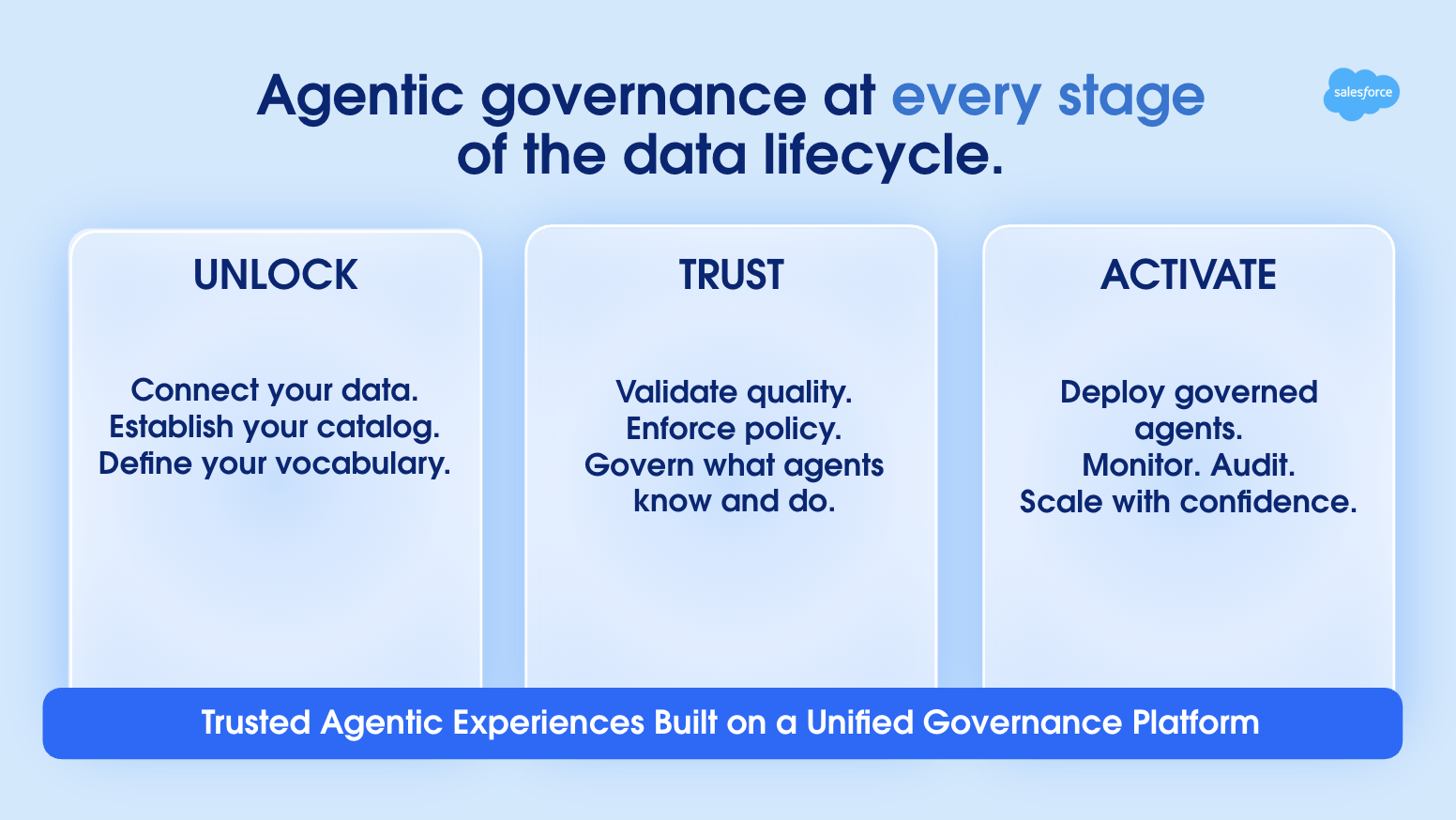
Stage 1: Unlock

You can’t govern what you can’t see. This is where you establish a shared vocabulary so every agent speaks the same language.

  • Informatica: Handles the heavy lifting‌ — ‌finding, classifying, and inventorying data while autogenerating quality rules.
  • MuleSoft: Connects everything in real-time, specifically managing MCP (Model Context Protocol) and Agent-to-Agent (A2A) orchestration so agents talk to each other in a governed way.
  • Data 360: Ingests data via streaming, batch, and real-time, and federates data via Zero Copy so agents can access data from any warehouse without creating brittle, ungoverned pipelines.

Stage 2: Trust

This is where you define the boundaries of what agents are permitted to know and do.

  • Informatica: Ensures everyone is aligned on an enterprise-wide golden record of customers, products and suppliers.
  • Data 360: Provides AI-powered tagging for classification, dynamic masking to protect sensitive fields, and lineage to visualize data flows by tracing upstream and downstream impacts.
  • Trusted Services: Enforces bulk data classification, encryption, and privacy policies specific to your regulatory requirements.

Stage 3: Activate

This is where you scale with the confidence that every action is controlled.

  • MuleSoft: Enforces policies to protect personally identifiable information (PII) and manages LLM token usage across every interaction.
  • Data 360: Enforces object, row, and field-level access at runtime so agents only see what the user is authorized to see.
  • Trusted Services: Your safety net. It investigates suspicious activity, manages customer consent, and retains field history indefinitely.

Let’s revisit the example earlier, but assume the agent was using governed data.

With governed data, the governance layer runs before the agent responds. Data policy is verified: Is this agent authorized to approve discounts? Margin data is validated from your ERP, as the company’s current margin is pulled in real time. Real-time context is pulled from your CRM, including account history, contract terms, and current pricing tier. The API call to the discount approval system is authorized and logged. And the agent responds: “[customer] is below the margin threshold. Discount exceeds policy DISC-2. Shall I route the VP approval request?”

The prompt is the same, but the outcome is completely different. With governance, the result is correct, auditable, and defensible. When regulators or your board ask if you had controls in place, you need to be able to say “yes.”

Governance isn’t the guardrail to your AI strategy‌ — ‌it is your AI strategy. Without it, you don’t have a strategy— you have an experiment.Start on your path to incorporating governance today. With the Agentforce 360 Platform, connect your data, enforce policies, and deploy governed agents that aren’t just powerful, but trusted.

Learn more

Trusted Services Solution Brief 

Data 360 Governance Data Sheet 

MuleSoft API Governance