

惯性聚合 高效追踪和阅读你感兴趣的博客、新闻、科技资讯
阅读原文 在惯性聚合中打开

推荐订阅源

B
Blog
C
Check Point Blog
The GitHub Blog
The GitHub Blog
Y
Y Combinator Blog
SecWiki News
SecWiki News
有赞技术团队
有赞技术团队
Latest news
Latest news
D
DataBreaches.Net
Blog — PlanetScale
Blog — PlanetScale
Project Zero
Project Zero
H
Help Net Security
Cyber Security Advisories - MS-ISAC
G
GRAHAM CLULEY
Engineering at Meta
Engineering at Meta
T
Threat Research - Cisco Blogs
腾讯CDC
P
Proofpoint News Feed
L
LINUX DO - 热门话题
C
Cisco Blogs
P
Palo Alto Networks Blog
Vercel News
Vercel News
P
Privacy International News Feed
爱范儿
爱范儿
Scott Helme
Scott Helme
L
Lohrmann on Cybersecurity
MyScale Blog
MyScale Blog
K
Kaspersky official blog
B
Blog RSS Feed
美团技术团队
Microsoft Security Blog
O
OpenAI News
博客园 - 叶小钗
量子位
T
Tenable Blog
C
Cybersecurity and Infrastructure Security Agency CISA
J
Java Code Geeks
Application and Cybersecurity Blog
Hacker News: Ask HN
Hacker News: Ask HN
OSCHINA 社区最新新闻
OSCHINA 社区最新新闻
L
LINUX DO - 最新话题
F
Fortinet All Blogs
N
News | PayPal Newsroom
The Hacker News
The Hacker News
C
CXSECURITY Database RSS Feed - CXSecurity.com
cs.CV updates on arXiv.org
博客园 - 【当耐特】
N
News and Events Feed by Topic
V
Visual Studio Blog
Google DeepMind News
Last Week in AI
Last Week in AI

Salesforce

Scale Your MRR: Subscription Management For Small Business Streamlining Commerce Media Ad Inventory Management 12 AI Sales Strategies for Startups That Actually Work Sell Smarter: Ecommerce Metrics To Track For Your Small Business Shop Apply the Orchestration Density Framework to Your Next Automation Decision Wait, Black Friday Planning In Spring? It’s Time to Start Holiday Promotions AI-First Operations, One Process at a Time How BCU Is Transforming Banking Service with Agentforce Salesforce Headless 360: What the Agent Consumer Means for Your Integration Architecture Meet Customers Where They Are: Agentforce Contact Center Now Offers WhatsApp Voice 11 Free Lead Generation Tips for Small and Growing Businesses SFR-VibeTrain: The Agent That Trains Agents Why Technical Accuracy is the Wrong Metric for Agent Success Strengthening Salesforce Security Against AI-Driven Threats Join Us in the Community Hub at Connections 2026 The Best Way To Build AI Agents That Customers Trust 5 Ways AI is Changing the Communication Game For Startups Trust in the Era of Agents: Highlights from the 2nd Annual Trusted AI Impact Report You Can Be an Agentic Enterprise No Matter What Size Business How to Make Your Email Marketing Accessible for Everyone What is Headless? Don’t Lose Your Head, SMBs: It’s a Good Thing Architect the Future UI: Slack as Your Agentic Surface Point of Sale Innovations to Modernize the Shopper Experience Governing the Agentic Enterprise at Scale with MuleSoft Omni Gateway How to Cut Service Time with Case Routing Automation 5 Tips for Marketers to Get Started with Salesforce Flow No One is Vibe Coding Trade Promotion Management 7th Edition State of Sales Report: 3 Growth Trends for Startups and SMBs How the Architect Vista Brought Architectural Thinking to Life at TDX 2026 5 Steps to Develop an Architect Mindset With AI Why AI Isn’t Replacing Developers, It’s Empowering Them 10 Ways to Make Your AI Agent a Better Communicator AI in Design 2025: What Real Use Taught Us. How Salesforce Personalization Learns Which Offers Drive Revenue The 4-Step Guide to Salesforce Agent and Application Development Get Ready for Connections 2026: Top Sessions and New Reveals 8 Ways AI Agents Are Evolving in 2026 4 Principles to Make the Right Salesforce UI Decisions Apprentice Journey Shines a Light on Talent Pathways at Salesforce Agent Script: The Control Plane for Agentic Decisions Scaling the Agentforce Life Sciences Ecosystem to Drive the Future of Pharma and MedTech Unlocking Unstructured Data: Building AI-Powered Support Triage with Data 360 Asking For a Friend: What Are Rich Communication Services (RCS)? 5 Slack Shortcuts For Small Teams 195% ROI In Field Service? Here’s How They Did It Submit Your Architect Session: The Dreamforce 2026 Call for Participation Is Open What Is an AI Assistant for Small Business? B2C Commerce April release: Transforming the B2C developer experience with agents Meet Your 24/7 Prospecting Partner — And 5 More Stand-Out Features In Our April Release 11+ Small Business YouTube Channels You Need to Follow Today Stop Treating Disputes Management Like IT Tickets Limitless Service: A New Operating Model for Growth in the Agentic Era What is Transactional Reconciliation in Email and SMS Marketing? How to Prepare for National Small Business Week (2026) How to Design a High-Scale Multi-Cloud Incident Journey 10 Ways An AI CRM Can Amplify Your Startup Vibe Code Better Agents with Agentforce Free vs. Paid CRM: Which is Right for Your Business? Salesforce Customer Success Awards 2026: Lead Era of the Agentic Enterprise 12 Free Webinars for Small Business Owners (2026) The Agentforce Life Sciences Consultant Certification Maximize Growth: The Power of Partnerships for SMBs Salesforce AI Research at ICLR 2026 Data Protection For Small Business: How To Safeguard Yourself Beyond 100K Tokens: Evaluating AI Agents in Long-Context Software Engineering Top 32 Small Business Tools To Try Today 6 New Innovations Redefining Salesforce Development How to Win the Battle for Attention in the Agentic Email Inbox Mastering the Eisenhower Matrix: Prioritize Like a Pro 10 Signs It’s Time To Upgrade Your CRM and How To Get Started (2026) Celebrating 10 Years of Financial Services Innovation How SMBs Can Gain An Edge With Agentic AI: Key Trends From Our Marketing Report How MAN Truck & Bus is Shaping the Future of Sales with Salesfive Introducing the Future of Salesforce Data Protection: Backup & Recover Next Stop Making AI Slop – Build a Foundation for Authentic AI Content 5 Tips to Help Marketers Navigate AI Email Summaries Data Sharing: Is it Safe? Is it Secure? Everything You Need to Know Small Business Week Readiness: 4 Things to Do Before May (2026) How Salesforce Employees Make an Impact During Earth Month AI Agents Are Advancing Rapidly… Is Your Testing Strategy Keeping Up? What Is Microproductivity and Why Is It Helping So Many Teams? TDX 2026 Roundup: Agentforce Edition 3 Ways Salesforce Connections Has Boosted My Career AI Agents Don’t Just Answer‌ — ‌They Act. Do You Have a Governance Strategy? The Future of MedTech Field Execution is Agentic 5 Steps to Prepare Your Data For an AI CRM From Break/Fix to Profit Engine: Aftermarket Service for Robot OEMs Building Trusted Human-Agent Collaboration: A Practical Framework ISV Strategy for the Salesforce Summer ’26 Release 5 Email Marketing Tips for Small Business Commerce Shops Should You Give Your AI Agent a Human Name? Creating Pathways into AI for People with Disabilities The Organized Chaos of Upfronts: 3 Hurdles Impacting Your Yield Trying to Scale Beyond ‘One-Off’ AI Tasks? You’re Probably Using the Wrong Interface What is Cost Per Lead (CPL)? The Case for Unified CCaaS and CRM — And Why the Data Makes It Clear In the New Era of AI, You Need to Win Over Both Humans and Agents What Is SPIN Selling? A Way to Build Trust With Your Customers G2 Crowns Salesforce as Best Financial Services Software Hidden Insights: The Guide to Tableau For Small Business Owners
How Indeed Builds, Tests, and Deploys Agents Without Ever Opening a Browser
Ran Fu, Deep · 2026-05-19 · via Salesforce

Indeed, the world’s #1 job site and a leading hiring platform, supports millions of employers with help from Agentforce. The engineering team has numerous agents in production, spanning IT support, sales, employer services, and a web-facing portal. Building those agents was one challenge. Making them reliable enough to run at production volume was another.

The core problem: When an agent’s critical decisions run through a large language model, they usually work. At Indeed’s scale, “usually” creates real operational risk. The shift that changed everything was moving key logic out of free-text prompts and into deterministic, authored code. Then came a second key pivot: building, testing, and deploying those agents entirely through APIs and coding agents, with no browser UI in sight.

That’s Salesforce Headless 360 in action. Instead of configuring agents through a browser UI, Indeed’s engineering team builds entirely through APIs, CLI, and MCP — the same interfaces their coding agents already use. 

They author logic in Cursor, test against production scenarios through APIs rather than a browser, and deploy without context-switching between tools. It’s Salesforce infrastructure, accessed the way developers already work.

If your team is building agents and trying to close the gap between demo and production, Indeed’s developer workflow is worth studying.

Here’s how the full stack connects — from the Salesforce Platform and agent portfolio, through MuleSoft integrations, down to the coding agent workflow that powers the build cycle.
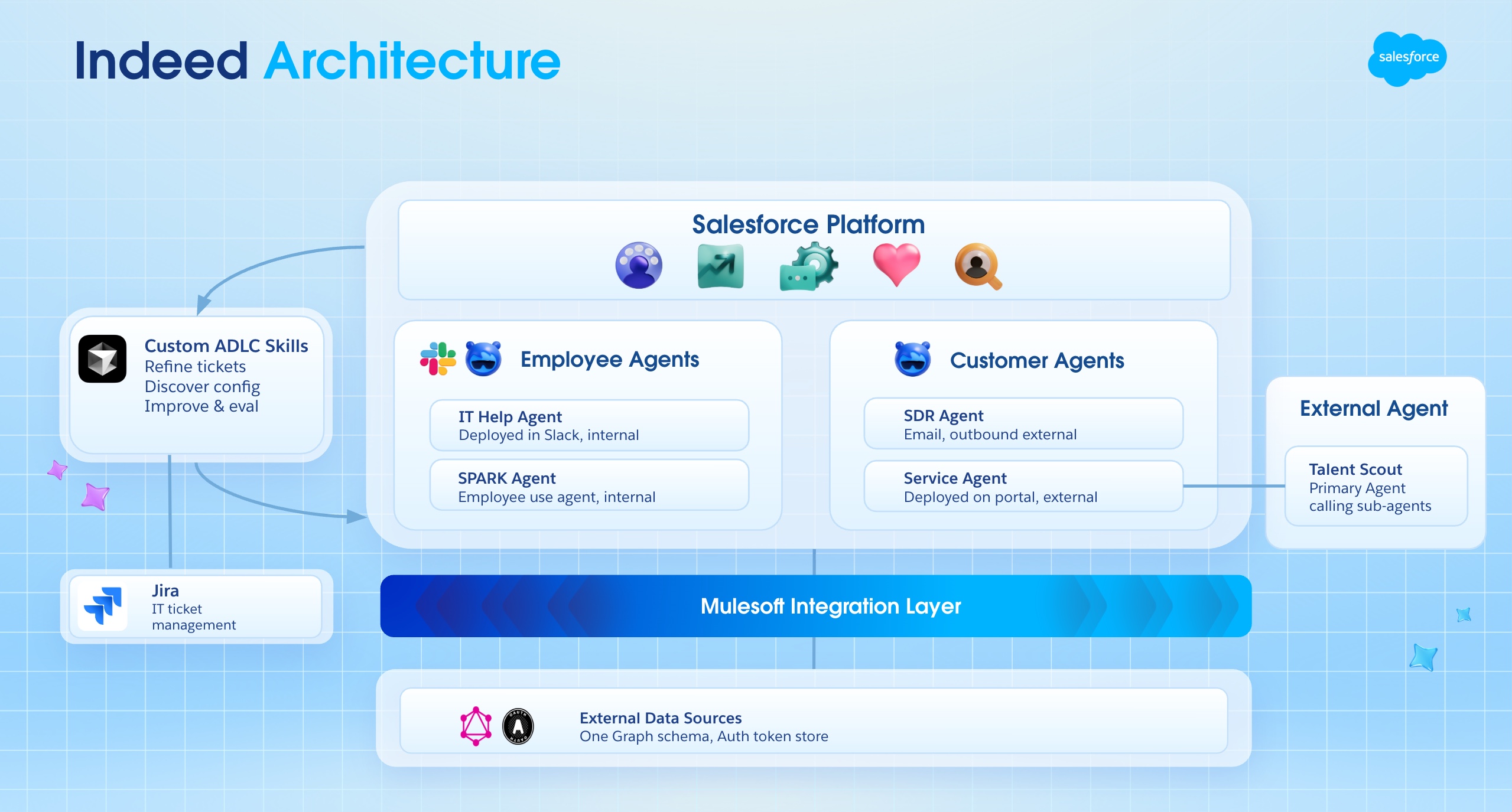
Architecture diagram titled "Indeed Architecture" with Salesforce branding. Top layer: Salesforce Platform with product icons. Middle layer: two groups of agents — Employee Agents (including IT Help Agent deployed in Slack) and Customer Agents (including SDR Agent via email and Service Agent deployed on portal). Left side: Custom ADLC Skills box showing Cursor-based workflows for refining tickets, discovering config, and improving and evaluating agents. Right side: External Agent box. Bottom: MuleSoft Integration Layer connecting to External Data Sources including One Graph schema and Auth token store.
Indeed’s Agentforce architecture: employee-facing and customer-facing agents run on the Salesforce Platform, connected to external data sources through MuleSoft, with custom ADLC skills in Cursor powering the API-driven build and iteration workflow. 

From one big prompt to deterministic logic

Before Agent Script, Indeed’s agents relied on large prompt instructions. The model read the prompt, reasoned through conditions, and decided what to do. 

Oliver Bodden, a senior technical product manager on Indeed’s team, saw firsthand how edge cases crept in as the prompt grew. 

“We started with one prompt, and every request passed through the LLM for reasoning. It worked at first. But as our evaluation framework surfaced more edge cases, the prompt kept growing to handle new conditions and decision points, and that’s when we started seeing inconsistencies,” Bodden said. “When you’re A/B testing prompts just to keep behavior stable, that’s usually a sign you need a different approach.”

Agent Script solves this by letting developers pin specific decisions to deterministic code paths that never hit the LLM. If an employer asks “why is my job flagged?” the system runs a lookup action, checks account status, and routes to the correct response through authored logic, every time. The model only handles the parts where flexibility genuinely adds value, like personalizing a troubleshooting response based on context.

The result is twofold: the model gets smaller, targeted prompts because conditions have been extracted into authored logic, and the paths that matter most behave reliably. State management improves, too. Instead of hoping the model maintains context between turns, variables are explicitly stored and tracked across the conversation.
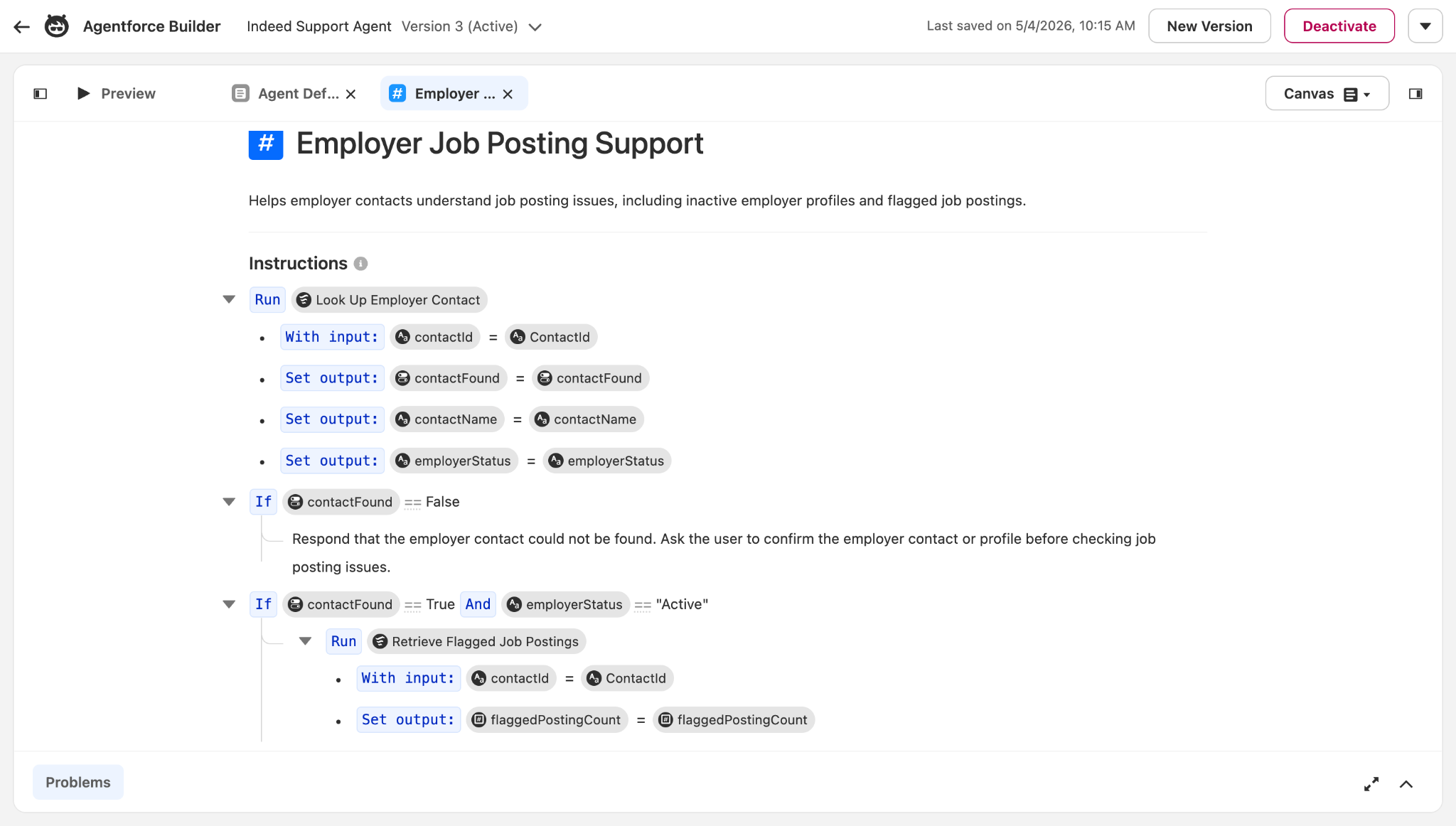
Agentforce Builder canvas view showing the Employer Job Posting Support subagent's deterministic routing: a lookup action for employer contact, then if/then branches based on contactFound and employerStatus that retrieve flagged job postings or generate inactive employer guidance.
Before the model handles anything, Agent Script routes each employer interaction through deterministic logic, checking contact status, employer status, and flagged postings.

This is where Salesforce Headless 360 meets reliability. Agent Script is authored in code, versioned like code, and deployed through the same API-driven workflows as everything else in Indeed’s stack. No clicking through a UI to configure logic. No gap between what a developer writes and what runs in production.

Building and iterating with coding agents

Indeed’s engineering team builds and iterates on agents using coding agents directly in Cursor.

Here’s one example: The team identifies an opportunity to tighten how the Indeed Service Agent responds when an employer asks about a flagged job. They want it to focus specifically on the flag reason and recommend next steps, rather than surfacing broader account status information. Instead of manually editing prompt instructions, Indeed’s developers run an ADLC skill in Cursor that drafts a fix. 

Then they switch to the Agent Builder to see what changed. The script view shows the deterministic routing logic: If the employer’s account is active, check for flagged job postings and surface the flag reason. If inactive, route to account status guidance instead. Each path fires reliably without model interpretation.

“Now I can describe the problem in Cursor, use skills to guide the agent through the fix, and validate the result across scenarios. What used to take hours now takes minutes,” Bodden said.
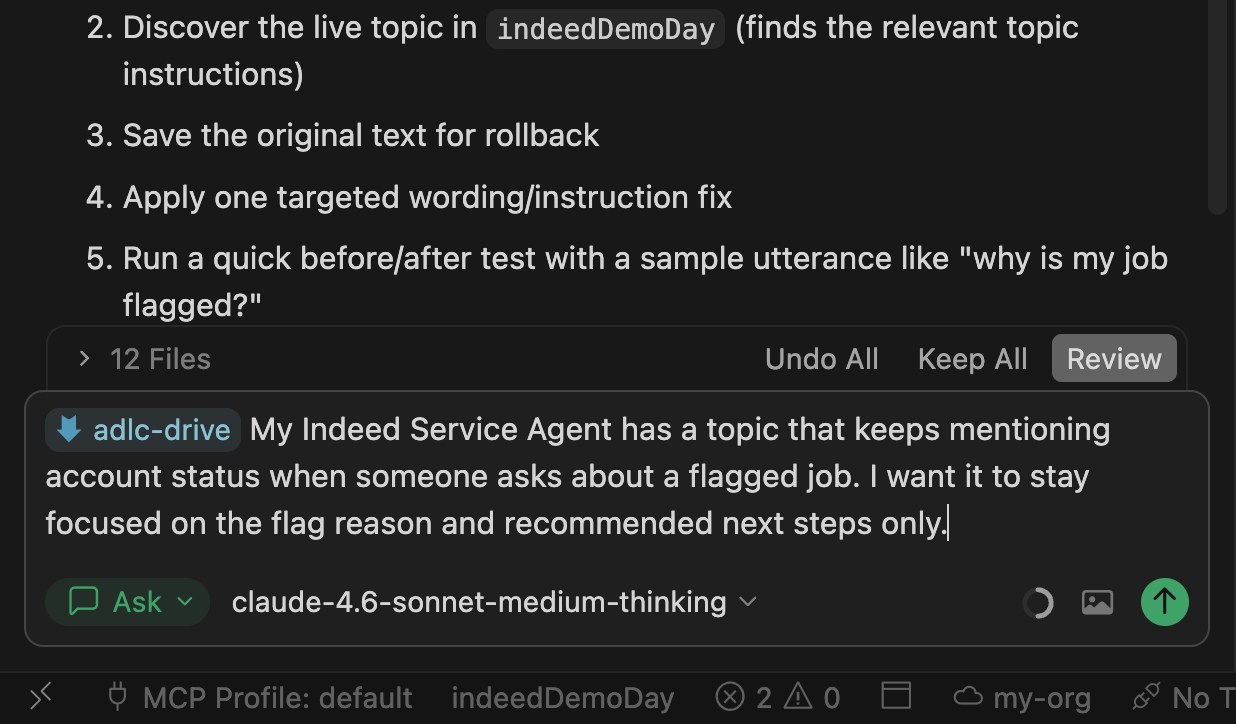
Cursor IDE showing an ADLC skill prompt asking to fix a subagent's response behavior, with 12 generated file changes ready for review.
A natural-language prompt in Cursor triggers the ADLC skill, which drafts file changes across the agent’s configuration. The developer reviews and accepts them in the same IDE.

Indeed’s team runs a testing phase within the same ADLC skill in Cursor. They validate across scenarios that used to require manual QA: an active employer with a flagged job, an inactive employer asking about a review, and other edge cases. All of it runs through Salesforce Headless 360’s API layer, with no manual clicking through a browser UI.

What Indeed’s agent portfolio looks like

Indeed has multiple Agentforce agents running in production, with more on the way. Here are some of their production agents:

  • Service Agent (web portal): Helps employers troubleshoot flagged jobs, account issues, and onboarding questions through a Lightning Web Component portal. Escalates to human agents with full conversation history and summaries.
  • IT Help Agent (Slack): Resolves common hardware and software issues directly in Slack, allowing employees to get answers without opening a formal IT case.
  • SDR Agent (email): Handles outbound lead qualification and meeting scheduling for Indeed’s sales organization.
  • Spark Agent: A dual-purpose sales and service agent that handles both customer-facing and internal workflows.

All of this runs without a browser UI. These agents are deployed, monitored, and iterated on through APIs and CLI — the same Headless 360 infrastructure that powers the build and test cycle.
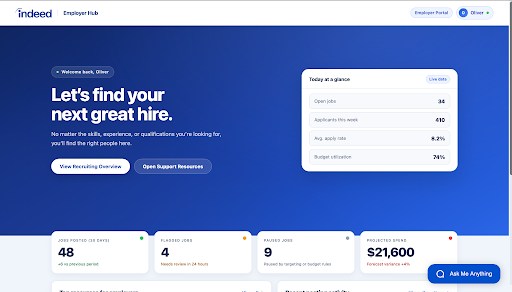
Indeed's employer-facing website showing the Indeed Service Agent chatbot widget. The employer has asked "Why is my job flagged?" and the agent responds with structured flagged job posting details including job title, ID, flag reason, and daily budget.
The Indeed Service Agent responds to an employer’s flagged-job question with structured details pulled from Data 360, deployed on Indeed’s employer portal via an embedded Lightning Web Component.

What escalation looks like

When an employer needs more help than the agent can provide, the system routes them to a human through the Service Cloud Console. Here’s what that looks like. 

The human agent receives the full conversation history and a summary of the engagement, so they pick up without asking the employer to repeat anything. Indeed tracks metrics on this handoff, measuring whether humans spend less time resolving issues when the AI provides pre-digested context.

Agent Script makes this handoff deterministic. No matter how the conversation got there, an escalation request fires the same routing logic and packages the same context for the human agent.


“Escalation is one of the areas where you can’t afford breakdowns,” Bodden said. “We needed the handoff between the agent and the human to feel seamless. The agent summarizes the conversation, surfaces the relevant account details, and packages the context so the human can pick up immediately without retracing steps. We measure the operational impact on the other side, and the time savings have been significant.”
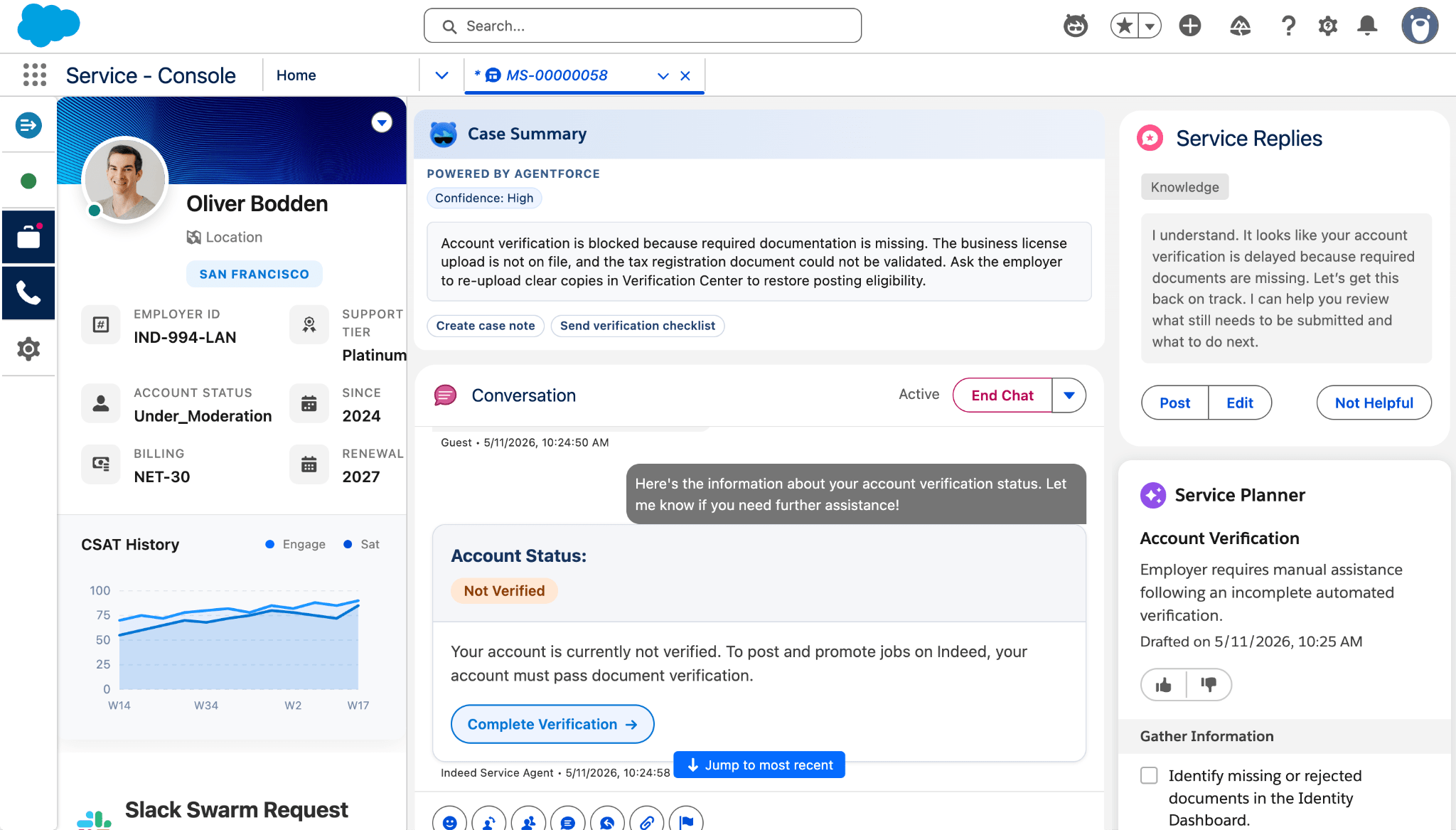
Alt text: Salesforce Service Console showing a seamless agent-to-human handoff: Oliver Bodden's employer profile on the left, full conversation history with account verification details in the center, and an AI-generated Service Planner summary on the right.
After escalation, the human agent sees the full conversation history, employer profile, and a Service Planner summary – no retracing steps.

The data layer underneath

The agents themselves are only as useful as the data feeding them. Indeed uses Data 360 to pre-process employer profiles, account status, flagged job metadata, and support history into a unified layer that every agent can access at runtime. When the Service Agent looks up a flagged posting, it’s pulling from pre-computed data, not running queries against raw tables mid-conversation.

This is what makes Agent Script’s deterministic routing practical at scale. The if/then logic works because the data is already structured, enriched, and ready. Without that foundation, each new agent would require custom data plumbing. With it, the team wires up new agents to the same pre-processed layer and starts further ahead every time.

“The first agent took months. The latest agent took weeks,” Bodden said. “That’s the compounding effect. Once the data foundation is in place and you’re building in code with the right tools, each new agent starts further ahead than the last one did.”

Ready to learn more about how Indeed is using Agentforce? Check out their Demo Day story here.