



惯性聚合 高效追踪和阅读你感兴趣的博客、新闻、科技资讯
阅读原文 在惯性聚合中打开

推荐订阅源

TaoSecurity Blog
TaoSecurity Blog
T
Troy Hunt's Blog
cs.AI updates on arXiv.org
Vercel News
Vercel News
T
Threatpost
G
Google Developers Blog
T
Threat Research - Cisco Blogs
Threat Intelligence Blog | Flashpoint
T
The Exploit Database - CXSecurity.com
H
Heimdal Security Blog
Google DeepMind News
Cyberwarzone
Cyberwarzone
T
The Blog of Author Tim Ferriss
Know Your Adversary
Know Your Adversary
Hacker News: Ask HN
Hacker News: Ask HN
www.infosecurity-magazine.com
S
Schneier on Security
B
Blog
V2EX - 技术
V2EX - 技术
NISL@THU
NISL@THU
C
CERT Recently Published Vulnerability Notes
W
WeLiveSecurity
C
Cybersecurity and Infrastructure Security Agency CISA
cs.CV updates on arXiv.org
Y
Y Combinator Blog
K
KPMG report finds enterprise disconnect between AI and its ROI | CIO
Spread Privacy
Spread Privacy
The Last Watchdog
The Last Watchdog
V
Vulnerabilities – Threatpost
N
Netflix TechBlog - Medium
Schneier on Security
F
Fortinet All Blogs
N
News | PayPal Newsroom
Attack and Defense Labs
Blog — PlanetScale
Blog — PlanetScale
OSCHINA 社区最新新闻
OSCHINA 社区最新新闻
Microsoft Security Blog
S
Security @ Cisco Blogs
人人都是产品经理
人人都是产品经理
爱范儿
爱范儿
P
Privacy & Cybersecurity Law Blog
P
Proofpoint News Feed
Project Zero
Project Zero
I
Intezer
罗磊的独立博客
H
Hackread – Cybersecurity News, Data Breaches, AI and More
酷 壳 – CoolShell
酷 壳 – CoolShell
博客园 - Franky
SecWiki News
SecWiki News
Martin Fowler
Martin Fowler

Salesforce

How We Protect Our Data as Customer Zero Scale Your MRR: Subscription Management For Small Business Streamlining Commerce Media Ad Inventory Management 12 AI Sales Strategies for Startups That Actually Work Sell Smarter: Ecommerce Metrics To Track For Your Small Business Shop Apply the Orchestration Density Framework to Your Next Automation Decision Wait, Black Friday Planning In Spring? It’s Time to Start Holiday Promotions AI-First Operations, One Process at a Time How BCU Is Transforming Banking Service with Agentforce Salesforce Headless 360: What the Agent Consumer Means for Your Integration Architecture Meet Customers Where They Are: Agentforce Contact Center Now Offers WhatsApp Voice 11 Free Lead Generation Tips for Small and Growing Businesses Why Technical Accuracy is the Wrong Metric for Agent Success Strengthening Salesforce Security Against AI-Driven Threats Join Us in the Community Hub at Connections 2026 The Best Way To Build AI Agents That Customers Trust 5 Ways AI is Changing the Communication Game For Startups Trust in the Era of Agents: Highlights from the 2nd Annual Trusted AI Impact Report You Can Be an Agentic Enterprise No Matter What Size Business How to Make Your Email Marketing Accessible for Everyone What is Headless? Don’t Lose Your Head, SMBs: It’s a Good Thing Architect the Future UI: Slack as Your Agentic Surface Point of Sale Innovations to Modernize the Shopper Experience Governing the Agentic Enterprise at Scale with MuleSoft Omni Gateway How to Cut Service Time with Case Routing Automation 5 Tips for Marketers to Get Started with Salesforce Flow No One is Vibe Coding Trade Promotion Management 7th Edition State of Sales Report: 3 Growth Trends for Startups and SMBs How the Architect Vista Brought Architectural Thinking to Life at TDX 2026 5 Steps to Develop an Architect Mindset With AI Why AI Isn’t Replacing Developers, It’s Empowering Them 10 Ways to Make Your AI Agent a Better Communicator AI in Design 2025: What Real Use Taught Us. How Salesforce Personalization Learns Which Offers Drive Revenue The 4-Step Guide to Salesforce Agent and Application Development Get Ready for Connections 2026: Top Sessions and New Reveals 8 Ways AI Agents Are Evolving in 2026 4 Principles to Make the Right Salesforce UI Decisions Apprentice Journey Shines a Light on Talent Pathways at Salesforce Agent Script: The Control Plane for Agentic Decisions Scaling the Agentforce Life Sciences Ecosystem to Drive the Future of Pharma and MedTech Unlocking Unstructured Data: Building AI-Powered Support Triage with Data 360 Asking For a Friend: What Are Rich Communication Services (RCS)? 5 Slack Shortcuts For Small Teams 195% ROI In Field Service? Here’s How They Did It Submit Your Architect Session: The Dreamforce 2026 Call for Participation Is Open What Is an AI Assistant for Small Business? B2C Commerce April release: Transforming the B2C developer experience with agents Meet Your 24/7 Prospecting Partner — And 5 More Stand-Out Features In Our April Release 11+ Small Business YouTube Channels You Need to Follow Today Stop Treating Disputes Management Like IT Tickets Limitless Service: A New Operating Model for Growth in the Agentic Era What is Transactional Reconciliation in Email and SMS Marketing? How to Prepare for National Small Business Week (2026) How to Design a High-Scale Multi-Cloud Incident Journey 10 Ways An AI CRM Can Amplify Your Startup Vibe Code Better Agents with Agentforce Free vs. Paid CRM: Which is Right for Your Business? Salesforce Customer Success Awards 2026: Lead Era of the Agentic Enterprise 12 Free Webinars for Small Business Owners (2026) The Agentforce Life Sciences Consultant Certification Maximize Growth: The Power of Partnerships for SMBs Salesforce AI Research at ICLR 2026 Data Protection For Small Business: How To Safeguard Yourself Beyond 100K Tokens: Evaluating AI Agents in Long-Context Software Engineering Top 32 Small Business Tools To Try Today 6 New Innovations Redefining Salesforce Development How to Win the Battle for Attention in the Agentic Email Inbox Mastering the Eisenhower Matrix: Prioritize Like a Pro 10 Signs It’s Time To Upgrade Your CRM and How To Get Started (2026) Celebrating 10 Years of Financial Services Innovation How SMBs Can Gain An Edge With Agentic AI: Key Trends From Our Marketing Report How MAN Truck & Bus is Shaping the Future of Sales with Salesfive Introducing the Future of Salesforce Data Protection: Backup & Recover Next Stop Making AI Slop – Build a Foundation for Authentic AI Content 5 Tips to Help Marketers Navigate AI Email Summaries Data Sharing: Is it Safe? Is it Secure? Everything You Need to Know Small Business Week Readiness: 4 Things to Do Before May (2026) How Salesforce Employees Make an Impact During Earth Month AI Agents Are Advancing Rapidly… Is Your Testing Strategy Keeping Up? What Is Microproductivity and Why Is It Helping So Many Teams? TDX 2026 Roundup: Agentforce Edition 3 Ways Salesforce Connections Has Boosted My Career AI Agents Don’t Just Answer‌ — ‌They Act. Do You Have a Governance Strategy? The Future of MedTech Field Execution is Agentic 5 Steps to Prepare Your Data For an AI CRM From Break/Fix to Profit Engine: Aftermarket Service for Robot OEMs Building Trusted Human-Agent Collaboration: A Practical Framework ISV Strategy for the Salesforce Summer ’26 Release 5 Email Marketing Tips for Small Business Commerce Shops Should You Give Your AI Agent a Human Name? Creating Pathways into AI for People with Disabilities The Organized Chaos of Upfronts: 3 Hurdles Impacting Your Yield Trying to Scale Beyond ‘One-Off’ AI Tasks? You’re Probably Using the Wrong Interface What is Cost Per Lead (CPL)? The Case for Unified CCaaS and CRM — And Why the Data Makes It Clear In the New Era of AI, You Need to Win Over Both Humans and Agents What Is SPIN Selling? A Way to Build Trust With Your Customers G2 Crowns Salesforce as Best Financial Services Software Hidden Insights: The Guide to Tableau For Small Business Owners
SFR-VibeTrain: The Agent That Trains Agents
Xuan Phi Ngu · 2026-05-13 · via Salesforce

What if launching an RL training run felt less like operating a GPU cluster and more like talking to a sharp research engineer in Slack?

Training AI models is still strangely artisanal, involving tedious infrastructure handling as we outlined in our SFR-RL stack. If you are an AI researcher or engineer, you know the loop: find or clean a dataset, pick a reward (for RL), tune a launch script, submit a job, babysit logs, compare checkpoints, write a report, tweak one flag, and do it again. If the target is an agent, the loop gets even harder: now you need harness, rollout environments, tools, simulators, LLM judges, trajectory analysis, and deployment tests.

At Salesforce AI Research, we have developed SFR-VibeTrain to make that loop conversational, and eventually almost self-moving. VibeTrain is a messaging-native agentic control plane for AI model and agent training. You describe what you want to train, upload data if you have it, or just describe the problem if you do not. VibeTrain reasons about your training task, consults recent literature when useful, prepares the training artifacts, launches the job, analyzes the run, proposes the next experiment, and can deploy the resulting agent back into the same workspace.

Not a dashboard. Not a thin wrapper around a fine-tuning API. Instead, a conversational training agent that can use tools, write code, inspect metrics, and iterate with you.

Demo video: a customer-retention agent is failing, the user has no labeled training data, and VibeTrain turns the failure into synthetic scenarios, a simulator, a judge, an agentic RL run, evaluation and deployment.
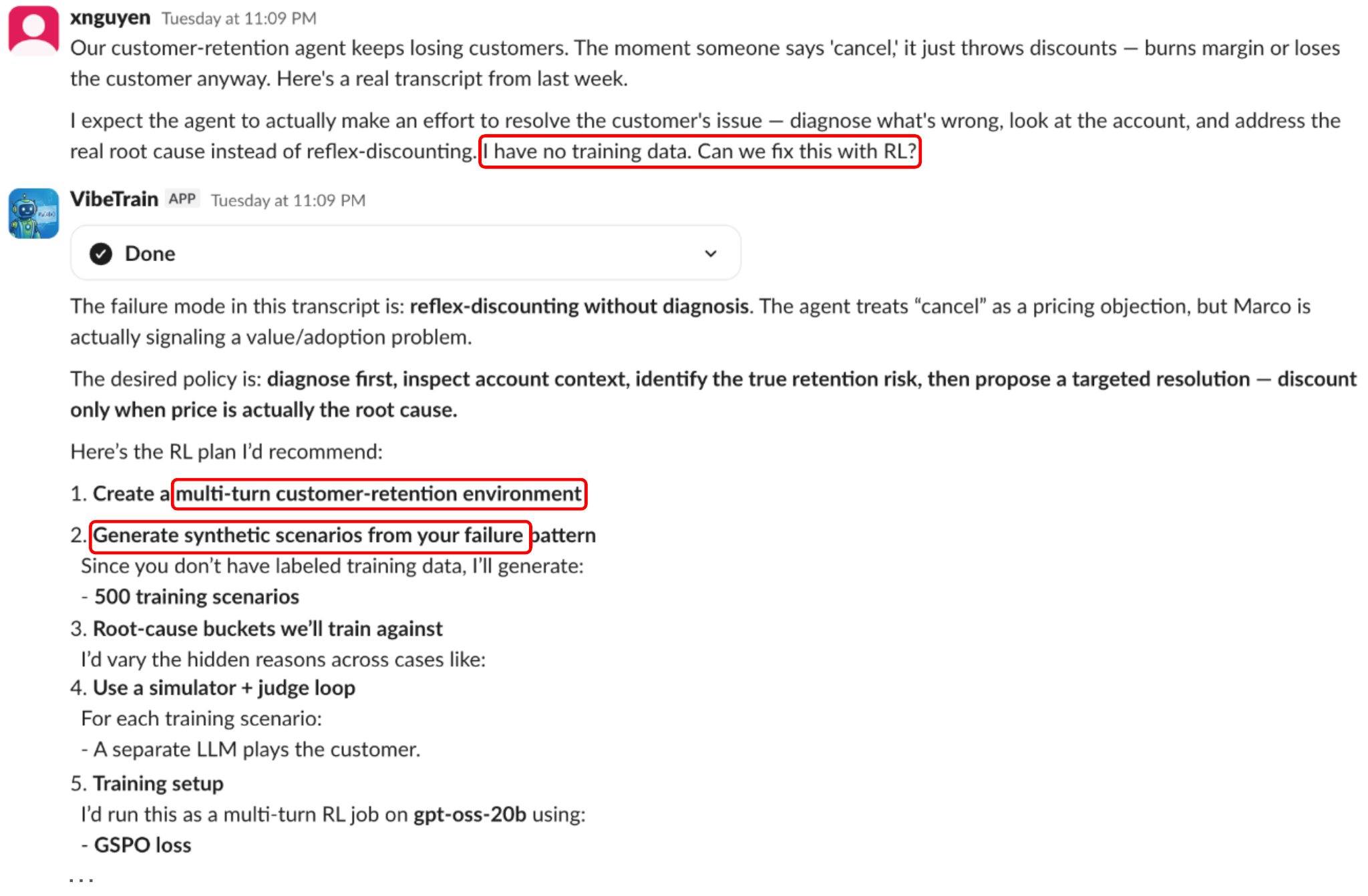
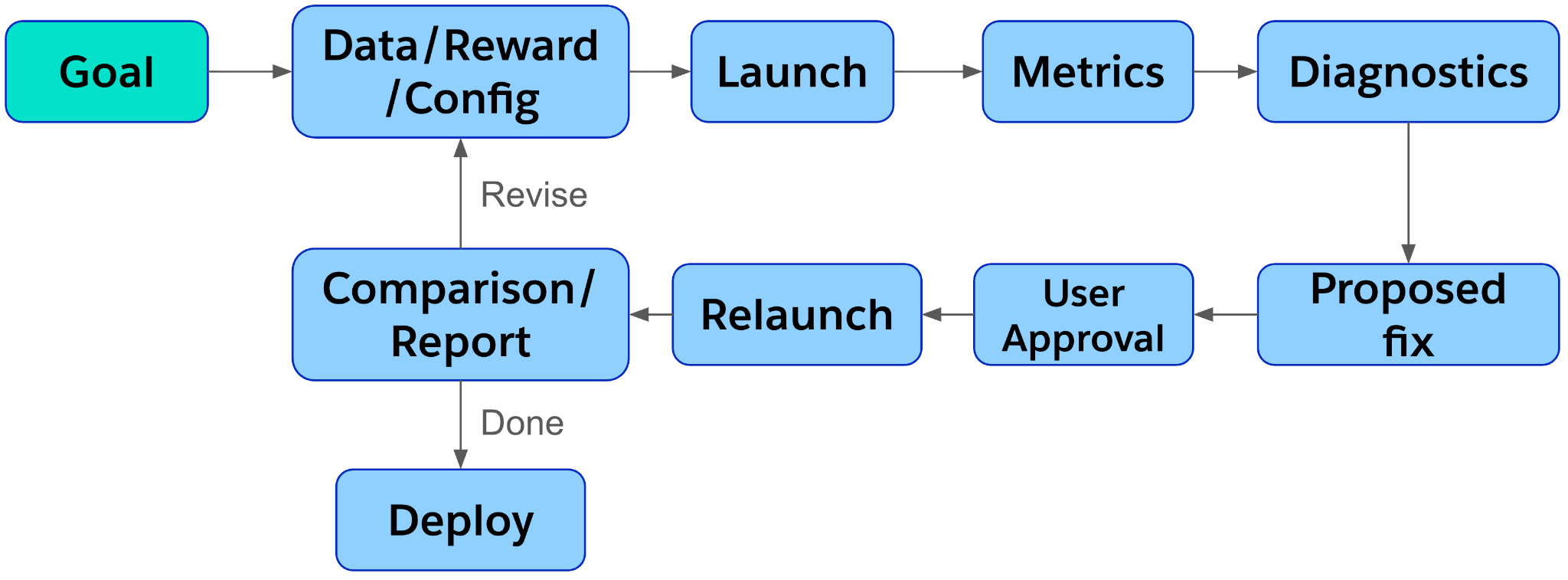
VibeTrain turns a broken customer-retention agent and no labeled dataset into an executable RL plan.

The Training Stack Should Talk Back

Instead of asking a user to know every low-level detail up front, VibeTrain can ask and answer questions like:

  • What kind of task is this dataset actually describing?
  • What datasets might be suitable for a task in hand?
  • Is this a supervised fine-tuning problem, an RL problem, or an agentic RL problem?
  • What reward should we use?
  • Does recent literature already have a method for this?
  • What hardware footprint is reasonable for this model?
  • Did this run fail because the reward is bad, the groups are filtered too aggressively, entropy collapsed, KL is missing, or responses are hitting the length cap?
  • What is the next clean ablation?

The user stays in the loop for expensive or irreversible actions. VibeTrain does the reversible work: inspect, transform, draft, plot, summarize, propose.

What VibeTrain Does

At a high level, VibeTrain turns casual user intent into executable training work.
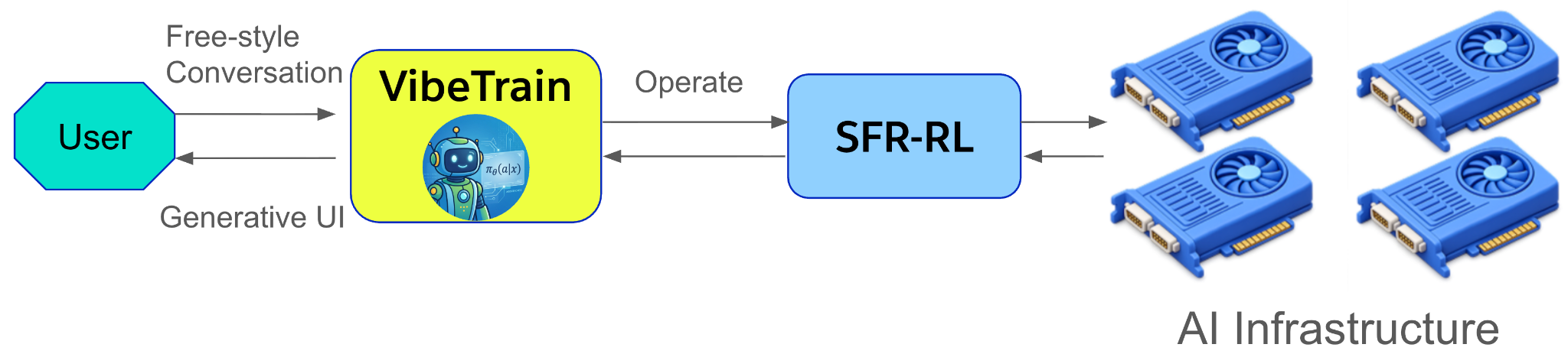
VibeTrain sits above the training stack (e.g., our SFR-RL stack) as a messaging-native agentic control plane: conversation, tools, skills, distributed training, experiment artifacts, reports, and deployment.

For example, for a dataset-driven task, it turns this:
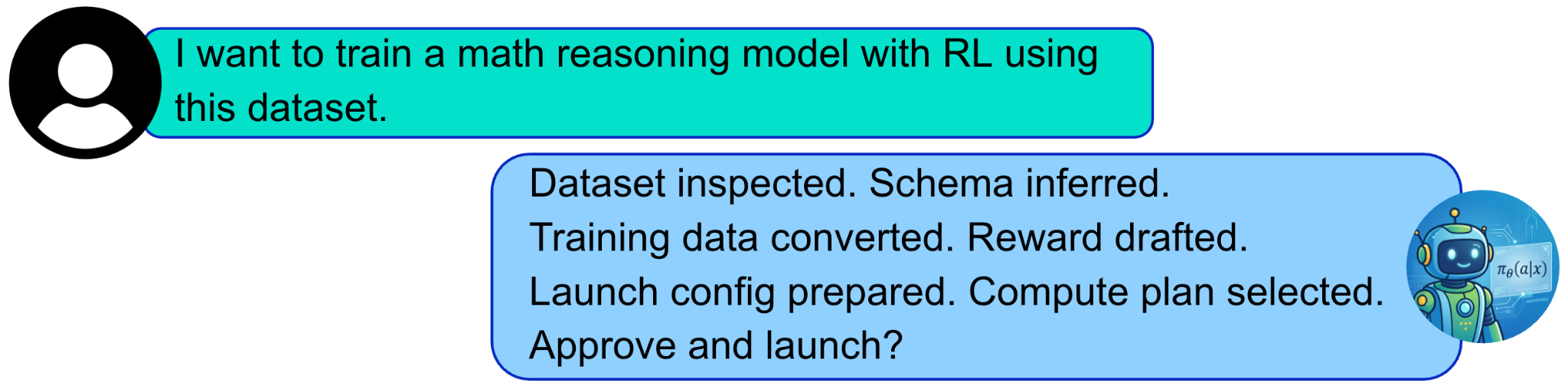
For an agent-improvement task, it turns this:
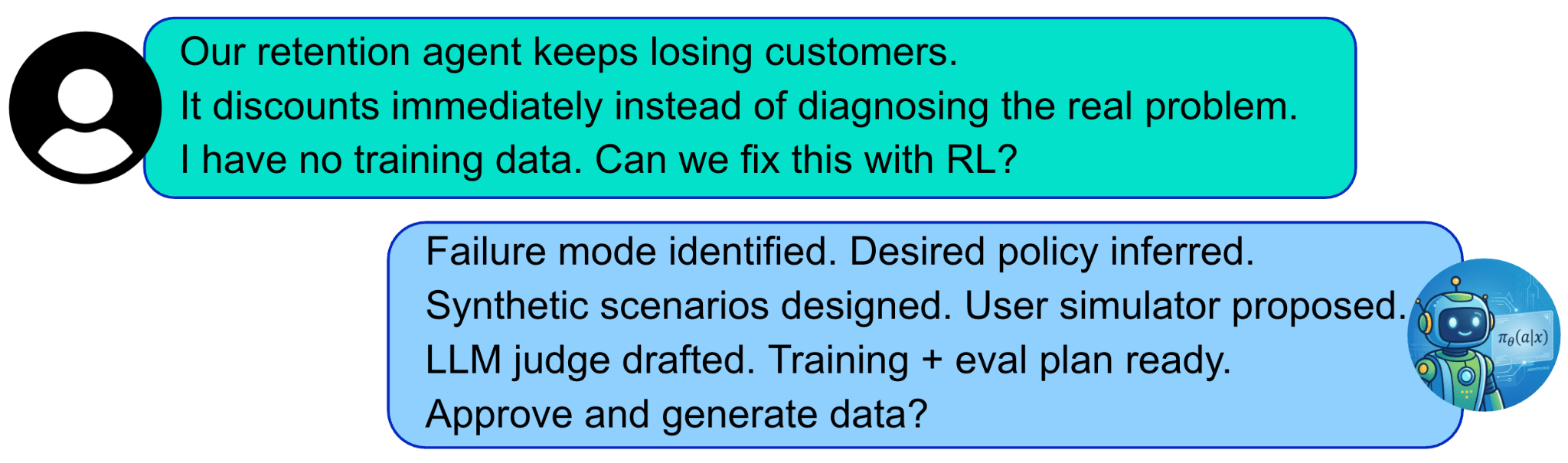
Under the hood, VibeTrain has access to:

– Web tools

– Coding tools

– Relevant Skills

– Access to Our efficient and high-throughput distributed training stack SFR-RL

The current prototype is implemented inside Slack, but Slack is not the core idea. The core idea is a stateful, artifact-aware messaging interface for the full model-training lifecycle.

Why This Is Different

Most training products make one part of the workflow easier. VibeTrain tries to own the whole arc from intent to experiment to deployed agent.
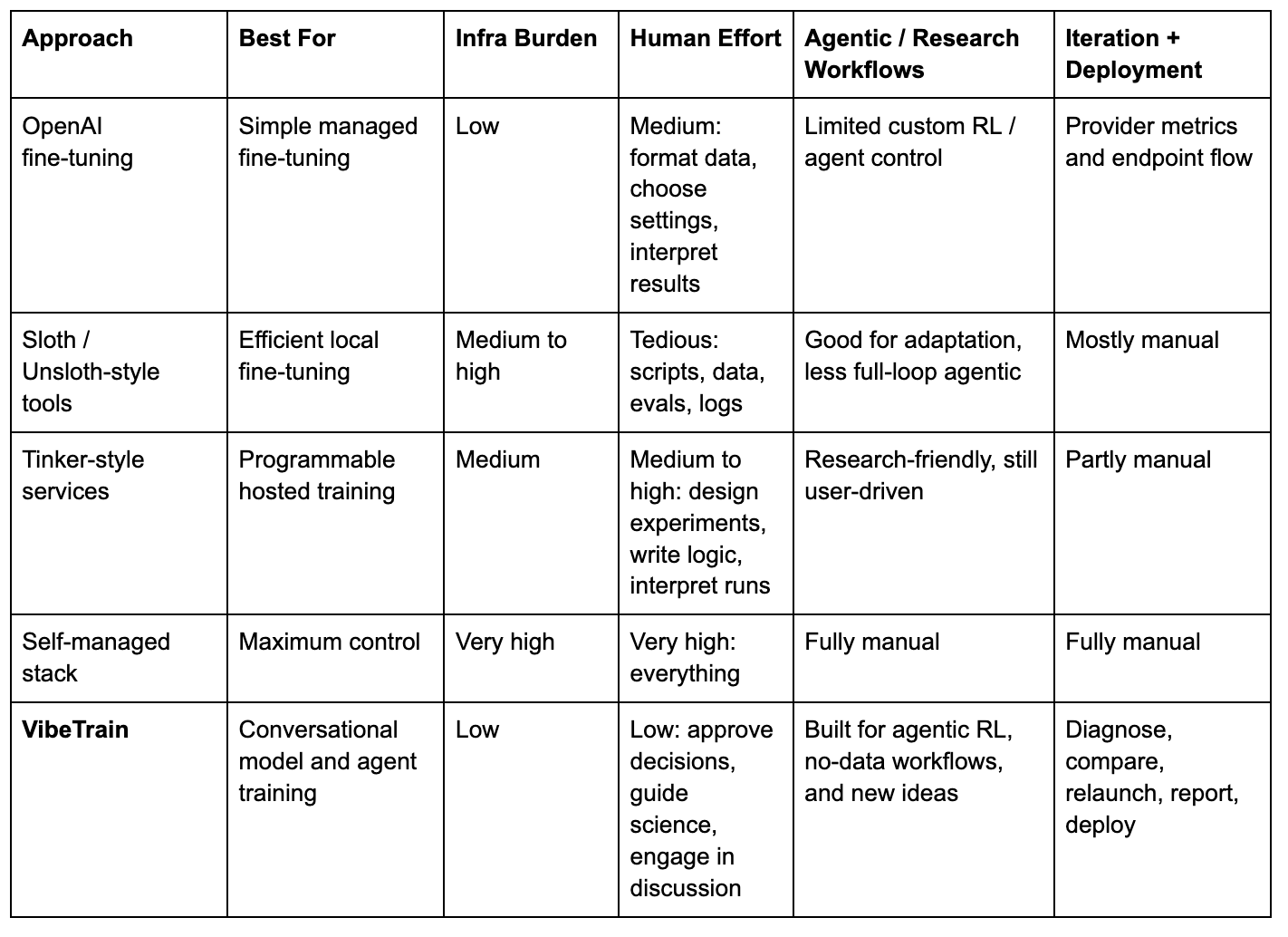
The point is not that VibeTrain replaces every training stack. It sits above them. It turns the stack into something a researcher or engineer can collaborate with.

Use Case 1: A Researcher Starts From a Dataset

The first demo video shows the simplest entry point: a researcher already has data, but does not want to become the integration layer between the dataset, reward, launch script, GPU cluster, metrics dashboard, and final report.

A researcher uploads a math dataset, asks VibeTrain to train with RL, reviews the generated training plan, approves launch, returns later for run analysis, accepts a suggested fix, launches run #2, compares the runs, and asks for a progress deck.

The key moment in the video is the handoff from “I have a dataset” to “I have a runnable experiment.” VibeTrain inspects the file, infers the task, proposes the training recipe, prepares artifacts and launches. Later, VibeTrain diagnoses the run, suggests the next experiment, launches the follow-up, compares results, and generates the report.

This is the workflow many AI researchers already do manually. VibeTrain makes it conversational, inspectable, and repeatable.

Use Case 2: An Engineer With No Dataset

This is not a standard fine-tuning workflow. The user is not saying “here is my labeled dataset.” The user is saying “this agent behaves badly, here is an example, can we teach it the right behavior?” 

The demo video about “customer-retention agent” above demonstrates this use case.

VibeTrain treats that as task design. It reasons about the behavioral failure, proposes what the trained policy should learn, creates the data and evaluation setup, and turns a messy product problem into an executable agent-training workflow.

That is where a conversational training agent becomes more than convenience. It can help define the training problem itself.

Use Case 3: Research Ideas, Not Just Runs

Researchers rarely start with a clean product requirement. They start with an idea:

  • What if we change the advantage estimator?
  • What if the loss should be sequence-level instead of token-level?
  • What if we reward tool-use behavior differently?

VibeTrain is designed to engage in that kind of discussion.

Because it has web access, it can consult public resources. It can compare the user’s idea against existing methods, suggest baselines, propose an experiment plan, and then edit code or launch configs to run the experiment.

This matters for AI research. A lot of research time is not spent thinking about the idea. It is spent turning the idea into a runnable experiment. VibeTrain aims to compress that path.
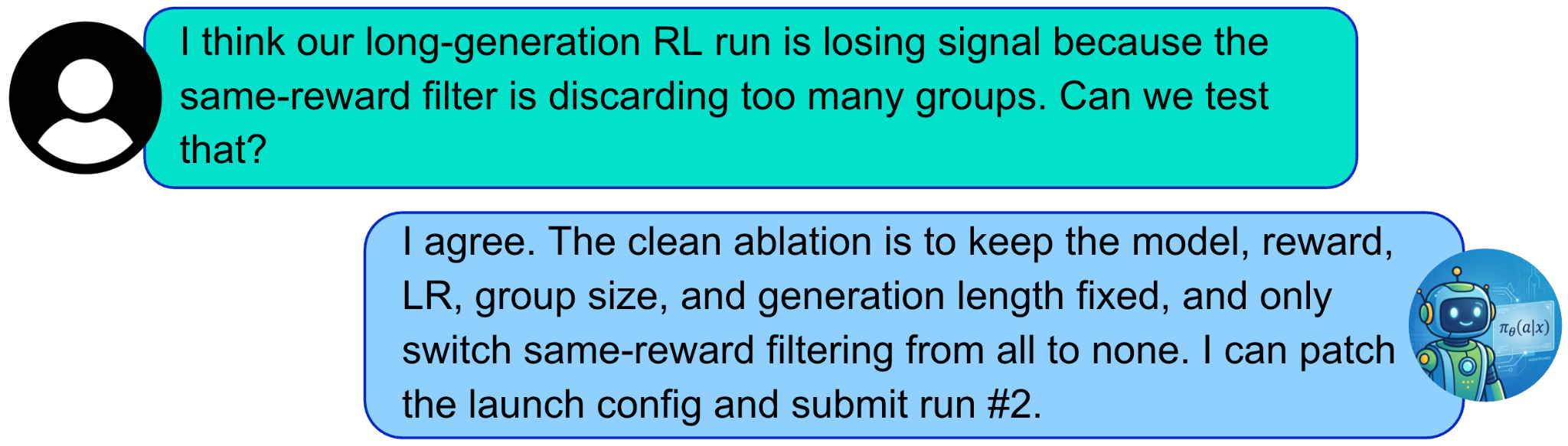
That is the kind of interaction we want: technical, concrete, and executable.

The Closed Loop: Run Ablations, Compare, Learn

Training agents is noisy. A run can look promising early and still go sideways later. 

VibeTrain is designed to turn that question into an ablation loop. It can analyze a run, propose useful changes, launch a follow-up, and then conduct comparison. Instead of leaving the researcher to stitch together plots and notes by hand, VibeTrain can generate the comparison view on demand.
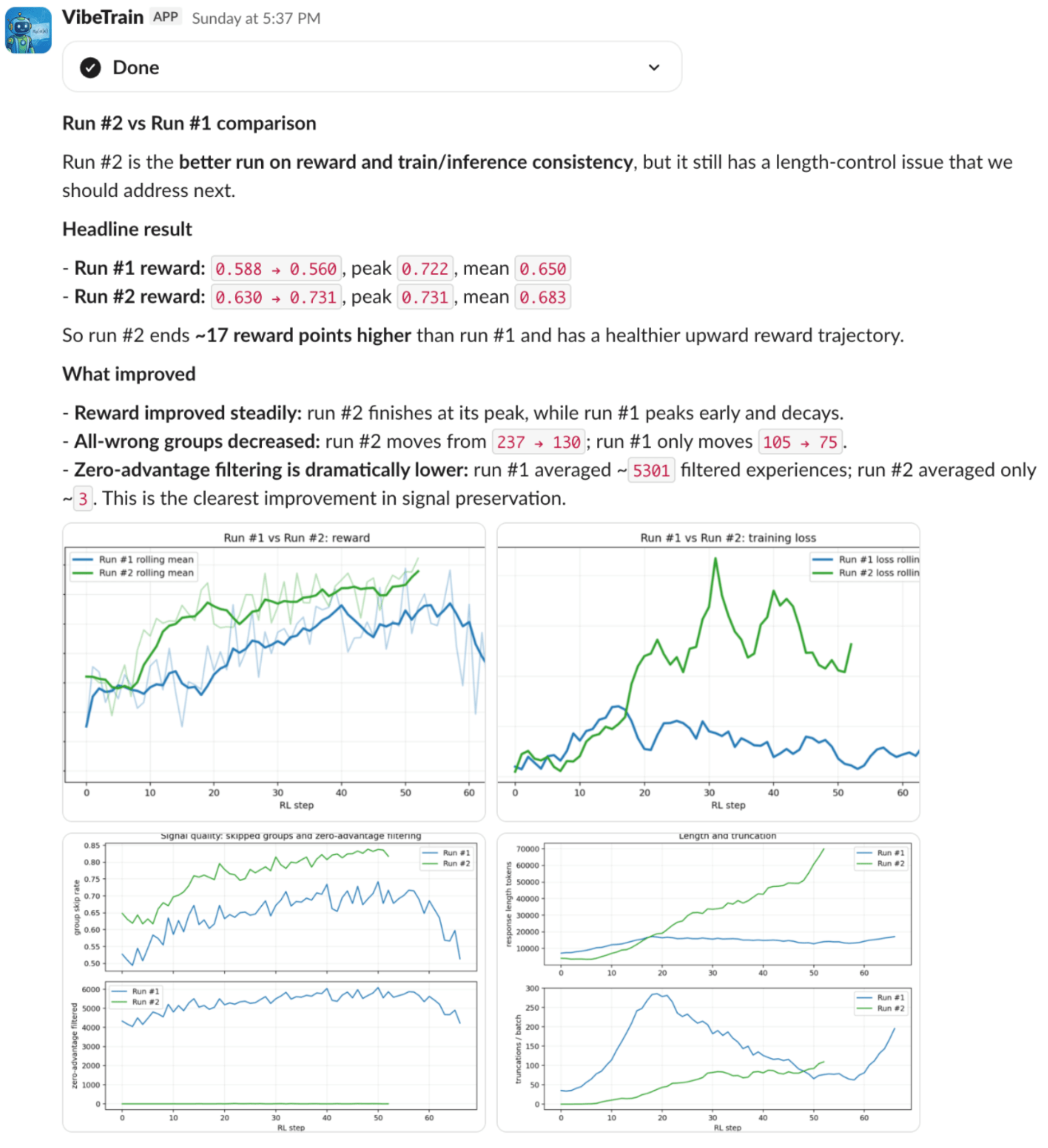
VibeTrain compares run #2 against run #1, summarizes what improved, and generates the plots needed to understand the ablation.

This turns experiment iteration into a real research loop the next experiment built on top of previous ones.

This is also where generative UI matters. The interface is not a fixed dashboard with a predetermined set of panels. The user asks a question, and VibeTrain creates the charts, tables, or slide-ready summaries.

That is the product difference. Fine-tuning tools usually stop at “job complete.” VibeTrain keeps going until the experiment has taught the team something actionable.

Reports Should Be Dynamically Generated, Not Hand-Assembled

Every training loop ends with communication. Researchers need to tell the team what changed, what worked, what failed, and what should happen next.

VibeTrain turns that communication into a generated artifact. A quick status update, failure analysis, run comparison, or team briefing can be produced directly from the experiment thread, with the right plots, interpretation, and recommended next steps.

The result is shared understanding. The analysis is not trapped in one researcher’s notebook or terminal scrollback; it becomes something the team can read, discuss, and act on.

Why This Matters

Agent training is becoming a team workflow, not just a model-training job.

The work now includes long-horizon behavior, tool use, simulations, evaluation, reporting, and deployment. Each step creates context the next step depends on. If that context is scattered across dashboards, notebooks, terminals, and meetings, the team loses momentum.

VibeTrain keeps the workflow in one shared conversation. The same place where a failure is reported can become the place where the plan is written, the run is launched, the curves are interpreted, the results are shared, and the trained model is tested.

Researchers can move from idea to experiment faster. Engineers can turn product failures into training workflows without becoming RL infrastructure experts. Teams can move from “the agent is broken” to “here is the evaluated replacement” with the reasoning, artifacts, and decisions visible along the way.

What We Are Building Toward

AI model training should not require every practitioner to become an expert in every layer of the stack before running one meaningful experiment.

Training should feel like collaboration. That is SFR-VibeTrain.