


惯性聚合 高效追踪和阅读你感兴趣的博客、新闻、科技资讯
阅读原文 在惯性聚合中打开

推荐订阅源

T
Troy Hunt's Blog
Y
Y Combinator Blog
云风的 BLOG
云风的 BLOG
B
Blog RSS Feed
S
Securelist
H
Help Net Security
Security Archives - TechRepublic
S
Secure Thoughts
Spread Privacy
Spread Privacy
C
Check Point Blog
WordPress大学
WordPress大学
AWS News Blog
AWS News Blog
L
Lohrmann on Cybersecurity
K
KPMG report finds enterprise disconnect between AI and its ROI | CIO
P
Privacy International News Feed
T
The Exploit Database - CXSecurity.com
N
News and Events Feed by Topic
Blog — PlanetScale
Blog — PlanetScale
PCI Perspectives
PCI Perspectives
T
Tor Project blog
钛媒体:引领未来商业与生活新知
钛媒体:引领未来商业与生活新知
C
Cyber Attacks, Cyber Crime and Cyber Security
Google Online Security Blog
The Hacker News
The Hacker News
宝玉的分享
宝玉的分享
www.infosecurity-magazine.com
C
Cisco Blogs
Last Week in AI
Last Week in AI
Webroot Blog
Webroot Blog
GbyAI
GbyAI
I
InfoQ
罗磊的独立博客
The GitHub Blog
The GitHub Blog
Google DeepMind News
Latest news
Latest news
P
Palo Alto Networks Blog
博客园 - Franky
T
Threat Research - Cisco Blogs
OSCHINA 社区最新新闻
OSCHINA 社区最新新闻
S
Security Affairs
H
Hacker News: Front Page
P
Privacy & Cybersecurity Law Blog
小众软件
小众软件
The Register - Security
Cyber Security Advisories - MS-ISAC
B
Blog
V
Vulnerabilities – Threatpost
人人都是产品经理
人人都是产品经理
博客园_首页
aimingoo的专栏
aimingoo的专栏

Salesforce

How We Protect Our Data as Customer Zero Scale Your MRR: Subscription Management For Small Business Streamlining Commerce Media Ad Inventory Management 12 AI Sales Strategies for Startups That Actually Work Sell Smarter: Ecommerce Metrics To Track For Your Small Business Shop Apply the Orchestration Density Framework to Your Next Automation Decision Wait, Black Friday Planning In Spring? It’s Time to Start Holiday Promotions AI-First Operations, One Process at a Time How BCU Is Transforming Banking Service with Agentforce Salesforce Headless 360: What the Agent Consumer Means for Your Integration Architecture Meet Customers Where They Are: Agentforce Contact Center Now Offers WhatsApp Voice 11 Free Lead Generation Tips for Small and Growing Businesses SFR-VibeTrain: The Agent That Trains Agents Why Technical Accuracy is the Wrong Metric for Agent Success Strengthening Salesforce Security Against AI-Driven Threats Join Us in the Community Hub at Connections 2026 The Best Way To Build AI Agents That Customers Trust 5 Ways AI is Changing the Communication Game For Startups Trust in the Era of Agents: Highlights from the 2nd Annual Trusted AI Impact Report You Can Be an Agentic Enterprise No Matter What Size Business How to Make Your Email Marketing Accessible for Everyone What is Headless? Don’t Lose Your Head, SMBs: It’s a Good Thing Architect the Future UI: Slack as Your Agentic Surface Point of Sale Innovations to Modernize the Shopper Experience Governing the Agentic Enterprise at Scale with MuleSoft Omni Gateway How to Cut Service Time with Case Routing Automation 5 Tips for Marketers to Get Started with Salesforce Flow No One is Vibe Coding Trade Promotion Management 7th Edition State of Sales Report: 3 Growth Trends for Startups and SMBs How the Architect Vista Brought Architectural Thinking to Life at TDX 2026 5 Steps to Develop an Architect Mindset With AI Why AI Isn’t Replacing Developers, It’s Empowering Them 10 Ways to Make Your AI Agent a Better Communicator AI in Design 2025: What Real Use Taught Us. How Salesforce Personalization Learns Which Offers Drive Revenue The 4-Step Guide to Salesforce Agent and Application Development Get Ready for Connections 2026: Top Sessions and New Reveals 8 Ways AI Agents Are Evolving in 2026 4 Principles to Make the Right Salesforce UI Decisions Apprentice Journey Shines a Light on Talent Pathways at Salesforce Agent Script: The Control Plane for Agentic Decisions Scaling the Agentforce Life Sciences Ecosystem to Drive the Future of Pharma and MedTech Unlocking Unstructured Data: Building AI-Powered Support Triage with Data 360 Asking For a Friend: What Are Rich Communication Services (RCS)? 5 Slack Shortcuts For Small Teams 195% ROI In Field Service? Here’s How They Did It Submit Your Architect Session: The Dreamforce 2026 Call for Participation Is Open What Is an AI Assistant for Small Business? B2C Commerce April release: Transforming the B2C developer experience with agents Meet Your 24/7 Prospecting Partner — And 5 More Stand-Out Features In Our April Release 11+ Small Business YouTube Channels You Need to Follow Today Stop Treating Disputes Management Like IT Tickets Limitless Service: A New Operating Model for Growth in the Agentic Era What is Transactional Reconciliation in Email and SMS Marketing? How to Prepare for National Small Business Week (2026) How to Design a High-Scale Multi-Cloud Incident Journey 10 Ways An AI CRM Can Amplify Your Startup Free vs. Paid CRM: Which is Right for Your Business? Salesforce Customer Success Awards 2026: Lead Era of the Agentic Enterprise 12 Free Webinars for Small Business Owners (2026) The Agentforce Life Sciences Consultant Certification Maximize Growth: The Power of Partnerships for SMBs Salesforce AI Research at ICLR 2026 Data Protection For Small Business: How To Safeguard Yourself Beyond 100K Tokens: Evaluating AI Agents in Long-Context Software Engineering Top 32 Small Business Tools To Try Today 6 New Innovations Redefining Salesforce Development How to Win the Battle for Attention in the Agentic Email Inbox Mastering the Eisenhower Matrix: Prioritize Like a Pro 10 Signs It’s Time To Upgrade Your CRM and How To Get Started (2026) Celebrating 10 Years of Financial Services Innovation How SMBs Can Gain An Edge With Agentic AI: Key Trends From Our Marketing Report How MAN Truck & Bus is Shaping the Future of Sales with Salesfive Introducing the Future of Salesforce Data Protection: Backup & Recover Next Stop Making AI Slop – Build a Foundation for Authentic AI Content 5 Tips to Help Marketers Navigate AI Email Summaries Data Sharing: Is it Safe? Is it Secure? Everything You Need to Know Small Business Week Readiness: 4 Things to Do Before May (2026) How Salesforce Employees Make an Impact During Earth Month AI Agents Are Advancing Rapidly… Is Your Testing Strategy Keeping Up? What Is Microproductivity and Why Is It Helping So Many Teams? TDX 2026 Roundup: Agentforce Edition 3 Ways Salesforce Connections Has Boosted My Career AI Agents Don’t Just Answer‌ — ‌They Act. Do You Have a Governance Strategy? The Future of MedTech Field Execution is Agentic 5 Steps to Prepare Your Data For an AI CRM From Break/Fix to Profit Engine: Aftermarket Service for Robot OEMs Building Trusted Human-Agent Collaboration: A Practical Framework ISV Strategy for the Salesforce Summer ’26 Release 5 Email Marketing Tips for Small Business Commerce Shops Should You Give Your AI Agent a Human Name? Creating Pathways into AI for People with Disabilities The Organized Chaos of Upfronts: 3 Hurdles Impacting Your Yield Trying to Scale Beyond ‘One-Off’ AI Tasks? You’re Probably Using the Wrong Interface What is Cost Per Lead (CPL)? The Case for Unified CCaaS and CRM — And Why the Data Makes It Clear In the New Era of AI, You Need to Win Over Both Humans and Agents What Is SPIN Selling? A Way to Build Trust With Your Customers G2 Crowns Salesforce as Best Financial Services Software Hidden Insights: The Guide to Tableau For Small Business Owners
Vibe Code Better Agents with Agentforce
Molly Futrel · 2026-04-24 · via Salesforce

Vibe coding is now an integral part of how many developers work. With only natural language prompts, you can use coding tools like Claude Code, Cursor, and Codex to scaffold an agent in minutes. More impressive, though, is building an agent that’s reliable, context-aware, and ready for production.

Say you work for an airline. If you have intermediate skills with Claude Code, you can vibe code a simple customer service agent in the time it takes to read this blog. But if that agent isn’t connected to your systems of work or your customer’s booking and tier information, it’s just a glorified chatbot. It can answer questions, but it’s powerless to resolve issues.

Agentforce closes that gap. It gives vibe-coded agents the customer data, integrated systems of work, and dynamic UI your agents need to be truly helpful in production.

Watch this demo to see how to vibe code better agents with Agentforce.

Let’s take a closer look at the build process, and consider tips for using Agentforce to vibe code better agents.

Start with What Your Org Already Knows

Production-ready agents need grounding in established business logic. One of the biggest advantages of building in Agentforce is that your Salesforce org already contains so much of that crucial intel. There’s no need to start from scratch to recreate existing flows, Apex classes, and integrations with third-party systems.

Per the example in our demo video, if your org is already integrated with external systems, you can use Claude to discover the components of that integration and create them as agent actions. The agent inherits your org’s existing guardrails and logic rather than rebuilding it.

Agentforce Builder lets you inspect the result. You can open the full agent configuration after a vibe-coded build, review the agent router, examine the subagents responsible for specialized tasks, and click into any action to see exactly what Claude created and why.
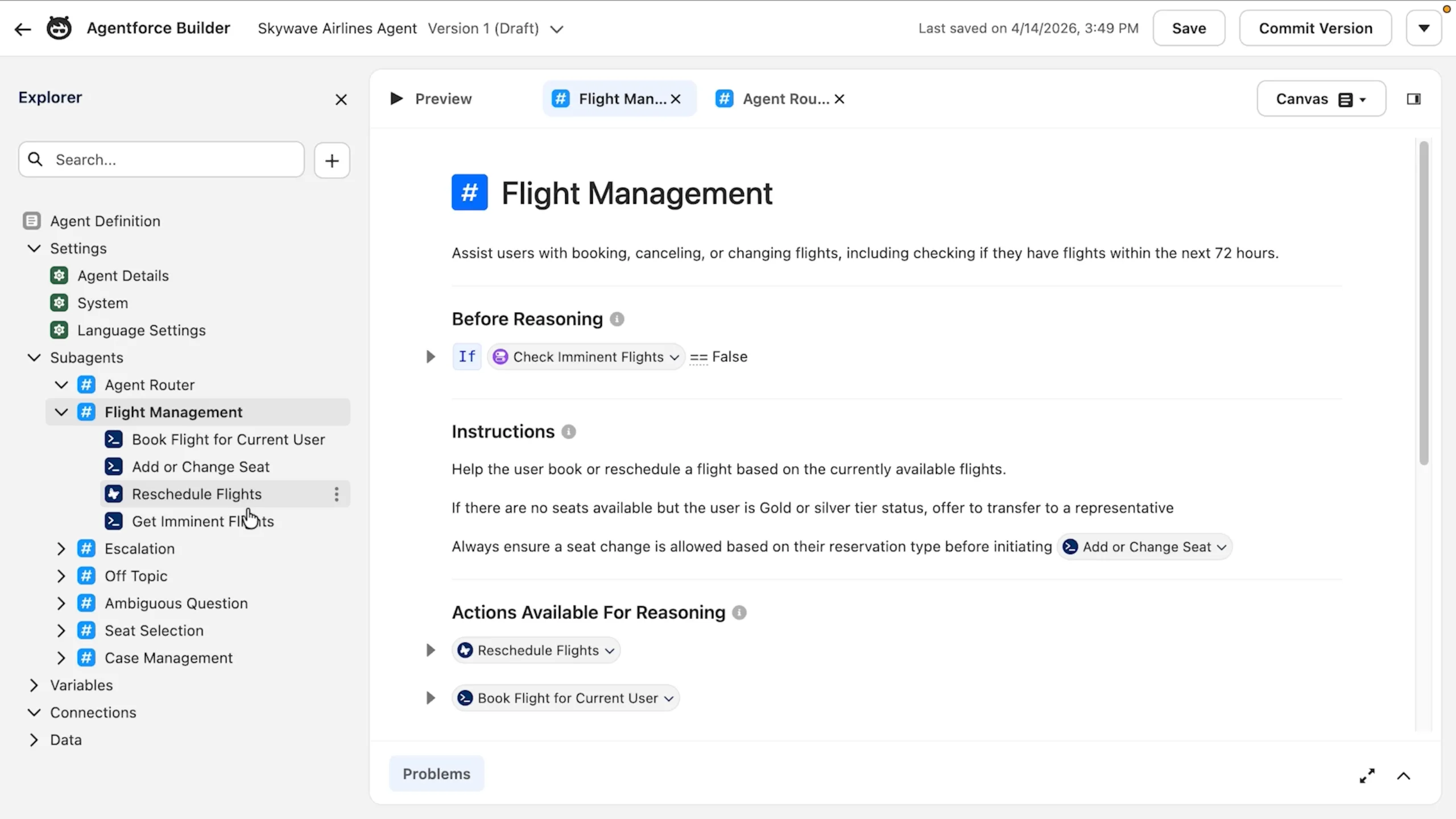
Agent config screenshot from demo.
To better understand what you’ve built with vibe coding, open it up in Agentforce Builder.
From the demo: “Here we can see the full agent configuration that Claude created.” 

Once you’ve inspected the build, you can fine-tune it directly in Builder via the Canvas or Script view.
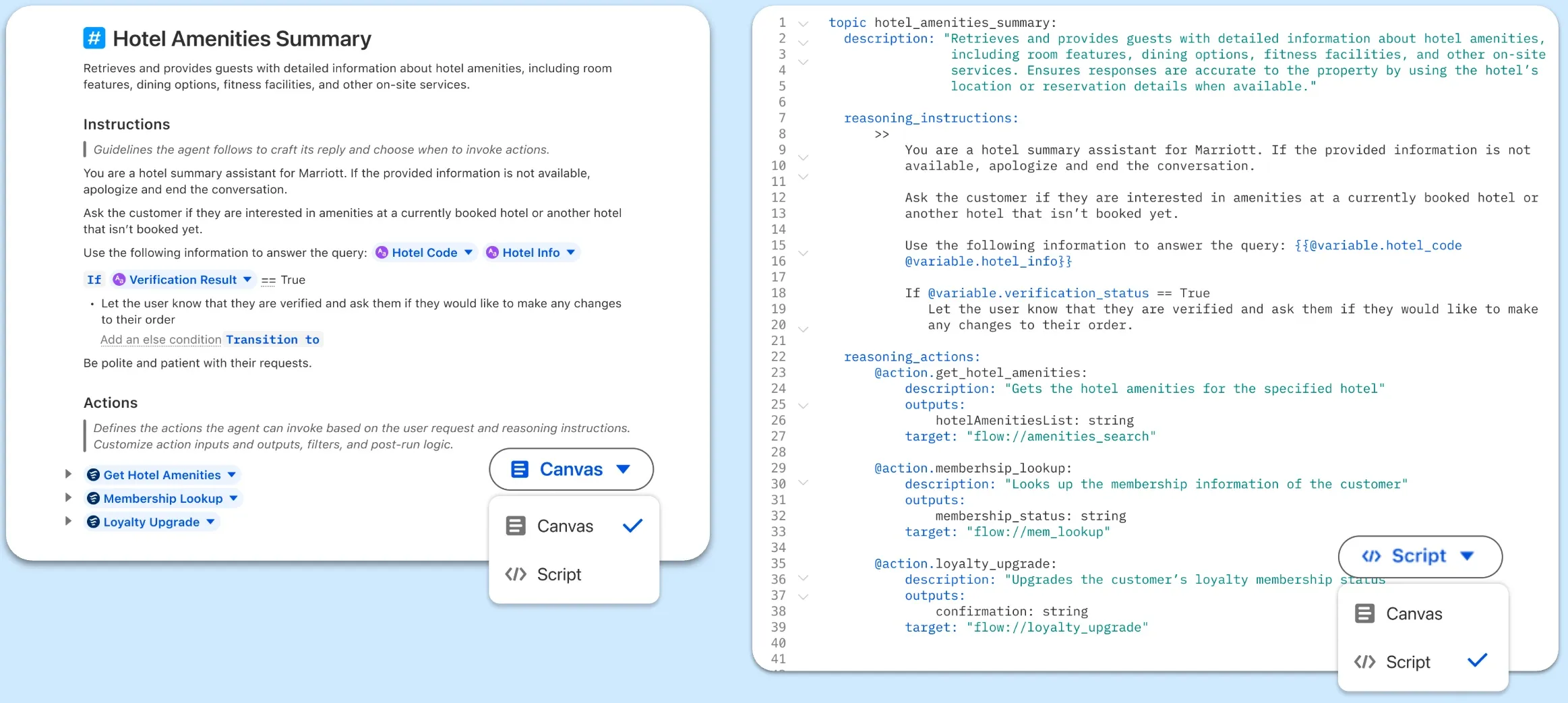
Screenshots comparing the Canvas and Script views in Agentforce Builder.
A side-by-side comparison of a Canvas and Script view in Agentforce Builder. 

Datasite Admin Grant Roberson uses both the Canvas and Script views depending on what he’s doing. “For writing instructions, I’m always going to be in the Canvas,” said Roberson. “If I’m adjusting something, I find that it works a little bit better in [Agent Script] because it’s easier to make granular adjustments.”

Give Your Agent the Right Data at the Right Time

Reliable agents need access to accurate, real-time information about things like customer history, product details, and policies. The more relevant context you can put in front of the model at the right moment, the more precise its response will be. 

The flight rescheduling demo shows this process in action. First, the agent uses an API call to get the customer’s reservation data from the booking system. It then passes that data into a prompt to evaluate refund policies and flight availability. By sequencing these actions, the agent finishes the task without a human handoff, delivering a response that’s personalized, policy-compliant, and actionable. 

Connect Your Systems of Work

Getting the data right is only part of the picture. Another important piece is making sure your agent has the right system connectivity to act on that data. 

Agentforce connects to the systems your team already works in. Beyond answering questions, your agents can take actions to complete tasks. No need to escalate to a human to rebook a flight or update a record. A real win is when an agent handles a reschedule from start to finish without dropping context or needing a handoff. Resolving the issue right then and there is how technical reliability translates into a better customer experience.

For use cases that involve multiple specialized jobs, let an agent router with dedicated subagents handle the division of labor. In the demo, the airline agent used the subagent router to hand off to the flight management subagent. If a customer asked a question about changing seats, the agent would hand off to the seat selection subagent instead. Each subagent takes responsibility for a specific task, keeping the overall architecture modular and easier to maintain as your agent evolves. 

Extending Agent Responses with LWC

Once your agent has the right data and system connections, it can do a lot more than respond in plain text. With Lightning Web Components (LWC) and Lightning Types, agents can render dynamic, interactive outputs directly in the conversation, like flight options a customer can select, booking confirmations with real details, or forms and action buttons that let users complete a task without leaving the chat.

Your favorite AI coding tool can help create LWCs, too. Give it your brand guidelines and a component goal, and let it draft up the structure and styling. The output still requires review and refinement, but it gives you a handy head start.

Architecting Agents for Reliability and Scale

Moving a prototype into production requires shifting from monolithic, instruction-heavy prompts to a modular, governed architecture. Agentforce achieves reliability by isolating reasoning in the Agent Script while delegating functional tasks like UI rendering or data fetching to modular, deterministic components. 

Depending on your use case, these field-tested practices help ensure your agent remains performant and predictable.

1. Hydrate Your Tools with ADLC Skills

Your Salesforce org is the richest data layer you can give your agent — but only if your coding tools know how to read it. Before you begin coding in your preferred developer environment, load the Agentforce Development Lifecycle (ADLC) skills from this public repository. These skills provide your tool with the enterprise-grade frameworks and org awareness needed to generate compatible code. Coding tools equipped with these skills can read your existing flows and classes to generate recommendations grounded in your specific setup, rather than generic boilerplate content.
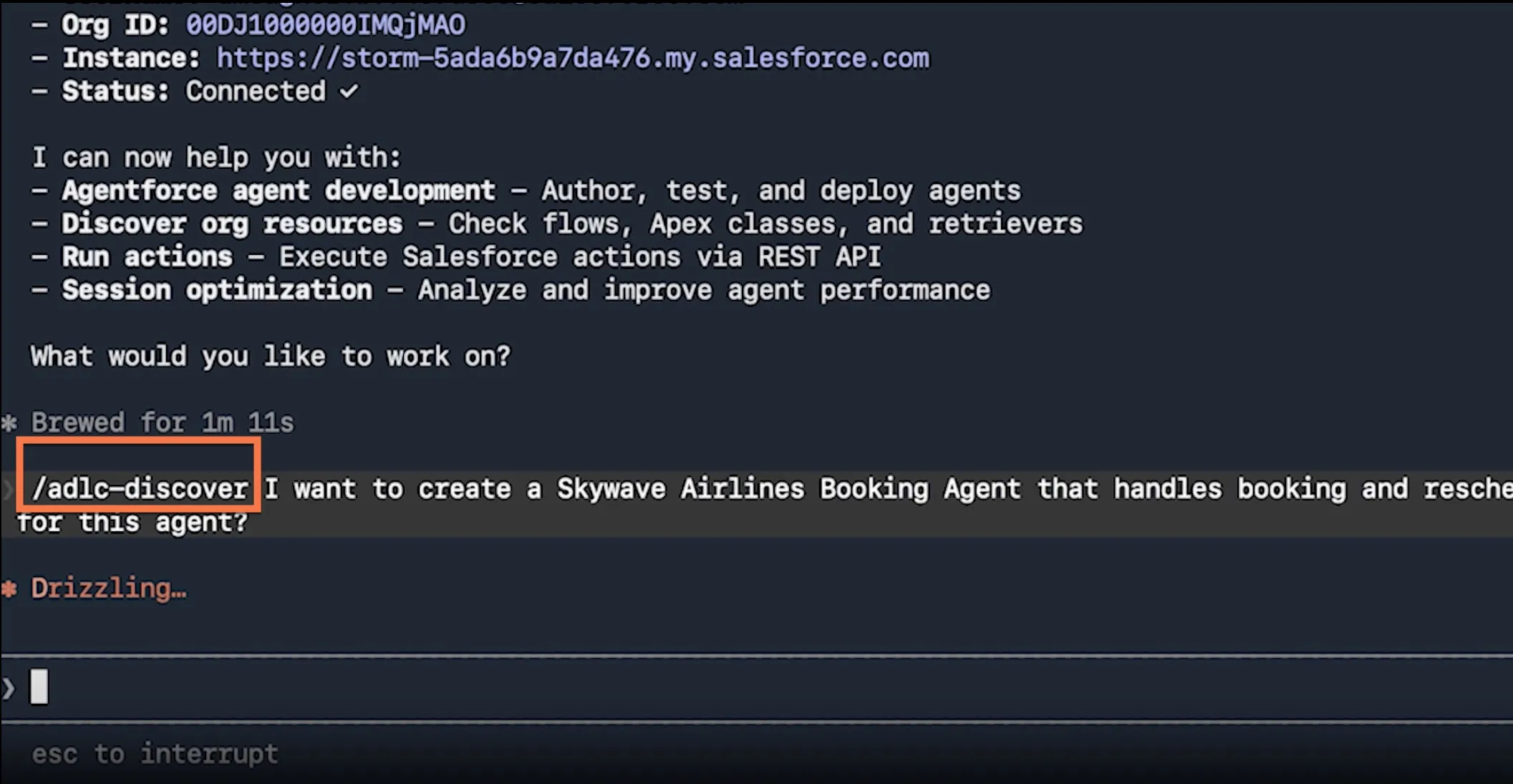
A screenshot from the demo using an Agentforce skill in Claude Code.
In the demo video, we use an Agentforce skill in Claude Code. The skill, /adlc-discover, lets Claude read the existing flows, Apex classes, and connected systems, then generate recommendations grounded in that org’s specific setup. 

2. Be Explicit with Guardrails
When moving from a vibe-coded concept to a production agent, use Agent Script to explicitly define rules and guardrails in compliance with your company policies.

3. Build Lean and Test Iteratively

Vibe coding makes it easy to over-engineer an agent with too many instructions. Start with a few essential guidelines per topic. Test the agent for performance and accuracy before adding the next instruction. If the agent’s reasoning degrades, strip back the most recent additions to restore consistent functionality. This iterative approach prevents prompt bloat and makes debugging easier.

For more tips like these, see Five Pro Tips for Using Agentforce Vibes on the Salesforce Developers Blog. 

From Vibe Code to Production

 Vibe coding makes it faster than ever to build an agent. Agentforce makes it one worth trusting.

If you’re ready to build, start by running a discovery pass against your Salesforce org to surface the flows, classes, and connected systems already in place.

When you’re ready to inspect what your coding tool built before you ship it, Agentforce Builder gives you a clear view of the full agent configuration: the router, subagents, actions, and how they connect.

 Use your favorite coding tools to build your agents. Agentforce provides the production-grade foundation — data, integrations, and UI — so what you ship is actually enterprise-ready.