

惯性聚合 高效追踪和阅读你感兴趣的博客、新闻、科技资讯
阅读原文 在惯性聚合中打开

推荐订阅源

IT之家
IT之家
C
CXSECURITY Database RSS Feed - CXSecurity.com
V
Visual Studio Blog
D
Darknet – Hacking Tools, Hacker News & Cyber Security
小众软件
小众软件
L
LangChain Blog
Cyberwarzone
Cyberwarzone
美团技术团队
The Register - Security
Threat Intelligence Blog | Flashpoint
T
Tor Project blog
V
V2EX
Security Archives - TechRepublic
Hacker News: Ask HN
Hacker News: Ask HN
L
LINUX DO - 最新话题
Recent Announcements
H
Hackread – Cybersecurity News, Data Breaches, AI and More
酷 壳 – CoolShell
酷 壳 – CoolShell
freeCodeCamp Programming Tutorials: Python, JavaScript, Git & More
aimingoo的专栏
aimingoo的专栏
人人都是产品经理
人人都是产品经理
F
Full Disclosure
V2EX - 技术
V2EX - 技术
The Cloudflare Blog
博客园 - 叶小钗
T
Threat Research - Cisco Blogs
阮一峰的网络日志
阮一峰的网络日志
G
GRAHAM CLULEY
OSCHINA 社区最新新闻
OSCHINA 社区最新新闻
Latest news
Latest news
S
Security @ Cisco Blogs
Spread Privacy
Spread Privacy
Project Zero
Project Zero
K
Kaspersky official blog
MyScale Blog
MyScale Blog
Attack and Defense Labs
云风的 BLOG
云风的 BLOG
博客园 - 【当耐特】
Hacker News - Newest:
Hacker News - Newest: "LLM"
大猫的无限游戏
大猫的无限游戏
P
Privacy International News Feed
Google DeepMind News
WordPress大学
WordPress大学
C
Cybersecurity and Infrastructure Security Agency CISA
Webroot Blog
Webroot Blog
罗磊的独立博客
Vercel News
Vercel News
N
News and Events Feed by Topic
A
Arctic Wolf
C
CERT Recently Published Vulnerability Notes

Salesforce

How We Protect Our Data as Customer Zero Scale Your MRR: Subscription Management For Small Business Streamlining Commerce Media Ad Inventory Management 12 AI Sales Strategies for Startups That Actually Work Sell Smarter: Ecommerce Metrics To Track For Your Small Business Shop Apply the Orchestration Density Framework to Your Next Automation Decision Wait, Black Friday Planning In Spring? It’s Time to Start Holiday Promotions AI-First Operations, One Process at a Time How BCU Is Transforming Banking Service with Agentforce Salesforce Headless 360: What the Agent Consumer Means for Your Integration Architecture Meet Customers Where They Are: Agentforce Contact Center Now Offers WhatsApp Voice 11 Free Lead Generation Tips for Small and Growing Businesses SFR-VibeTrain: The Agent That Trains Agents Why Technical Accuracy is the Wrong Metric for Agent Success Strengthening Salesforce Security Against AI-Driven Threats Join Us in the Community Hub at Connections 2026 The Best Way To Build AI Agents That Customers Trust 5 Ways AI is Changing the Communication Game For Startups Trust in the Era of Agents: Highlights from the 2nd Annual Trusted AI Impact Report You Can Be an Agentic Enterprise No Matter What Size Business How to Make Your Email Marketing Accessible for Everyone What is Headless? Don’t Lose Your Head, SMBs: It’s a Good Thing Architect the Future UI: Slack as Your Agentic Surface Point of Sale Innovations to Modernize the Shopper Experience Governing the Agentic Enterprise at Scale with MuleSoft Omni Gateway How to Cut Service Time with Case Routing Automation 5 Tips for Marketers to Get Started with Salesforce Flow No One is Vibe Coding Trade Promotion Management 7th Edition State of Sales Report: 3 Growth Trends for Startups and SMBs How the Architect Vista Brought Architectural Thinking to Life at TDX 2026 5 Steps to Develop an Architect Mindset With AI Why AI Isn’t Replacing Developers, It’s Empowering Them 10 Ways to Make Your AI Agent a Better Communicator AI in Design 2025: What Real Use Taught Us. How Salesforce Personalization Learns Which Offers Drive Revenue The 4-Step Guide to Salesforce Agent and Application Development Get Ready for Connections 2026: Top Sessions and New Reveals 8 Ways AI Agents Are Evolving in 2026 4 Principles to Make the Right Salesforce UI Decisions Apprentice Journey Shines a Light on Talent Pathways at Salesforce Agent Script: The Control Plane for Agentic Decisions Scaling the Agentforce Life Sciences Ecosystem to Drive the Future of Pharma and MedTech Unlocking Unstructured Data: Building AI-Powered Support Triage with Data 360 Asking For a Friend: What Are Rich Communication Services (RCS)? 5 Slack Shortcuts For Small Teams 195% ROI In Field Service? Here’s How They Did It Submit Your Architect Session: The Dreamforce 2026 Call for Participation Is Open What Is an AI Assistant for Small Business? B2C Commerce April release: Transforming the B2C developer experience with agents Meet Your 24/7 Prospecting Partner — And 5 More Stand-Out Features In Our April Release 11+ Small Business YouTube Channels You Need to Follow Today Stop Treating Disputes Management Like IT Tickets Limitless Service: A New Operating Model for Growth in the Agentic Era What is Transactional Reconciliation in Email and SMS Marketing? How to Prepare for National Small Business Week (2026) How to Design a High-Scale Multi-Cloud Incident Journey 10 Ways An AI CRM Can Amplify Your Startup Vibe Code Better Agents with Agentforce Free vs. Paid CRM: Which is Right for Your Business? Salesforce Customer Success Awards 2026: Lead Era of the Agentic Enterprise 12 Free Webinars for Small Business Owners (2026) The Agentforce Life Sciences Consultant Certification Maximize Growth: The Power of Partnerships for SMBs Salesforce AI Research at ICLR 2026 Data Protection For Small Business: How To Safeguard Yourself Beyond 100K Tokens: Evaluating AI Agents in Long-Context Software Engineering Top 32 Small Business Tools To Try Today 6 New Innovations Redefining Salesforce Development How to Win the Battle for Attention in the Agentic Email Inbox Mastering the Eisenhower Matrix: Prioritize Like a Pro 10 Signs It’s Time To Upgrade Your CRM and How To Get Started (2026) Celebrating 10 Years of Financial Services Innovation How SMBs Can Gain An Edge With Agentic AI: Key Trends From Our Marketing Report How MAN Truck & Bus is Shaping the Future of Sales with Salesfive Introducing the Future of Salesforce Data Protection: Backup & Recover Next Stop Making AI Slop – Build a Foundation for Authentic AI Content 5 Tips to Help Marketers Navigate AI Email Summaries Data Sharing: Is it Safe? Is it Secure? Everything You Need to Know Small Business Week Readiness: 4 Things to Do Before May (2026) How Salesforce Employees Make an Impact During Earth Month AI Agents Are Advancing Rapidly… Is Your Testing Strategy Keeping Up? What Is Microproductivity and Why Is It Helping So Many Teams? TDX 2026 Roundup: Agentforce Edition 3 Ways Salesforce Connections Has Boosted My Career AI Agents Don’t Just Answer‌ — ‌They Act. Do You Have a Governance Strategy? The Future of MedTech Field Execution is Agentic 5 Steps to Prepare Your Data For an AI CRM From Break/Fix to Profit Engine: Aftermarket Service for Robot OEMs Building Trusted Human-Agent Collaboration: A Practical Framework ISV Strategy for the Salesforce Summer ’26 Release 5 Email Marketing Tips for Small Business Commerce Shops Should You Give Your AI Agent a Human Name? Creating Pathways into AI for People with Disabilities The Organized Chaos of Upfronts: 3 Hurdles Impacting Your Yield What is Cost Per Lead (CPL)? The Case for Unified CCaaS and CRM — And Why the Data Makes It Clear In the New Era of AI, You Need to Win Over Both Humans and Agents What Is SPIN Selling? A Way to Build Trust With Your Customers G2 Crowns Salesforce as Best Financial Services Software Hidden Insights: The Guide to Tableau For Small Business Owners
Trying to Scale Beyond ‘One-Off’ AI Tasks? You’re Probably Using the Wrong Interface
Avi Shah · 2026-04-10 · via Salesforce

For all the talk of scale in enterprise AI, it’s ironic that most of us interact with LLMs through an interface designed for doing things one at a time. The humble prompt window has been a productivity boon for knowledge workers thanks in no small part to its radical simplicity: ask almost anything and get an answer. It’s the type of blank canvas perfect for pressure testing campaign ideas, researching new topics or generating personalized sales emails. But while agents and LLM prompts can help hasten these types of tasks, speed is not the same as scale. 

What happens when you have an AI workflow that needs to run not once, but hundreds of times? And what if that workflow isn’t a single prompt, but a chain of prompts and agents orchestrated in sequence? How would you design it to be secure, auditable and integrated? Where would you visualize it? How would you funnel the results into other business systems? Whether you’re enriching and scoring leads, QA’ing customer service interactions, or mining cases for insights, scaling the power of LLMs to run across thousands of records in parallel isn’t as simple as asking your agent to “please run my process 1,000 times.” 
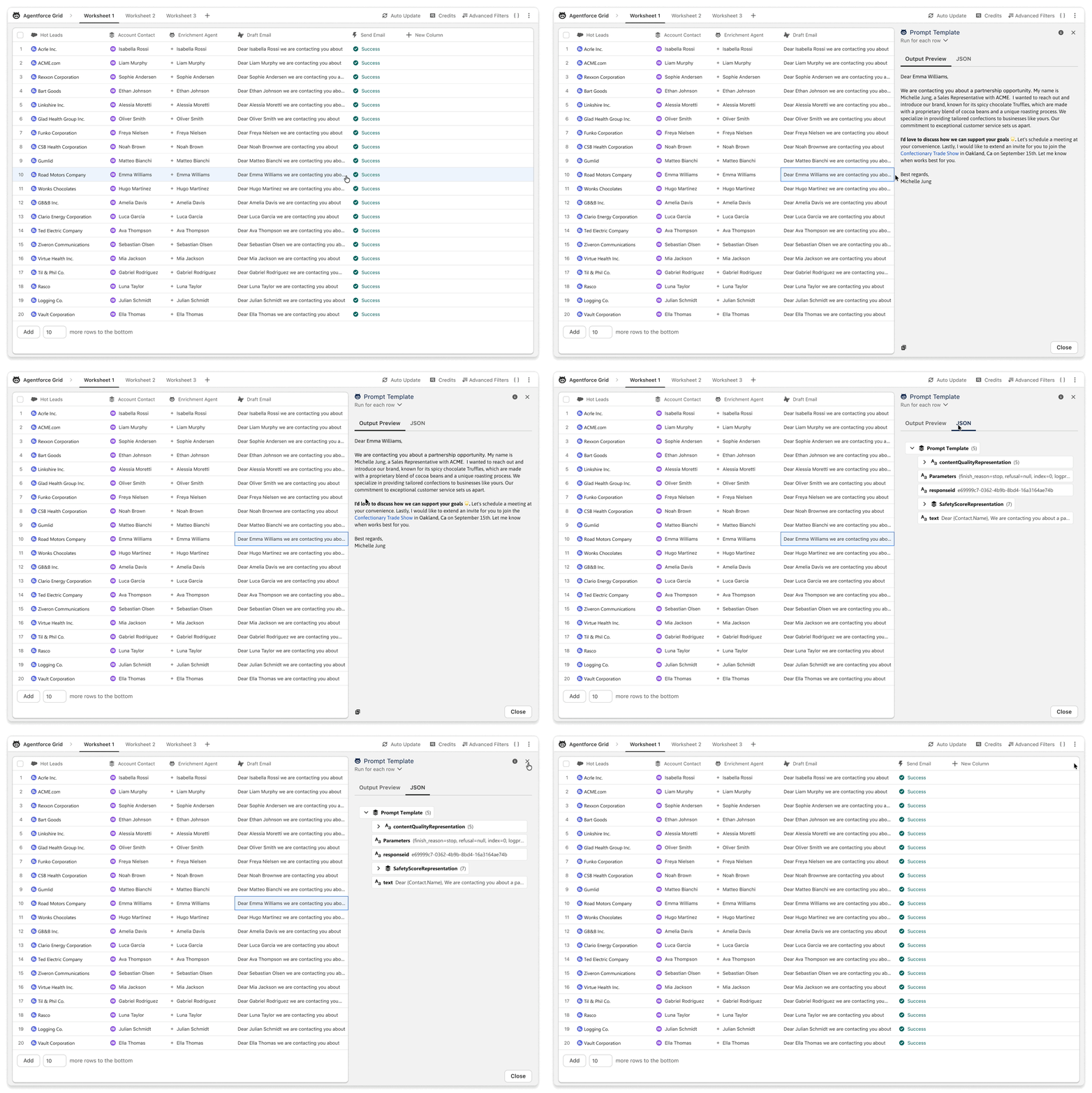
Grid allows you to build AI workflows in a spreadsheet-style UI.

Chaining together AI processes and executing them in bulk requires a new kind of interface, or rather, a spin on a classic. To understand why, let’s look at a customer example. 

50 hours optimizing one prompt

Earlier this year, a global B2B software company set out to improve forecast accuracy and drive new business. They had thousands of open opportunities in Salesforce and a simple goal: flag at-risk deals and generate the exact next steps a rep should take.

But they soon found that no matter how much they tuned and re-tuned their prompt, it couldn’t handle the full end-to-end workflow. Diagnosing deal risk required one prompt; turning that diagnosis into concrete next steps required another. While an agent could technically orchestrate those steps, it quickly became a black box. There was no way to inspect intermediate outputs, debug failures, or iterate step-by-step across thousands of records. 

To do this at scale, they had to pull thousands of records and write a script to run the deal risk prompt on each one, then pass each output to the agent to determine next steps. When the “next step” looked wrong, no one could tell why — was the underlying deal data incomplete? Was the risk analysis flawed? Or did the agent misapply the methodology? Iteration meant rerunning the entire workflow, spot-checking a handful of results, and praying for the best.

By the time they had something they trusted, they had spent more than 50 hours building and debugging a workflow they wanted to run every week.

We know what you’re thinking: surely there’s a better way! Reader, there sure is. 

Not reinventing the wheel

In the example above, it’s easy to overlook the unsung yet crucial role of the CSV file. It’s where we aggregate all of our data only to have to export it into a prompt window to then have to manually copy-and-paste the results into Slack. Imagine how much easier our lives would be if we simply brought our AI agents and LLM prompts directly into the spreadsheet along with really robust data integration.
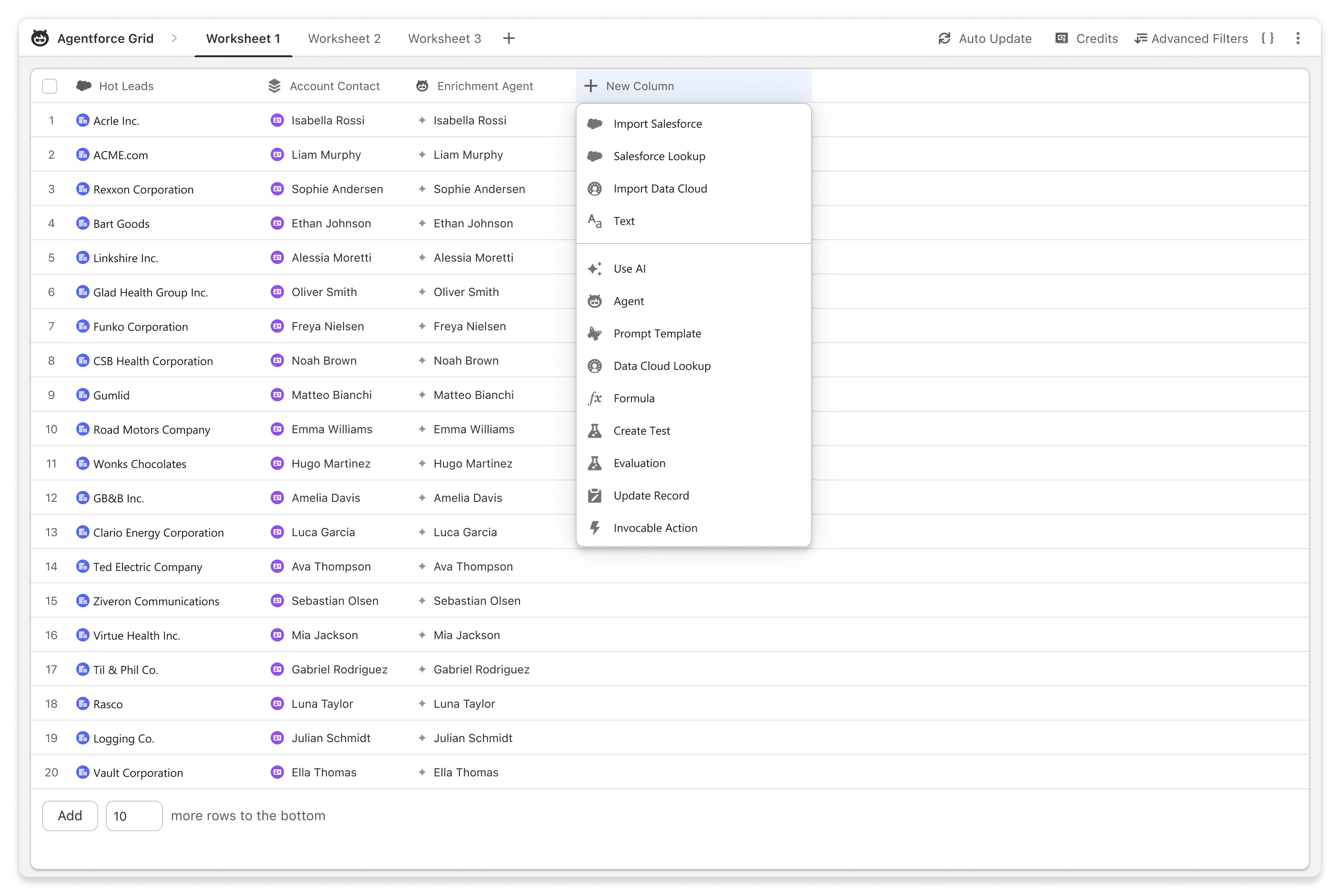
Grid’s columns let you quickly build compounding workflows.

That’s exactly what we’re doing with Agentforce Grid, a new AI workspace built like a spreadsheet that allows you to chain together CRM data, Data 360, LLM prompts, AI agents and actions into high-level AI workflows that run in batch.    

Grid delivers two essential capabilities for running AI at scale: bulk execution and compounding workflows. Grid integrates natively with Salesforce CRM and Data 360 to enable you to import thousands of records with just a few clicks. You can quickly specify which objects and metadata fields to pull in, or enter a raw SOQL query to perform lookups or grab related lists. Each record becomes a row in the Grid. 
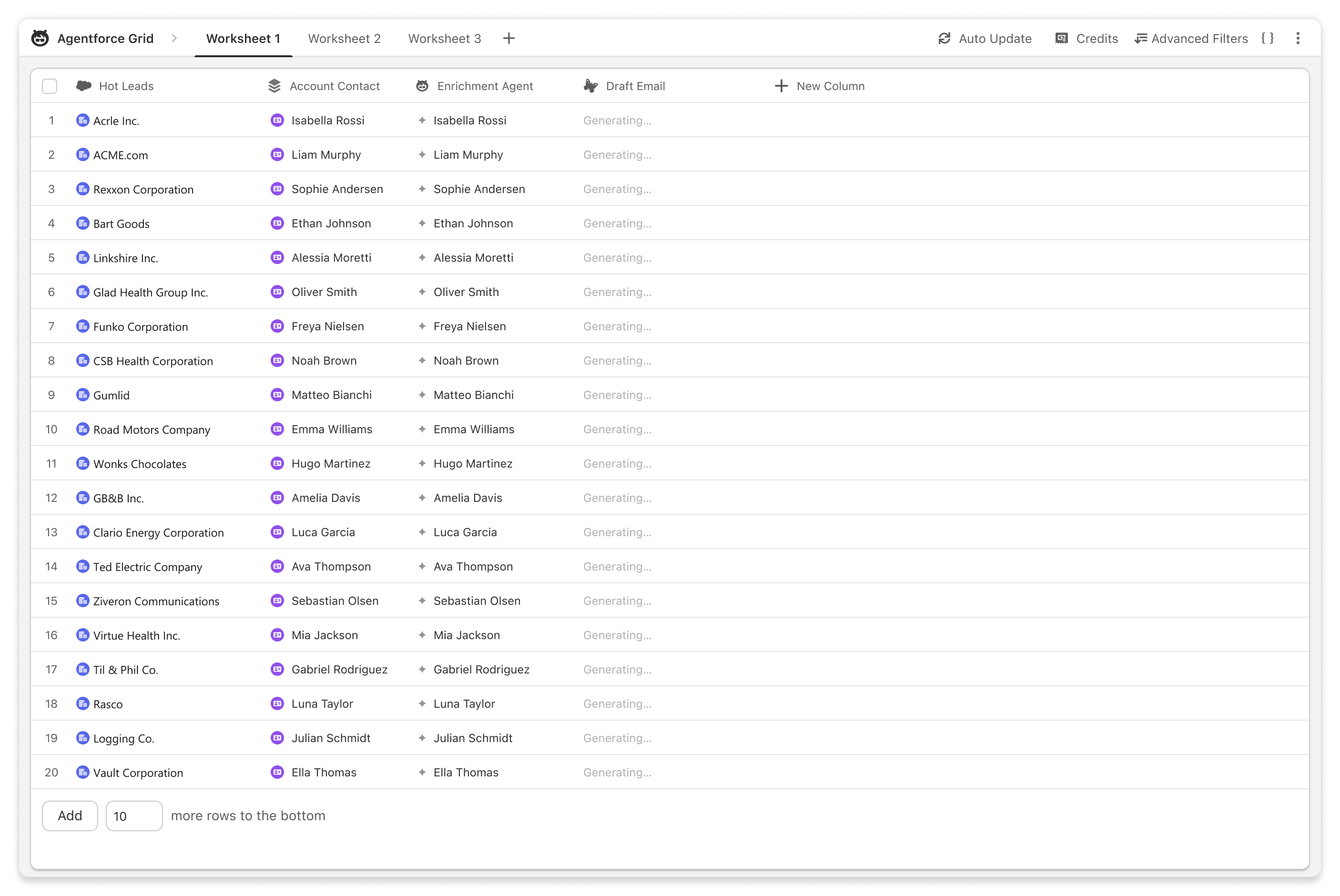
Grid allows you to run a prompt across hundreds of records in parallel.

But Grid’s real power lies in its columns. Let’s imagine that for each record in the spreadsheet, you want to apply a prompt template that generates an account summary. Simply add a Prompt Template column or AI column to your spreadsheet, select the prompt template you want to use and point it at the column containing the account data to be summarized. Grid will run the template in parallel with the context from each row, saving countless hours. Think of each column as a discrete step in the workflow, progressively building on the previous step until the work turns into a real outcome, like a personalized email or an update to an opportunity record. And thanks to native integration with CRM, Grid can write these summaries back into your CRM directly via invocable actions, as well as leverage existing prompt templates, agents and flows.
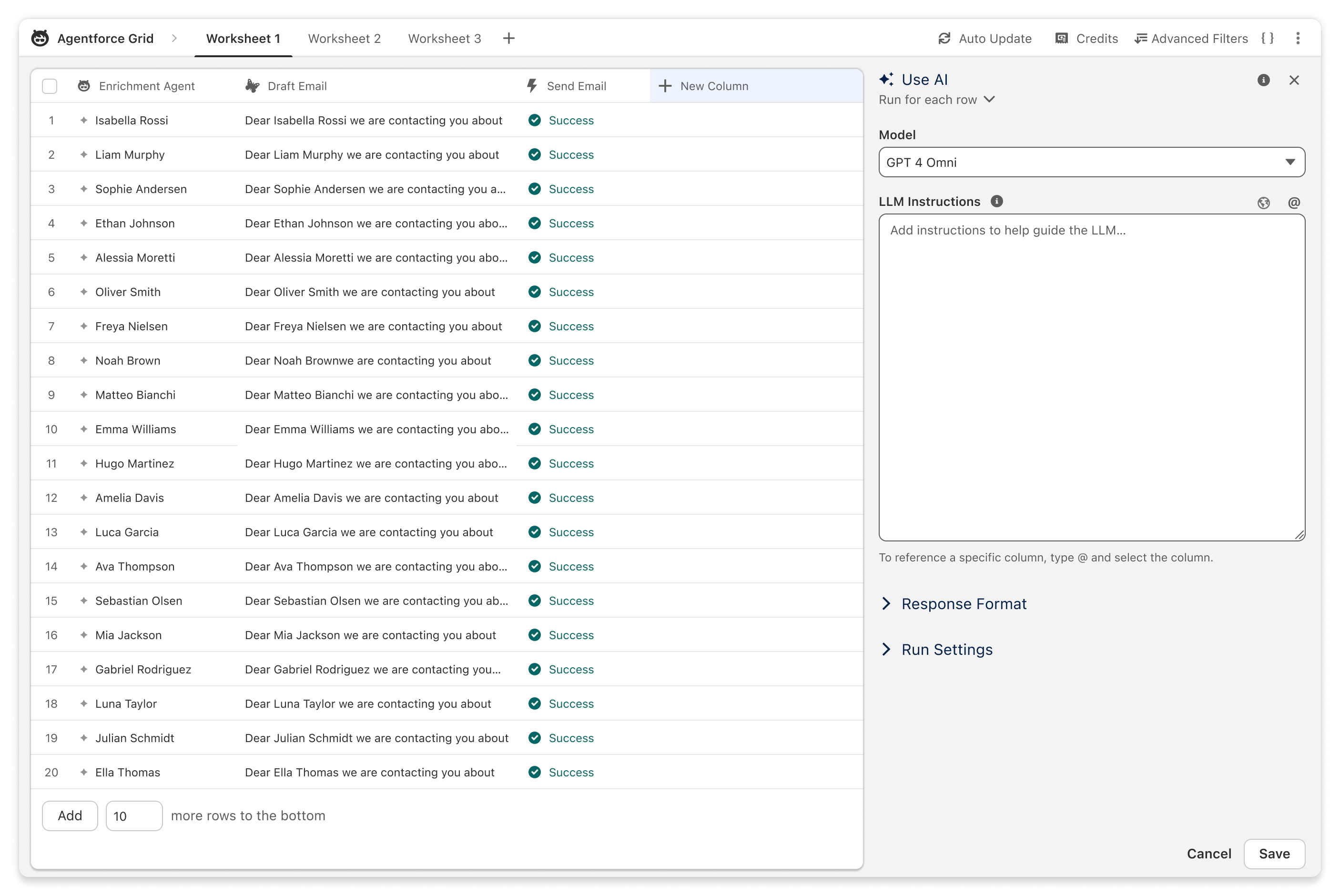
Create new AI columns on the fly.

But how can we tell if Grid is doing a good job? 

A visual and auditable prototyping engine

The same prompt can generate a lot of variance across a hundred or thousand different records, so it’s important to validate your outputs before deploying an AI workflow to production. This challenge is even greater when chaining multiple prompts or agents together.This is where Grid’s spreadsheet-style UI really shines, making it easy to compare AI-generated results step-by-step, side-by-side. If a generated output fails an evaluation, pinpointing the problem is as simple as looking back through the previous columns to see where the process went wrong and why.   

But this isn’t merely a new interface for batch testing (formal testing should still occur in Testing Center, which is also getting a new spreadsheet-style UI!). Since Grid is where you compose the workflow itself, it’s easy to quickly diagnose what’s happening under the hood and make any necessary tweaks. That makes Grid your new starting point and one-stop shop for prototyping and iterating AI workflows.

While the path to AI at scale is different for every organization, it’s always good to have the right tools for the task at hand. LLMs and AI agents are an essential piece of the puzzle, but chat interfaces alone won’t get us to enterprise scale and reliability. Grid is your new destination for building, chaining and running AI workflows on real data. 

To get started, reach out to your AE today.