





If you work in life sciences commercial or medical operations, you already know: healthcare provider (HCP) events are one of your most powerful engagement channels. They’re also one of your most regulated ones.
Every attendee, every expense, every expert interaction carries compliance weight, including fair market value rates, transfer of value reporting, participation caps, jurisdiction-specific mandates. And if your team is managing all of that across spreadsheets, disconnected systems, and email threads? The risk adds up fast.
Here’s the good news: AI and a unified platform are changing what’s possible. Here are five ways life sciences organizations are using them to run compliant HCP events at scale without slowing down.
See how Agentforce Life Sciences for Customer Engagement centralizes field events on one platform.
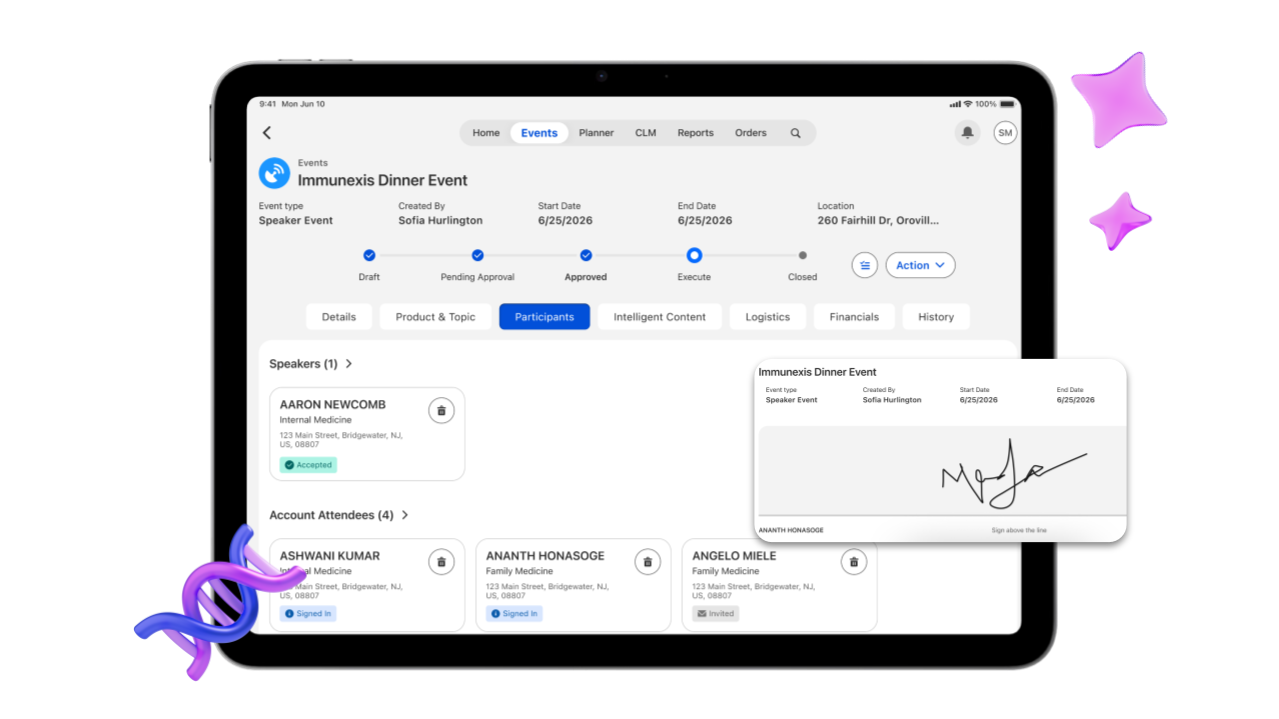
Most compliance processes work like this: you run the event, then someone reviews it. That’s a problem, because by the time a violation surfaces, you’re already dealing with the fallout.
With compliance built into each step of your events workflow, it happens continuously rather than after the fact. Apply fair market value (FMV) rates automatically. Capture transfer of value in real time. Enforce participation caps at the point of invitation before an issue becomes a violation.
Jurisdiction-specific mandates? Those are localized and enforced automatically, too. No more manually tracking regulatory requirements by region.
The shift here is fundamental: compliance moves from a gate at the end of the process to a guardrail built into every step.
Think about everything a field rep has to coordinate for a single dinner program: attendee recruitment, RSVPs, venue booking, catering, onsite logistics, post-event expense reconciliation. That’s a lot of moving parts, and in most organizations, they’re spread across multiple tools. The true value of MSLs and field teams lies in fostering high-impact expert engagement, rather than being bogged down by the friction of manual administrative tasks.
On a unified platform, all of it lives in one place. Automated workflows move each event from planning through execution, with real-time budget visibility aligned to your compliance rules built in from the start. Agents can assist with proactive speaker recommendations and logistical hurdles so teams can focus more time on the high-value clinical conversations needed to drive therapy and device adoption.
The result: your field reps spend less time chasing confirmations and more time doing what actually matters: building meaningful relationships with HCPs.
See how KAMs, FRMs, MSLs, and Field Reps can each increase efficiency on a unified platform.

Managing a national KOL speaker series is a different challenge than coordinating a field dinner, but the stakes are just as high. You’re defining expert needs across geographies, products, and audiences. You’re onboarding speakers, validating their qualifications, and tracking interactions across the year. You’re coordinating with agencies and vendors, each with their own SLAs.
With a system of execution, you get something you can’t get from fragmented tools: visibility. Budget planning by product, region, or event type. Vendor coordination and SLA tracking in one place. Real-time alerts when you’re approaching thresholds.
You can run a bigger, more sophisticated program and stay in control of every piece of it.
One of the biggest bottlenecks in HCP event management is the “last mile” of invoicing and payments. Here’s a scenario that probably sounds familiar: your speaker program is running smoothly, but the contract and payment process is a mess. Statements of work are generated in one system. Approvals happen over email. Invoices land in someone’s inbox. Payments are tracked in a spreadsheet.
Every handoff is a delay. Every delay is a relationship risk with the KOLs that you’ve worked hard to develop.
With a streamlined flow, you can create transparency across the contract lifecycle from template generation, to approval, to invoice, to payment tracking, all in one place. Faster payments. Fewer errors. And a significantly better experience for your experts.
This one might be the biggest unlock of all. Right now, your field rep running a dinner program and your home office team managing the speaker series are operating on separate systems with separate data. That means disconnected HCP profiles, duplicated effort, and blind spots in your engagement strategy.
When field and home office events run on a unified platform and data model, with shared HCP data across engagement, utilization, and networks, AI can do something really powerful: surface the right speakers based on complete context, forecast cap exposure before it’s a problem, and flag compliance risks across both programs in real time.
That’s not just operational efficiency. That’s a smarter, more connected HCP engagement strategy.
HCP event management in life sciences isn’t a back-office function. It’s a strategic capability, one that directly shapes your HCP relationships, your commercial execution, and your regulatory standing.
If your team is still running events on fragmented systems, you’re carrying more risk than you need to. And you’re leaving real efficiency on the table.
A unified, AI-powered platform makes it possible to run every HCP event, field or home office, on time, on budget, and in compliance. Not as a goal to work toward. As the way things work.
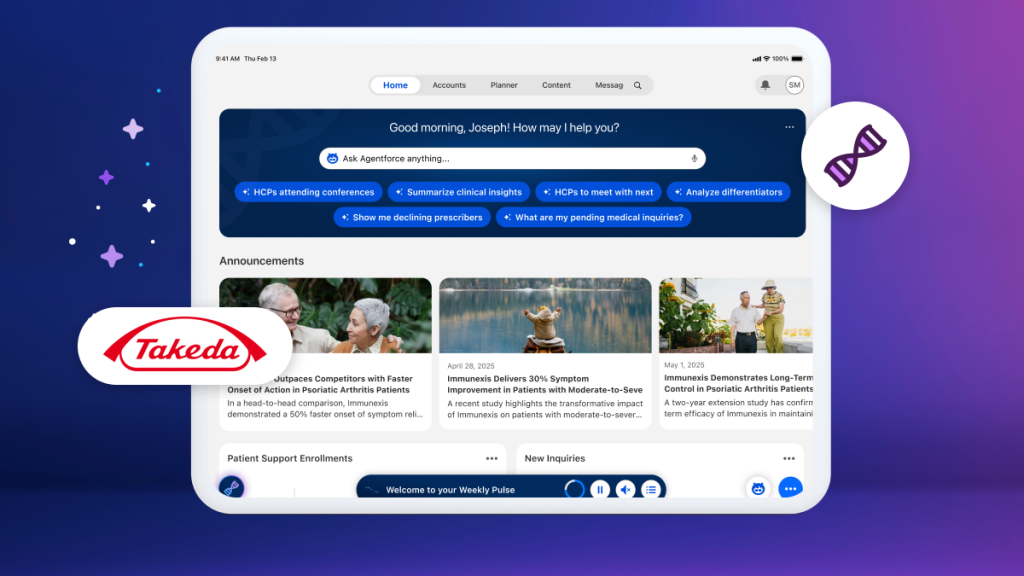
Takeda is embracing agentic AI to help healthcare professionals get the information they need to deliver the best possible health outcomes.
此内容由惯性聚合(RSS阅读器)自动聚合整理,仅供阅读参考。 原文来自 — 版权归原作者所有。