
惯性聚合 高效追踪和阅读你感兴趣的博客、新闻、科技资讯
阅读原文 在惯性聚合中打开

推荐订阅源

SecWiki News
SecWiki News
OSCHINA 社区最新新闻
OSCHINA 社区最新新闻
V
Visual Studio Blog
博客园 - 叶小钗
S
SegmentFault 最新的问题
IT之家
IT之家
大猫的无限游戏
大猫的无限游戏
博客园_首页
Apple Machine Learning Research
钛媒体:引领未来商业与生活新知
钛媒体:引领未来商业与生活新知
月光博客
月光博客
酷 壳 – CoolShell
酷 壳 – CoolShell
腾讯CDC
D
Darknet – Hacking Tools, Hacker News & Cyber Security
V
V2EX
阮一峰的网络日志
阮一峰的网络日志
L
Lohrmann on Cybersecurity
量子位
C
Cyber Attacks, Cyber Crime and Cyber Security
T
Tor Project blog
J
Java Code Geeks
cs.CL updates on arXiv.org
博客园 - 三生石上(FineUI控件)
Attack and Defense Labs
AI
AI
The Cloudflare Blog
T
Tailwind CSS Blog
S
Schneier on Security
爱范儿
爱范儿
PCI Perspectives
PCI Perspectives
Stack Overflow Blog
Stack Overflow Blog
S
Secure Thoughts
Exploit-DB.com RSS Feed
T
The Exploit Database - CXSecurity.com
博客园 - 【当耐特】
V2EX - 技术
V2EX - 技术
S
Securelist
P
Proofpoint News Feed
T
Threat Research - Cisco Blogs
Help Net Security
Help Net Security
C
Cisco Blogs
N
News and Events Feed by Topic
人人都是产品经理
人人都是产品经理
B
Blog RSS Feed
K
Kaspersky official blog
T
The Blog of Author Tim Ferriss
G
Google Developers Blog
S
Security Affairs
freeCodeCamp Programming Tutorials: Python, JavaScript, Git & More
Simon Willison's Weblog

Analytics Vidhya

Handling Imbalanced Classification: What Works Better Than SMOTE GPT-5.6 Is Here: Sol, Terra, and Luna Loop Engineering for AI Agents: How /loop is Changing AI Workflows DeepSeek DSpark: The Speculative Decoding Trick Behind 400% Faster LLM OKF: Redefining Knowledge Bases for AI Agents Modern VLMs Explained: How GPT-4o, Gemini, Claude Vision, and Qwen-VL Work YOLO26 Tutorial: Object Detection, Pose Estimation & More Large Action Models (LAMs) vs Agentic LLMs: What's the Real Difference? Claude Sonnet 5: The Fable 5 at Home The Best $20 AI Plan: ChatGPT Plus vs Claude Pro vs Gemini Pro GraphRAG vs Vector RAG: Which Retrieval Method is Best? Using AI When You Don’t Trust AI The Self-Improving Loop in AI Agents: Architecture, Benefits, and How it Outperforms Traditional Agent Workflows Harness-1: The 20B Retrieval Subagent That Beats GPT-5.4 at Search Sakana Fugu: Multi-Agent System as a Model Claude's Hidden Art Skill: Making Illustrations With Code System Design for ML Interviews: 10 Real Problems Walked Through Most People Use ChatGPT Wrong: 10 Features and Tips That Changed How I Work OpenAI Just Launched 3 Free AI Courses with Certificates Autoregressive Models: Predicting the Future Using the Past Gemini Omni: AI Video Generation Inside Gemini DiffusionGemma: Google’s Diffusion-Based Open Model for Faster Text Generation Top 10 AI Engineering Tools Everyone is Using in 2026 I Tested Claude Fable 5: Can Anthropic’s Newest AI Deliver on the Hype? Prophet vs NeuralProphet vs TimeGPT vs Chronos: A Practical Comparison Build an Emergency Helpline Voice Agent with LangChain Choosing the Right Vector Database for RAG and AI Applications Google Gemma 4 12B: Architecture, Benchmarks, Access, and Hands-on Guide for Developers Agent Observability with LangSmith, Langfuse, and Arize: A Hands-On Comparison How to Use Claude Managed Agents? Google AI Studio vs Gemini App: What’s the Difference? AI Workflows for Sales Teams: Prospect Research, Lead Qualification, and CRM Updates on Autopilot Using LangGraph 25 Most Influential AI Pioneers to Meet at DataHack Summit 2026 Claude Opus 4.8: A Smarter Model in the Right Direction PySpark Optimization: 12 Proven Techniques to Speed Up Your Spark Jobs 10 Everyday Tasks You Can Automate with AI Today (With n8n Templates) Google Antigravity 2.0: The Full Developer Guide (I/O 2026) Build a Claude Cowork-Like Browser Agent Using Playwright MCP and Claude Desktop Pandas vs Polars vs DuckDB: Which Library Should You Choose? Qwen3.7-Max: Alibaba’s New Agent-First LLM for Coding, Reasoning, and Long-Horizon AI Workflows The Biggest Announcements from Google I/O 2026 Top 9 AI Events and Conferences in 2026 that you Must Attend Gemini 3.5 Flash: Frontier Intelligence with Speed Kimi WebBridge: Hands-on Guide to Kimi’s Browser Extension for AI Agents 40 Advanced SQL Window Functions Every Data Scientist Must Know(with examples) Top 10 AI Research Papers of 2025 6 Steps to Crack GenAI Case Study Interviews (With Real Examples) OpenAI Omni Moderation: How to Filter Text & Images for Free DataHack Summit 2026: You Just Cannot Skip This AI Event of the Year OpenAI’s New API Voice Models Will Change the Way You Use AI Hermes Agent Guide: What is it and How to Use it? Top 10 LLM Research Papers of 2026 Agent Memory Patterns in Cognitive Science and AI Systems 10 AI Agents Every AI Engineer Must Build (with GitHub Samples) 23 Tips for Smart Claude Code Token Saving and Workflow Optimization Feature Engineering with LLMs: Techniques & Python Examples ChatGPT is Now Inside Excel and Google Sheets: Here is How to Use it Gemini API File Search: The Easy Way to Build RAG Top 10 Open-Source Libraries to Fine-Tune LLMs Locally ML Intern in Practice: From Prompt to a Shipped Hugging Face Model 15+ Solved Agentic AI Projects with Github Links How People are Figuring Out Life With Claude MemPalace Explained: Building Long-Term Memory for AI Agents Beyond RAG Grok Voice Think Fast 1.0: Build Voice AI Agents That Actually Think Compressing LSTM Models for Retail Edge Deployment: A Practical Comparison MCP vs Agent Skills: Different Altogether GPT 5.5 vs Opus 4.7: Which is the Best AI Model Today? What is Agentic AI? Claude Code vs Codex: A Detailed Terminal Agent Comparison Google Deep Research Max: Build Autonomous AI Research Agents in Minutes Meta Muse Spark Review: Is It Worth the Hype? ChatGPT Images 2.0 vs Nano Banana 2: Which is Better? Cursor V3 Explained: The AI Coding Agent That’s Replacing Traditional IDEs in 2026 DeepSeek-V4: The Most Powerful Open-Source Model Ever Is GPT Image 2 the Best Image Generation Model? Token Economics: Why AI is Getting “Cheaper” From Idea to Output: Claude Does the Design Work Opus 4.7 vs Opus 4.6: Should You Switch? Build Human-Like AI Voice App with Gemini 3.1 Flash TTS How to Structure a Claude Code Project that Thinks Like an Engineer Gemma 4 Tool Calling Explained: Build AI Agents with Function Calling (Step-by-Step Guide) Anthropic Launches Claude Opus 4.7 For “Most Difficult Tasks” Top 28 Claude Shortcuts that will 10X your Speed GPT-5.4-Cyber: Why OpenAI is Keeping its Most Powerful Model Under Lock and Key Google AI Studio Guide: Every Feature Explained Mastering Deep Agents: Context Engineering that Actually Works 21 Computer Vision Projects from Beginner to Advanced (2026 Guide) Excel 101: Excel Agent Mode Explained MiniMax M2.7 Goes Open-Weight to Let You Run Agents Locally Top 10 Gemma 4 Projects That Will Blow Your Mind GLM-5.1: Architecture, Benchmarks, Capabilities & How to Use It Understanding BERTopic: From Raw Text to Interpretable Topics From Karpathy’s LLM Wiki to Graphify: AI Memory Layers are Here 10 Most Important AI Concepts Explained Simply Project Glasswing is World’s Most Powerful AI in Action How to Run Gemma 4 on Your Phone Without Internet: A Hands-On Guide Running Claude Code for Free with Gemma 4 and Ollama LLM Wiki Revolution: How Andrej Karpathy’s Idea is Changing AI Rethinking Enterprise Search: How Cortex Search Turns Data into Business Impact Google’s Gemma 4: Is it the Best Open-Source Model of 2026?
How to Choose the Right AI Model for Your Needs
Vasu Deo Sankrityayan · 2026-06-04 · via Analytics Vidhya

A few years ago, choosing an AI model was relatively simple. You probably didn’t even know the term AI model as ChatGPT was used synonymously with it. It was the obvious (and maybe the only) choice at the time. 

But times have changed. ChatGPT is no longer the one-stop for AI models. Claude, Grok, Gemini, Deepseek, Qwen, Kimi, Llama… and many more are available to use. This choice was supposed to empower the users. But this is reality has had the opposite effect!

This is because these models look and feel the same (the same chatbot interface) and are evolving at a comparable pace. So the real question is no longer “Which model is the best?”

It is: Which model is the best for me?

And based on what I’ve seen, this is where most people get it wrong.

Table of contents

  • The Problem
  • Benchmarks: The Smoke Screen
  • The Perspective: What works for Us?
  • The Choice: Your Own Framework
    • My Choice
  • Conclusion

The Problem

ChatGPT can write polished emails for you. But so can Claude, DeepSeek, Gemini, and almost every other AI model today.
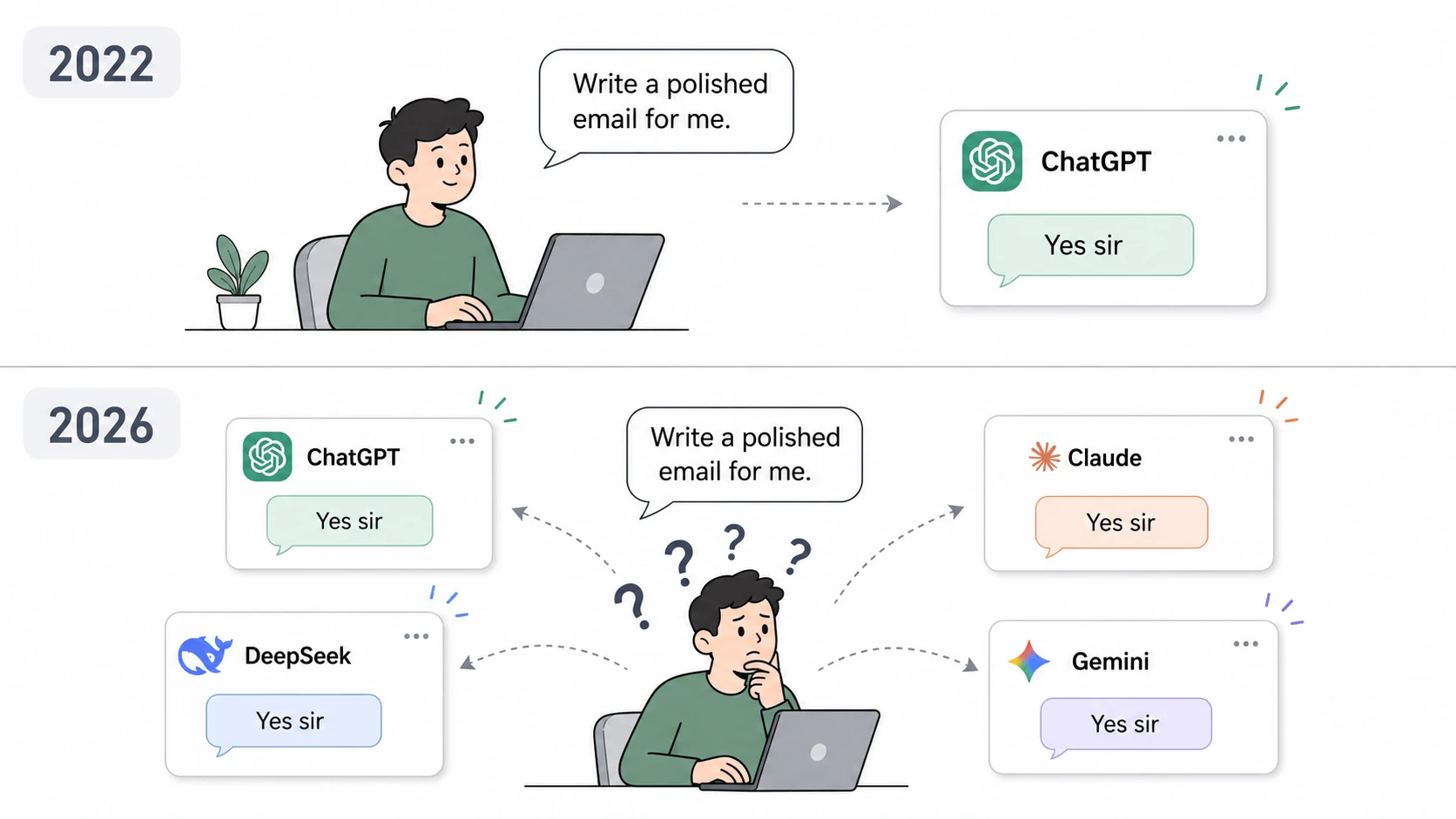
AI Models that can be chosen in 2026

That is the problem.

At the surface level, these models are interchangeable. They can all summarize documents, explain concepts, write code, and answer questions. For the average user, the differences are not immediately obvious.

So people start choosing models for the wrong reasons:

  • Their friend recommended it.
  • It went viral on social media last week.
  • It topped an AI benchmark (which isn’t always a good indicator)
  • It was the first model they tried.
  • It happens to be the default option in an app they already use.

None of these are terrible reasons. But they are not particularly thoughtful ones either.

The better way to choose an AI model is to stop asking which one is best overall and start asking what you actually need the model to do. But before going over what to do when choosing a model, let’s take a look at a few things not to do. 

Benchmarks: The Smoke Screen

Most people start using a chatbot for one primary reason. Maybe they need help writing, coding, researching, or brainstorming.

And if you’re here for best of the best in a specific domain you can use this table as a guide for picking your model:

Task Best Picks Why
General chat and everyday help Claude Opus 4.6 / 4.7 Thinking Ranked at the top of LMArena’s text leaderboard, which uses blind human preference votes across open-ended tasks. (Arena AI)
Coding Claude Opus 4.7 GPT-5.5 SWE-bench and SWE-bench Pro are among the strongest public signals for real software engineering ability. (SWEbench)
Reasoning and complex problem-solving Claude Opus 4.8 Gemini 3.1 Pro Artificial Analysis ranks Claude Opus 4.8 highest among reasoning models; Gemini models also perform strongly on reasoning-focused leaderboards. (Artificial Analysis)
Real-world work tasks Claude Opus 4.1 GPT-5.2 GDPval evaluates economically valuable tasks across 44 occupations, making it closer to actual workplace usage than older academic benchmarks. (OpenAI)
Image generation and editing GPT Image 2 GPT Image 1.5 Artificial Analysis ranks GPT Image 2 highest for text-to-image and GPT Image 1.5 highest for image editing based on blind preference votes. (Artificial Analysis)

Now if the previous table was able to influence your model choice, this is the exact problem I was referring to. 

Because, these results were obtained using the flagship version of the listed models, which are all paid. This might not be a problem for those who have a subscription of these models, but for those without, here is how the equation changes:

  • Claude Opus: Can’t be accessed without a paid subscription.
  • GPT-5.5 Thinking: Free users get 10 GPT-5.5 messages every 5 hours, then chats switch to the mini model: Thinking access is much more limited than paid tiers.
  • Gemini 3.1 Pro: Google uses compute-based limits that refresh every 5 hours until a weekly cap is reached: higher access to Gemini 3.1 Pro is tied to Google AI Pro/Ultra plans.
  • GPT Image 2: ChatGPT Free includes image generation, but OpenAI lists it as limited and slower.

You can clearly see how these models are no longer a choice if you’re are lacking a subscription. 

Considering that most of the users of an AI model are using the free tier, the disparity in the service model is noteworthy.

Note: This should alert you for any benchmark or metric for a model. This is because most of these are obtained using the SOTA variants of the models which are usually paid. Their free variants — leave a lot to be desired.

The Perspective: What works for Us?

Choosing a model based solely on benchmark rankings is a lot like choosing a car based solely on its top speed. The number may be correct, but you might be looking for safety and comfort (making it kind of pointless). 

In practice, factors like pricing, rate limits, context windows, ecosystem integrations, and even response style preference often have a bigger impact on the user experience than a few percentage points on a leaderboard.
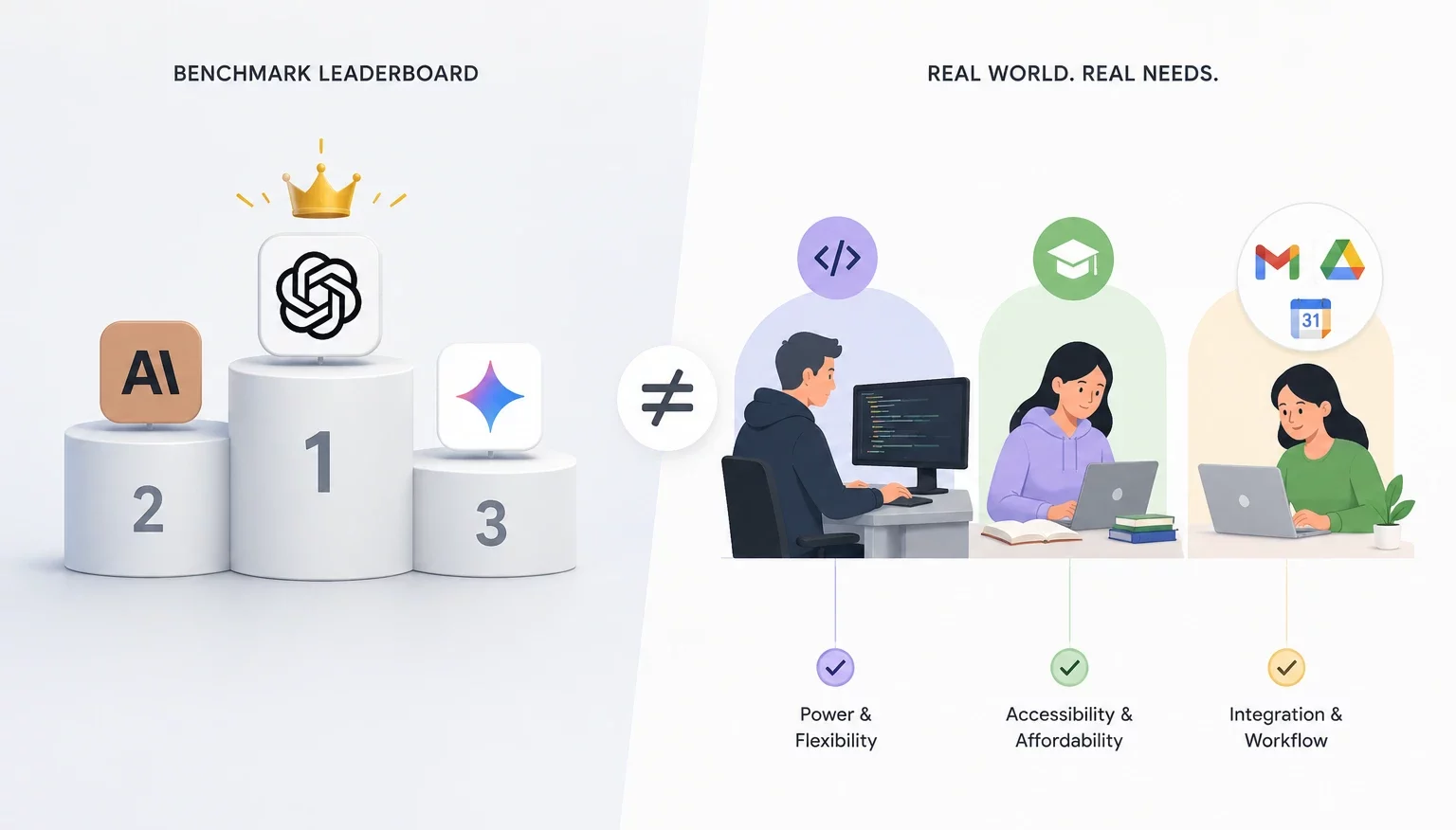
Real world needs are different from benchmarks

This is why two people can look at the exact same benchmark results and still arrive at completely different model choices. 

  1. A software engineer with a AI model subscription
  2. A student using free-tier tools
  3. A marketer already embedded in Google’s ecosystem 

These are solving different problems under different constraints.

So before deciding which model to use, it helps to zoom out from the leaderboards and consider the factors that actually shape your day-to-day experience.

The Choice: Your Own Framework

Instead of relying on a benchmark or a framework someone posted online, we’ll build our own evaluation metric.

Start with something simple: list the three most common tasks you use a chatbot for.

Your actual tasks.

For me, that would be:

  1. Writing a first draft of an article.
  2. Comparing several options (on Amazon) and recommending one.
  3. Learning something new through a back-and-forth conversation.

The point is to ground the evaluation in our own reality.

You don’t care if a model tops a benchmark leaderboard if it fails at the things you actually need it to do. 

  • Claude might be the smartest model on paper, but if you need image generation and it can’t create images, it’s useless.
  • Gemini might score exceptionally well on coding benchmarks while being terrible at making purchasing decisions makes it a terrible choice.

So instead of asking “Which model is the best?”, we’re asking a much narrower question:

Which model is the best for me?

Once you’ve picked your tasks, create a simple scoring rubric.

For each task, rate the model on a scale of 1 to 5. The exact criteria don’t matter. Maybe you care about accuracy. About speed, or maybe you care about how often the model misunderstands instructions.

Just make sure you’re measuring the same things across every model. Then run each task through every chatbot you’re evaluating.

My Choice

In my case upon evaluation the top 3 models right now on my workload gave me the following results: 

Task GPT Claude Gemini
Writing ★★★★★ ★★★★☆ ★★☆☆☆
Research ★★★★★ ★★★★☆ ★★★★☆
Learning ★★★★☆ ★★★★☆ ★★★★☆
Final Score 14/15 Winner 12/15 10/15

GPT-5.5 came out ahead for my workload because it was consistently useful across all three tasks. 

Conclusion

There is no universally best AI model. The right choice depends on your preference and work. Benchmarks can guide you, but they cannot make that decision for you.

The safest approach is simple: test a few models on three tasks you regularly perform, score them consistently, and pick the one that wins for your use case. That keeps your decision grounded in evidence, not hype.

I specialize in reviewing and refining AI-driven research, technical documentation, and content related to emerging AI technologies. My experience spans AI model training, data analysis, and information retrieval, allowing me to craft content that is both technically accurate and accessible.