



惯性聚合 高效追踪和阅读你感兴趣的博客、新闻、科技资讯
阅读原文 在惯性聚合中打开

推荐订阅源

博客园 - 三生石上(FineUI控件)
D
Docker
GbyAI
GbyAI
宝玉的分享
宝玉的分享
Jina AI
Jina AI
钛媒体:引领未来商业与生活新知
钛媒体:引领未来商业与生活新知
Vercel News
Vercel News
博客园_首页
Recent Announcements
Cyber Security Advisories - MS-ISAC
Hugging Face - Blog
Hugging Face - Blog
腾讯CDC
S
SegmentFault 最新的问题
Microsoft Security Blog
酷 壳 – CoolShell
酷 壳 – CoolShell
美团技术团队
V
V2EX
WordPress大学
WordPress大学
奇客Solidot–传递最新科技情报
奇客Solidot–传递最新科技情报
V
Visual Studio Blog
IT之家
IT之家
Apple Machine Learning Research
T
Tailwind CSS Blog
让小产品的独立变现更简单 - ezindie.com

Towards AI

Building AI Agents in Rust — part 4 | Towards AI The Verified Identity Agent Bridge | Towards AI You Can’t Prompt Your Away Your LLM Problems | Towards AI The Free Agent Trap | Towards AI Your Agentic Loop Will Drift. Here Is the KL Divergence Equation That Measures How Far It Has Wandered From Its Original Instruction. | Towards AI Beyond Chat: Processing Images, PDFs, and Documents with the OpenAI Adapter in Oracle Integration Cloud | Towards AI Building AI Agents in Rust — part 3 | Towards AI Self-Hosting Airflow at Home: Automating Stock Price Data Collection | Towards AI The 76-Hour Frontier: How the Takedown of Claude Fable 5 Birthed the Military-Industrial-AI Complex | Towards AI I Trained a Markdown File to Boost GPT-5.5 by 23 Points — It Shouldn't Work | Towards AI We Replaced ChatGPT With a Local AI Server. Six Months of Honest Data. | Towards AI What Really Makes Cars Pollute? A Data Science Deep Dive into CO₂ Emissions | Towards AI Training GPT-2 From Scratch on a GTX1050 | Towards AI Principal Component Analysis (PCA): Theory, Mathematics, and Applications Build a Zero-Cost Web Automation Pipeline With OpenRouter, OpenClaw, and MediaUse I Gave Qwen3.7-Plus a Screenshot and It Found the Exact Pixel to Click for $0.40 Beyond the Prompt: Why Autonomous AI Agents Are Replacing the Chatbot Moonshot Cracked Claude Code’s Playbook with an MIT Terminal Agent and a $0.60 Model Connections, Roles, and Warehouses: Getting CoCo Desktop Production-Ready from Day One My First $5,000 Month Writing About AI Engineering on Medium Google Shrank Gemma 4 by 72% and Unsloth Fixed the 4-Bit Bug Nobody Else Caught on One 4090, and 4-Bit Shouldn’t Be This Good LangChain Explained: Understanding Models, Prompts, Chains, Memory, Indexes, and Agents TOON: Beyond JSON for LLMs Claude Code Casual, Pro, Elite: The Three Working Personas of Claude Code Mastery MiniMax M3 Decodes 1M Tokens 15x Faster — and It Shouldn’t Be This Cheap Using Amazon SQS for AI Agent Orchestration I Ran a 1.5B-Active Model on My Laptop That Embarrassed a 26B by 46 Points How to Build a Self-Improving Company with AI Part 3 — Implementation/Engine-Level: Choosing the Runtime That Gives You These for Free Part 2 — Serve-Level Speed: System Design That Stabilizes P95/P99
The Best Engineers Stopped Writing Prompts: The 4 Layers ...
Chew Loong Nian - AI ENGINEER · 2026-06-22 · via Towards AI

Free: 6-day Agentic AI Engineering Email Guide.
Learnings from Towards AI's hands-on work with real clients.

The Best Engineers Stopped Writing Prompts: The 4 Layers That Replaced Prompt Engineering

Last Updated on June 22, 2026 by

Author(s): Chew Loong Nian – AI ENGINEER

Originally published on Towards AI.

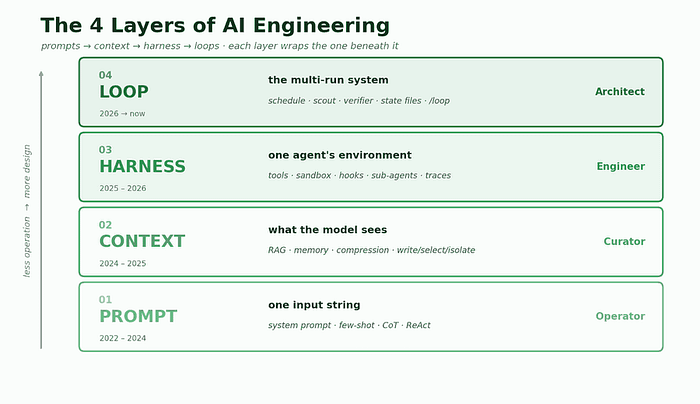
Boris Cherny built Claude Code. In June 2026 he said the quiet part out loud: “I don’t prompt Claude anymore. I have loops running that prompt Claude and figuring out what to do. My job is to write loops.” In four years, the highest-value skill in applied AI has been rewritten 4 times — from prompts, to context, to the harness, to the loop. Each rewrite moved the job one layer outward, and each layer trades less manual operation for more system design.

The Best Engineers Stopped Writing Prompts: The 4 Layers That Replaced Prompt Engineering

After the opening, the article lays out a “through-line” for why the job keeps shifting: each new layer wraps the previous one. It details Layer 1 (prompt engineering), where the key object is a single input string and the challenge is phrasing and tool-use via prompt structure (few-shot, chain-of-thought, ReAct), but notes its brittleness and the assumption that the model already has everything it needs. It then covers Layer 2 (context engineering), focused on filling a limited context window with the right information using retrieval, memory, summarization, and strategies to prevent context rot—yet still observes that humans remain responsible for choosing what gets retrieved and when. Layer 3 (harness engineering) is presented as the environment around the agent—tools, permissions, sandboxing, lifecycle hooks, retries, traces, and sub-agents—moving reliability concerns into configuration rather than just model behavior. Finally, it introduces Layer 4 (loop engineering), where the system is scheduled and run repeatedly without constant manual prompting: triggers, goal/state persistence, scouting tasks, invoking harnessed agents, verifying outputs (often with a second agent), and writing memory across iterations. The piece concludes with a diagnostic to identify which layer you’re practicing, a “climb one layer” starting path, and a verdict that the next frontier after loops will likely involve fleets of coordinating loops, pushing the highest-paid skills further outward from direct prompt writing.

Read the full blog for free on Medium.

Published via Towards AI


Towards AI Academy

We Build Enterprise-Grade AI. We'll Teach You to Master It Too.

15 engineers. 100,000+ students. Towards AI Academy teaches what actually survives production.

Start free — no commitment:

6-Day Agentic AI Engineering Email Guide — one practical lesson per day

Agents Architecture Cheatsheet — 3 years of architecture decisions in 6 pages

Our courses:

AI Engineering Certification — 90+ lessons from project selection to deployed product. The most comprehensive practical LLM course out there.

Agent Engineering Course — Hands on with production agent architectures, memory, routing, and eval frameworks — built from real enterprise engagements.

AI for Work — Understand, evaluate, and apply AI for complex work tasks.

Note: Article content contains the views of the contributing authors and not Towards AI.