







Originally published on Towards AI.
Single agent, subagents, skills, agent teams, dynamic workflows — a builder’s map, and the one that isn’t really orchestration
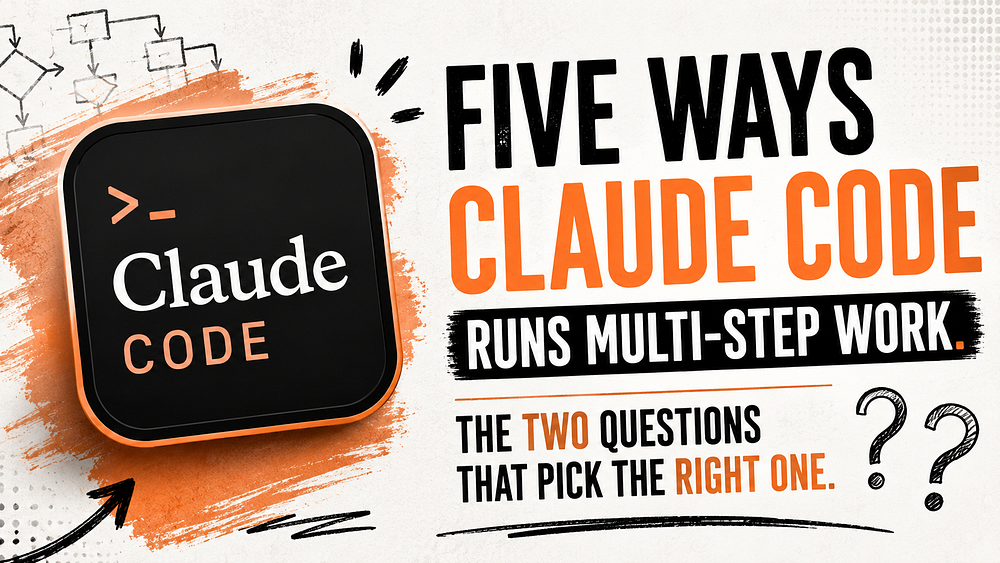
On May 28, Claude Code got its fifth way to run a multi-step job, and I watched a room of good engineers immediately reach for the wrong one.
The article argues that choosing between Claude Code’s multi-step primitives is not primarily about how many agents you want to spawn—agent count is an output, not an input. It presents five ways to run work (single agent, subagents, skills, agent teams, and dynamic workflows), clarifying that skills are orthogonal because they package know-how (e.g., via SKILL.md) and don’t orchestrate or spawn agents. It then sorts the orchestration options with two key questions: who holds the plan (model-held vs code-held, where dynamic workflows move the plan into JavaScript for determinism, repeatability, and verifiable coordination) and how many memories/contexts the task needs (single context vs isolated subagent contexts vs peer coordination via agent teams using shared codebases and hub-and-spoke coordination). Finally, it emphasizes using these questions in order, defaulting to the simplest option that fits, and watching the first run to avoid the “thirty-times tax” from overusing complex orchestration when the job doesn’t require it.
Read the full blog for free on Medium.
Published via Towards AI
Towards AI Academy
We Build Enterprise-Grade AI. We'll Teach You to Master It Too.
15 engineers. 100,000+ students. Towards AI Academy teaches what actually survives production.
Start free — no commitment:
→ 6-Day Agentic AI Engineering Email Guide — one practical lesson per day
→ Agents Architecture Cheatsheet — 3 years of architecture decisions in 6 pages
Our courses:
→ AI Engineering Certification — 90+ lessons from project selection to deployed product. The most comprehensive practical LLM course out there.
→ Agent Engineering Course — Hands on with production agent architectures, memory, routing, and eval frameworks — built from real enterprise engagements.
→ AI for Work — Understand, evaluate, and apply AI for complex work tasks.
Note: Article content contains the views of the contributing authors and not Towards AI.