









Last Updated on May 26, 2026 by
Author(s): Rick Hightower
Originally published on Towards AI.
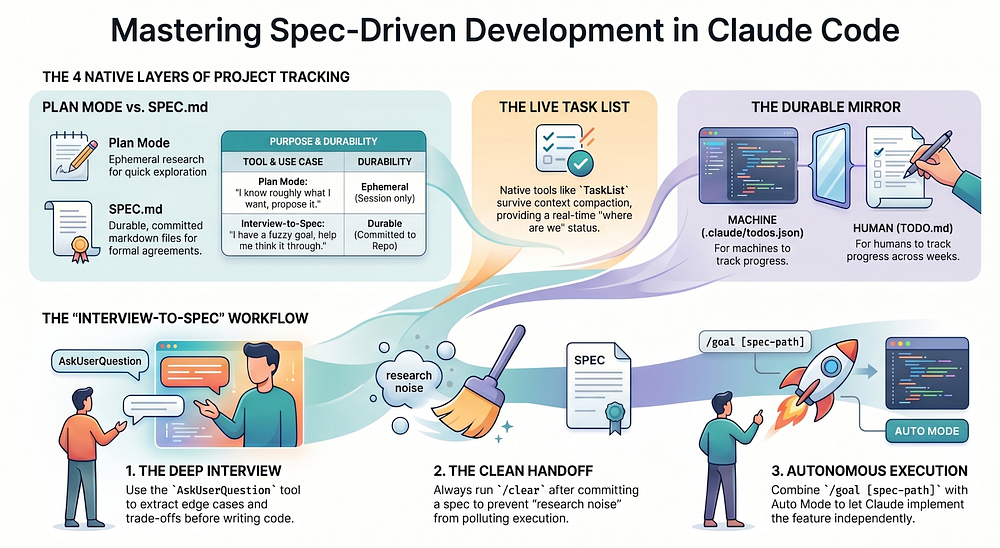
Part 4: Stop coding blind: the spec-driven workflow built-in that turns Claude Code from a function writer into a feature builder.
Summary: In this article, working engineers love Claude Code for writing functions and quietly resent it for building features. The fix is not a plugin or a hand-rolled TODO.md. It is spec-driven development with Claude Code, built from four native layers: plan mode, the interview-to-spec pattern, the live task list, and a durable todos.json mirror. You will learn when to use each layer, how to wire them together, and how to hand Claude a spec and walk away.
Throughout the article, the importance of using a spec-driven approach with Claude Code is emphasized, showcasing the structured workflow that eliminates the confusion and chaos often experienced during project execution. The article discusses the essential layers that interact seamlessly to ensure developers can remain effective and track their progress without relying on additional tools, ultimately creating a smoother and faster development process that employs both planning and execution strategies effectively.
Read the full blog for free on Medium.
Published via Towards AI
Towards AI Academy
We Build Enterprise-Grade AI. We'll Teach You to Master It Too.
15 engineers. 100,000+ students. Towards AI Academy teaches what actually survives production.
Start free — no commitment:
→ 6-Day Agentic AI Engineering Email Guide — one practical lesson per day
→ Agents Architecture Cheatsheet — 3 years of architecture decisions in 6 pages
Our courses:
→ AI Engineering Certification — 90+ lessons from project selection to deployed product. The most comprehensive practical LLM course out there.
→ Agent Engineering Course — Hands on with production agent architectures, memory, routing, and eval frameworks — built from real enterprise engagements.
→ AI for Work — Understand, evaluate, and apply AI for complex work tasks.
Note: Article content contains the views of the contributing authors and not Towards AI.