惯性聚合 高效追踪和阅读你感兴趣的博客、新闻、科技资讯
阅读原文 在惯性聚合中打开

推荐订阅源

OSCHINA 社区最新新闻
OSCHINA 社区最新新闻
WordPress大学
WordPress大学
CTFtime.org: upcoming CTF events
小众软件
小众软件
美团技术团队
Attack and Defense Labs
S
Security Archives - TechRepublic
C
Comments on: Blog
腾讯CDC
V
Visual Studio Blog
Help Net Security
Help Net Security
MyScale Blog
MyScale Blog
S
Secure Thoughts
P
Privacy & Cybersecurity Law Blog
I
Intezer
NISL@THU
NISL@THU
T
Tor Project blog
G
Google Developers Blog
罗磊的独立博客
E
Exploit-DB.com RSS Feed
Hugging Face - Blog
Hugging Face - Blog
The Cloudflare Blog
P
Proofpoint News Feed
C
Cisco Blogs
量子位
A
Arctic Wolf
Scott Helme
Scott Helme
Schneier on Security
Blog — PlanetScale
Blog — PlanetScale
I
InfoQ
让小产品的独立变现更简单 - ezindie.com
Stack Overflow Blog
Stack Overflow Blog
T
Troy Hunt's Blog
H
Heimdal Security Blog
云风的 BLOG
云风的 BLOG
N
News and Events Feed by Topic
cs.CL updates on arXiv.org
SecWiki News
SecWiki News
P
Proofpoint News Feed
有赞技术团队
有赞技术团队
B
Blog
C
Check Point Blog
O
OpenAI News
N
News | PayPal Newsroom
www.infosecurity-magazine.com
freeCodeCamp Programming Tutorials: Python, JavaScript, Git & More
L
LINUX DO - 最新话题
L
Lohrmann on Cybersecurity
Hacker News: Ask HN
Hacker News: Ask HN
Security Latest
Security Latest

Runpod Blog.

DeepSeek V4 in the wild, and how to run it on Runpod New Runpod datacenter now live: AP-IN-1 Track GPU spend across your team with Cost Centers The GPU supply supercycle is here. Here’s what AI builders need to know. Community Spotlight: One-click AI image and video generation on Runpod with SwarmUI | Runpod Blog Community Spotlight: LoRA Pilot Data Prep to Inference Introducing the Runpod Assistant: Manage Your Cloud GPU Resources with Natural Language OpenAI's Parameter Golf: Train the Best Language Model That Fits in 16MB on Runpod LLM inference optimization: techniques that actually reduce latency and cost Pruna P-Video and Vidu Q3 public endpoints now available on Runpod Runpod brand spelling guide Quickstart - Runpod Documentation The AI market looks nothing like the narrative Training StyleGAN3 with Vision-Aided GAN on Runpod KoboldAI – The Other Roleplay Front End, And Why You May Want to Use It How to Connect Cursor to LLM Pods on Runpod for Seamless AI Dev Community Spotlight: How AnonAI Scaled Its Private Chatbot Platform with Runpod Prompt Scheduling with Disco Diffusion on Runpod Runpod's Latest Innovation: Dockerless CLI for Streamlined AI Development Run Your Own AI from Your iPhone Using Runpod Introducing Flash: Run GPU workloads on Runpod Serverless: No Docker required Use Claude Code with your own model on Runpod: No Anthropic account required Avoid Errors by Selecting the Proper Resources for Your Pod What hackers built on Runpod at TreeHacks 2026 Easily Back Up and Restore Your Pod with Cloud Sync + Backblaze B2 The Complete Guide to GPU Requirements for LLM Fine-Tuning AI Guides, Tutorials & GPU Infrastructure Insights | Runpod Your first Claude Code project within Runpod: a complete setup guide 10 billion Serverless requests and counting Building for resilience: Runpod’s response to the AWS us-east-1 outage How to Connect Google Colab to Runpod Founder Series #1: The Runpod Origin Story AMD MI300X vs. NVIDIA H100: Mixtral 8x7B Inference Benchmark How to Run the FLUX Image Generator with ComfyUI on Runpod Run Llama 3.1 405B with Ollama on Runpod: Step-by-Step Deployment How to Run FLUX Image Generator with Runpod (No Coding Needed) How to Use 65B+ Language Models on Runpod Deploy Llama 3.1 with vLLM on Runpod Serverless: Fast, Scalable Inference in Minutes Open Source Video & LLM Roundup: The Best of What’s New Run vLLM on Runpod Serverless: Deploy Open Source LLMs in Minutes Introduction to vLLM and PagedAttention New update to Github integration: release rollback! | Runpod Blog A note to the developers who built Runpod with us Deploy ComfyUI as a Serverless API Endpoint Setting up Slurm on Runpod Clusters: A Technical Guide Building an OCR System Using Runpod Serverless Lessons While Using Generative Language and Audio For Practical Use Cases Runpod RoundUp 3 – AI Music and Stock Sound Effect Creation New Navigational Changes To Runpod UI Use alpha_value To Blast Through Context Limits in LLaMa-2 Models Runpod Roundup 5 – Visual/Language Comprehension, Code-Focused LLMs, and Bias Detection Runpod is Proud to Sponsor the StockDory Chess Engine Runpod Roundup 4 – Open Source LLM Evaluators, 3D Scene Reconstruction, Vector Search Meta and Microsoft Release Llama 2 as Open Source SuperHot 8k Token Context Models Are Here For Text Generation How to Manage Funding Your Runpod Account Encrypted Volumes on Runpod: Protect Your Data at Rest How to Run a "Hello World" on Runpod Serverless Runpod AI field notes: December 2025 Faster GitHub Builds: Major Performance Improvements to Our Automated Integration Partnering with Defined AI to Bridge the Data Wealth Gap How to Run Serverless AI and ML Workloads on Runpod How to fine-tune a model using Axolotl Transcribe and translate audio files with Faster Whisper Runpod Achieves SOC 2 Type II Certification: Continuing Our Compliance Journey Orchestrating GPU workloads on Runpod with dstack Exploring Runpod Serverless: Create Workers From Templates DeepSeek V3.1: A Technical Analysis of Key Changes from V3-0324 Deep Cogito Releases Suite of LLMs Trained with Iterative Policy Improvement Wan 2.2 Releases With a Plethora Of New Features Iterative Refinement Chains with Small Language Models The New Runpod.io: Clearer, Faster, Built for What’s Next Introducing Clusters: On-Demand Multi-Node AI Compute Run DeepSeek R1 on Just 480GB of VRAM How Do I Transfer Data Into My Runpod? Spot vs. On-Demand Instances: What’s the Difference? Deploy GitHub Repos to Runpod with One Click Run GGUF Quantized Models Easily with KoboldCPP on Runpod How to Work with GGUF Quantizations in KoboldCPP Introducing Better Forge: Spin Up Stable Diffusion Pods Faster Supercharge Your LLMs with SGLang: Boost Performance and Customization Mastering Serverless Scaling on Runpod: Optimize Performance and Reduce Costs RAG vs. Fine-Tuning: Which Is Best for Your LLM? Run Larger LLMs on Runpod Serverless Than Ever Before – Llama-3 70B (and beyond!) How to Run vLLM on Runpod Serverless (Beginner-Friendly Guide) Embracing New Beginnings: Welcoming Banana.dev Community to Runpod Stable Diffusion + ComfyUI on Runpod: Easy Setup Guide Runpod RoundUp 2 – 32k Token Context LLMs and New StabilityAI Offerings Runpod Roundup: High-Context LLMs, SDXL, and Llama 2 16k Context LLM Models Now Available On Runpod Savings Plans Are Here For Secure Cloud Pods – How To Purchase a Monthly Plan And Save Big Pygmalion-7b from PygmalionAI has been released, and it's amazing Ada Architecture Pods Are Here – How Do They Stack Up Against Ampere? Spin up a Text Generation Pod with Vicuna and Experience a GPT-4 Rival Using OpenPose to Annotate Poses Within Stable Diffusion Set Up a Chatbot with Oobabooga on Runpod Connect VSCode to Your Runpod Instance (Quick SSH Guide) Deploy a Stable Diffusion UI on Runpod in Minutes Google Colab Pro vs. Runpod: Best GPU Cloud for AI Workloads How to Run a GPU-Accelerated Virtual Desktop on Runpod
From No-Code to Pro: Optimizing Mistral-7B on Runpod for Power Users
Eliot Cowley · 2026-01-20 · via Runpod Blog.

A previous blog post, No-Code AI: How I Ran My First LLM Without Coding, walked through deploying the Mistral-7B LLM on Runpod without writing code. The author did this with the text-generation-webui-oneclick-UI-and-API template, which enables you to interact with the model through a chat interface using text-generation-web-ui.

This post builds on that foundation, exploring the same deployment path but through a more technical lens. If you have already deployed Mistral before, see how you can further optimize and customize it to get better control and performance.

What you’ll learn

In this blog post, you’ll learn how to:

  • Deploy Mistral-7B with quantized weights
  • Deploy Mistral-7B using vLLM workers

Requirements

Before following this tutorial, do the following:

Deploy Mistral with quantized weights

LLM quantization is a compression technique that reduces the precision of a model’s parameters from a high-precision format, such as 32-bit floating point, to a lower-precision format, such as 8-bit integers. This reduces the size of the model, meaning that it consumes less memory, requires less storage, is more energy-efficient, and runs faster.

We’ll deploy Mistral-7B in the GGUF format, which is optimized for efficient storing and deploying of models and designed to work well on consumer hardware. It also provides improved performance and support for quantization.

Let’s deploy a 4-bit quantization of the Mistral-7B model and compare performance across different GPUs.
  1. Sign into the Runpod Console and open the Explore page.
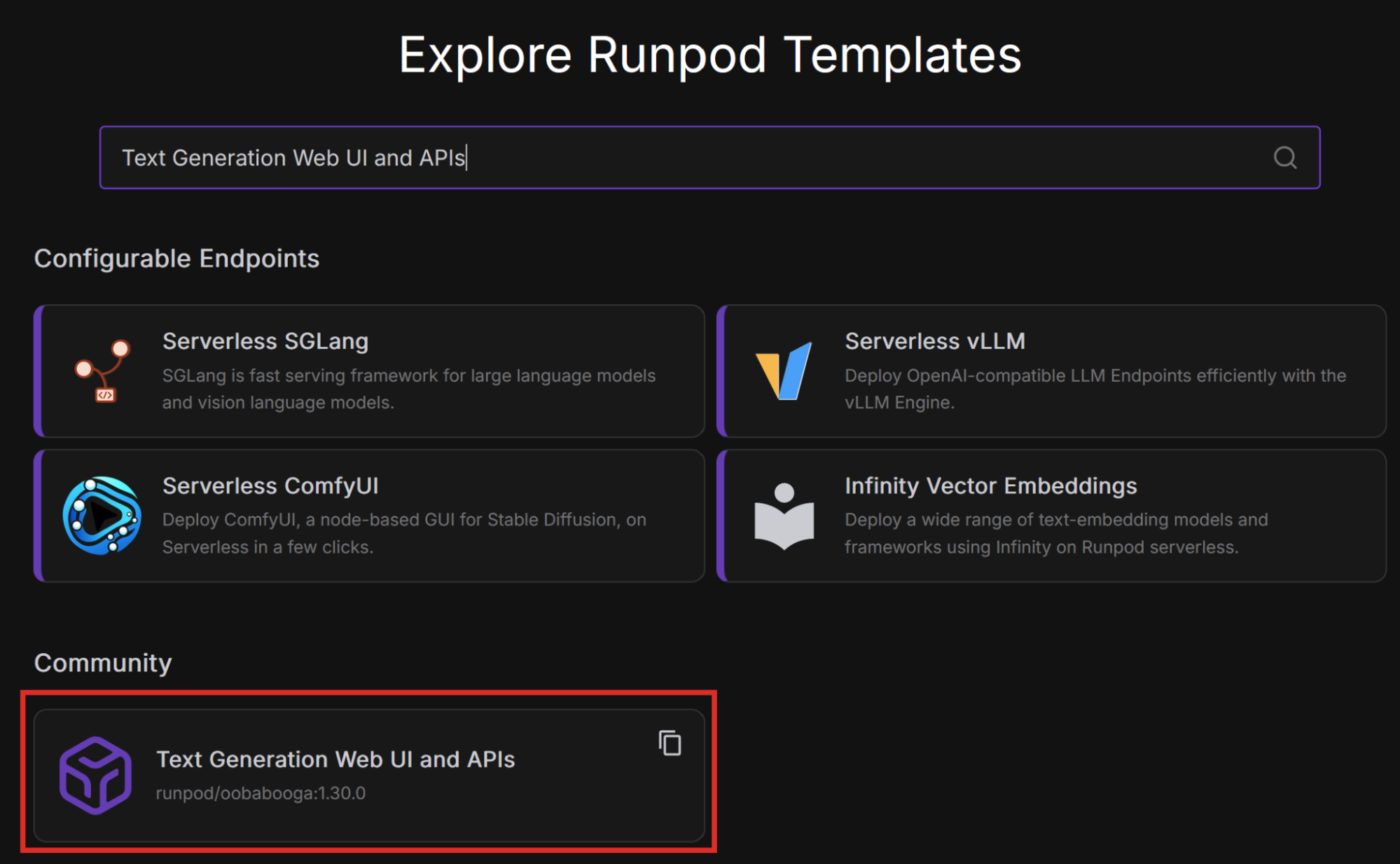
  2. Search for Text Generation Web UI and APIs and select it. This template is developed by Runpod and uses the same web UI that was used in No-Code AI: How I Ran My First LLM Without Coding.

Explore Runpod Templates page with the Text Generation Web UI and APIs community template highlighted

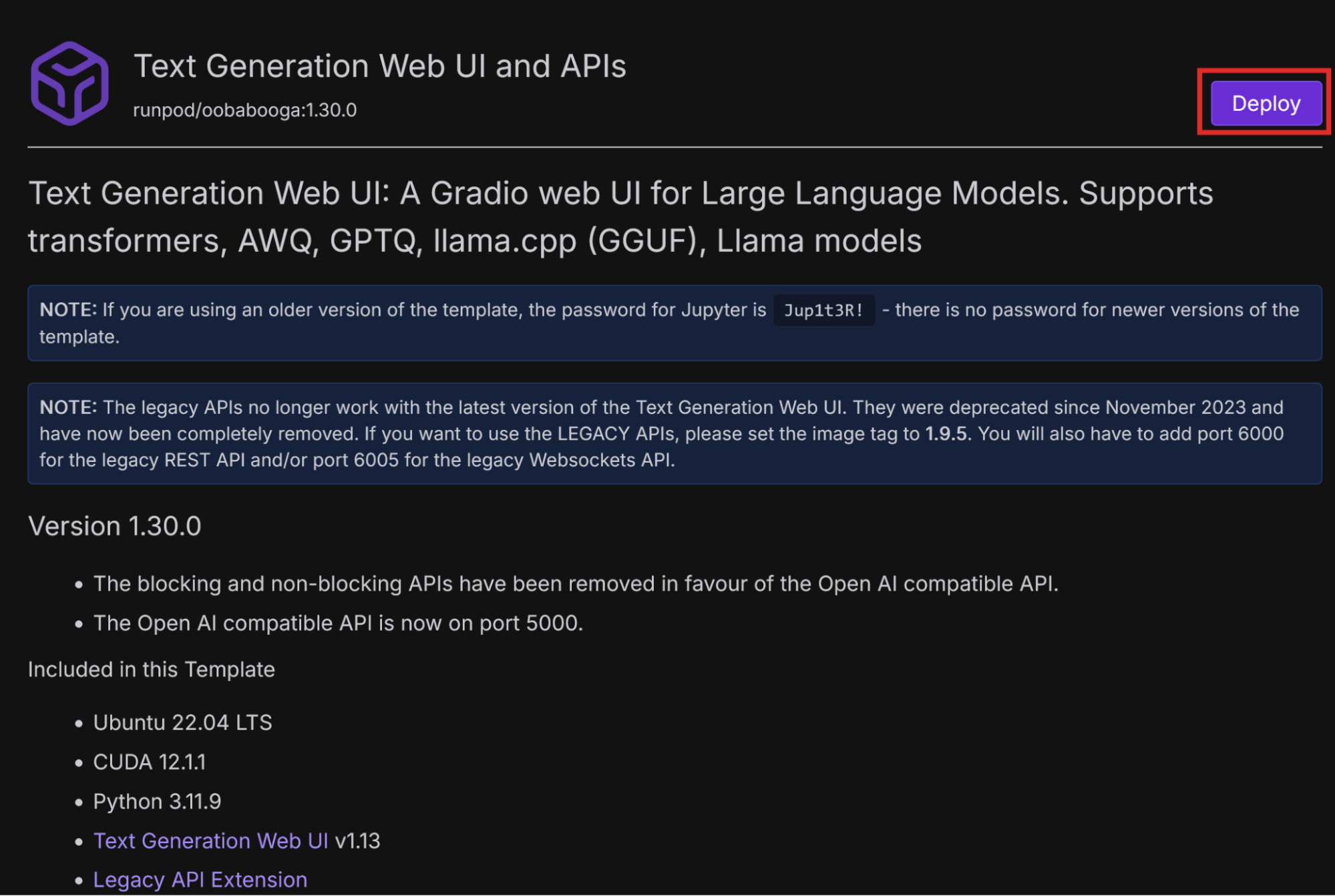
  1. Select Deploy.

Text Generation Web UI template details in the Runpod console with the Deploy button highlighted

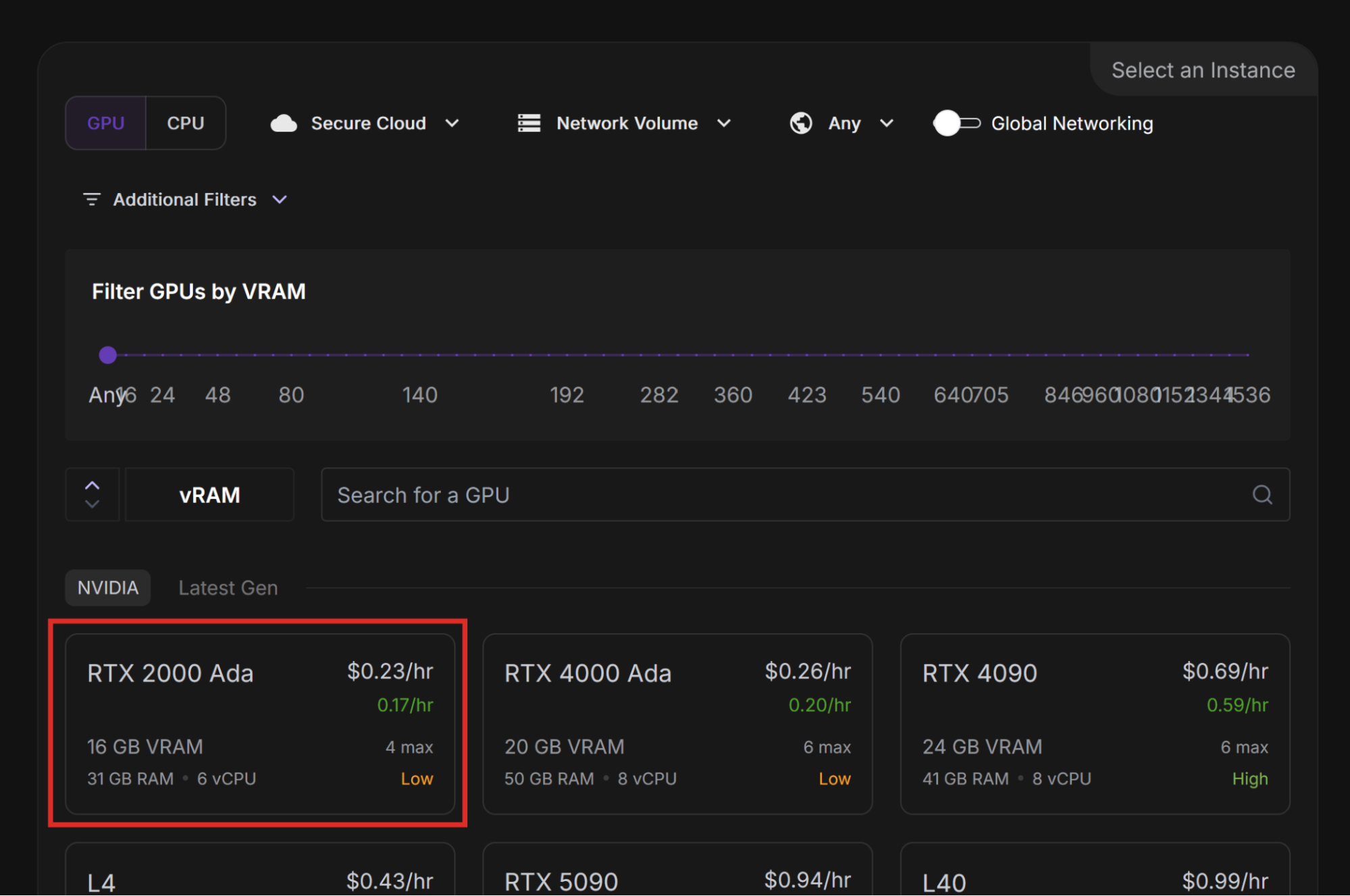
  1. Let’s start with the cheapest GPU, the RTX 2000 Ada with 16 GB VRAM.

Runpod GPU selection screen with the RTX 2000 Ada card highlighted

Note: Prices are subject to change.
  1. Enter a name in the Pod Name field, then select Edit Template.

Runpod pod deployment configuration with the Edit Template button highlighted

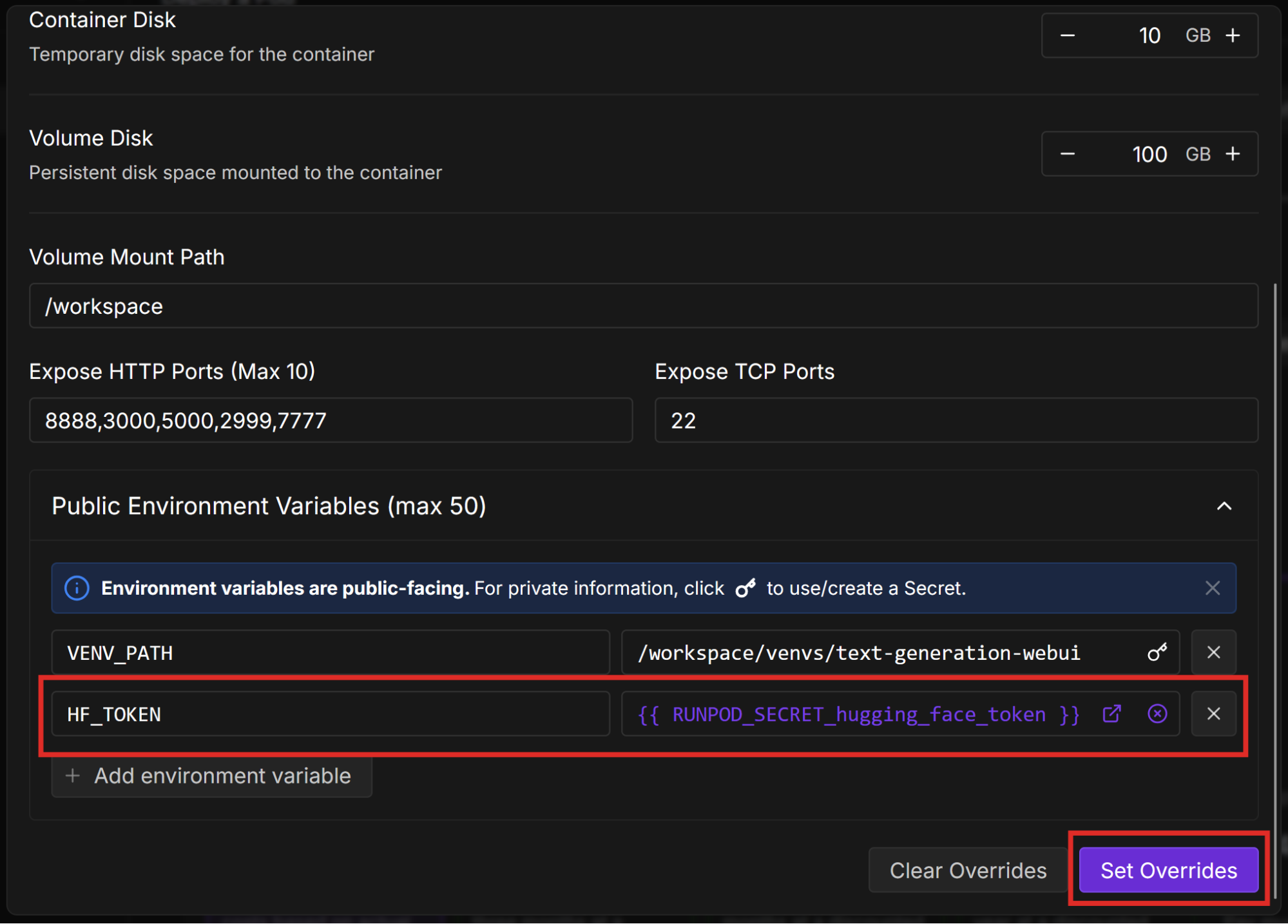
  1. Select Add environment variable. Set the key to HF_TOKEN and the value to your Hugging Face access token. Then, select Set Overrides.
    Note:
    These environment variables are public, meaning that anyone can view them. Rather than enter your Hugging Face access token directly here, use a secret.

Runpod template overrides with an HF_TOKEN environment variable and the Set Overrides button highlighted

  1. Runpod starts to deploy your pod. Select the arrow next to the pod to expand it, then select Logs to view progress.

Running Runpod pod card with utilization metrics and the Logs button highlighted

  1. Wait until the log on the Container tab says Container is READY! then select Connect on the pod.
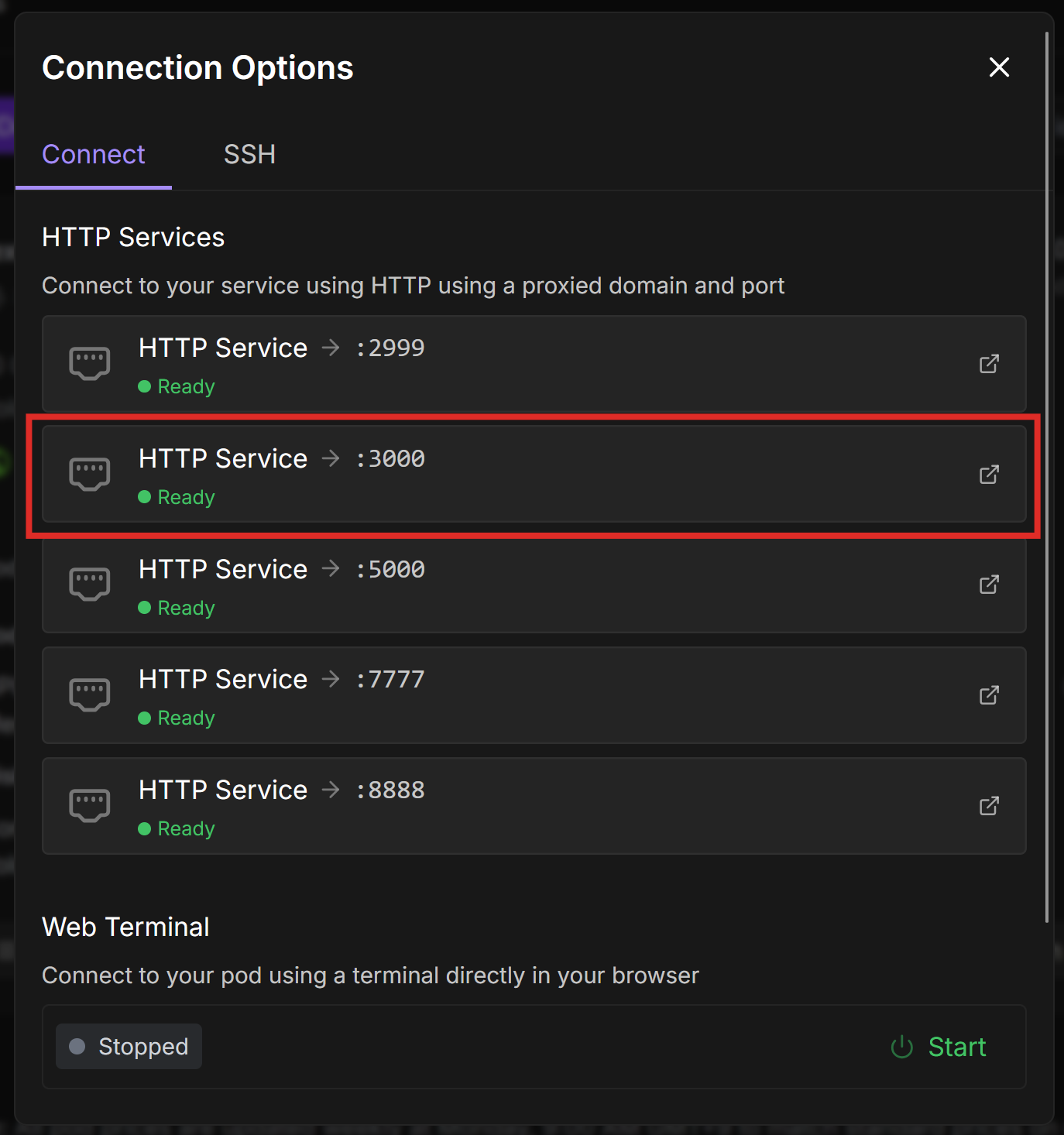
  1. Connect to port 3000 (the Text Generation Web UI service).

Runpod Connection Options dialog with the HTTP service on port 3000 highlighted

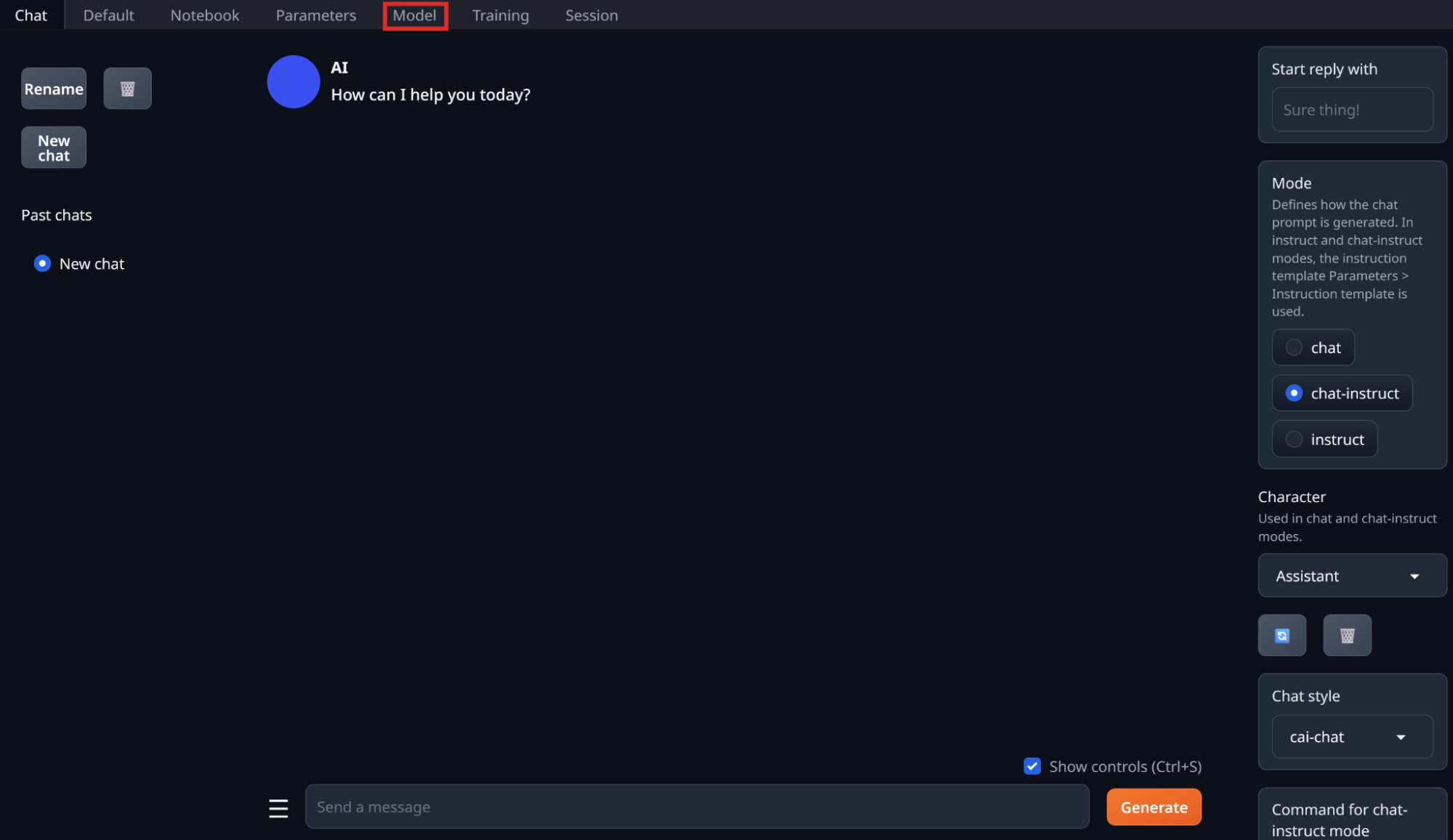
  1. Let’s deploy the Mistral-7B model. Select the Model tab.

Text Generation Web UI chat interface with the Model tab highlighted

  1. We’ll deploy the MaziyarPanahi/Mistral-7B-Instruct-v0.3-GGUF model from Hugging Face. This is the mistralai/Mistral-7B-Instruct-v0.3 model in GGUF format.

    An instruct model is a type of LLM that has been fine-tuned to follow specific instructions or commands, making it effective for tasks like summarization, translation, and answering questions directly.

    Under Download model or LoRA, enter “MaziyarPanahi/Mistral-7B-Instruct-v0.3-GGUF”. In the box below that, enter “Mistral-7B-Instruct-v0.3.IQ4_XS.gguf”, which is the file name of the IQ4_XS (4-bit quantization) version of the model. Then select Download.
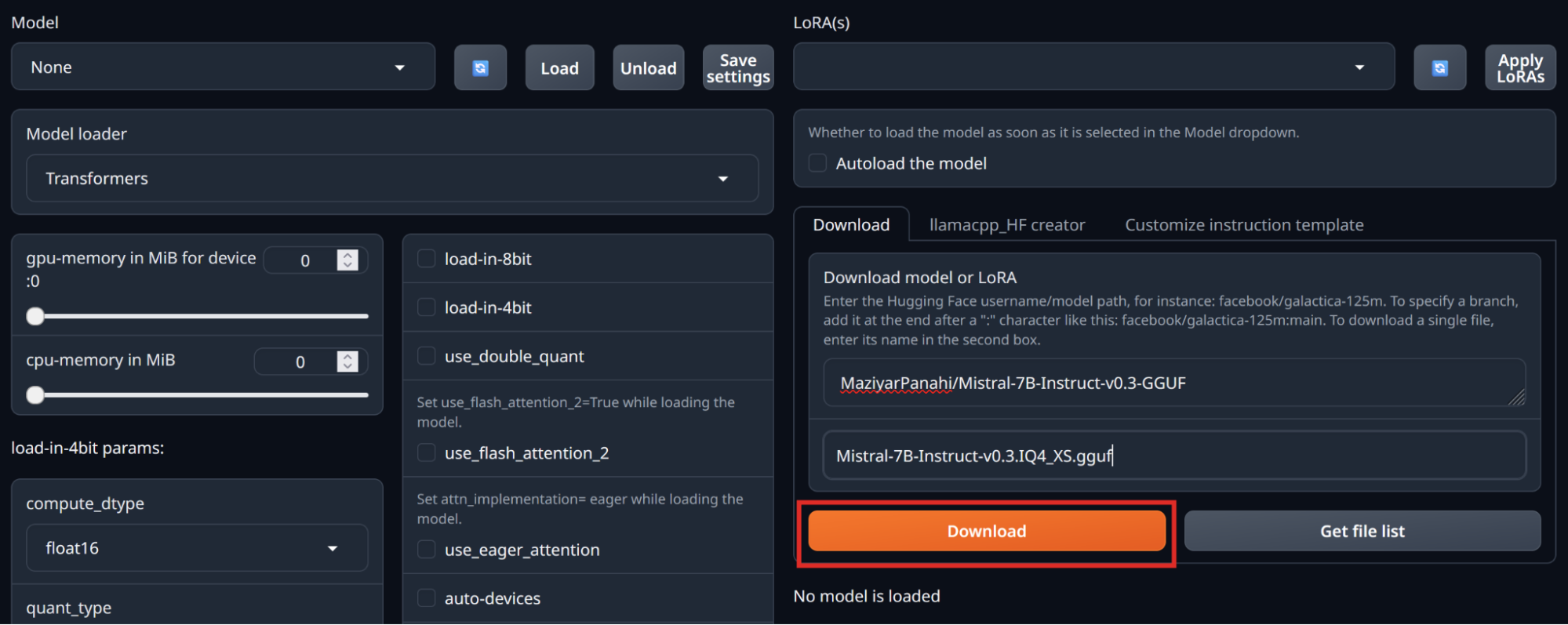
Text generation web UI model tab with the Mistral-7B GGUF download fields and Download button highlighted

  1. After the model is downloaded, select the refresh button so it is displayed in the Model drop-down menu. Select it from the menu, then select Load. The settings for the model should be loaded. Then select Save settings.

Text generation web UI with the Mistral-7B GGUF model selected and llama.cpp loader settings shown

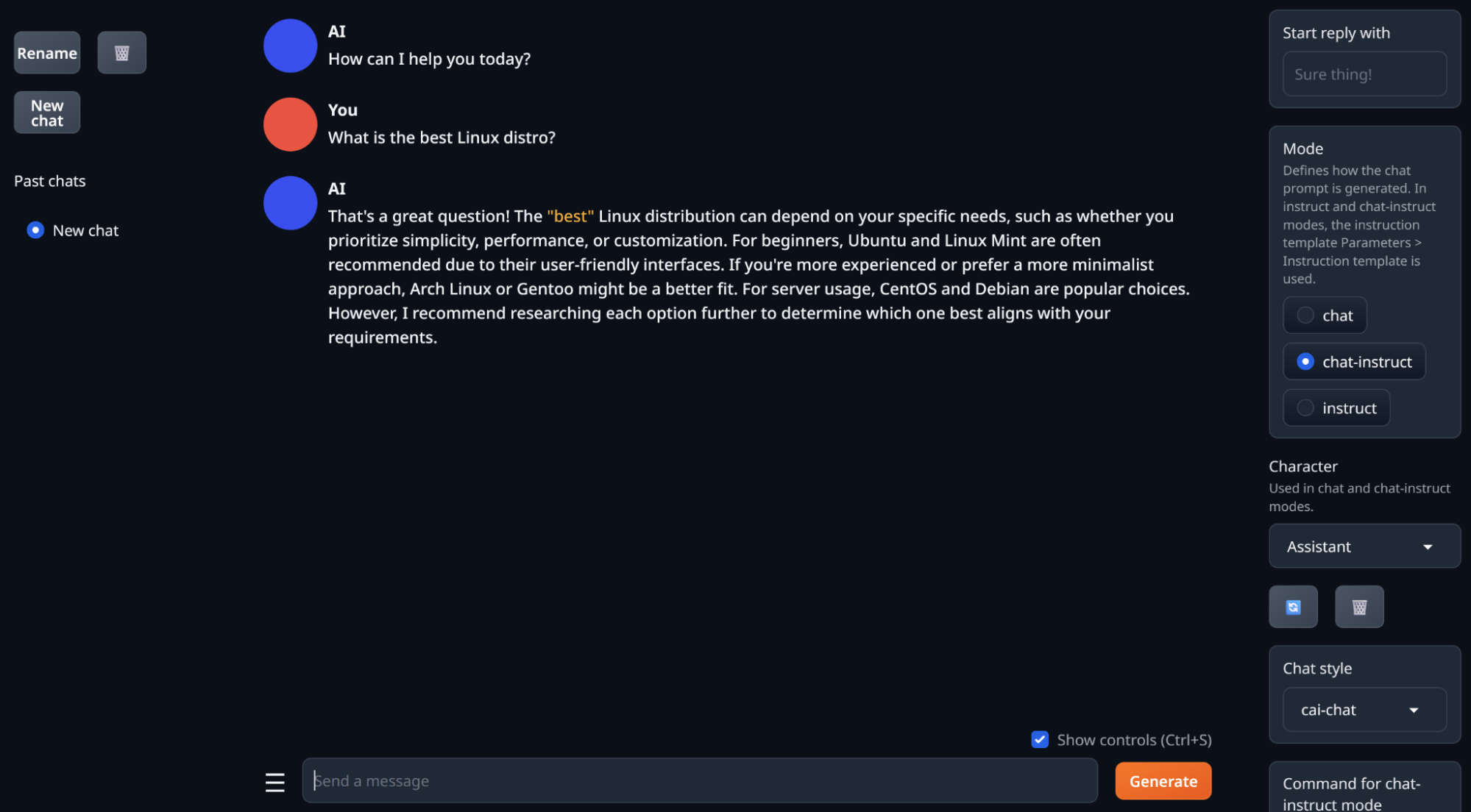
  1. Go back to the Chat tab and try asking the model a question, such as, “What is the best Linux distro?” Confirm that it gives an intelligible response.

Text generation web UI chat session answering a question about the best Linux distro

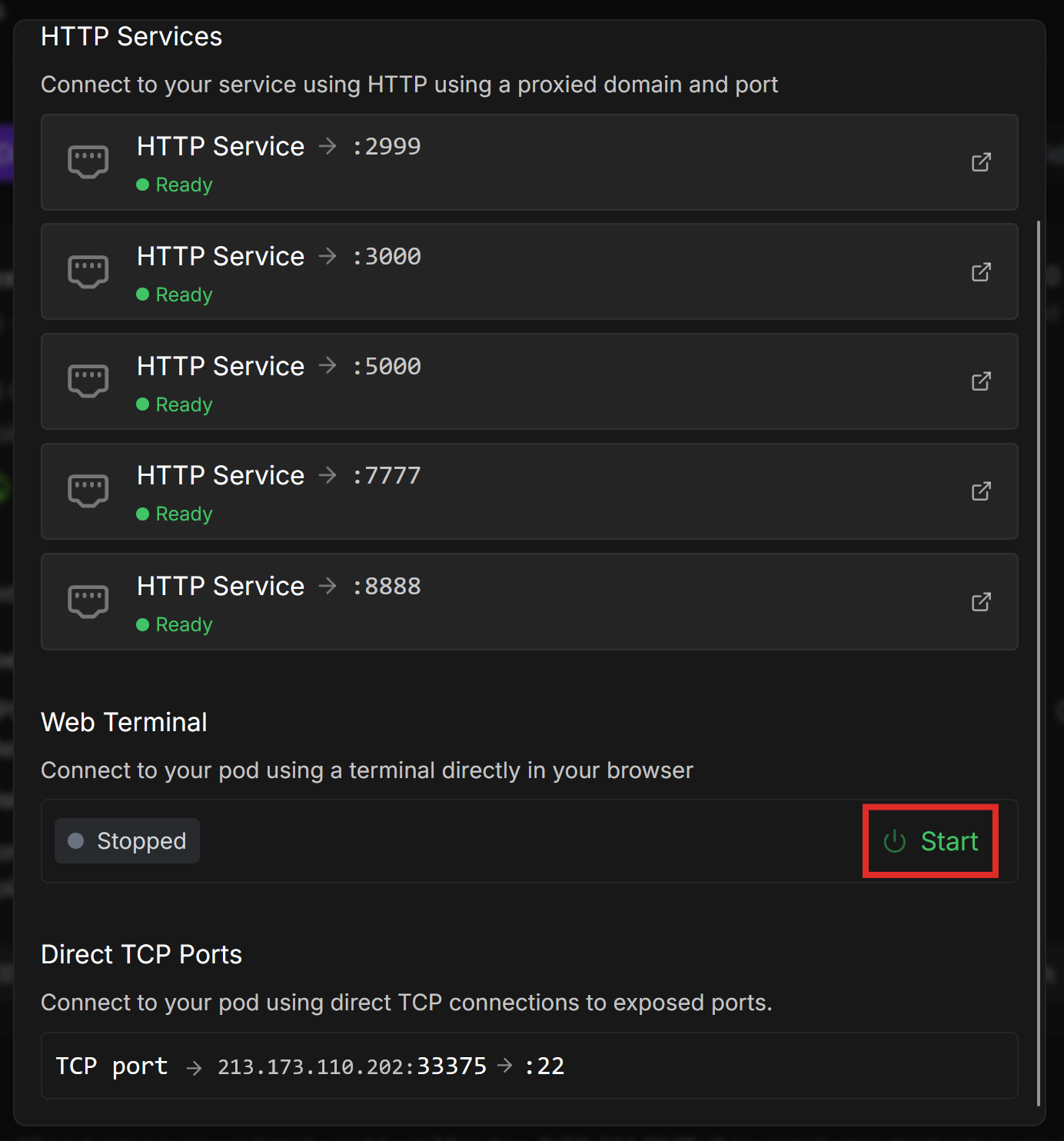
  1. Let’s check the performance of the model by reading through the logs. Go back to the pod overview page and select Connect. Under Web Terminal, select Start. After Runpod starts it up, select Open Web Terminal.

Runpod console pod connection panel with HTTP services, web terminal Start button, and TCP port

Note: If the web terminal says Connection Closed, try refreshing the page.
  1. Enter the following command:

tail outputs the last 10 lines (by default) of a file. The -f switch “follows” the file as new text is added, and outputs it to the terminal.

The main part we are interested in is the last line, which should look something like this:

Output generated in 3.98 seconds (29.17 tokens/s, 116 tokens, context 95, seed 17592148)

Make a note of this somewhere, because we’ll use it to compare to another GPU’s performance.

  1. Create another pod following the exact same steps, but this time, select a GPU with more VRAM, such as the RTX 5090.
  2. Ask the same question that you asked the model running on the lower-performance GPU.
    Note:
    In my testing, the first time I asked a question took a lot longer than subsequent times. For the purposes of this blog post, I’m going to compare performance on the second question I ask each model.
  1. Check the log using the web terminal to check the performance. Compare the throughput (tokens/second) of the two pods. Here are my results:
  • RTX 2000 Ada: 29.17 tokens/second
  • RTX 5090: 91.84 tokens/second

    You should see an exponential increase in performance between the lower- and higher-end GPUs. In my case, doubling the VRAM from 16 to 32 GB multiplied the performance by a factor of about 3X.
    Use this information to determine the types of GPUs that you use for your workloads, balancing the tradeoffs of cost and performance.

Next steps

Compare the performance of the 4-bit quantized model with the non-quantized model, or other quantizations. You should see performance gains with lower-precision models.

Don’t forget to Stop your pods when you’re done using them, and Terminate them when you no longer need them!

Deploy vLLM workers

A vLLM worker is a specialized container that efficiently deploys and serves LLMs on Runpod Serverless, designed for performance, scaling, and cost-effective operation.

Runpod Serverless allows you to create an endpoint that you can call via an API. Runpod allocates workers to the endpoint, which handle API calls as they come in.

Serverless vLLMs have several advantages over pods:

  • vLLMs come with the inference engine pre-configured, optimized for memory usage and faster inference.
  • vLLM APIs are compatible with OpenAI APIs, so you can reuse your existing code just by switching the endpoint URL and API key.
  • Runpod Serverless automatically scales your endpoint workers based on demand and bills on a per-second basis.

If you are not comfortable writing code to call your endpoint, deploying a pod template is a more user-friendly option. However, if you know how to call an API, vLLM on Runpod Serverless is a great option.

Let’s deploy Mistral-7B using vLLM workers. You can deploy LLMs using either the Runpod Console or a Docker image. We’ll go through the Runpod Console method in this blog post, but if you plan to run a vLLM endpoint in production, it’s best to package your model into a Docker image ahead of time, as this can significantly reduce cold start times. See Deploy using a Docker image.
  1. Sign into the Runpod Console and open the Serverless page.
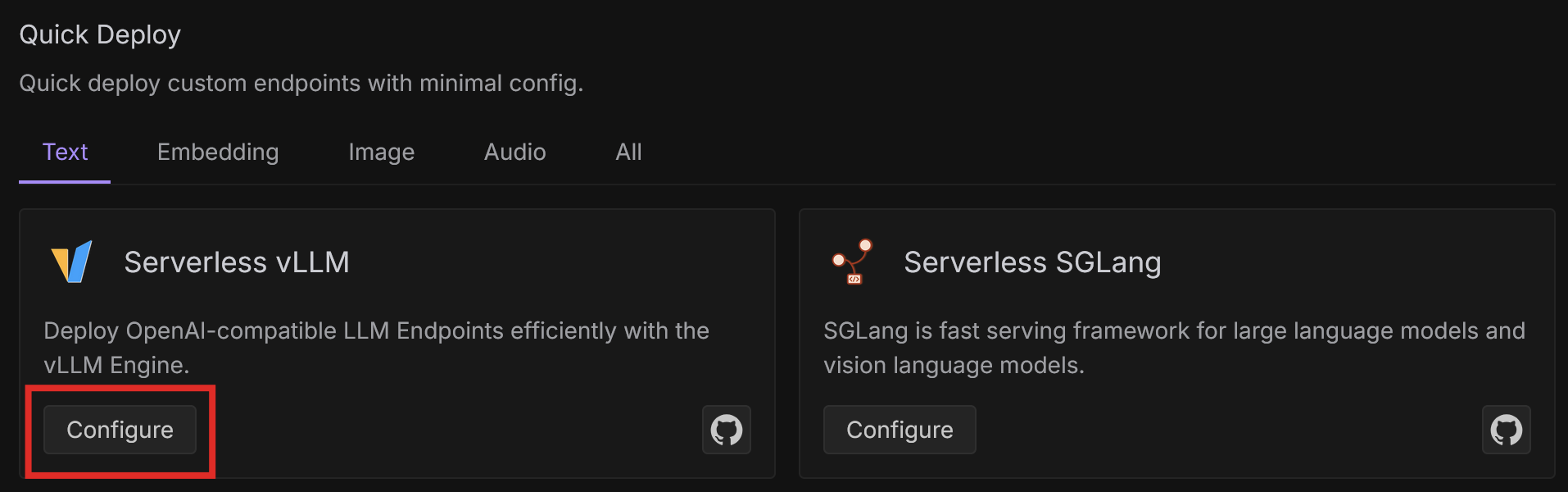
  2. Under Quick Deploy, in the Text tab, under Serverless vLLM, select Configure.

Runpod console Quick Deploy section with the Serverless vLLM Configure button highlighted

  1. Under Hugging Face Models, enter mistralai/Mistral-7B-Instruct-v0.3. Under Hugging Face Token, enter your Hugging Face user access token. Select Next.
    Note:
    Rather than enter your Hugging Face access token directly here, use a secret.

Runpod console Deploy vLLM Endpoint form with Mistral-7B-Instruct entered as the Hugging Face model

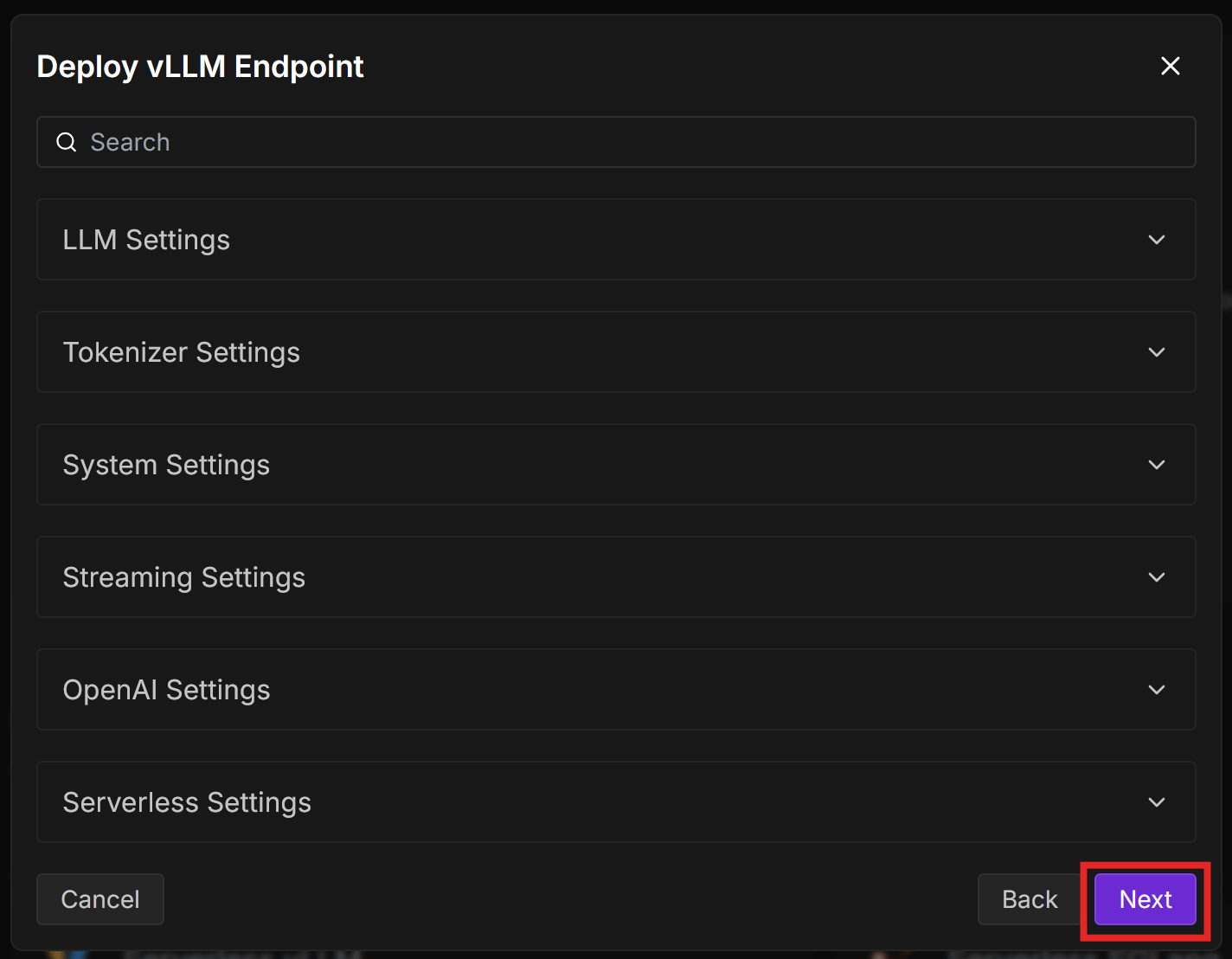
  1. Leave the default vLLM settings and select Next.

Runpod console vLLM endpoint settings sections with the Next button highlighted

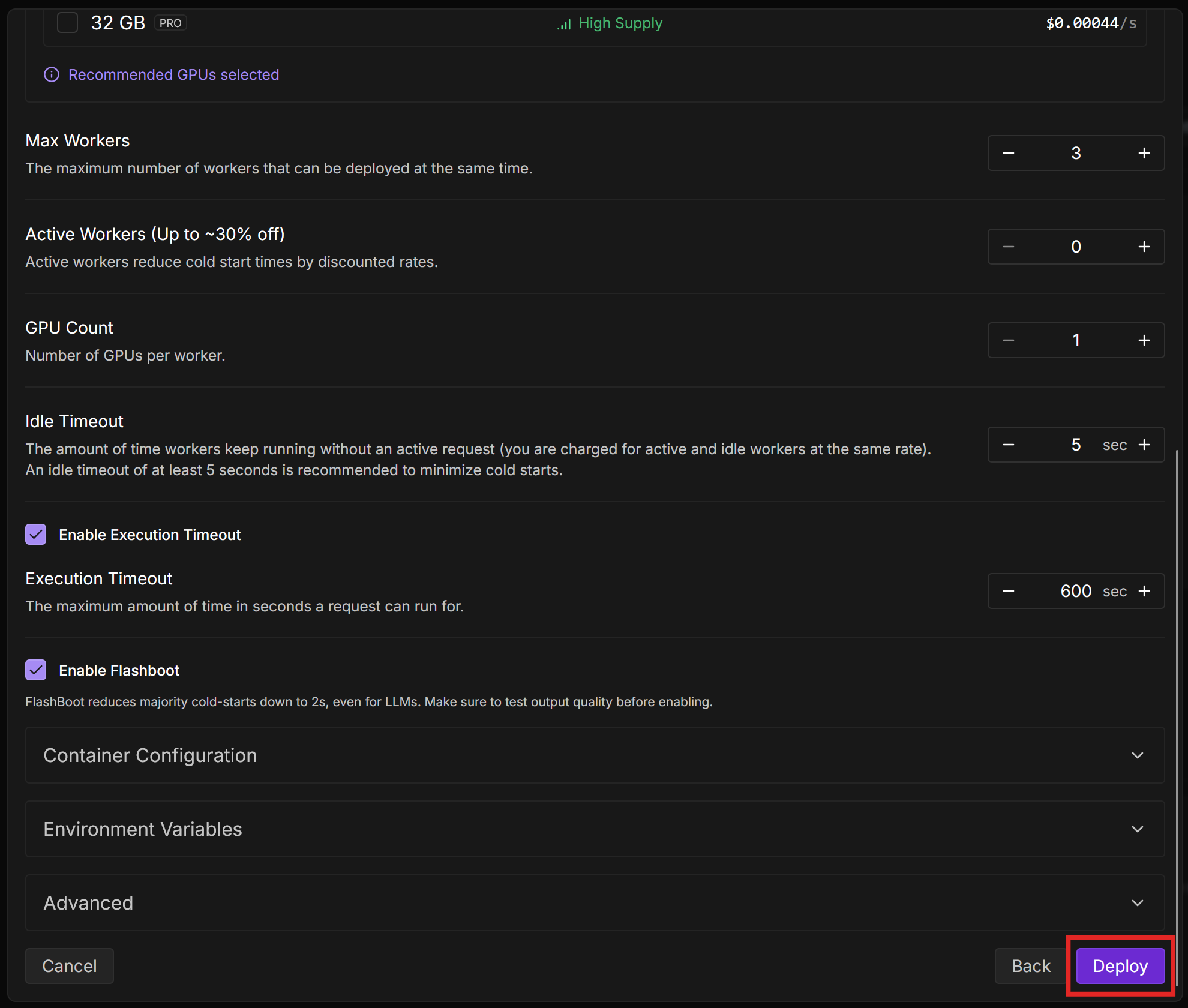
  1. Leave the default worker configuration settings and select Deploy. In our example, we will test workers with 48GB GPUs.
    Note:
    Prices are subject to change.

Runpod console endpoint worker configuration with GPU count, timeouts, and the Deploy button highlighted

  1. Runpod initializes the endpoint and deploys a vLLM worker image with the Mistral-7B model. Wait until the status is Ready.
  2. On your endpoint page, select the Requests tab. Note the default test request:

Select Run to initialize the workers and send a “Hello World” prompt to the model. You can watch the status of the request on the page, which is refreshed every few seconds.
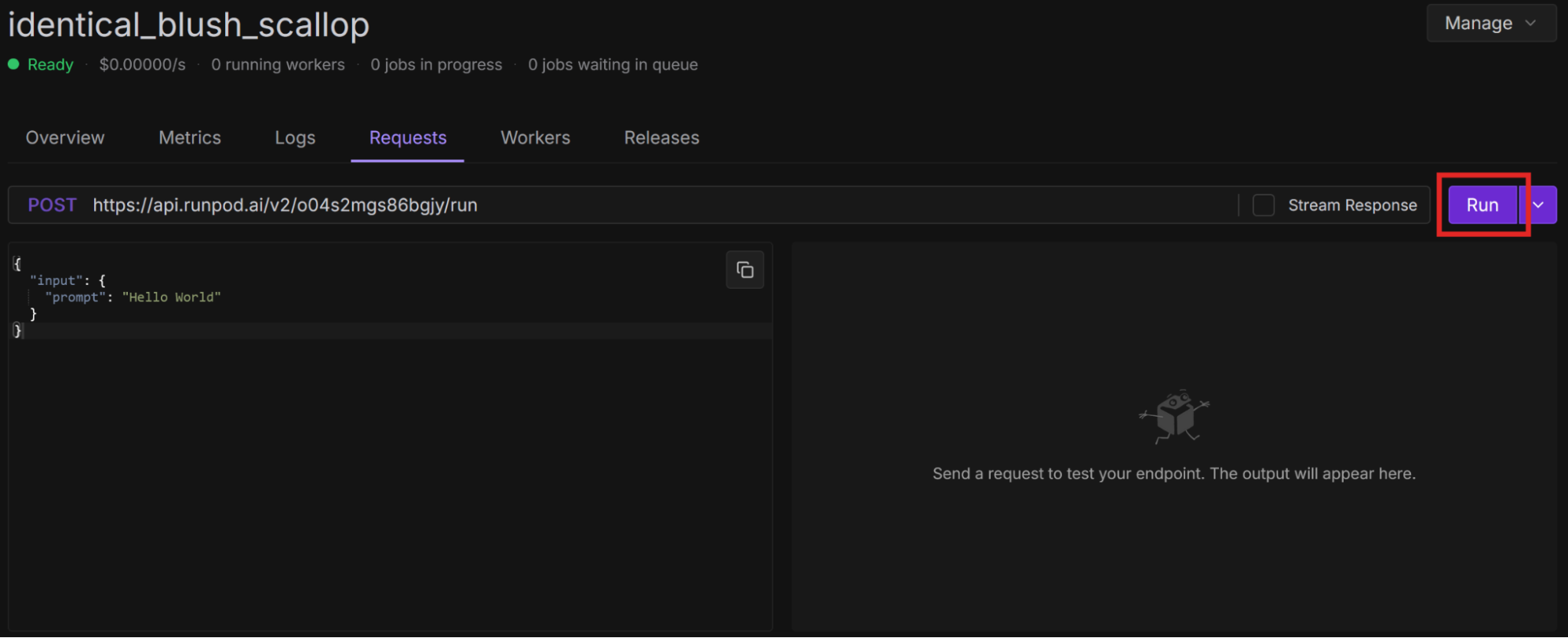
Runpod console endpoint Requests tab with a Hello World test prompt and the Run button highlighted

Note: This may take a while because the workers download the model during initialization.
  1. When the worker finishes processing the request, you can see the response on the right, which should be similar to this:

The response may be weird - I got some commentary on an American football team. You should get a better response if you ask a question. Select New Request to input a different prompt, like “What is the best Linux distro?”
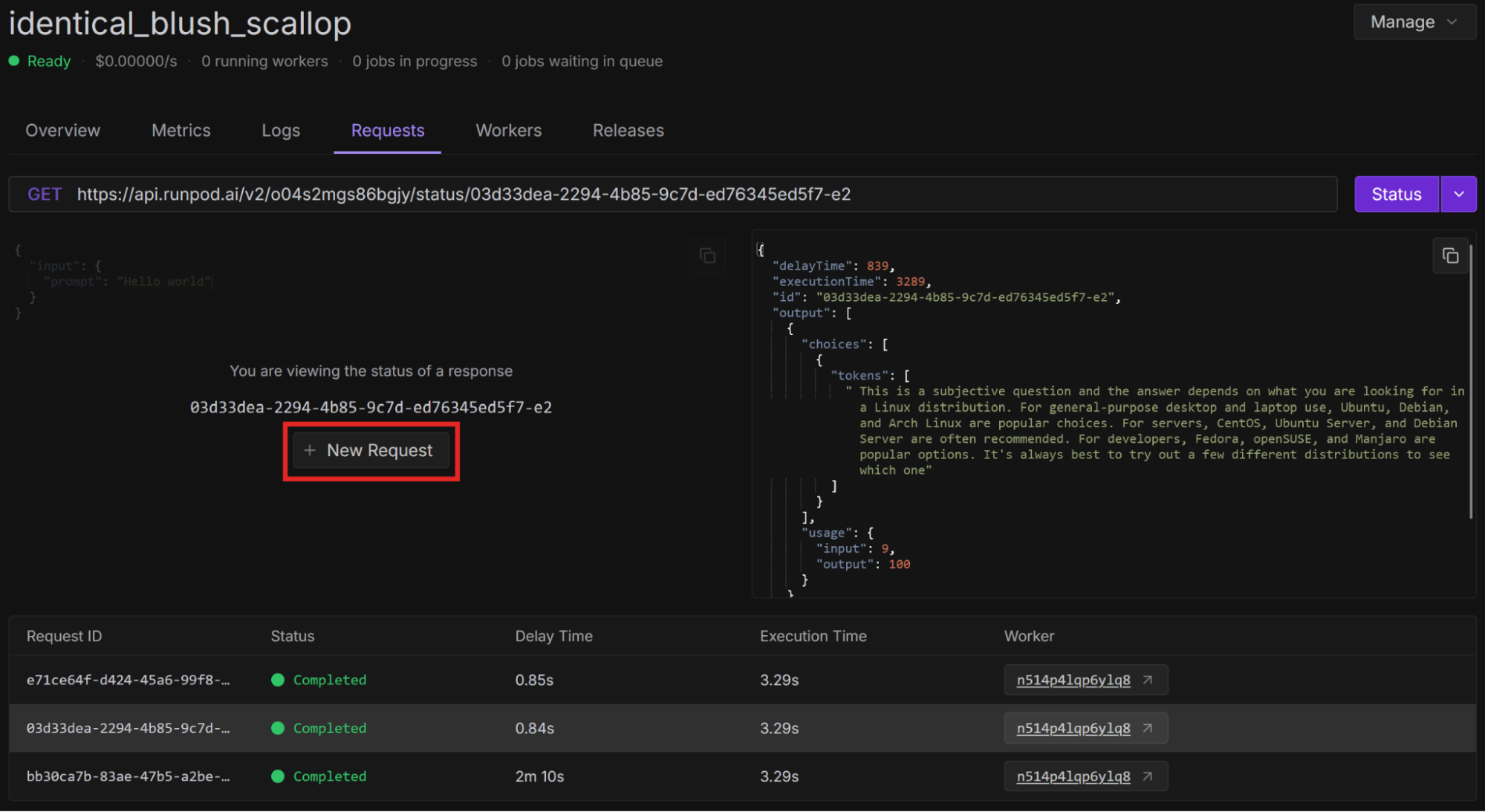
Runpod console endpoint Requests tab showing a completed request with JSON response output

Next steps

Compare the performance of using vLLM workers across various situations:

  • vLLM workers versus pod + web UI
  • Quantized versus non-quantized models
  • Low-end versus high-end GPUs

You should see performance gains across the board when using vLLM workers, both in terms of inference speed and cost.

If you want to further optimize performance, try increasing the minimum active workers. When a worker is not being used, it goes into an idle state, from which it takes some time to wake up and start a new task. If you have a certain number of active workers available at all times, you can decrease the time it takes to start a new task. For more ways to optimize your endpoints, see Endpoint configuration and optimization.

Don’t forget to delete your endpoints when you’re done using them. On the endpoint overview page, select Manage > Delete Endpoint.

Conclusion

Once you are comfortable deploying a model like Mistral-7B using a pod template or vLLM on Runpod Serverless, there are many things you can do to further optimize for performance and cost. We’ve only touched on a few here, but there are so many more areas to explore.

In summary, to optimize the performance of your workloads:

  • Use quantized (lower-precision) GGUF models
  • Use higher-VRAM GPUs
  • Deploy vLLM workers on Runpod Serverless
  • Compare different strategies to balance cost and performance

Author profile: Eliot Cowley