惯性聚合 高效追踪和阅读你感兴趣的博客、新闻、科技资讯
阅读原文 在惯性聚合中打开

推荐订阅源

N
News and Events Feed by Topic
Stack Overflow Blog
Stack Overflow Blog
CTFtime.org: upcoming CTF events
量子位
Apple Machine Learning Research
B
Blog RSS Feed
F
Full Disclosure
aimingoo的专栏
aimingoo的专栏
云风的 BLOG
云风的 BLOG
小众软件
小众软件
Hugging Face - Blog
Hugging Face - Blog
A
About on SuperTechFans
G
Google Developers Blog
U
Unit 42
腾讯CDC
雷峰网
雷峰网
爱范儿
爱范儿
H
Help Net Security
Engineering at Meta
Engineering at Meta
Vercel News
Vercel News
Cloudbric
Cloudbric
freeCodeCamp Programming Tutorials: Python, JavaScript, Git & More
S
Secure Thoughts
有赞技术团队
有赞技术团队
Jina AI
Jina AI
L
LINUX DO - 最新话题
Martin Fowler
Martin Fowler
C
Cybersecurity and Infrastructure Security Agency CISA
V
Visual Studio Blog
TaoSecurity Blog
TaoSecurity Blog
F
Fortinet All Blogs
S
Security @ Cisco Blogs
K
KPMG report finds enterprise disconnect between AI and its ROI | CIO
IT之家
IT之家
T
The Blog of Author Tim Ferriss
K
Kaspersky official blog
N
News | PayPal Newsroom
美团技术团队
月光博客
月光博客
PCI Perspectives
PCI Perspectives
Exploit-DB.com RSS Feed
Google Online Security Blog
L
LINUX DO - 热门话题
Help Net Security
Help Net Security
Recent Announcements
cs.CL updates on arXiv.org
罗磊的独立博客
酷 壳 – CoolShell
酷 壳 – CoolShell
Latest news
Latest news
让小产品的独立变现更简单 - ezindie.com

Runpod Blog.

DeepSeek V4 in the wild, and how to run it on Runpod New Runpod datacenter now live: AP-IN-1 Track GPU spend across your team with Cost Centers The GPU supply supercycle is here. Here’s what AI builders need to know. Community Spotlight: One-click AI image and video generation on Runpod with SwarmUI | Runpod Blog Community Spotlight: LoRA Pilot Data Prep to Inference Introducing the Runpod Assistant: Manage Your Cloud GPU Resources with Natural Language OpenAI's Parameter Golf: Train the Best Language Model That Fits in 16MB on Runpod LLM inference optimization: techniques that actually reduce latency and cost Pruna P-Video and Vidu Q3 public endpoints now available on Runpod Runpod brand spelling guide Quickstart - Runpod Documentation The AI market looks nothing like the narrative KoboldAI – The Other Roleplay Front End, And Why You May Want to Use It How to Connect Cursor to LLM Pods on Runpod for Seamless AI Dev Community Spotlight: How AnonAI Scaled Its Private Chatbot Platform with Runpod Prompt Scheduling with Disco Diffusion on Runpod Runpod's Latest Innovation: Dockerless CLI for Streamlined AI Development Run Your Own AI from Your iPhone Using Runpod Introducing Flash: Run GPU workloads on Runpod Serverless: No Docker required Use Claude Code with your own model on Runpod: No Anthropic account required Avoid Errors by Selecting the Proper Resources for Your Pod What hackers built on Runpod at TreeHacks 2026 Easily Back Up and Restore Your Pod with Cloud Sync + Backblaze B2 The Complete Guide to GPU Requirements for LLM Fine-Tuning AI Guides, Tutorials & GPU Infrastructure Insights | Runpod Your first Claude Code project within Runpod: a complete setup guide 10 billion Serverless requests and counting Building for resilience: Runpod’s response to the AWS us-east-1 outage How to Connect Google Colab to Runpod Founder Series #1: The Runpod Origin Story AMD MI300X vs. NVIDIA H100: Mixtral 8x7B Inference Benchmark How to Run the FLUX Image Generator with ComfyUI on Runpod Run Llama 3.1 405B with Ollama on Runpod: Step-by-Step Deployment How to Run FLUX Image Generator with Runpod (No Coding Needed) How to Use 65B+ Language Models on Runpod Deploy Llama 3.1 with vLLM on Runpod Serverless: Fast, Scalable Inference in Minutes Open Source Video & LLM Roundup: The Best of What’s New Run vLLM on Runpod Serverless: Deploy Open Source LLMs in Minutes Introduction to vLLM and PagedAttention New update to Github integration: release rollback! | Runpod Blog A note to the developers who built Runpod with us Deploy ComfyUI as a Serverless API Endpoint Setting up Slurm on Runpod Clusters: A Technical Guide Building an OCR System Using Runpod Serverless From No-Code to Pro: Optimizing Mistral-7B on Runpod for Power Users Lessons While Using Generative Language and Audio For Practical Use Cases Runpod RoundUp 3 – AI Music and Stock Sound Effect Creation New Navigational Changes To Runpod UI Use alpha_value To Blast Through Context Limits in LLaMa-2 Models Runpod Roundup 5 – Visual/Language Comprehension, Code-Focused LLMs, and Bias Detection Runpod is Proud to Sponsor the StockDory Chess Engine Runpod Roundup 4 – Open Source LLM Evaluators, 3D Scene Reconstruction, Vector Search Meta and Microsoft Release Llama 2 as Open Source SuperHot 8k Token Context Models Are Here For Text Generation How to Manage Funding Your Runpod Account Encrypted Volumes on Runpod: Protect Your Data at Rest How to Run a "Hello World" on Runpod Serverless Runpod AI field notes: December 2025 Faster GitHub Builds: Major Performance Improvements to Our Automated Integration Partnering with Defined AI to Bridge the Data Wealth Gap How to Run Serverless AI and ML Workloads on Runpod How to fine-tune a model using Axolotl Transcribe and translate audio files with Faster Whisper Runpod Achieves SOC 2 Type II Certification: Continuing Our Compliance Journey Orchestrating GPU workloads on Runpod with dstack Exploring Runpod Serverless: Create Workers From Templates DeepSeek V3.1: A Technical Analysis of Key Changes from V3-0324 Deep Cogito Releases Suite of LLMs Trained with Iterative Policy Improvement Wan 2.2 Releases With a Plethora Of New Features Iterative Refinement Chains with Small Language Models The New Runpod.io: Clearer, Faster, Built for What’s Next Introducing Clusters: On-Demand Multi-Node AI Compute Run DeepSeek R1 on Just 480GB of VRAM How Do I Transfer Data Into My Runpod? Spot vs. On-Demand Instances: What’s the Difference? Deploy GitHub Repos to Runpod with One Click Run GGUF Quantized Models Easily with KoboldCPP on Runpod How to Work with GGUF Quantizations in KoboldCPP Introducing Better Forge: Spin Up Stable Diffusion Pods Faster Supercharge Your LLMs with SGLang: Boost Performance and Customization Mastering Serverless Scaling on Runpod: Optimize Performance and Reduce Costs RAG vs. Fine-Tuning: Which Is Best for Your LLM? Run Larger LLMs on Runpod Serverless Than Ever Before – Llama-3 70B (and beyond!) How to Run vLLM on Runpod Serverless (Beginner-Friendly Guide) Embracing New Beginnings: Welcoming Banana.dev Community to Runpod Stable Diffusion + ComfyUI on Runpod: Easy Setup Guide Runpod RoundUp 2 – 32k Token Context LLMs and New StabilityAI Offerings Runpod Roundup: High-Context LLMs, SDXL, and Llama 2 16k Context LLM Models Now Available On Runpod Savings Plans Are Here For Secure Cloud Pods – How To Purchase a Monthly Plan And Save Big Pygmalion-7b from PygmalionAI has been released, and it's amazing Ada Architecture Pods Are Here – How Do They Stack Up Against Ampere? Spin up a Text Generation Pod with Vicuna and Experience a GPT-4 Rival Using OpenPose to Annotate Poses Within Stable Diffusion Set Up a Chatbot with Oobabooga on Runpod Connect VSCode to Your Runpod Instance (Quick SSH Guide) Deploy a Stable Diffusion UI on Runpod in Minutes Google Colab Pro vs. Runpod: Best GPU Cloud for AI Workloads How to Run a GPU-Accelerated Virtual Desktop on Runpod
Training StyleGAN3 with Vision-Aided GAN on Runpod
Zhen Lu · 2026-03-11 · via Runpod Blog.

Image generation has evolved tremendously over the last couple of years. Generative Adversarial Networks have emerged as state-of-the-art in the field of image generation, the latest iteration of which is StyleGAN3.

What is StyleGAN3?

GAN is an acronym for "generative adversarial network" – a machine learning framework where two neural networks are set against each other, represented as G, the generator and D, the discriminator. The generator's job is to generate fake images to trick the discriminator, and the discriminator's job is to determine whether an image is real or fake.

The cutting-edge StyleGAN3 algorithm is the latest development in a long line of advancements in GANs. This algorithm can generate incredibly realistic images and has been used by researchers to generate everything from faces to 3D objects.

While the potential applications of StyleGAN3 are vast, one of the most exciting is its potential for creating realistic images.

In the past, GANs have had difficulty generating high-resolution images without introducing artifacts. Artifacts arise when the generator network upsamples low-resolution photos in a process known as aliasing. StyleGAN3 uses a novel upsampling method that doesn't introduce these artifacts, allowing it to generate high-resolution images without aliasing.

This is a significant improvement over previous generations of GANs, and it opens up a whole new range of possibilities for image generation. For example, StyleGAN3 could be used to generate realistic faces for use in video games or movies.

In addition to its ability to generate high-resolution images, StyleGAN3 is much faster than previous generations of GANs. This is because it uses a training method called "progressive growing" that allows the StyleGAN3 network to be trained using lower resolution images initially, with more detail being gradually added later as the training progresses. This is much faster than training a GAN on high-resolution images from scratch, which can take days or weeks.

StyleGAN3 is an exciting new development in the world of generative neural networks, and it has the potential to revolutionize the field of image generation.

Training StyleGAN3

Training notebook for Runpod

I decided to train a fork of StyleGAN3 - “Vision-aided GAN”[3] on 4x A6000s generously provided by Runpod. Training StyleGAN3 requires at least 1 high-end GPU with 12GB of VRAM.

Vision-aided GAN leverages previously trained models to improve training quality significantly. This slightly increases training time; however, the results are typically much better.

I am using the “danbooru2019 portraits”[4] subset of the danbooru2019 dataset to train (which contains approximately 300,000 images, though that volume of images is not strictly necessary). The parameters used were:

and, for vision-aided GAN:

Refer to the training configurations to choose the correct values for your hardware, config and dataset. Reducing the --batch value typically warrants increasing --gamma and/or lowering the D and G learning rates (--dlr and --glr). Think of --gamma as the “randomness” or “creativity” of the model.

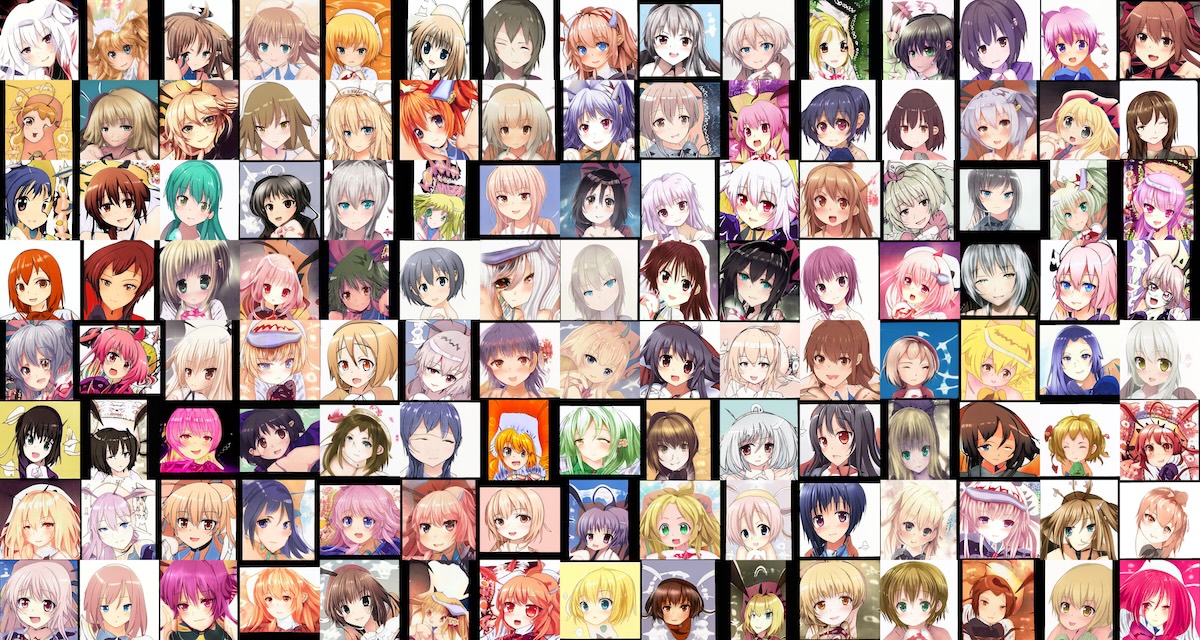
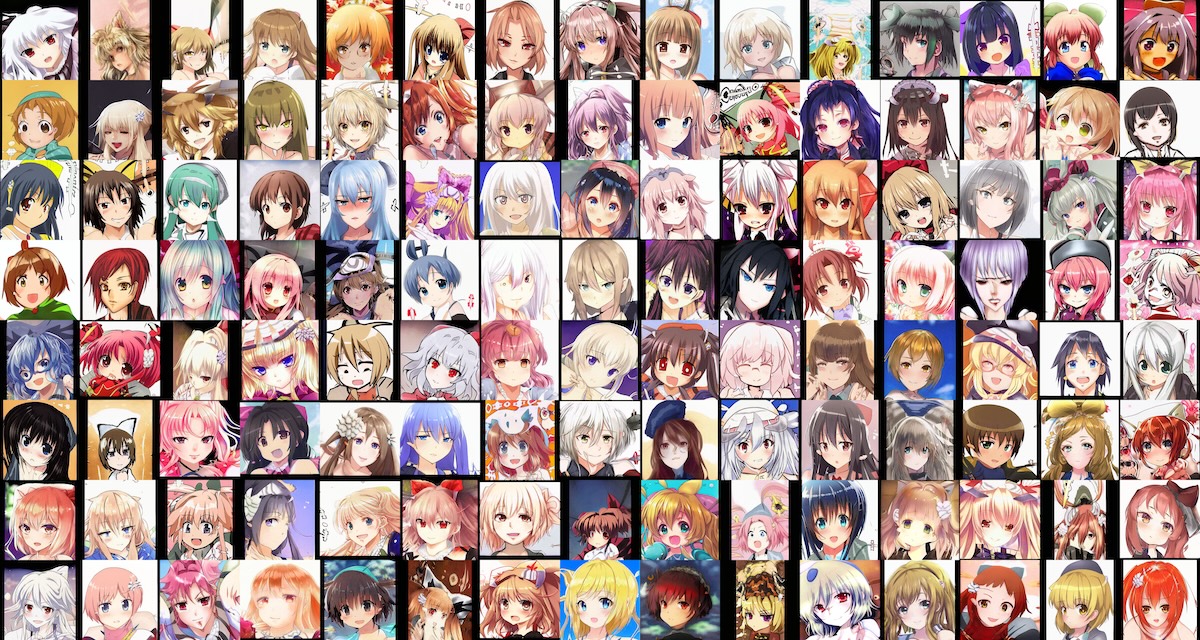
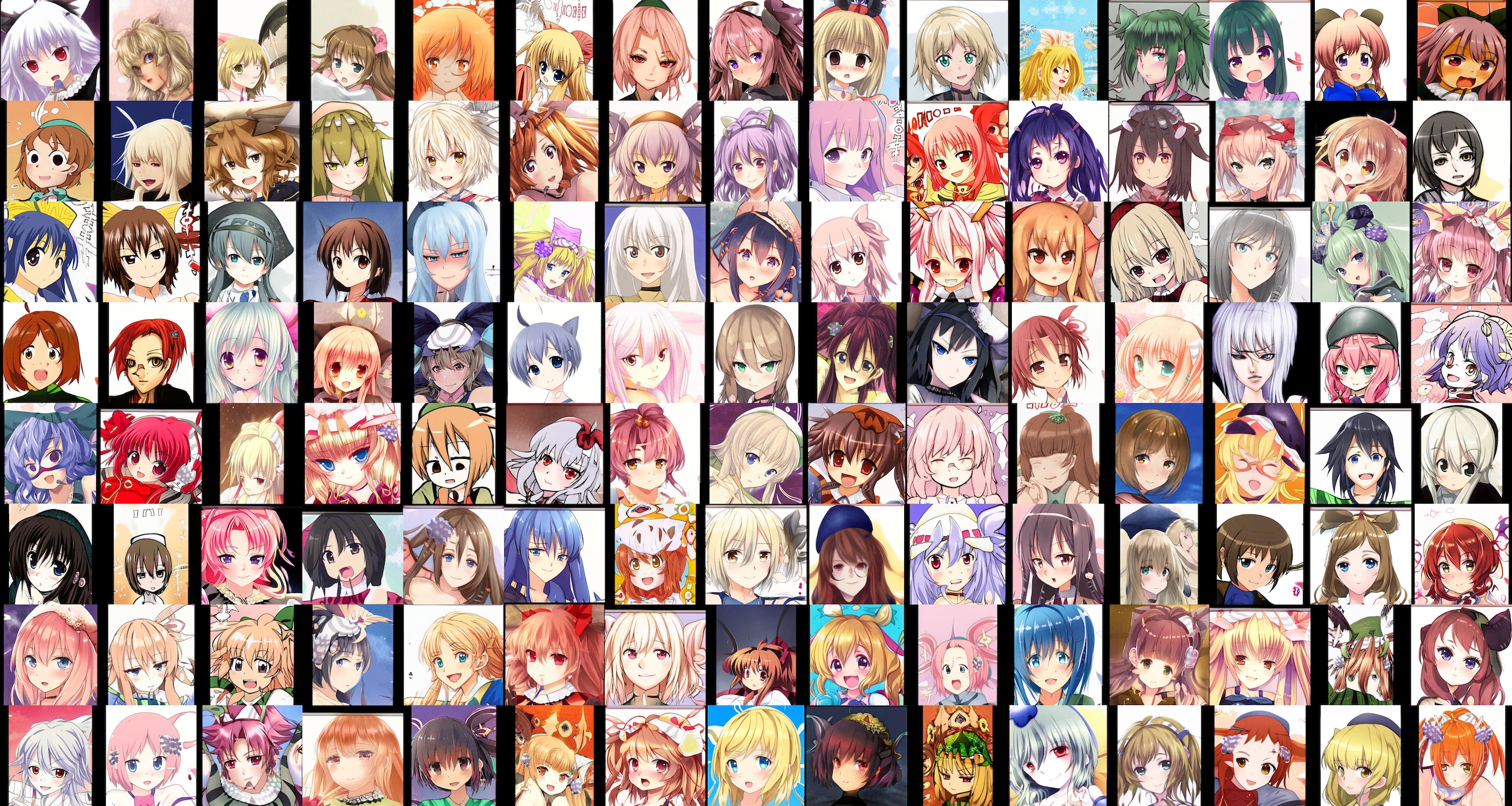
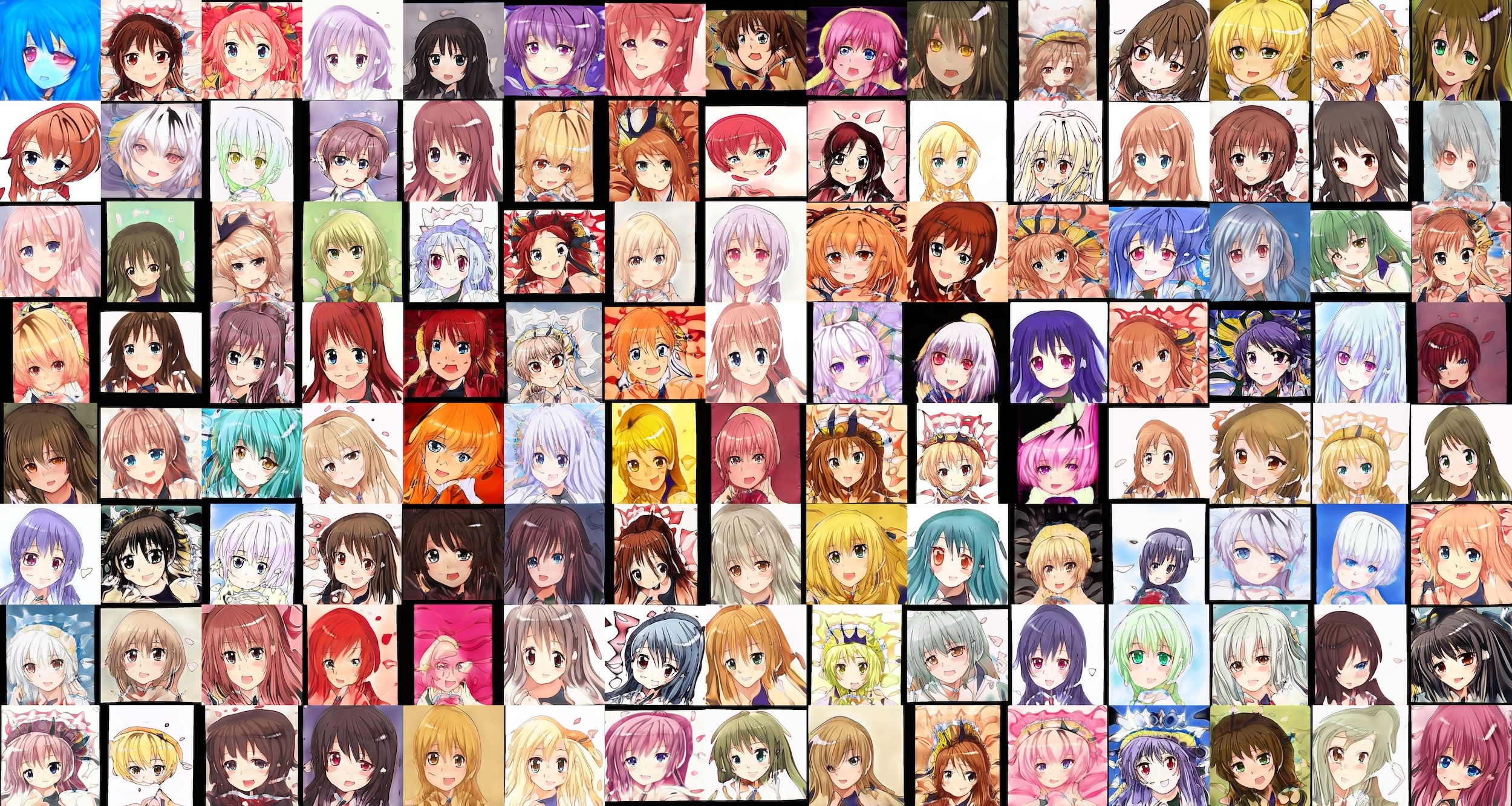
At about 900kimg into training, I introduced the vision-aided GAN parameters and switched to their version of StyleGAN3. After about a week of training, the model reached 11100kimg, At this point, training was terminated.

1000kimg
Grid of anime character faces generated by StyleGAN3 during training

2000kimg

Grid of StyleGAN3-generated anime faces after additional training iterations

8000kimg

Grid of anime faces generated by StyleGAN3 at a later training checkpoint

11000kimg

Final grid of anime faces generated by the trained StyleGAN3 model

There are noticeable artifacts that seem to happen with StyleGAN3. However, the older StyleGAN2-ADA does not seem to have these artifacts. You can find the model download and more information in the StyleGAN3 anime repository.

Artifacts

StyleGAN3 artifact sample

Closing Thoughts

StyleGAN3 is an exciting new algorithm that will revolutionize the field of image generation. It can generate high-resolution images and is much faster than previous generations of GANs. I believe that StyleGAN3 will have a significant impact on the field of image generation and I am looking forward to seeing how it continues to develop in the future, and what new exciting applications are built upon it.

References

  1. Alias-Free Generative Adversarial Networks (StyleGAN3) https://github.com/NVlabs/stylegan3
  2. Progressive Growing of GANs for Improved Quality, Stability, and Variation arXiv:1710.10196 [cs.NE]
  3. Vision-aided GAN https://github.com/nupurkmr9/vision-aided-gan
  4. Gwern Branwen, Anonymous, & The Danbooru Community; “Danbooru2019 Portraits: A Large-Scale Anime Head Illustration Dataset”, 2019-03-12. Web. Accessed 2022-06-19 https://www.gwern.net/Crops#danbooru2019-portraits

Guest authored by Exploding-cat (08-02-2022)

Author profile: Zhen Lu