





Tuesday, Aug 11th, 2009 by Tim | Tags: English, memcachedb, redis, tokyo cabinet, tokyo tyrant
I had tested the following key-value store for set() and get()
2 Linux boxes in a LAN, 1 server and 1 test client
Linux Centos 5.2 64bit
Intel(R) Xeon(R) CPU E5410 @ 2.33GHz (L2 cache: 6M), Quad-Core * 2
8G memory
SCSI disk (standalone disk, no other access)
db-4.7.25.tar.gz
libevent-1.4.11-stable.tar.gz
memcached-1.2.8.tar.gz
memcachedb-1.2.1-beta.tar.gz
redis-0.900_2.tar.gz
tokyocabinet-1.4.9.tar.gz
tokyotyrant-1.1.9.tar.gz
Memcachedb startup parameter
Test 100 bytes
./memcachedb -H /data5/kvtest/bdb/data -d -p 11212 -m 2048 -N -L 8192
(Update: As mentioned by Steve, the 100-byte-test missed the -N paramter, so I added it and updated the data)
Test 20k bytes
./memcachedb -H /data5/kvtest/mcdb/data -d -p 11212 -b 21000 -N -m 2048
Tokyo Tyrant (Tokyo Cabinet) configuration
Use default Tokyo Tyrant sbin/ttservctl
use .tch database, hashtable database
ulimsiz=”256m”
sid=1
dbname=”$basedir/casket.tch#bnum=50000000″ # default 1M is not enough!
maxcon=”65536″
retval=0
Redis configuration
timeout 300
save 900 1
save 300 10
save 60 10000
# no maxmemory settings
Client in Java, JDK1.6.0, 16 threads
Use Memcached client java_memcached-release_2.0.1.jar
JRedis client for Redis test, another JDBC-Redis has poor performance.
Test 1, 1-5,000,000 as key, 100 bytes string value, do set, then get test, all get test has result.
Request per second(mean)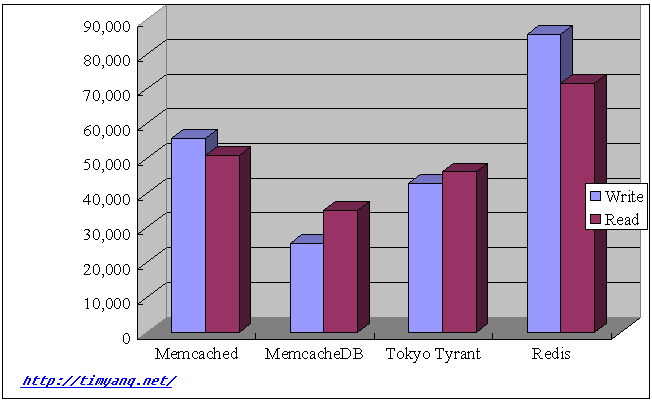
| Store | Write | Read |
| Memcached | 55,989 | 50,974 |
| Memcachedb | 25,583 | 35,260 |
| Tokyo Tyrant | 42,988 | 46,238 |
| Redis | 85,765 | 71,708 |
Server Load Average
| Store | Write | Read |
| Memcached | 1.80, 1.53, 0.87 | 1.17, 1.16, 0.83 |
| MemcacheDB | 1.44, 0.93, 0.64 | 4.35, 1.94, 1.05 |
| Tokyo Tyrant | 3.70, 1.71, 1.14 | 2.98, 1.81, 1.26 |
| Redis | 1.06, 0.32, 0.18 | 1.56, 1.00, 0.54 |
Test 2, 1-500,000 as key, 20k bytes string value, do set, then get test, all get test has result.
Request per second(mean)
(Aug 13 Update: fixed a bug on get() that read non-exist key)
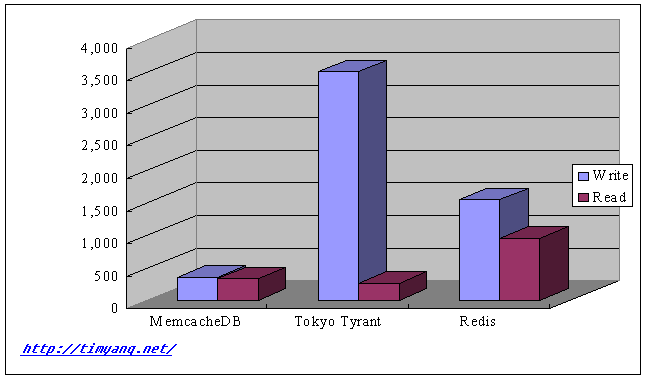
| Store | Write | Read |
| Memcachedb | 357 | 327 |
| Tokyo Tyrant | 3,501 | 257 |
| Redis | 1,542 | 957 |
When test Redis server, the memory goes up steadily, consumed all 8G and then use swap(and write speed slow down), after all memory and swap space is used, the client will get exceptions. So use Redis in a productive environment should limit to a small data size. It is another cache solution rather than a persistent storage. So compare Redis together with MemcacheDB/TC may not fair because Redis actually does not save data to disk during the test.
Tokyo cabinet and memcachedb are very stable during heavy load, use very little memory in set test and less than physical memory in get test.
MemcacheDB peformance is poor for write large data size(20k).
The call response time was not monitored in this test.
此内容由惯性聚合(RSS阅读器)自动聚合整理,仅供阅读参考。 原文来自 — 版权归原作者所有。