
惯性聚合 高效追踪和阅读你感兴趣的博客、新闻、科技资讯
阅读原文 在惯性聚合中打开

推荐订阅源

IT之家
IT之家
Last Week in AI
Last Week in AI
博客园_首页
酷 壳 – CoolShell
酷 壳 – CoolShell
博客园 - 叶小钗
大猫的无限游戏
大猫的无限游戏
人人都是产品经理
人人都是产品经理
V
Visual Studio Blog
宝玉的分享
宝玉的分享
博客园 - Franky
奇客Solidot–传递最新科技情报
奇客Solidot–传递最新科技情报
月光博客
月光博客
T
Tailwind CSS Blog
让小产品的独立变现更简单 - ezindie.com
量子位
博客园 - 聂微东
S
SegmentFault 最新的问题
博客园 - 司徒正美
罗磊的独立博客
V
V2EX
freeCodeCamp Programming Tutorials: Python, JavaScript, Git & More
美团技术团队
小众软件
小众软件
Jina AI
Jina AI

VnExpress English

Chinese robotics chip founder Wang Xinyang becomes billionaire as shares jump 144% post IPO US humanoid robot Digit deadlifts 29 kg Apple's Tim Cook to step down as CEO in September Canada Research Chair Janusz Pawliszyn, one of the world’s top analytical science figures, joins Chinese university Why Terence Tao is seen as one of the world’s greatest living mathematicians China builds ‘big science’ model to foster self-reliance Which is the only Asian country with two universities in the global top 5 for data science and AI? MIT named world’s best for mathematics for nine straight years Humanoid robots race past humans in Beijing half-marathon, showing rapid advances Meet Chris Espinosa, the only Apple employee still with the company since its founding 50 years ago Faulty wireless call buttons at Hanoi cafe disrupt car, motorbike smart keys ViTrox cofounder Chu Jenn Weng returns to Malaysia’s richest list as shares climb ondemand for chip inspection equipment Unitree humanoid robot goes viral after chasing wild boars on Warsaw street Over 300 humanoid robots race in China half-marathon Agibot humanoid robots conduct world-first tablet testing on live factory line Hanoi to add 53 electric buses from April 18 Thousands of mathematicians threaten boycott of US congress where Fields Medal is awarded Khan Academy to launch AI degree under $10,000 to rival Harvard, Stanford US scientists build spring-powered computer that runs without electricity Meet the only two female mathematicians to win Fields Medal in its nearly century-long history China deploys world’s largest all-electric container ship China develops world's first crystal enabling GPS-free navigation for submarines AI reshapes software development as firms adopt more iterative models Unitree starts selling cheapest humanoid robot from $6,800 Vietnam ramps up push for self-reliant semiconductor industry Why world's leading biologist Zhang Kai leaves Yale for China’s university at the height of career Nearly half of US college students consider changing majors over AI’s impact on jobs AI adoption faces hurdles as firms seek practical business value Vietnam's richest man Pham Nhat Vuong’s aerospace firm to launch satellite in 2027 Chinese AI autonomously solves decade-old math problem in hours
China develops next-generation 2D chip with 1,000-fold fa...
2026-04-15 · via VnExpress English

By Phong Ngo   April 14, 2026 | 06:45 pm PT

Chinese scientists say they have developed a method to grow ultra-thin two-dimensional (2D) semiconductor materials some 1,000 times faster than existing techniques, a breakthrough that could support next-generation AI chips.

Rising demand for high-performance, energy-efficient chips, driven by AI and large language models, is pushing existing semiconductor technology close to its limits.

As transistors, the tiny switches that power chips, shrink to near-atomic sizes, engineers face increasing challenges such as heat buildup, manufacturing constraints, and quantum effects that can disrupt performance.

To address these limits, researchers are exploring alternative materials, including so-called 2D semiconductors, which are only a few atoms thick and could deliver faster performance while using less energy, according to Interesting Engineering.

These materials can be adjusted to carry electrical signals in different ways by adding small amounts of other elements, creating two essential types: n-type and p-type materials. Modern chips require both types to work together to form transistors.

While stable and high-performing n-type materials already exist, reliable p-type materials remain difficult to produce, creating a bottleneck for further development.
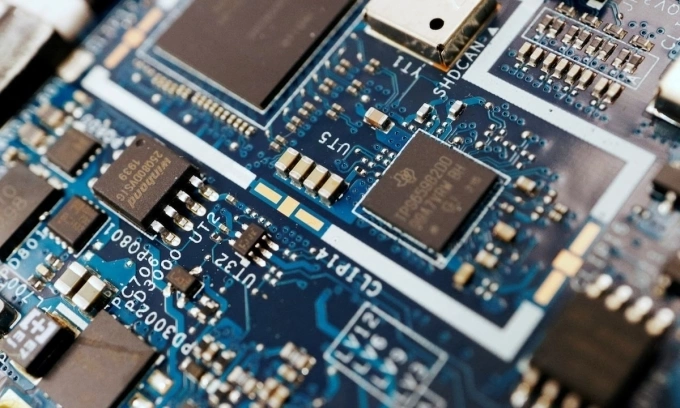
Semiconductor chips are seen on a circuit board of a computer in this illustration picture taken Feb. 25, 2022. Photo by Reuters

Semiconductor chips are seen on a circuit board of a computer in this illustration picture taken Feb. 25, 2022. Photo by Reuters

To tackle this issue, a team led by Zhu Mengjian of the National University of Defence Technology, along with Ren Wencai and Xu Chuan from the Institute of Metal Research under the Chinese Academy of Sciences, developed a new production method, according to the South China Morning Post.

The researchers modified an existing manufacturing technique by introducing a gold and tungsten base layer, enabling the growth of large sheets of 2D material with controllable electrical properties.

In a study published March 26 in the journal National Science Review, the team said the method increased production speed from extremely slow rates to about 20 micrometers per minute, roughly 1,000 times faster than previously reported.

The material also demonstrated strong electrical performance, durability, and the ability to handle heat, all of which are essential for advanced chip applications.

The researchers said the breakthrough could accelerate efforts to bring 2D semiconductor materials into large-scale manufacturing, particularly in widely used chip designs across the electronics industry.