


惯性聚合 高效追踪和阅读你感兴趣的博客、新闻、科技资讯
阅读原文 在惯性聚合中打开

推荐订阅源

GbyAI
GbyAI
freeCodeCamp Programming Tutorials: Python, JavaScript, Git & More
IT之家
IT之家
K
KPMG report finds enterprise disconnect between AI and its ROI | CIO
N
News | PayPal Newsroom
Cloudbric
Cloudbric
Webroot Blog
Webroot Blog
www.infosecurity-magazine.com
Simon Willison's Weblog
Spread Privacy
Spread Privacy
Threat Intelligence Blog | Flashpoint
V
Vulnerabilities – Threatpost
Attack and Defense Labs
C
Cyber Attacks, Cyber Crime and Cyber Security
Cisco Talos Blog
Cisco Talos Blog
C
Cybersecurity and Infrastructure Security Agency CISA
H
Hackread – Cybersecurity News, Data Breaches, AI and More
P
Proofpoint News Feed
阮一峰的网络日志
阮一峰的网络日志
S
Secure Thoughts
T
Tor Project blog
Latest news
Latest news
aimingoo的专栏
aimingoo的专栏
V2EX - 技术
V2EX - 技术
Exploit-DB.com RSS Feed
OSCHINA 社区最新新闻
OSCHINA 社区最新新闻
钛媒体:引领未来商业与生活新知
钛媒体:引领未来商业与生活新知
S
Securelist
T
Tenable Blog
N
Netflix TechBlog - Medium
Google Online Security Blog
博客园 - Franky
T
Troy Hunt's Blog
量子位
大猫的无限游戏
大猫的无限游戏
T
Threat Research - Cisco Blogs
T
The Exploit Database - CXSecurity.com
MongoDB | Blog
MongoDB | Blog
H
Heimdal Security Blog
D
Docker
W
WeLiveSecurity
Stack Overflow Blog
Stack Overflow Blog
G
Google Developers Blog
博客园 - 叶小钗
腾讯CDC
The Hacker News
The Hacker News
WordPress大学
WordPress大学
人人都是产品经理
人人都是产品经理
Project Zero
Project Zero
Martin Fowler
Martin Fowler

Backups done right! on restic

restic · Restic 0.19.1 Released restic · Restic 0.19.0 Released restic · Restic 0.18.1 Released restic · REST-server 0.14.0 released restic · Restic 0.18.0 Released restic · Restic 0.17.3 Released restic · Restic 0.17.2 Released restic · Restic 0.17.1 Released restic · Restic 0.17.0 Released restic · REST-server 0.13.0 released restic · Restic 0.16.5 Released restic · Restic 0.16.4 Released restic · Restic 0.16.3 Released restic · Restic 0.16.2 Released restic · Restic 0.16.1 Released restic · Restic 0.16.0 Released restic · REST-server 0.12.1 released restic · REST-server 0.12.0 released restic · Restic 0.15.2 released restic · Restic 0.15.1 Released restic · Restic 0.15.0 Released restic · Restic 0.14.0 Released restic · Restic 0.13.1 Released restic · Restic 0.13.0 Released restic · Rest Server 0.11.0 released restic · Restic 0.12.1 released restic · Restic 0.12.0 released restic · Restic 0.11.0 released restic · restic 0.10.0 released restic · Rest Server 0.10.0 Released restic · restic 0.9.6 released restic · restic 0.9.5 released restic · restic 0.9.4 released restic · New Year, New Infrastructure! restic · restic 0.9.3 released restic · Enabling the Go Build Cache on Travis/AppVeyor restic · restic 0.9.2 released restic · restic 0.9.1 released restic · restic 0.9.0 released restic · The restic project turns four! restic · Using rclone as a restic Backend restic · restic 0.8.3 released restic · restic 0.8.2 released restic · moving to restic.net restic · restic 0.8.1 released restic · restic 0.8.0 released restic · Upcoming changes for the S3 backend restic · restic 0.7.3 released restic · restic 0.7.2 released restic · Meeting at FrOSCon 2017 restic · Discourse Forum restic · Please upgrade to restic 0.7.1! restic · restic 0.7.1 released restic · Meeting at FrOSCon 2017 restic · restic 0.7.0 released restic · restic on GoTime #48 restic · restic 0.6.0 released restic · restic 0.6.1 released restic · restic 0.6.0-rc.1 released restic · restic 0.5.0 released restic · restic 0.4.0 released restic · The Go Devroom at FOSDEM 2017 restic · restic 0.3.3 released, Debian package restic · restic 0.3.2 released restic · restic 0.3.1 released restic · restic 0.3.0 released restic · Removing Snapshots restic · restic 0.2.0 released restic · Documentation and Manual restic · OpenChaos at CCC Cologne: restic restic · Verifying Code Archive Integrity restic · Foundation - Introducing Content Defined Chunking (CDC) A Solution to the Backup Inconvenience restic · Introduction to the restic Blog
restic · Configuring GitHub Issue Templates
2018-09-09 · via Backups done right! on restic

09 Sep 2018

Like many other Open Source projects, restic uses GitHub for hosting the source code and managing issues. Over time, we discovered that oftentimes users open an issue on GitHub which just consists of a question, for example on how to use restic in a certain situation. While such issues can be answered quickly, sometimes there’s no consent on when the issue can be seen as resolved and therefore closed (the issue is not actionable). The GitHub issue tracker is then cluttered with issues for which there is no clear next action and no clear “resolved” state. This blog post describes how we set up the issue templates on GitHub to resolve this situation nicely.

A year ago in August 2017 we decided to install a forum based on Discourse at https://forum.restic.net. It developed nicely and over time attracted a stable base of core users and developers who are ready to help each other and new restic users.

This leaves the question: how do users who have a question find the forum? Sure, it’s linked on the website, but that did not seem enough. Thankfully, GitHub supports templates for all newly created issues, so we added a bit of text which encourages users to use the forum if they are unsure:

Welcome! If you have a question or are unsure if you should open an issue, please use the forum instead!

https://forum.restic.net

The forum is a better place for questions about restic or general suggestions and topics, e.g. usage or documentation questions! This issue tracker is mainly for tracking bugs and feature requests directly relating to the development of the software itself, rather than the project.

Thanks for understanding, and for contributing to the project!

We also added a few questions users should answer in order to make debugging easier, but it turned out that the set of questions we ask for bugs is not helpful when suggesting a new feature. We then discovered (almost accidentally), that GitHub also supports several different types of issue templates, so now when you create a new issue for restic, you’re greeted with the following dialogue:
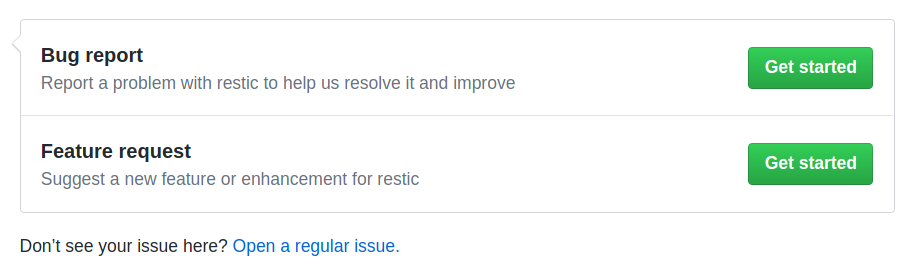
Opening a new Issue on GitHub

The “Bug report” and “Feature request” templates are stored in the files Bug.md and Feature.md in the directory .github/ISSUE_TEMPLATE of the restic repository. The headline and description can be set in the header of the file, for example the “Bug report” template starts with the following text:

---
name: Bug report
about: Report a problem with restic to help us resolve it and improve
---

<!--

Welcome! - We kindly ask that you:

  1. Fill out the issue template below - not doing so needs a good reason.
  2. Use the forum if you have a question rather than a bug or feature request.

[...]
-->

The “Feature request” template is very similar, just with other questions. We’re using a combination of Markdown headlines to structure the issue text, and HTML comments for a bit of background explanation. The HTML comments are not shown when displaying an issue in GitHub, so they don’t distract from the content.

This leaves us with the third kind of issue users can create by clicking on the link titled “Open a regular issue”. For this, the file .github/ISSUE_TEMPLATE.md can be used (we currently don’t use this, which makes the issue form open with a blank textarea).

This allows users to select the type of issue they would like to create, and in all cases there’s a hint to use the forum if they are unsure what to do. This works very well for us.

If you’re a user and submitted an issue before (or maybe you’ve been redirected to the forum), please tell us about the experience? Did you like it? Was it awkward? How do other projects handle nudging users into submitting high-quality issues that are actionable? Please leave a comment in the forum linked below this article!