


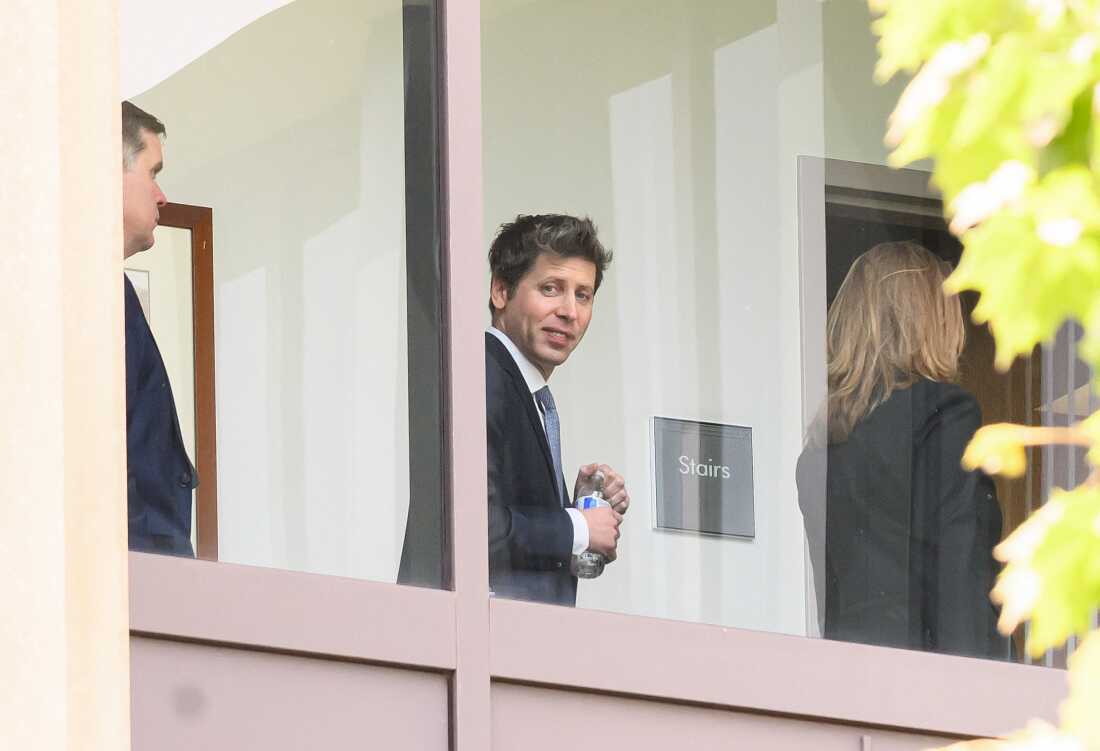
OpenAI CEO Sam Altman walks inside the federal courthouse during a recess in the proceedings in the trial over Elon Musk's lawsuit against OpenAI in Oakland, California, on May 12, 2026. JOSH EDELSON/AFP via Getty Images hide caption
toggle caption
JOSH EDELSON/AFP via Getty Images
OpenAI CEO Sam Altman took the stand on Tuesday to defend himself against accusations from co-founder-turned-adversary Elon Musk that he "stole a charity" by converting the maker of ChatGPT into a for-profit juggernaut.
The trial, now in its third week, pits two of the tech world's biggest personalities against one another in a high-stakes clash that could usher in major changes for one of the world's leading artificial intelligence companies and potentially alter the AI landscape.
Musk's lawyers made the case that OpenAI, Altman and OpenAI president Greg Brockman, with the help of investments from Microsoft, jettisoned OpenAI's founding mission of being a non-profit focused on creating advanced AI for the benefit of humanity. Instead, the Musk team argues that they enriched themselves by creating a for-profit subsidiary that now effectively controls the nonprofit.
OpenAI's legal team has argued that Musk is motivated by sour grapes and is out to damage a competitor. And on the stand Tuesday, Altman pushed back against the notion that Musk actually cares about OpenAI.
"Mr. Musk did try to kill it," he said, adding that Musk launched a competitor called xAI, tried to poach its talent, and alleged that he engaged in "business interference."
The dispute goes back nearly a decade to when the founders of OpenAI — including Musk — decided they needed to create a for-profit entity in order to attract top talent and raise big money to develop competitive AI technology.
Musk, who donated $38 million to OpenAI early on, wanted control of the for-profit; the other founders were against it.
On the stand, Altman testified that the co-founders felt no single person should control AGI, or artificial general intelligence, and that Musk was not a good fit for the company.
Musk left the board in 2018, and Altman called that a morale boost for employees who did not like his "hardcore" approach.
The trial has opened a rare window into the machinations of some of Silicon Valley's most ambitious tech entrepreneurs as they debated the future of AI and wrangled over investment plans and control of OpenAI. It would go on to become a global leader in AI thanks to the launch of ChatGPT in 2022.
OpenAI's lawyers have drawn on once-private text messages and emails to try to paint Musk as power-hungry and initially supportive of plans for the for-profit to attract huge investments. The OpenAI team also tried to undermine Musk's credibility by highlighting messages that appeared to show that he tried to poach talent from OpenAI before he left the company's board, and was kept appraised of its decisions after leaving by then-board member Shivon Zilis, who is the mother of four of Musk's children.
Musk's lawyers, meanwhile, have tried to make the case that Altman and Brockman were intent on reaping personal profits from OpenAI despite its original nonprofit mission. OpenAI's nonprofit still exists, and owns the for-profit entity, now valued in the hundreds of billions of dollars. But Musk argues that it has been sidelined.
While cross examining Altman, Musk's attorney Steven Molo tried to undercut his credibility, asking if he was trustworthy. "I believe so," said Altman. When Molo asked Altman if he always told the truth, Altman replied: "I'm sure there are some times in my life when I did not." Asked if he had been called a liar by business associates, Altman said: "I have heard people say that."
If the United States District Court for the Northern District of California finds Altman, Brockman and Microsoft liable for Musk's two civil claims — "breach of charitable trust" and "unjust enrichment" — Musk has asked for them to "disgorge" up to $150 billion to the nonprofit entity.
He is also seeking the unwinding of the for-profit and wants Altman and Brockman removed from their leadership roles. That could radically reshape OpenAI and potentially undercut its AI development efforts.
Closing arguments are on Thursday, and a decision from an advisory jury and the judge overseeing the case, Yvonne Gonzalez Rogers, are possible next week.
Rachael Myrow, Senior Editor of KQED's Silicon Valley News Desk, contributed to this story from Oakland, Calif.
Microsoft is a financial supporter of NPR.
此内容由惯性聚合(RSS阅读器)自动聚合整理,仅供阅读参考。 原文来自 — 版权归原作者所有。