


Continuing today to unbox a high dividend ETF: XQQI.
At first glance, it seems like the same series as the previously mentioned QQQI.
The only difference is that XQQI is more aggressive.
If you're still not sure what an ETF is, you can refer to my ETF beginner series:
- Fund Classification & What is an ETF
- Types of ETFs & Which ETF is suitable for beginners
- Detailed Explanation of ETF Fees
- How to Choose an ETF
- How to Buy an ETF (China / US Stocks)
- ETF Related Tools
XQQI
XQQI, full name NEOS Boosted Nasdaq-100 High Income ETF.
The issuer is NEOS Investments.
If you've seen my previous ETF Unboxing: SPYI, as well as the recent QQQI, you should be familiar with NEOS. This company loves creating options income ETFs, with the main keywords being: high dividend yield, tax optimization, index options.
XQQI's objective is straightforward:
to pursue higher monthly dividend distributions through a Nasdaq-100 index options strategy, while also collecting a portion of the upside gains.
Note, there's a key term here: Boosted (Enhanced).
is equivalent to adding another layer of enhancement on top of the QQQI framework.
Basic Information
- Type: Active ETF
- Fee Rate: 0.98%
- Inception Date: February 2, 2026
- Issuer: NEOS Investments
- Underlying Exposure: Nasdaq-100 Index
- Dividend Frequency: Monthly
- Target Annual Distribution Rate:19-23%
- Asset Size:Approximately $92.69 million
- Median Bid-Ask Spread Over 30 Days:0.15%
- Primary Exchanges:CBOE
The above data is from the official website of NEOS, as of April 30, 2026.
First, the conclusion: this ETF is very new, very expensive, and very aggressive.
The fee is 0.98%, which is almost 1%. For an ETF, this is not cheap.
At such a high fee, what is being sold is the narrative of "high dividend yield" and "income enhancement."
How does it actually work?
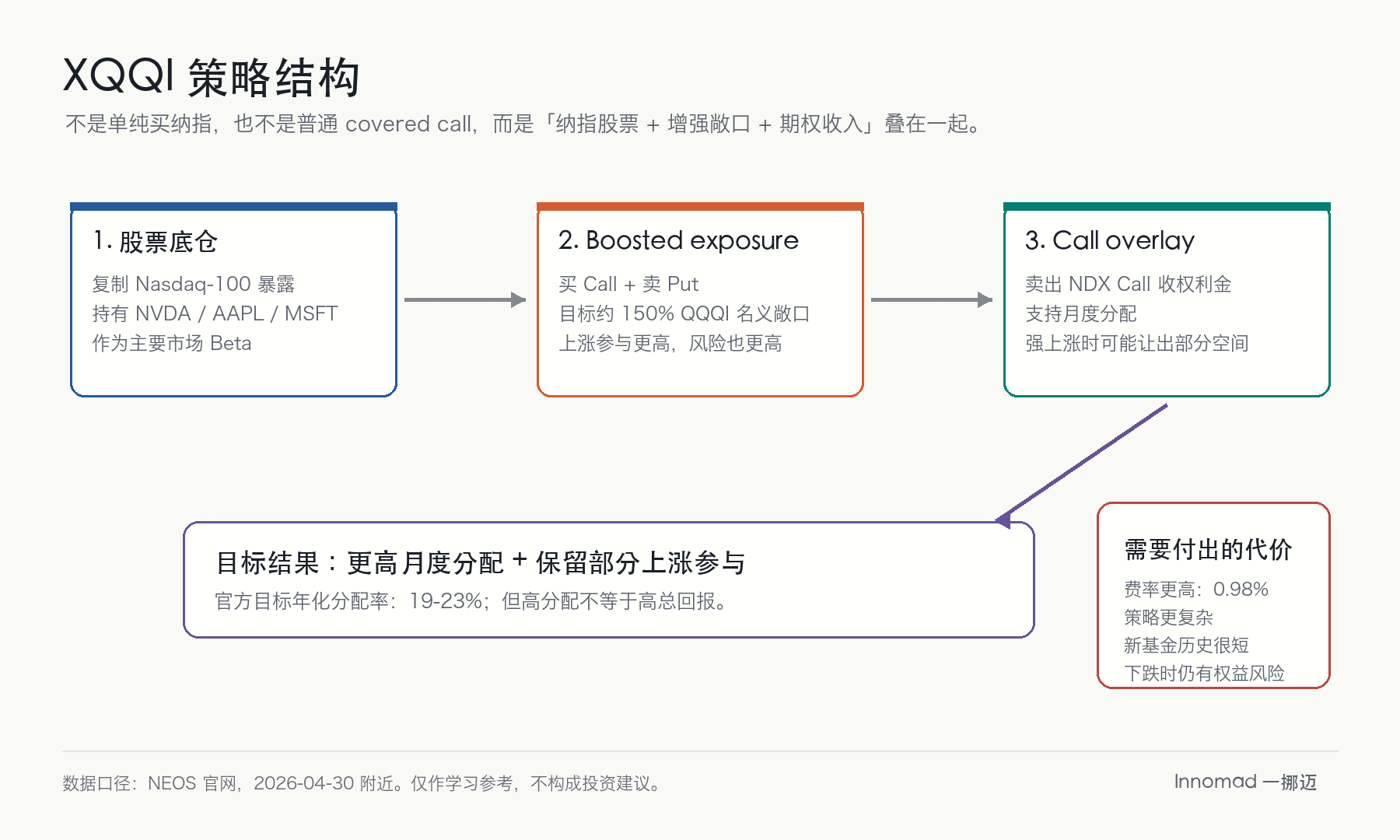
provides three layers of introduction to XQQI:
- naturally being a Nasdaq-100 index replica;
- using index options to enhance boosted leverage;
- creating monthly income with call options.
In layman's terms:
1. First, buy stocks of the Nasdaq 100
XQQI will hold a basket of stocks, aiming to replicate the Nasdaq-100 index.
So you can see familiar names in the holdings, similar to QQQI:
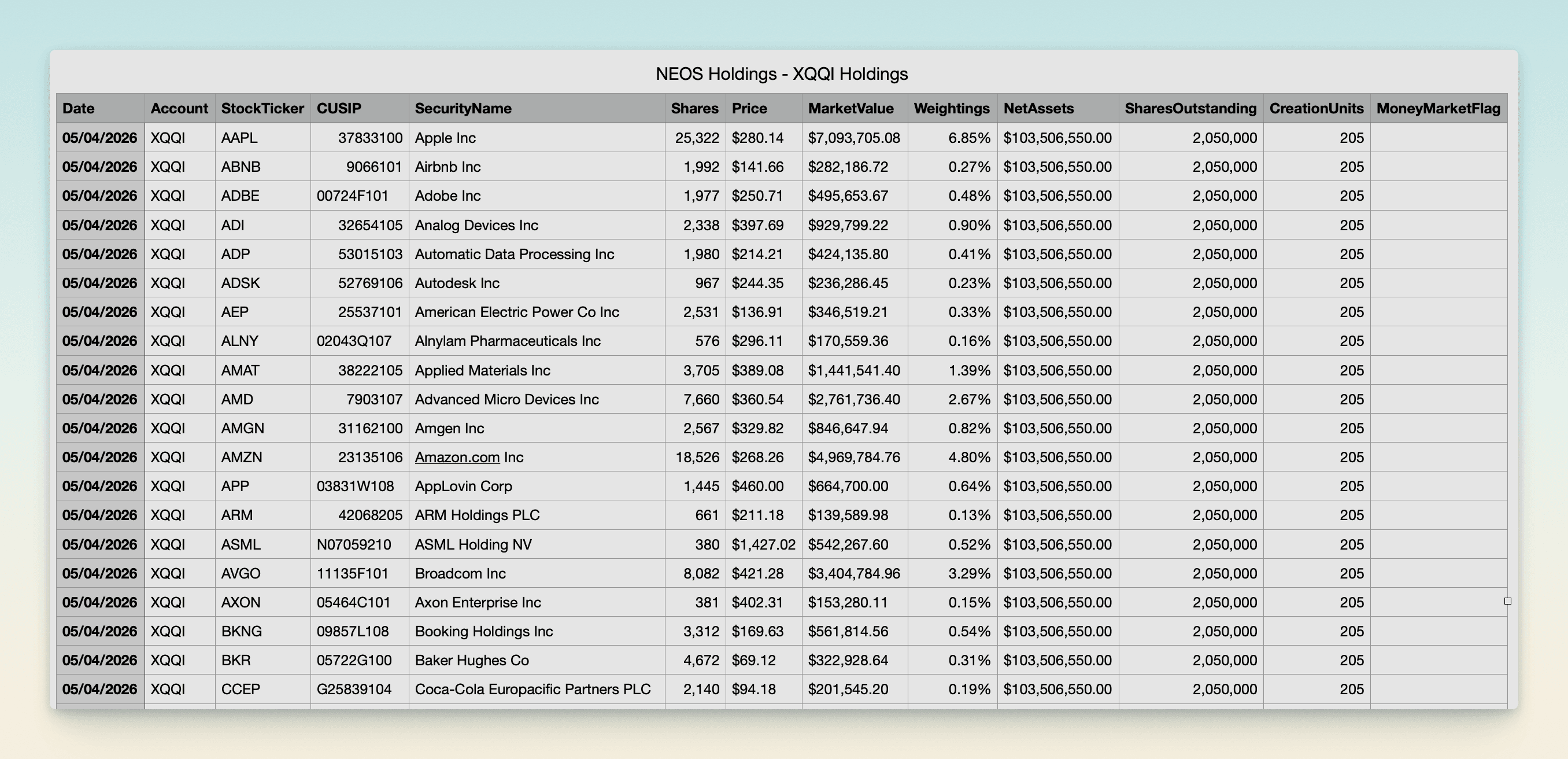
Data sourced from the NEOS website, dated May 1, 2026.
2. Then, do boosted exposure
There's something quite noticeable in the holdings:
| Position | Weight |
|---|---|
| NDX 07/17/26 C23700 | 6.76% |
This is a Call option on the NDX. A single ITM Call is equivalent to holding leveraged NDX.
As long as you see 150% notional exposure, there must be derivatives involved.
3. Finally, sell Call to generate income
The final step is to sell Call options on the NDX 100 index to collect premium, which is used to support monthly dividends. This is similar to many high-dividend ETFs, which use a covered call strategy.
The core logic of these strategies is actually quite similar:
- Market trades sideways or slowly rising: Sell Call to collect premium, dividend seems attractive;
- Market surges: Upward potential will be partly limited by sold Calls;
- Market declines: Premium can provide some cushion, but cannot stop the decline of equity positions themselves;
- High volatility: Option premiums are thicker, distribution rates look better;
- Low volatility: Option premiums become thinner, pressure for high distribution is greater.
If you understand the basic principles of option strategies, these are all simple logic.
Distribution Rate and SEC Yield
The target annual dividend rate provided by the XQQI official website is 19-23%.
As of March 31, 2026, the Distribution Rate shown on the official website is 20.62%.
It looks very attractive.
But there's another data point on the same page: 30-Day SEC Yield is -0.18%.
Putting these two numbers together is quite interesting.
The Distribution Rate is primarily calculated by annualizing the most recent distribution, reflecting "how much can be distributed per year based on the current distribution method."
SEC Yield is more inclined towards the income generated by the underlying assets.
A 20%+ and one close to 0, even negative, what does it indicate?
It indicates that a significant portion of XQQI's high distribution is not derived from natural stock dividends but rather from options strategies, capital gains, return of capital (ROC, principal repayment), and other sources.
The official website also states that as of the most recent distribution, a high proportion of XQQI's distribution was estimated as ROC.
Here, the pattern is quite obvious. It's similar to QQQI, but XQQI has a higher allocation rate and a higher ROC ratio.
The use of ROC is primarily for its second selling point: tax optimization.
High dividend does not equal high return.
The easiest place where people get confused about this type of ETF is right here.
The account receives money every month, which looks comfortable. But if the net value doesn't keep up in the long run, the money you receive is just your principal.
How does it compare to QQQI, JEPQ, and QYLD?
XQQI should be compared most with QQQI.
Because it is essentially a Boosted version of NEOS based on QQQI.
| ETF | Strategy | Fee Rate | Dividend Cycle | General Characteristics |
|---|---|---|---|---|
| QQQ | Directly Holds Nasdaq-100 | 0.20% | Quarterly | Doesn't Sell Options, Benefits from Full Price Movements |
| JEPQ | Nasdaq-100 Related Stocks + ELN/Option Income | 0.35% | Monthly | More Focused on Mature Large-Cap High-Income ETFs |
| QYLD | Nasdaq-100 covered call | 0.60% | month | More traditional covered call strategy, with clear upward limit |
| QQQI | Nasdaq-100 + NDX options income | 0.68% | month | NEOS's Nasdaq high-income version |
| XQQI | QQQI framework + Boosted exposure | 0.98% | month | Higher dividend target, also more complex |
In short:
- If you want long-term growth in the Nasdaq-100, the most direct way is QQQ/QQQM;
- If you want monthly cash flow, JEPQ, QQQI, QYLD are more common choices;
- If you want a higher dividend yield and can accept more complex options and leverage exposure, then XQQI comes into play.
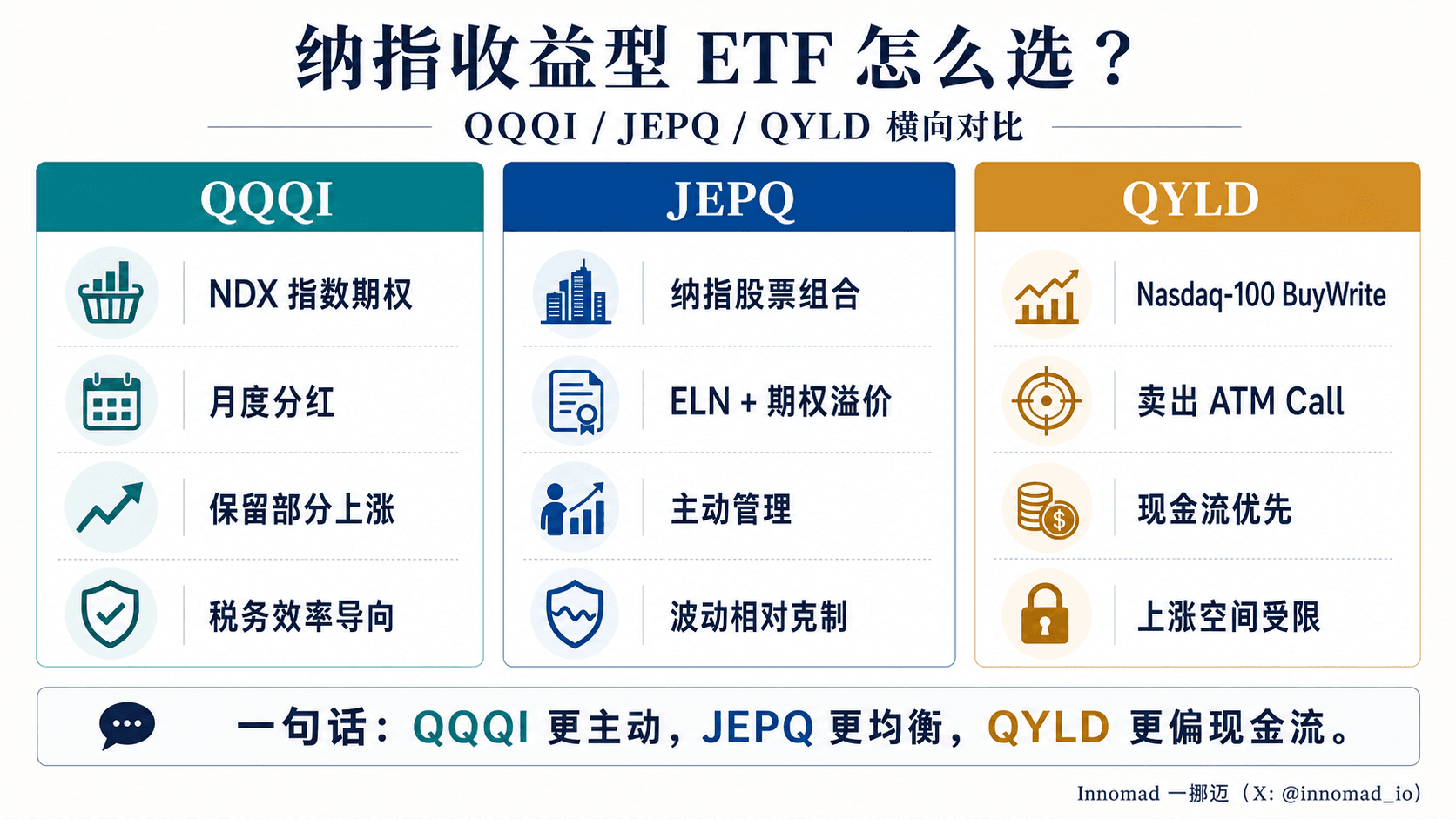
XQQI is not suitable to be used as a "Nasdaq alternative." It's more like a cash flow tool, and specifically a more aggressive cash flow tool.
How to evaluate performance?
XQQI was only launched in February 2026, so the data is too short to be meaningful. There's nothing to look at.
Risks
The risks of XQQI mainly lie in these aspects:
First layer is Upwardly limited。
This is a common flaw of covered call strategies. Selling Call options, although you collect premium, actually selling call is like "light short selling," which limits the upward potential in the results. If the Nasdaq index surges, you can only get the premium, and the subsequent rise is irrelevant to you.
The second layer is downside risk.
XQQI still holds a position in Nasdaq-100 stocks, and the premium can somewhat offset the downside risk, but not much.
The third layer is strategy complexity.
QQQ is simple, buying it means you're invested in Nasdaq 100.
XQQI is different, it has stocks, buying calls, selling puts, selling covered calls, ROC, tax treatment, with several layers of derivatives stacked together.
This is not a product that ordinary investors can fully understand by just looking at the holdings.
The fourth layer is too new .
XQQI has a very short track record, and its current size is still less than $100 million. Although QQQI under NEOS has become quite large, XQQI itself still needs time to prove itself.
What does a small scale mean?
- The bid-ask spread may be wider;
- the liquidity may not be as good as that of a mature ETF;
- the stability of the strategy still needs to be observed;
- If the scale doesn't take off in the future, there's also a risk of liquidation.
These are all covered in my ETF beginner series, and if you're interested, you can check it out.
Is it worth buying?
If you're looking for an ETF focused on "high dividend," I don't think XQQI is a good choice. There are already many pure high-dividend ETFs in the market, such as JEPQ, QQQI, and SPYI, which are all decent options.
If you fully understand XQQI's strategy logic, know its risks and limitations, and want to allocate an aggressive Nasdaq-related cash flow tool in your portfolio, then XQQI could be considered.
Additionally, whether you need to allocate to a high-dividend ETF is also a question that requires a comprehensive consideration of your investment goals, asset allocation strategy, and personal cash flow situation.
Yi Nuo Mai's summary
XQQI is an ETF with a strong NEOS style: high monthly dividends, tax optimization, covered call strategies, plus a bit of Boosted leverage positions.
High dividends are good, but you must also know: where does this money actually come from?
This article is for reference only and does not constitute investment advice. Investing involves risks, please DYOR (Do Your Own Research).