


We’ve all heard the debate about AI and jobs: An apocalypse is coming, there are only 18 months left to save white-collar work, no job will be unchanged. Former White House AI czar David Sacks, shortly before he resigned in a dispute over policy, argued doomsday predictions from figures such as Dario Amodei and Sam Altman had been a “damage to public trust.” Amodei and Altman have walked back their predictions of late, Fortune was among the first to note, but the fear and angst remain among Gen Z job seekers.
Meanwhile, the entry-level career ladder has started showing real cracks, with experts such as Stanford’s Erik Brynjolfsson arguing for clear signs in the data of disruption in AI-exposed occupations, even as the wider macro picture has shown that the earthquake isn’t here, yet.
A new PwC analysis of more than 1 billion job postings reveals a more precise and, for young workers, more troubling transformation: AI isn’t eliminating the entry-level job. It’s turning it into something entry-level workers can’t get.
The 2026 AI Jobs Barometer, released Monday, finds entry-level roles in highly AI-exposed occupations are now 7x more likely to require skills that have historically appeared later in a worker’s career—things like strategic decision-making, stakeholder management, leadership, and judgment. In the most AI-exposed occupations, 52% of new skills appearing in entry-level job postings were skills traditionally associated with experienced workers. In the least AI-exposed occupations, that figure was 7%.
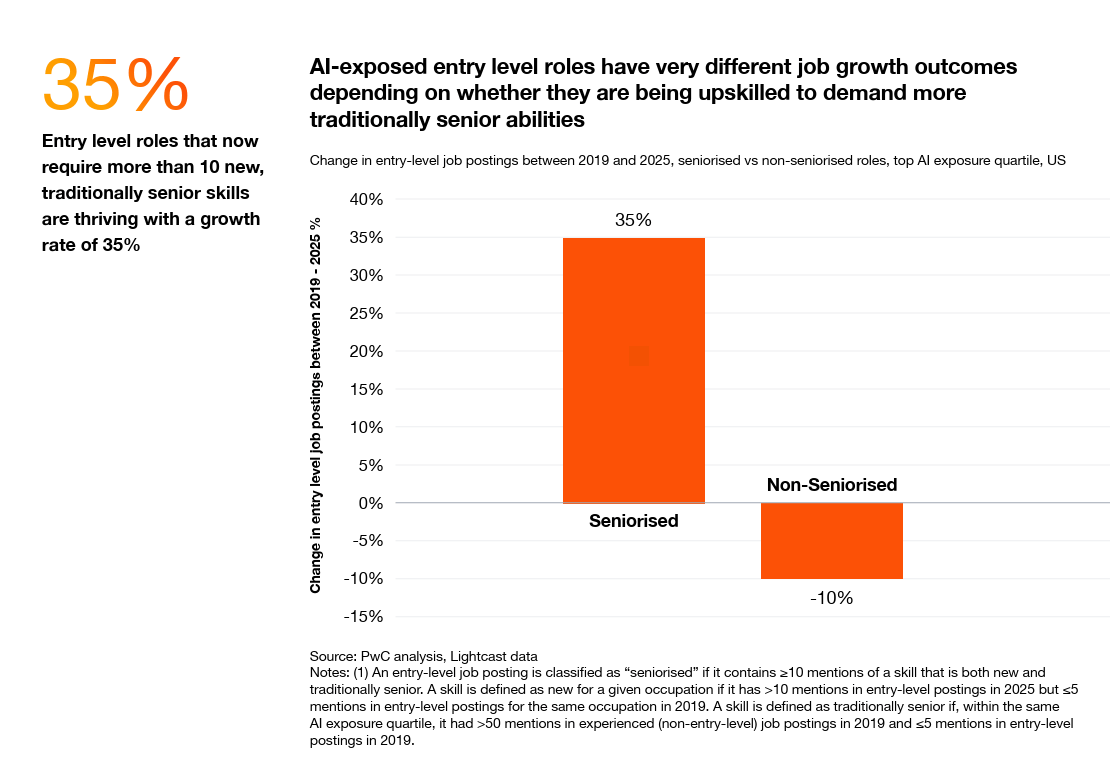
PwC calls this “seniorization,” and the numbers around it are stark. Job openings for these redrawn entry-level roles—the ones that now ask a 22-year-old to demonstrate capabilities a 35-year-old would have—have grown 35% since 2019. Traditional entry-level openings, in the same period, shrank 10%.
This is the mechanism behind a labor market anomaly Fortune has tracked for the past year. A Harvard working paper that analyzed 62 million workers found junior hiring fell nearly 8% within six quarters at companies that adopted AI—not through layoffs, but through a quiet freeze on new positions. Recent graduate unemployment hit 5.7% in the fourth quarter of 2025, according to the New York Fed, above the national rate and a near-reversal of the historic norm. Recent grad underemployment sits at 42.5%.
The PwC data offers an explanation. Entry-level positions haven’t vanished, but the job description has been quietly promoted up the skills ladder without notifying the people trying to get their foot in the door.
Dan Priest, PwC’s U.S. chief AI officer, was careful not to cast this as employers gaming the system.
“I’d be cautious about framing this as employers using AI as a pretext for anything,” he told Fortune. “What it does show is that employers are changing what they ask for in entry-level roles.”
He acknowledged the consequence directly: “If entry-level work is becoming more sophisticated, employers, educators, and policymakers all have a role to play in helping people build those capabilities earlier. The answer can’t simply be to raise the bar and hope talent appears.”
“The broader story is that AI is changing the shape of entry-level work,” Priest continued. “As AI takes on more routine tasks, employers are placing a greater premium on uniquely human capabilities and asking early-career workers to contribute those skills sooner than they have in the past.”
The bar has been raised, in other words, as AI reshapes not just what workers can do but what employers need. The infrastructure to clear it, not so much.
“The message for education is not simply ‘teach more AI,’” Priest said, but to teach AI along with the human capabilities that make AI useful. “The future advantage will go to people who can direct AI, challenge it and apply it to real, problems, not just prompt it.”
The other side of PwC’s barometer complicates the simple story. Companies in the most AI-exposed sectors recorded 34% labor productivity growth since 2018, against 24% for the least exposed. At the top of the distribution, what PwC calls a “superstar effect” is emerging: The highest-performing 20% of the most AI-exposed companies achieved average labor productivity growth of 163% since 2018—nearly 5x higher than the average for AI-exposed firms overall. More counterintuitively, headcount at AI-heavy companies is growing faster than at least-exposed peers.
This disrupts the basic “AI equals fewer workers” narrative, and the disruption is real. AI, at companies deploying it most effectively, appears to be expanding what organizations can do rather than simply substituting for the people who used to do it.
“What matters for leaders is that the gap is real,” Priest said. “The companies getting more value from AI are not just adding tools. They are redesigning workflows, rethinking decisions and embedding AI into how work gets done.”
But the headline figure masks a compositional question the barometer can’t fully answer: Hiring more, yes—but hiring whom? The seniorization finding suggests the entry-level share of those new headcounts is shrinking even as the totals grow. The most AI-exposed firms are hiring—and they’re looking for workers who can direct AI, apply judgment, and manage stakeholders. People who, historically, didn’t show up for their first interview.
Priest clarified the entry-level market is still growing in absolute terms. Across PwC’s global early-career dataset, about 11 million early-career jobs were posted in 2025, up from 7.3 million in 2018 and 3.2 million in 2012. But in highly AI-exposed occupations, he acknowledged that growth is increasingly concentrated in judgment-forward entry-level roles.
“The story isn’t that entry-level work is disappearing, it’s that the skills employers are looking for are evolving,” he said.
“In AI-exposed jobs, the skills gaining importance aren’t just technical AI skills,” he continued. “Increasingly, employers are looking for judgment, communication, leadership, creativity, and collaboration,” he added, nothing these have historically developed later in workers’ careers. That’s a paradox for the Gen Z job seeker—and the schools and internships training them.
There’s a further wrinkle in the data that cuts against the usual narrative. Job posting growth since 2012 has been significantly faster in less AI-exposed occupations than in highly exposed ones. By 2025, the lowest AI-exposure quartile had 4.7 postings for every posting in 2012. The highest exposure quartile: 1.9.
The occupations driving that growth are what you’d expect: construction, plumbing, welding, kitchen staff, agricultural workers, health care aides. These are physical, place-based, human-facing work that current AI can’t substitute for directly.
There’s a version of this finding that gets spun into reassurance: The trades are booming, the economy is balancing itself, but that reading is too comfortable. It elides the wage and status reality of many of these roles, ignores that the workers currently shut out of AI-exposed entry-level positions weren’t planning on plumbing careers, and sidesteps the structural question of who, exactly, is guiding them anywhere.
Priest said the barometer is based on job postings, so only tells us how employer demand is changing. But the findings do make clear, in his view, that the “transition” needs to be managed intentionally.
“If AI changes the first rung of the career ladder, then companies have a responsibility to redesign pathways into work, not just redesign work itself,” he said. The most successful Fortune 500 companies, he added, citing direct experience, are the ones that invest heavily in workforce transformation.
The picture, in aggregate, is of an AI economy delivering genuine productivity gains while quietly restructuring who can participate in them. The entry-level job hasn’t been killed. It’s been promoted—and the promotion happened without notice, without a training program and without the policy framework that might have softened the transition.
“AI is different from some earlier technology waves,” Priest said, “because it is touching a broader set of occupations at once.”
It isn’t confined to technology, reaching across professional services, finance, health care, education, operations, and many other areas.
此内容由惯性聚合(RSS阅读器)自动聚合整理,仅供阅读参考。 原文来自 — 版权归原作者所有。