






The obituary for middle managers is familiar. This layer, the argument goes, is an early casualty of AI. The evidence is compelling. But the larger story is the transformation of business itself, a new mode of conscious capitalism that will birth the “Meridian Manager.”
Gartner put the extinction idea into play with a projection that by 2026 one in five organizations would eliminate more than half of their middle management. The timeline has slipped; the trend has not. Such giants as Amazon, Walmart, and Microsoft are already trimming the layers between executives and the front line.
Business transformation specialist George Pesansky framed it well in his Fortune piece, “Surviving the Great Flattening: The coming extinction of the middle manager,” when he said “If your edge is ‘I know more,’ prepare to be leveled.” Among the most concrete research is the recent Harvard Business Review study “To Thrive in the AI Era, Companies Need Agent Managers,” which explores Salesforce’s Agentforce platform and the new role of managers overseeing autonomous AI agents.
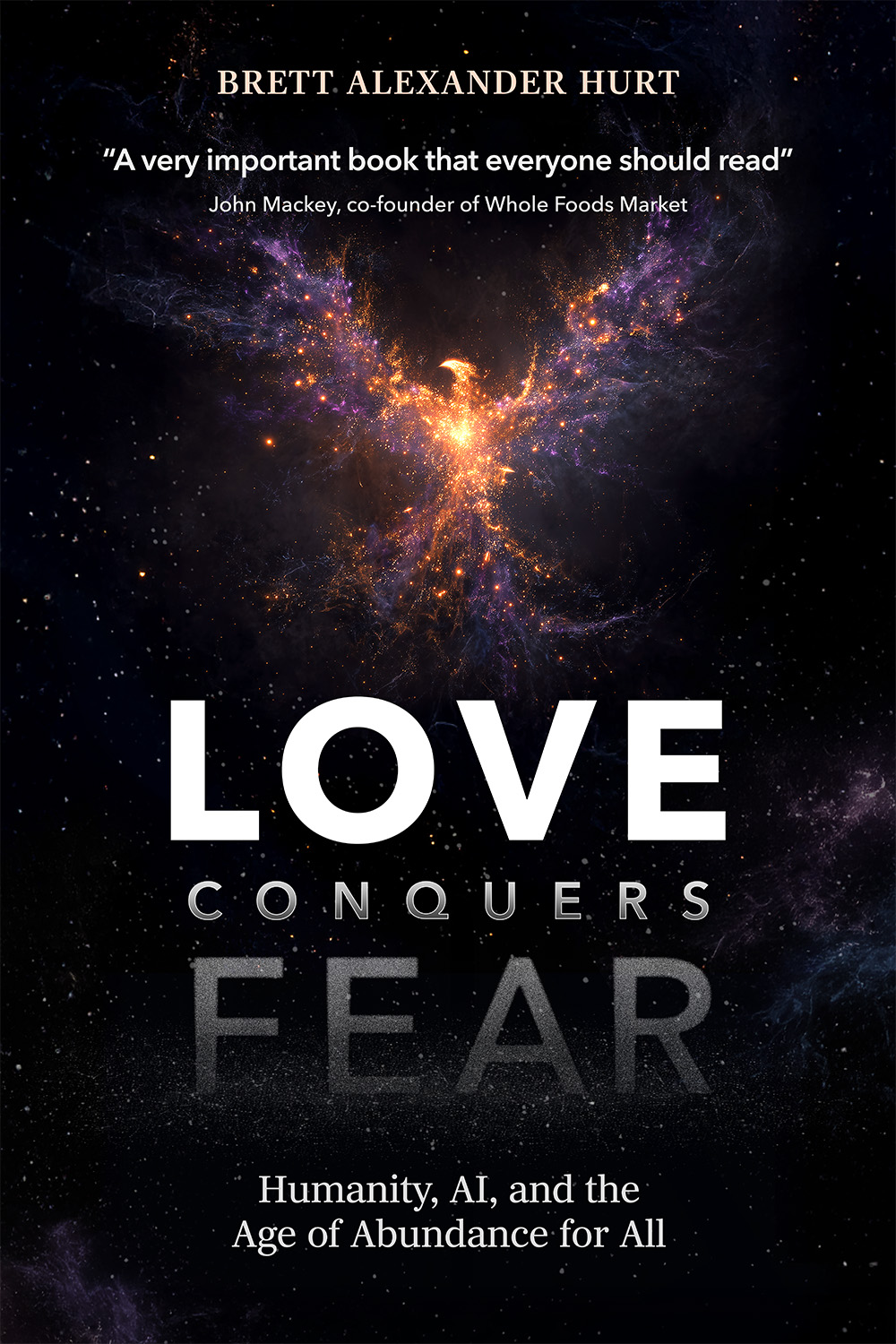
Pesansky and others are not wrong. In my forthcoming book, Love Conquers Fear, I note the prescient observer of the tech economy Reid Hoffman, who argues that the defining new skill of the age is “orchestration”—directing multiple AI agents simultaneously, compressing days of work into hours.
The debate has its facts largely right. What it has wrong is its premise. And the premise is the pyramid itself.
The hierarchical organization was never a permanent feature of human enterprise. It was an engineering solution to a specific problem: the scarcity and slowness of information. Middle management existed because knowledge was expensive to move. AI removes that bottleneck entirely. It doesn’t just flatten the pyramid — it makes it the wrong shape.
Critically, it is not AI alone dissolving the bottleneck. What is now converging upon us is the “Superfecta”: four exponentially accelerating technologies that together constitute something civilization has never encountered. Led by AI, the Superfecta also includes robotics, quantum computing, and brain-computer interfaces. The pyramid was built for scarcity. What the Superfecta delivers is abundance — and new structures are required.
To name what must replace the pyramid, I want to introduce two concepts. The first is linearalism: the operating logic of the industrial age where authority flows from top to bottom and work moves in sequence toward standardized outputs. Success is measured in a single dimension: profit. It was a remarkable achievement of its era. But it is structurally incapable of serving what comes next.
The second is sphericism, which the Superfecta makes possible. In the sphericist organization, purpose occupies the center: not a title or an executive, but a shared sense of why the organization exists and what value it creates beyond profit alone. AI gives every team direct, unmediated access to knowledge and analytical power.
It is at the surface of the sphere, not the bottom of a pyramid, where the organization meets the world. Teams are not above or below one another. The organization grows not by adding layers but by expanding its radius, generating economic, social, and human value simultaneously. This is the animating idea of conscious capitalism, a movement I have long embraced — championed most visibly by my friend John Mackey, co-founder of Whole Foods.
This returns us to middle management and to the question the obituaries get wrong.
The middle manager does not go extinct. The pyramid does.
The functions that middle managers performed do not disappear in a sphericist organization. They transform. Harvard’s research confirms that AI liberates managers from coordination and relay tasks, freeing them for judgment, contextual intelligence, and human connection that no system can replicate. The Salesforce Agentforce story is instructive. What emerged was not the elimination of management but its evolution toward managers who translate organizational purpose into the behavior of autonomous systems while holding the human values that govern both.
This evolved role is the Meridian Manager. A meridian runs from the surface of a sphere through its center and back again — in both directions, connecting every point to the core. The Meridian Manager is that living connection: between purpose at the center and value at the surface, between machine intelligence and the irreplaceable human judgment that must govern it. Their authority is not positional. It is contextual — grounded in knowledge of team, customer, and moment that no algorithm can hold. The middle manager was defined by where they sat. The Meridian Manager is defined by what they connect.
What is dying is the pyramid. What is being born — as we build it with courage and purpose — is something more alive, more just, and more genuinely abundant than anything the industrial age could imagine.
The opinions expressed in Fortune.com commentary pieces are solely the views of their authors and do not necessarily reflect the opinions and beliefs of Fortune.
此内容由惯性聚合(RSS阅读器)自动聚合整理,仅供阅读参考。 原文来自 — 版权归原作者所有。