






Companies in the heart of the U.S. oil patch don’t plan on opening up the taps anytime soon—even as the recent spike in crude prices offers a windfall opportunity—due to all the uncertainty weighing on the longer-term outlook.
In a survey of oil and gas executives conducted by the Dallas Fed, which covers the prolific Permian Basin, they signaled that supply will not change much.
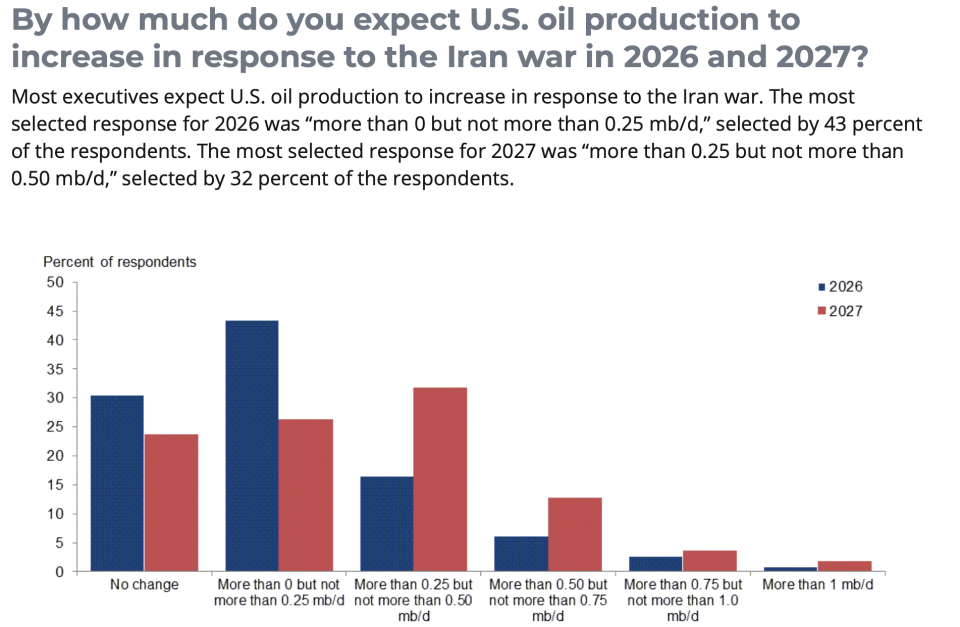
When asked how much they expect U.S. oil production to increase in response to the Iran war, 30% predicted no change this year, 43% saw an uptick ranging from 1 to 250,000 barrels per day, and 17% put it at 250,000-500,000. Only 1% said they see more than 1 million of additional output.
The outlook was more bullish for 2027, with 24% seeing no change in production, 26% expecting an increase of 1-250,000, and 32% predicting a boost of 250,000-500,000. Still, just 2% anticipate more than 1 million.
For comparison, Goldman Sachs has estimated that Persian Gulf crude output is down by 14.5 million barrels per day, or 57%, from before the Iran war started.
The reluctance of U.S. companies to pump more oil comes despite West Texas Intermediate futures soaring from $57 a barrel at the start of the year to $111 at the height of the war and just below $100 during the past week.
The Dallas Fed survey also tracks with an earlier one it conducted last month that showed half of exploration and production executives said the number of wells their firms expect to drill in 2026 has not changed, and 26% saw only a slight increase.
Comments collected anonymously by the latest report revealed that the extreme volatility in prices recently had created too much uncertainty, dampening capital spending views.
“Even after nearly a month of oil above $90 per barrel, rig counts declined, signaling little confidence that prices will hold,” one respondent said. “Closing the supply gap from the Iran conflict will require greater certainty and higher 2027 future prices to incentivize additional rig and frack deployments.”
Another noted that “with all of the chaos, predicting anything in the energy sector is very difficult.”
Executives also appeared to refer to President Donald Trump’s habit of using social media to jawbone energy prices lower and stock markets higher.
That’s as Wall Street has emerged as a notable check on his policies as previous selloffs have prompted him to back off from his most punitive tariff rates.
“The difference between the gyration of paper market oil prices versus what seems to be substantially higher physical prices sends conflicting signals to operators who cannot plan rigs and capital budgets when prices swing wildly based on tweets,” an oil boss said. “Our hypothesis is [that] the paper market is being manipulated. This will likely lead to an even worse supply and demand imbalance and higher prices in the medium term (next 12 months).”
A respondent in the oilfield services sector complained that “Uncertainty is problematic in the oil and gas business, and this administration is the definition of uncertainty.”
A peer echoed that remark, saying “The unpredictable nature of the current administration makes business modeling near impossible.”
Dallas Fed
With millions of barrels bottled up in the Persian Gulf, a wave of tankers from around the world is racing toward the Gulf of Mexico to load up on U.S. oil.
But that still won’t be enough to offset the shortfall from Mideast supplies, and shortages have been creeping into parts of Asia and Europe.
Energy experts have been warning oil futures are totally disconnected from the reality that exists in the physical market. But Paul Sankey, president of Sankey Research, warned a reckoning is unavoidable and imminent.
He pointed out that pre-war oil shipments via tankers from the Persian Gulf have only now reached their destinations. So with the Strait of Hormuz largely closed off for more than 40 days, the lack of new supplies can no longer be ignored.
As fresh inflows of Middle East oil have dried up, countries are tapping their reserves, and the inventory numbers have “started to get scary,” Sankey told Bloomberg TV on Thursday.
In fact, it’s guaranteed the situation will get worse, he warned, unlike typical attempts to make oil market forecasts, which can turn out very wrong due to extraneous reasons.
“In this case, we can be sure that the next two months is going to be an ongoing, absolute disaster even if you open the straits tomorrow because it’s just locked in by virtue of tankers, and the tankers are all in the wrong places,” Sankey explained.
Similarly, analysts at JPMorgan said in a note Tuesday that commercial inventories in OECD countries will hit “operational minimums” sometime between May 9 and May 30, “at which point price increases become exponential rather than linear.”
And after the war ends, the oil supply chain needs time to restart. Ports will take two months to reopen, and tanker crews will wait two to three weeks to feel safe enough to travel through the strait again. JPMorgan also estimated reviving oil production will take four months to reach 99% of capacity.
Meanwhile, the Strait of Hormuz, through which one-fifth of the world’s oil and liquified natural gas passed before the war, will not be viewed the same way again.
“The administration’s comment about an ‘Iran terror premium’ existing for decades with crude oil pricing is laughable,” an oil chief told the Dallas Fed. “But now the administration has created one where it did not exist before.”
此内容由惯性聚合(RSS阅读器)自动聚合整理,仅供阅读参考。 原文来自 — 版权归原作者所有。