





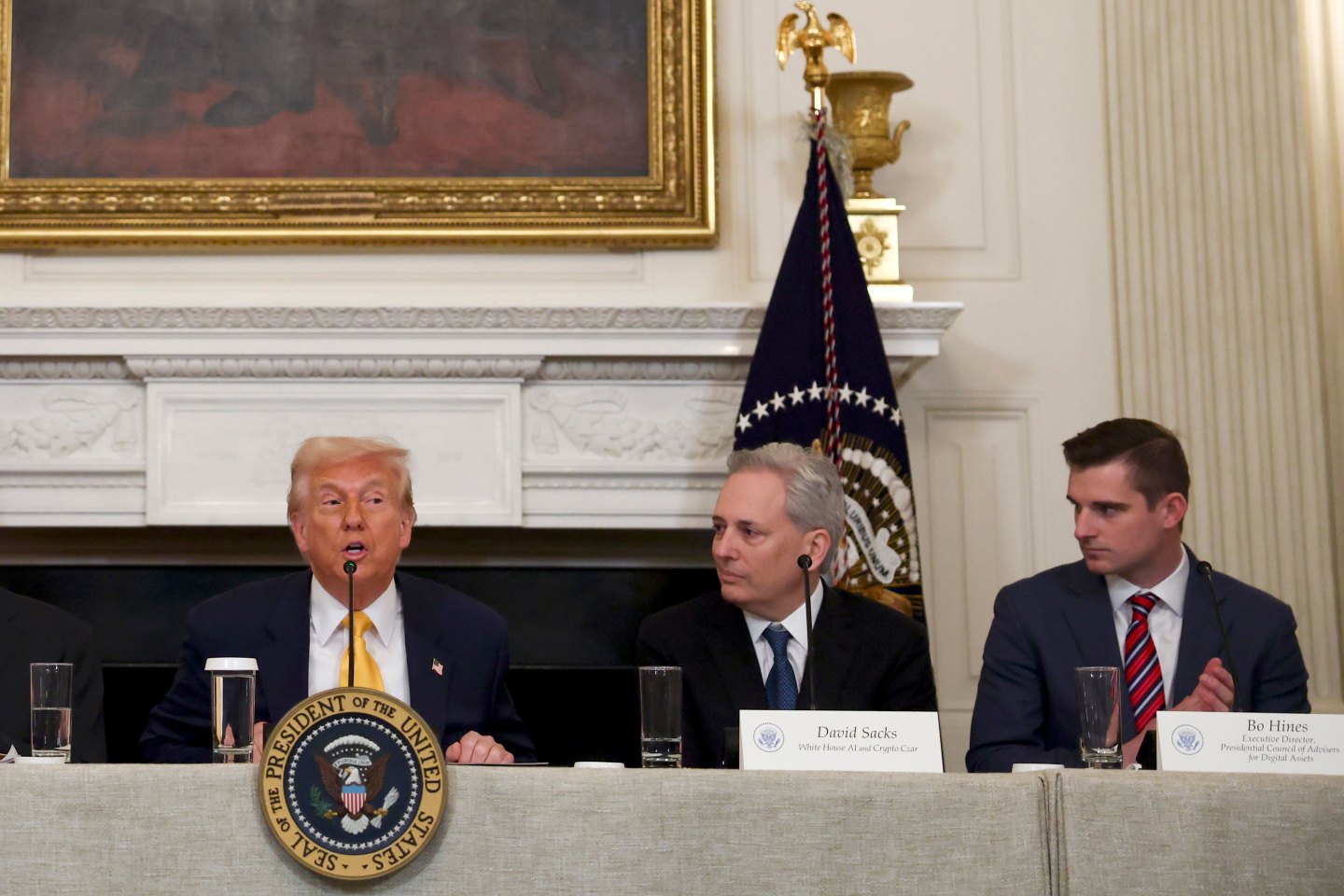
When Donald Trump hosted the first-ever White House crypto summit in March, he was surrounded by some of his top advisors in the elegant State Dining Room. To his right at the cloth-draped table was Treasury Secretary Scott Bessent, and to his left was his crypto and AI czar, venture capital heavyweight David Sacks. But next to Sacks was a figure who had been unknown to nearly everyone in the room until just a few months before: Bo Hines, a 29-year-old former congressional candidate and college wide receiver who had helped one of the Trump campaign’s top affiliated super PACs with advertising. Trump has tapped Hines to spearhead a radical effort to create crypto-friendly regulation and roll back the Biden administration’s crackdown on the industry.
In the months since his appointment, Hines has become a mini-celebrity in the crypto world—with CEOs and billionaire investors vying for appointments on his calendar, and lobbyists jostling for face time. In the first 30 days after becoming executive director of the President’s Council of Advisers on Digital Assets, Hines had met with more than 50 crypto lobbyists, investors, company founders, agency officials, and bankers, according to his calendar, obtained by Fortune via a Freedom of Information Act request. He’s sat down with Chris Dixon and Marc Andreessen of top Silicon Valley investment firm Andreessen Horowitz; Brad Garlinghouse, CEO of crypto company Ripple; and Bank of New York Mellon’s digital assets chief Caroline Butler.
Some of the meetings have been held at the White House. Others have been in coffee shops, over Zoom, and at the Old Ebbitt Grill, one of Washington, D.C.’s oldest dining saloons.
“I want to meet with everyone in this space—big players, small players,” Bo Hines told Fortune in a recent interview at the popular Israeli-American café Tatte, near the White House. “I want to hear ideas from everyone.”
Sacks, who boasts decades more business experience thanks to his roles as an early executive at PayPal and at his investment firm, Craft Ventures, has the higher-ranking role in the Trump administration. But the once little-known Hines has taken on more of the day-to-day duties of carrying out Trump’s agenda, mostly because Sacks is a part-time special government employee and is therefore limited to working 130 days annually. A spokesperson for the Office of Science and Technology Policy (OSTP) insists Hines and Sacks work side by side.
From his fourth-floor desk in the Eisenhower Executive Office Building next to the White House, Hines is now among the most powerful people in the crypto universe. In effect, he’s the main liaison between the White House and the crypto industry, aiming to channel their frustrations into tangible policy.
Now, with Trump’s tariff campaign wreaking havoc on global markets and causing digital asset prices to gyrate, Hines has even more challenges on his plate. Trump’s volatile economic approach has contributed to sharp declines in shares of blockchain-related companies. An extended economic crisis could further depress crypto prices, which have become increasingly linked to the performance of traditional equity markets. In short, Trump’s on-again, off-again tariff crusade risks reversing the blockchain industry’s economic progress over the past few years.
For a look at the first few months of Trump’s crypto agenda—and the man who’s trying to execute it—Fortune interviewed Hines and talked to more than a dozen people who had met or spoken with him since he started in January. Most spoke on the condition of anonymity because their discussions with Hines had been private. They described Hines as inexperienced in crypto but a fast learner eager to understand a renegade industry seeking legitimacy, even as it battles its own factionalism and infighting. “He’s drinking from the fire hose,” said one crypto executive and D.C. insider. “He’s the first touchpoint with the White House for anyone in crypto.”
Hines’s spokesperson suggested a Tatte location near the White House for our meeting, but his earlier meeting at another outpost of the chain ran late, and then he inadvertently showed up to a second, incorrect branch. By the time he arrived at his third Tatte of the day—sporting a dark gray suit and a grin—he quickly jumped into talking about crypto.
Hines, clean-shaven with tightly cropped hair, is polished and well-rehearsed from his two unsuccessful congressional runs in North Carolina in 2022 and 2024. He answers questions decisively, talking quickly, repeatedly praising Trump and insisting that regulating crypto should be—and will be—a bipartisan effort under this administration.
It’s clear Hines wants to be taken seriously—not perceived as a twentysomething with little political experience. He’s eager to be seen as a Trump ally who gets things done. “We love the president. We love the work that he’s doing, and we love the fact he’s putting America first and everything, including crypto,” Hines said.
Pool/AP
Once dominated by outsiders and government skeptics, the crypto sector has cozied up to D.C. lawmakers over the past few years. Disgraced FTX founder Sam Bankman-Fried spent tens of millions of dollars to elect pro-blockchain politicians in an effort to pass wide-ranging legislation to regulate the industry. But the collapse of his exchange spurred an enforcement campaign by the Biden administration that resulted in lawsuits against some of the sector’s top companies, including Coinbase, which the SEC alleged was operating without proper registration.
Led by Coinbase and other industry titans, the blockchain-related groups and individuals made nearly $250 million in political donations last election cycle to crypto-friendly politicians on both sides of the aisle. The effort paid off: Trump, who had previously described Bitcoin as a “scam,” became a crypto evangelist. During his campaign, for example, Trump promised to establish a federal Bitcoin reserve and push legislation that would create crypto-friendly rules for the industry. And he lured the support of prominent venture capitalists and crypto investors like Andreessen and his partner Ben Horowitz, who had complained about a lack of access to the previous administration.
Following his election in November, Trump began to make good on those pledges, including in his appointments of Sacks, a prominent backer of the cryptocurrency Solana, and Hines to the Office of Science and Technology Policy, an agency within the president’s executive office. Soon after his inauguration, Trump signed a series of executive orders to fulfill the different commitments, including establishing a working group, chaired by Sacks, to guide crypto policy, as well as setting up the federal government’s strategic crypto reserve.
In contrast to the Biden administration, which froze out much of the crypto industry, Hines has become a friendly face for executives and policy advisors looking to help shape the current administration’s approach. One executive who has met with Hines about five times said that because of Sacks’ time limitations and double-duty overseeing AI policy, Hines acts as more of a crypto industry sounding board. “David is only going to meet with the CEOs of the largest 20 to 40 players,” said the executive. “Bo can meet with the next 100.” One lobbyist told Fortune that Hines has been helpful with crypto clients, even offering to give out his cell phone number.
Trump’s crypto agenda is packed with different priorities, from passing landmark bills in Congress for regulating the sector, to helping the Securities and Exchange Commission create guidelines around issuing new cryptocurrencies. But top of mind for many executives has just been to be in the room. While Trump initially planned to create a “crypto council” of industry leaders, the White House quickly pivoted to hosting summits, largely because there was such a “feeding frenzy” to be included, as one executive put it. Meanwhile, Hines described the widely reported pivot as a “mischaracterization,” saying it was instead a product of all the “enthusiasm” around the council and the desire to “hear from more actors.”
Even the decision to host the first White House crypto summit sparked a rush by industry leaders to score invites, especially with final attendees unannounced until the day of the event. Only around 25 executives—many of them donors to the Trump campaign—made the cut. “A lot of egos were bruised,” said one lobbyist, who described the White House as “kind of the Wild West” for its lack of organization, planning, and communication.
Despite the chaos, the March event still marked a triumphant victory for the crypto industry. Hines, just one seat away from Trump, helped oversee a crowd that had filled his calendar for the previous month. “It’s the White House—who wouldn’t want to come?” Hines said. “The fact the president put that on for the industry shows a sea change, and a coming of age, for the industry itself.”
Generally, some insiders see Trump’s crypto policy as a bright spot in what’s been a chaotic couple of months in D.C. Crypto “really hasn’t been embroiled in all the other s–t that has been going on in Washington, which is awesome and an accomplishment,” says Scott Shewcraft, a lobbyist who works with several financial services companies.
Amanda Fischer, chief of staff under former SEC Chair Gary Gensler and current policy director at progressive think tank Better Markets, is far less enthusiastic. She has no issue with Hines meeting with industry groups. It’s an approach she said Gensler followed during his tenure at the SEC, though crypto leaders frequently complained that his “open door” policy was overstated. Instead, Fischer described the Trump administration’s embrace of crypto as “dangerous,” arguing the strategic reserve is using the power of government to prop up prices in a single asset class, and that some executive orders may erode the independence of federal agencies. “I am very concerned that they are engaged in policy actions that will help a very select group of individuals and companies at the expense of American investors and the stability of our financial system,” Fischer told Fortune.
Furthermore, crypto has faced major challenges amid Trump’s second-term onslaught of tariffs. Bitcoin, which rose from around $70,000 to over $100,000 between Trump’s election victory and inauguration, has since dropped sharply, including falling around 10% since Trump’s tariff announcement on April 2, before rebounding somewhat after he retreated on some of his threats.
Blockchain-related companies have also been under assault from investors. For example, Coinbase stock suffered its worst quarter in two years in the first three months of 2025, then tumbled 15% after Trump’s tariff announcement, followed by a partial recovery when Trump backtracked.
When Fortune asked Hines for comment through the OSTP spokesperson on Monday, the spokesperson did not address the market meltdown, instead writing that “the American people will benefit greatly from the President’s leadership in [digital assets].”
In his 40-minute conversation with Fortune, Hines only once shuffled in his seat—when asked about a post last month by Trump on the Truth Social network. In the post, Trump announced a “U.S. Crypto Reserve” that would include the cryptocurrencies XRP, Solana, and Cardano, without mentioning Bitcoin until a follow-up post nearly two hours later. Crypto leaders uncharacteristically criticized the idea, including Coinbase CEO Brian Armstrong. A government reserve, he argued, should only include Bitcoin, saying it’s the only fully decentralized cryptocurrency that is the successor to gold.
When Trump officially announced the executive order a few days later, it included more clarity that seemed to appease any detractors. The plan, in the end, would involve two separate initiatives: A Bitcoin-only reserve that would not include other types of tokens and a “digital asset stockpile” that would include other major cryptocurrencies forfeited to the government during criminal and civil investigations.
The whole episode underscored one of the Trump administration’s greatest challenges: Keeping all the disparate blockchain actors happy despite their conflicting financial interests.
“I’m not a party to every conversation that happens regarding what the president is going to put on Truth,” Hines said, referring to Truth Social. “What I can say is, you know, we’ve had clear conversations. We have the direction of what he wanted to accomplish, and he laid that out very clearly before he even took office.”
From the outside, Hines seems an unlikely pick to be shepherding Trump’s crypto agenda. Though Hines has long had ties to Trump, he had only limited experience with crypto and, until starting his current job, minimal contact with large crypto companies.
He started avidly trading crypto after playing in the 2014 Bitcoin St. Petersburg Bowl, a college football game sponsored by the crypto firm BitPay. Later, Hines cofounded Charlotte-based investment firm Nxum Group and led its political unit. One week before the 2024 election, Nxum donated $1 million worth of billboard advertisements to MAGA Inc., among the largest Trump-supporting super PACs, according to Federal Election Commission disclosures. He was also CEO of one of Nxum’s investments, an “anti-woke” media organization called Today Is America. That company helped manage the social media handles for a prominent conservative youth advocacy group that promoted a memecoin project that had pledged sales proceeds to the Trump campaign.
Hines’ short-lived political career started four years after graduating from Yale, when he ran for a House seat in North Carolina. He lost that race in the general election after getting Trump’s endorsement, followed by another unsuccessful House run in 2024.
Since Trump took office, the crypto industry has already achieved some of its top goals. They include dropping SEC lawsuits against Coinbase and Ripple. Trump also issued a presidential pardon for Ross Ulbricht, the founder of dark web marketplace Silk Road who had been given a double life prison sentence for helping facilitate the sale of narcotics on the platform and money laundering. Ulbricht had support from more libertarian corners of the crypto industry, which lobbied Trump for his release.
Still, Hines will have a packed slate moving forward. At the top of the agenda is helping advance a bill to oversee stablecoins, a type of dollar-backed cryptocurrency, that is working its way through the House and Senate and would represent the first major legislation to create regulation for the blockchain industry.
Hines says a bipartisan consensus is necessary to pass any bill, though he acknowledges he hasn’t engaged with any Democratic lawmakers. He says Republican lawmakers are working across the aisle while he’s been focused on meeting with policy organizations that interact with Democratic congressional members.
After stablecoins would come another, more challenging piece of legislation—a bill that would establish regulatory guidance for everything from issuing new tokens to how crypto exchanges operate. The law would create clear rules for the industry to operate legally after years of uncertainty.
Trump has said he wants to sign both the stablecoin and broader crypto legislation into law by the August recess. “We’re going to do anything we can to usher that along,” Hines said. “The president’s very adamant about delivering his promises to the industry.”
Along with legislation, Hines is meeting with different agencies, including the SEC, which is overhauling its approach to be more permissive to the crypto industry. The White House, he said, is also considering hosting additional summits focused on “subverticals” such as crypto mining, crypto exchanges, and venture capital.
Meanwhile, Hines is balancing his role as a new father. He and his wife had a baby son last fall. She still lives in North Carolina about a quarter of the time, while Hines is almost entirely in D.C. “I want my son to be able to look back one day and say that his dad played an integral part of doing something that revolutionized financial marketplaces forever and propelled the United States forward,” he said.
Since his electoral victory in November, President Trump has overseen sweeping changes to the government’s approach to crypto regulation:
此内容由惯性聚合(RSS阅读器)自动聚合整理,仅供阅读参考。 原文来自 — 版权归原作者所有。