







Hot off the back of another record-breaking earnings call from Nvidia, JPMorgan Private Bank’s Kriti Gupta and Nick Roberts believe it’s “entirely plausible” for the S&P to hit 9,000 by mid-2027.
In a note shared with Fortune ahead of its release this morning, the duo wrote that bullish sentiment is grounded in the AI revolution, pointing out that there hasn’t been a streak of six consecutive quarters of double-digit earnings growth since the aftermath of the global financial crisis (GFC).
"The path to 9,000 extends beyond the tech sector. It relies on broader AI adoption across sectors that increases productivity and bolsters margins across the board," the pair wrote, adding that the focus of the AI story is now shifting from infrastructure to adoption.
Headwinds, of course, include a bond market sell-off and questions over the Strait of Hormuz. On the latter, normalization of global oil supply would reverse the effects of current uncertainty in regions that have suffered the most from the oil price shock—like Europe or Japan—potentially even boosting them.
Last night we finally got a peek at SpaceX’s S-1 registration statement filed with the Securities and Exchange Commission, formally kicking off what is set to be one of the most consequential—and closely watched—initial public offerings (IPO) in corporate history.
For many investors, the head-scratcher has been why? Elon Musk, the richest man on the planet, has stitched together an unusual structure of various companies he controls: AI company, xAI, and social media platform X merged with SpaceX earlier this year, in a deal that valued the AI company at $250 billion and the rocket and space-based internet company at $1 trillion.
The latest filing lifts the lid: Musk believes if humans stay solely on Earth, they could face the same fate as the dinosaurs. So he’s built a business that he hopes will make a human colony on Mars possible.
Fortune’s Eva Roytburg highlights that alone, xAI could not raise the capital to build the AI infrastructure (robots to build homes, grow food and so on) that such a colony would require. SpaceX on its own had no AI business. The new company can use satellite internet company Starlink’s revenue, plus SpaceX’s launch business, to subsidize the AI buildout, and use xAI’s technology to make Mars governable at scale. Who will pay for the rest of it? That’s what the IPO is for.
Speaking of finances, Fortune’s Allie Garfinkle and Alexei Oreskovic did some digging and found that the Starlink business appears to be SpaceX’s primary financial engine, accounting for more than two-thirds of the revenue and earning $1.2 billion in profit in the most recent quarter. The space and AI divisions both lost money during the quarter.
The prospectus reveals that Musk’s Space Exploration Technologies Corp is growing at a steady clip—full-year revenue of $18.7 billion in 2025 increased roughly 33% from $14.1 billion in 2024—but that its losses are also accelerating as it pursues a mission to “build the systems and technologies necessary to make life multiplanetary, to understand the true nature of the universe, and to extend the light of consciousness to the stars” (which does sound like a costly endeavor).
As of March 31, SpaceX has racked up an “accumulated deficit” of $41.3 billion, with a $4.27 billion net loss in Q1 of this year, compared to $528 million in the year-ago quarter.
New research from the JPMorgan Chase Institute examines the finances of escalating climate risks and shows that, for low-income Americans, federal disaster relief is an absolute necessity rather than a helpful safety net.
As well as being less likely to cover unexpected expenses because of a weather disaster, low-income households are also much more likely to have their incomes disrupted by a storm because they are more likely to be hourly rather than salaried workers. Even households with healthy access to credit will have difficulty repaying debt without a stable income, the report found.
If financial aid becomes a budget managed on a state level, the report suggested funds would be most effective if they were restricted to low- and middle-income households—but it comes with a snag: “This could undermine how quickly payments are delivered to households. Given how important speed of delivery is to low-income households, evaluating applicants’ eligibility before payment delivery may not be possible.”
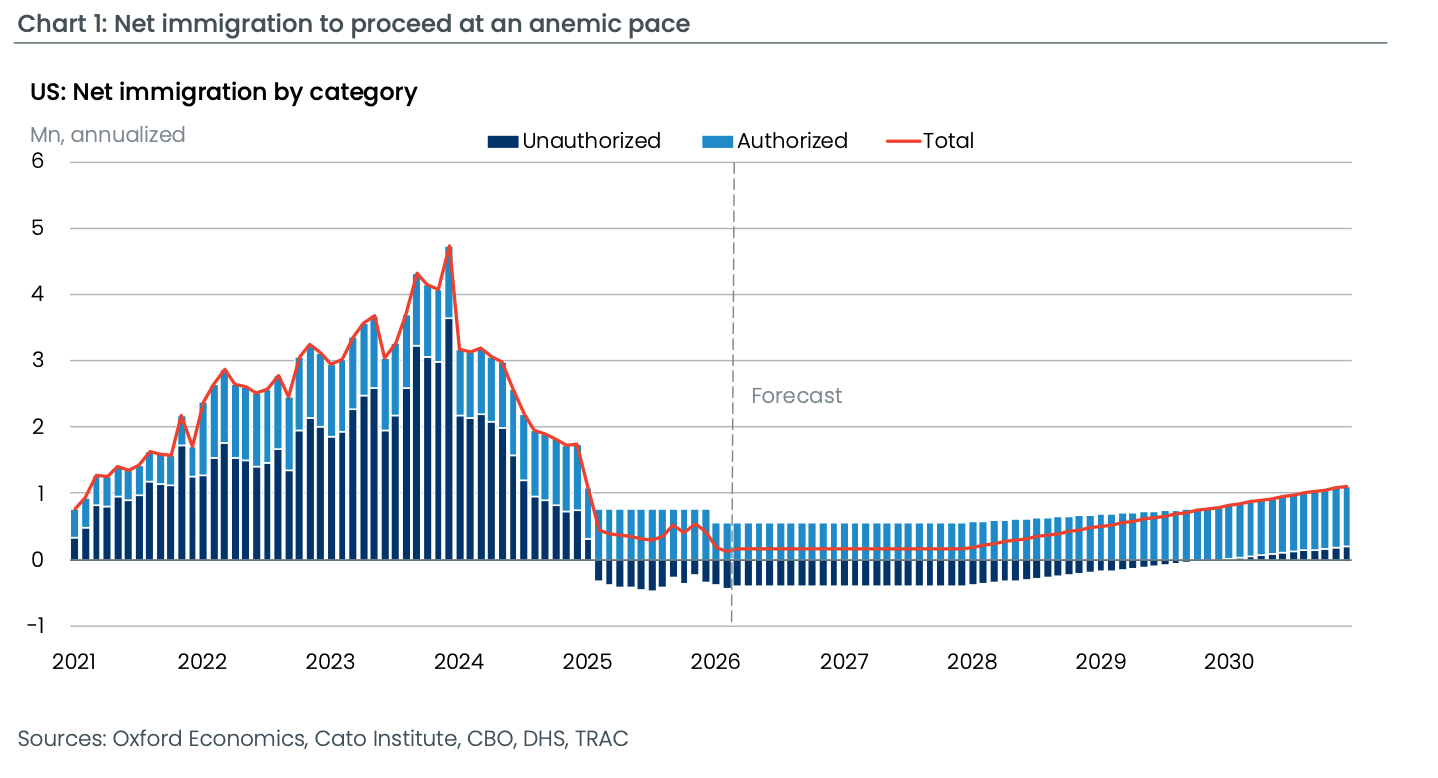
Oxford Economics believes 160,000 is the new baseline for net immigration in the U.S. Lead U.S. economist Bernard Yaros, in a note seen by Fortune, wrote that a clampdown on H-1B visas and green cards for certain foreign nationals had driven down previous revisions to the immigration forecast.
Yaros highlights that while policy on legal immigration seems to be easing, it’s not enough to change the forecast higher, meaning there will be no labor force growth over the next two years and a break-even level of employment near zero.
The economic impact is difficult to pinpoint, the economist adds, as shifts in policy or the impact of AI are difficult to predict. But he added: “Future economic growth will be more dependent on productivity trends, as labor plays a smaller role than in recent decades.”
More than four in 10 Americans are retiring earlier than they expected, often due to circumstances beyond their control, according to a new survey from Allianz Life.
The 2026 Annual Retirement Study from the Allianz Center for the Future of Retirement found the most common reason for those forced into retirement was due to health reasons (30%), which meant the individual could no longer perform the role. This was followed by an unexpected job loss, which was cited by 21%.
It goes to show that the concerns of the majority of those yet to retire aren’t unfounded: 59% said they worry they won’t be able to give up work on their own terms.
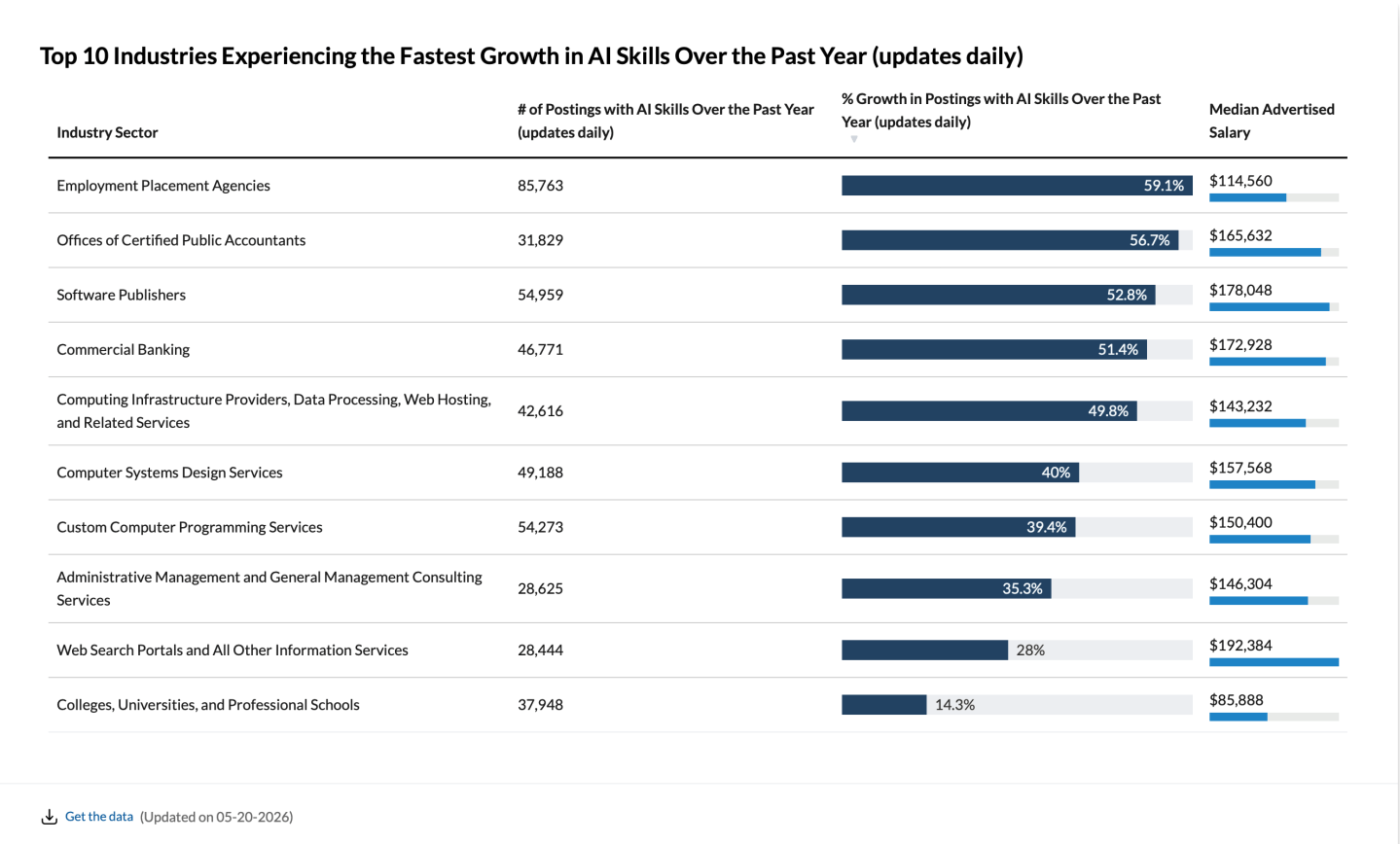
The Bipartisan Policy Center (BPC) has built an interesting dashboard tracking all things AI and employment. As well as a regional breakdown of states with the highest growth for AI demand year on year (spoiler alert: It’s North Dakota at 330%), it also has a daily barometer of national change in job postings year on year, and the change in job postings mentioning AI specifically.
If you’re wondering which industries are the most active and lucrative when it comes to hiring, there’s also a dashboard breaking that down. At the time of writing, recruitment is the sector with the highest growth in demand for AI skills, followed by accounting and publishing.
You can explore the dashboard here.
此内容由惯性聚合(RSS阅读器)自动聚合整理,仅供阅读参考。 原文来自 — 版权归原作者所有。