


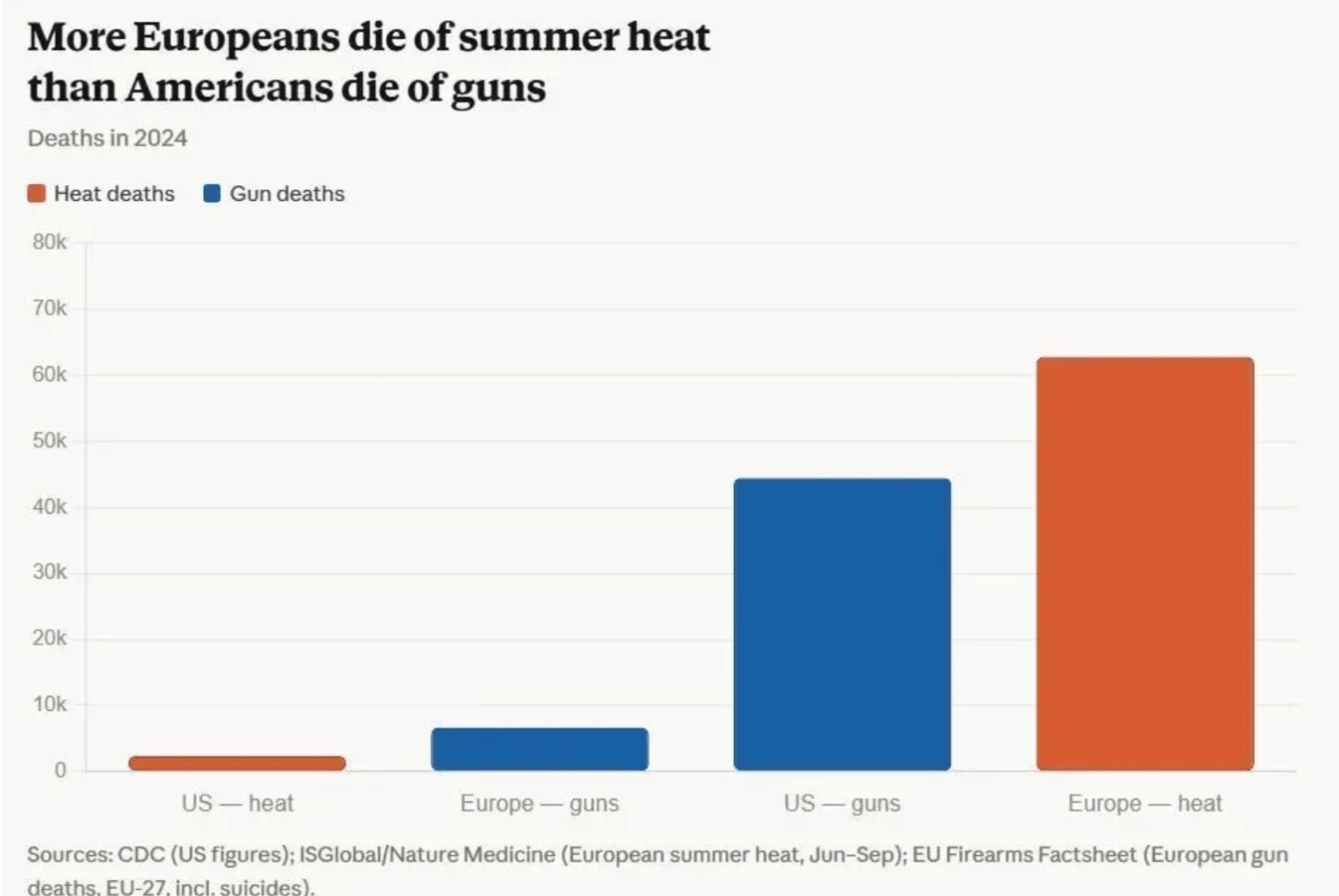
You’ve probably seen it by now. A chart, passed around on social media with the kind of grim satisfaction that only statistics can produce: more Europeans die each year from summer heat than Americans die from gun violence. The implication cuts both ways—Europe’s lack of air conditioning is deadlier than America’s lack of gun control—and it has been lighting up feeds across the political spectrum ever since.
Turns out, it’s mostly true. And this summer is making it impossible to ignore.
Hannah Ritchie’s By the Numbers Substack
Europe is currently in the grip of its second major heat emergency in two months. The UK Met Office and the World Meteorological Organization have put an 86% probability on at least one year between now and 2030 breaking 2024’s record as the hottest ever measured—with 2027 the most likely candidate as a developing El Niño peaks. In the meantime, 2026 is already tracking as one of the four warmest years on record, the fourth consecutive year to exceed 1.4°C above pre-industrial levels.
Temperatures in parts of France have topped 108°F, while Spain logged highs above 113°F in the south. The UK, Germany, France, Spain, Switzerland, and Luxembourg have all issued the highest-level red heat alerts. At least 40 people have drowned since last Thursday, with French Prime Minister Sébastien Lecornu publicly linking the deaths to soaring temperatures as people wade into unsupervised rivers and lakes seeking relief. So far, at least 18 more have died from direct heat causes in France alone—among them two toddlers found unresponsive in a hot car in the southeastern town of Carpentras, where temperatures exceeded 102°F that afternoon, and three elderly people between the ages of 80 and 95 who died near Bordeaux over the weekend.
And summer has barely started.
A developing El Niño is reshaping atmospheric circulation across Europe, with some models suggesting it could become the strongest El Niño in modern history—what meteorologists are informally calling a “Super El Niño” heading into 2027. The current heat dome is being driven by a ridge of high pressure over western Europe, reinforced by El Niño-driven jet stream shifts that are allowing hot Saharan air to push further north and linger longer than it should. While scientists caution that El Niño’s direct role in European summer heat is real, it pales to human-caused climate change, which is the dominant structural driver responsible for pushing global temperatures up roughly 1.4°C above pre-industrial levels across each of the last four years running.
Either way, Europe is the world’s fastest-warming continent, heating at roughly twice the global average, on infrastructure built for a climate that no longer exists. Which brings us back to that statistic, and what it actually shows when you dig into the numbers.
Hannah Ritchie’s By the Numbers Substack
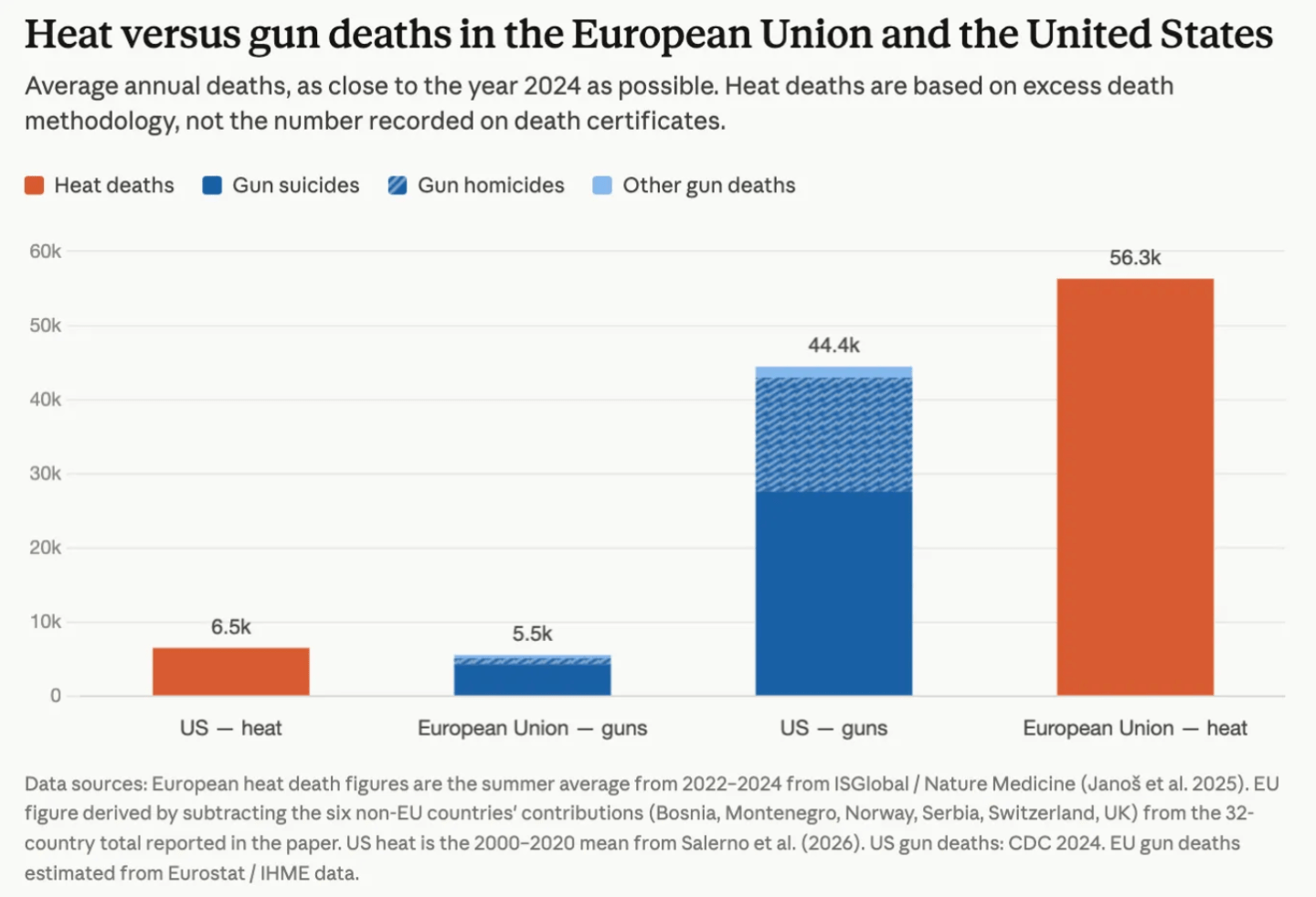
In 2025, heat waves killed some 24,400 people across Europe, with 16,500 of those deaths attributed directly to climate change. The year before, more than 62,700 Europeans died of heat-related causes. Gun deaths in the U.S., by comparison, totaled 44,447 in 2024 according to the CDC, before falling in 2025 to roughly 38,700. By the raw numbers, it’s not close. The viral stat, for once, is sort of right—but Hannah Ritchie, a data scientist and author of the Substack By the Numbers, looked at the viral chart and found that while the headline survives, the methodology underneath it does not fully hold up. “The chart has several issues,” she wrote.
The two numbers are produced using fundamentally different methods. The European heat death figures are based on modeled “excess deaths”—a standard epidemiological approach that tries to capture everyone who died earlier than they would have in cooler conditions, including from cardiovascular disease, stroke, and respiratory failure, which casts a wide net. “But the US number,” Ritchie wrote, “isn’t based on this type of modeling; it’s based on heat deaths recorded on death certificates.” That’s a far narrower count which only captures cases where a physician specifically wrote heat as the cause of death. The result is that the two figures being compared are not measuring the same thing. “If you used death certificate figures for Europe,” Ritchie wrote, “they’d be far lower.”
There’s a second problem: The original viral chart uses European Union figures for gun deaths, but a broader geographic definition of Europe—including the UK, Switzerland, Norway, Serbia, Bosnia and Herzegovina, and Montenegro—for heat deaths. More Europe means more heat deaths.
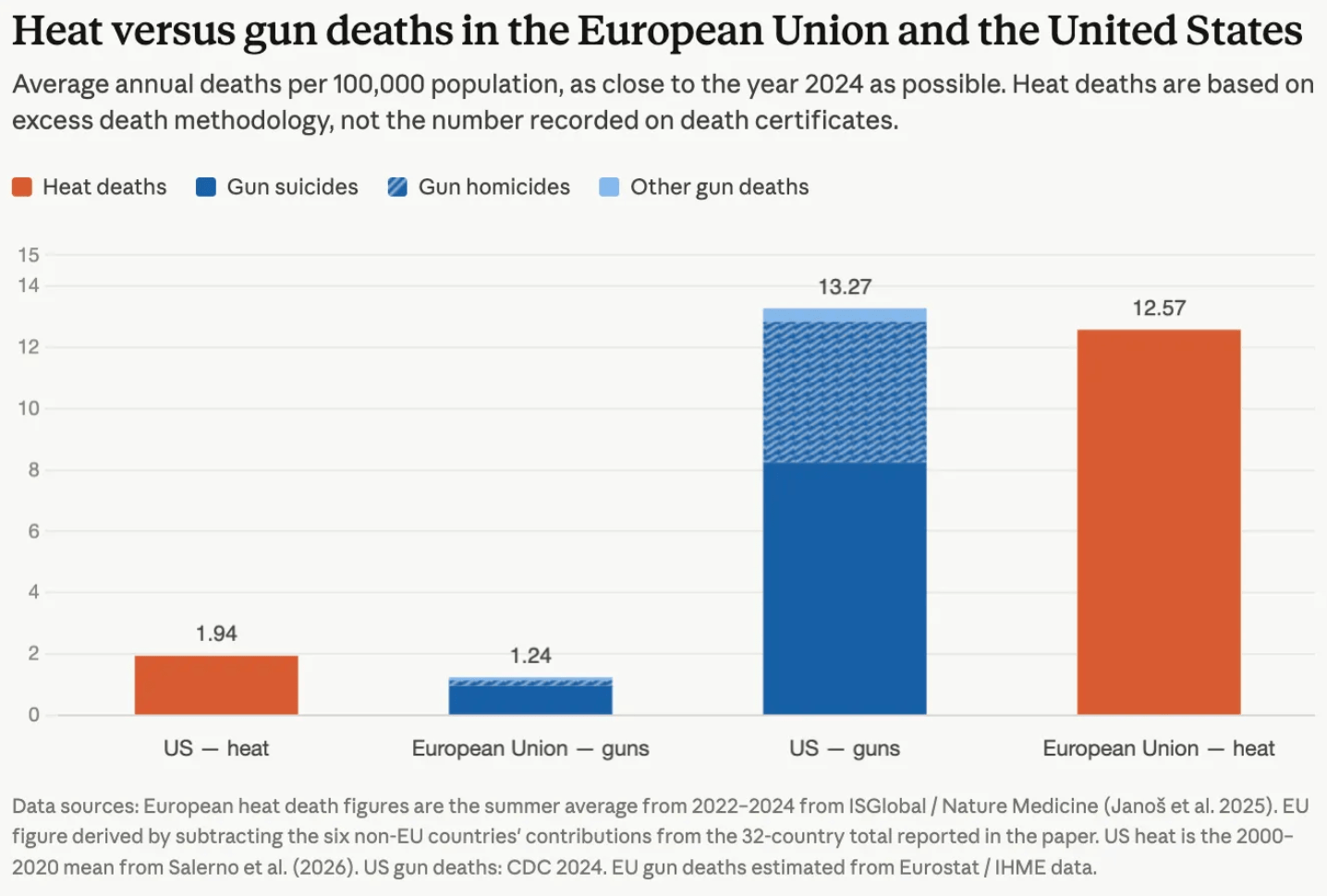
Ritchie instead used excess death modeling for the U.S. as well, drawing on a study estimating roughly 6,100 to 6,500 heat-related American deaths per year between 2000 and 2020. She averaged Europe’s 2022 through 2024 figures—67,873; 50,798; and 62,775, for an annual average of roughly 60,500—to avoid anchoring to any single catastrophic year. And she produced two versions: one using EU-27 figures consistently throughout, and one using the broader 32-country European definition for both measures. Her conclusion: “It doesn’t change the conclusions much.” The core claim mostly holds in absolute terms. But then comes the adjustment the viral chart skips entirely: when Ritchie controls for population, expressing both figures as rates per 100,000 people, the picture shifts. “Gun deaths in the US are now slightly larger than European heat death rates,” she wrote.
Hannah Ritchie’s By the Numbers Substack
“I think this comparison is a bit silly,” she wrote, “but sympathize with the overall sentiment.” Fewer gun deaths in America would not make European heat deaths acceptable, or vice versa. What the data is actually showing, she argued, is something simpler: status quo bias. “Both places take the status quo as a given”—a high-mortality situation in one domain that each society would never accept in another. Europe would never absorb tens of thousands of annual gun deaths without demanding legislative action. America would never absorb tens of thousands of annual heat deaths without demanding someone install a thermostat.
Only about 20% of European homes have air conditioning, compared to roughly 90% of U.S. households, according to the International Energy Agency. Northern European housing stock was built to retain warmth, not expel it. The continent never built out cooling infrastructure at scale because, for most of its modern history, it didn’t need to. Extreme weather events including heat waves cost European economies nearly $50 billion last year alone. Meanwhile, as a Johns Hopkins analysis found, firearm-related homicide and suicide rates for Americans under 25 are nearly 486 times higher than in the UK.
These are both wealthy societies paying enormous and entirely preventable death tolls that they have collectively chosen to absorb rather than address. With an 86% chance that the coming years bring an even more punishing heat record, and a Super El Niño potentially still building toward its peak, it’s like how Ritchie put it: “Things don’t have to be this bad. It’s a choice.”
此内容由惯性聚合(RSS阅读器)自动聚合整理,仅供阅读参考。 原文来自 — 版权归原作者所有。