


惯性聚合 高效追踪和阅读你感兴趣的博客、新闻、科技资讯
阅读原文 在惯性聚合中打开

推荐订阅源

GbyAI
GbyAI
Threat Intelligence Blog | Flashpoint
P
Proofpoint News Feed
L
Lohrmann on Cybersecurity
S
Secure Thoughts
Attack and Defense Labs
人人都是产品经理
人人都是产品经理
Stack Overflow Blog
Stack Overflow Blog
W
WeLiveSecurity
O
OpenAI News
SecWiki News
SecWiki News
博客园 - Franky
NISL@THU
NISL@THU
Microsoft Azure Blog
T
Tor Project blog
Microsoft Security Blog
aimingoo的专栏
aimingoo的专栏
Security Latest
Security Latest
H
Hacker News: Front Page
Google Online Security Blog
P
Privacy & Cybersecurity Law Blog
Cyber Security Advisories - MS-ISAC
D
Darknet – Hacking Tools, Hacker News & Cyber Security
月光博客
月光博客
李成银的技术随笔
Spread Privacy
Spread Privacy
F
Full Disclosure
F
Fortinet All Blogs
T
The Exploit Database - CXSecurity.com
Vercel News
Vercel News
AWS News Blog
AWS News Blog
WordPress大学
WordPress大学
IntelliJ IDEA : IntelliJ IDEA – the Leading IDE for Professional Development in Java and Kotlin | The JetBrains Blog
V
Visual Studio Blog
J
Java Code Geeks
博客园 - 三生石上(FineUI控件)
G
Google Developers Blog
云风的 BLOG
云风的 BLOG
博客园 - 司徒正美
Engineering at Meta
Engineering at Meta
Last Week in AI
Last Week in AI
P
Palo Alto Networks Blog
宝玉的分享
宝玉的分享
T
True Tiger Recordings
N
News and Events Feed by Topic
酷 壳 – CoolShell
酷 壳 – CoolShell
Cisco Talos Blog
Cisco Talos Blog
N
News | PayPal Newsroom
S
SegmentFault 最新的问题
Jina AI
Jina AI

Fortune | FORTUNE

Current price of oil as of May 21, 2026 'We do not want humans to have the same fate as dinosaurs': SpaceX IPO reads like Hollywood fantasy version of the future | Fortune James Murdoch vows 'ambitious journalism and agenda-setting conversations' as he takes over New York, Vox brands | Fortune Wall Street thinks there's a chance the S&P 500 could push 20% higher by 2027 | Fortune Trump Accounts have a bigger problem than billionaire stock donations | Fortune SpaceX's IPO filing is full of surprises | Fortune The U.S. freight network is broken by design. One merger could start fixing it | Fortune Europe is considering price caps to control inflation. CEOs are shaking their heads in despair | Fortune The SpaceX IPO is a referendum on Elon Musk and his plan to colonize Mars | Fortune America's new AI map shows something surprising: 'A lot of normal people are adopting AI' | Fortune 'Flexible hot girl summer' is still on, but it's going to cost you | Fortune With bond yields surging to 4.7%, it's time to rotate out of stocks says Research Affiliates' forecasting model | Fortune Sheryl Sandberg tells Gen Z the 10-year career plan is dead as AI wipes out entry-level jobs: 'Don't script your career when the future is uncertain' | Fortune Microsoft lost its way in the AI race. Can Copilot get it back on course? | Fortune Vice President JD Vance rebuffs question about President Trump’s stock investments, says Trump is so wealthy he doesn’t trade stocks himself | Fortune Elon Musk's pay package reveals what SpaceX actually is: a $1 trillion monster built to colonize Mars | Fortune SpaceX IPO targets $28.5 trillion total addressable market, mission to 'make life multiplanetary' and understand 'true nature of the universe' | Fortune Nvidia Q1 earnings: Chipmaker beats on earnings and boosts dividend, but forecasts disappoint | Fortune Blast Off: SpaceX finally files IPO prospectus, reveals revenue is up–but losses are too | Fortune SpaceX will be worth trillions, but the space station that made it possible is worth even more — if we don't squander it | Fortune Antler CEO Magnus Grimeland says Silicon Valley doesn't have a monopoly on tech: 'People can innovate from almost anywhere' | Fortune A 'proudly autistic' workplace expert says putting neurodivergent employees in a typical office is like dropping a polar bear in Austin, Texas | Fortune Pay transparency is exposing a bigger problem: Most companies can't explain why they pay what they pay | Fortune 80% of companies have an immigrant in a top leadership role—Trump's visa crackdown is forcing them to make a 'plan C,' says immigration expert | Fortune Harvard admits it was too easy to get A grades, vows crackdown | Fortune Barney Frank, legendary liberal who ripped into left-wing dysfunction on his death bed, dies at 86 | Fortune ‘We’ve given them the short end of the stick’: Business school dean says AI could eliminate many jobs for young people—even as they lead innovation | Fortune A dating expert says ghosting and quiet quitting are the same problem at their core, and corporate life has more to learn from romance than it admits The one number that will actually move Nvidia's stock Wednesday night | Fortune While other tech CEOs warn of mass job losses, Glean's chief says AI will never replace a single worker | Fortune Jeff Bezos on Zohran Mamdani's big mistake: 'When you don't know how to solve a problem, create a villain, blame them' | Fortune Trump's EEOC chair is suing The New York Times because 'we should bring it on behalf of white workers too' | Fortune Electricity prices are up 40% since 2021, but data centers shouldn't get all the blame | Fortune Prices at the pump hit $4 a gallon in all 50 states—just as summer driving season begins | Fortune A senior comms exec says your AI notetaker could be your company's biggest liability | Fortune How 8,000 robots are changing work inside logistics giant DHL Supply Chain | Fortune Jurassic Park isn't just a movie anymore as de-extinction startup hatches live chicks | Fortune Anti-Trump Republicans are dead pols walking. Call them the 'YOLO caucus' | Fortune 56-year-old woman dies after stepping out of car and into open manhole in New York City | Fortune San Francisco thinks AI can save the whales. Here's how | Fortune 'We will not be intimidated into silence': George Soros foundation pledges $300 million toward democratic rights | Fortune Target posts biggest jump in comparable sales in 4 years as turnaround takes shape | Fortune Single Gen Z women are destroying their male counterparts when it comes to buying their first house | Fortune The sound of graduating from college in the AI summer of 2026: boo! | Fortune Trump gets revenge on Epstein rebel Thomas Massie in Kentucky GOP primary | Fortune 3 reasons kids hate AI—especially the ones who refuse to even try it | Fortune Days after Trump flies out of Beijing, Xi and Putin hail the best friendship in their history | Fortune Despite a $500 million net worth, Shaq just finished his fourth degree. He warns graduates: 'Your character will take you further than your resume' | Fortune Accenture exec says the consulting giant is hiring more entry-level workers out of college compared to last year | Fortune Indeed chief economist says execs are 'overestimating the speed' of AI transformation in the labor market | Fortune Meet the brothers who turned a homegrown AI agent into a $12 million bet on the future of work — in six weeks | Fortune America's new AI map shows something surprising: 'A lot of normal people are adopting AI' | Fortune Current price of oil as of May 20, 2026 The definitive guide to trade wars just dropped. Its authors have one message for Washington: Study your enemy | Fortune Variational raises $50 million Series A to bring liquidity from traditional markets to blockchain rails | Fortune The 50-year-old law that governed every software company just broke. Here's what replaces it | Fortune U.S. national debt officially hits $39 trillion—adding $5 billion a day since October | Fortune Circle cofounder raises $30 million for Series A ‘AI-native bank’ Catena Labs | Fortune A doctor shortage is coming. AI could be the only realistic fix | Fortune CEOs are handing out AI tokens like paychecks—and figuring out how to justify the spend | Fortune How Metropolis built a $5 billion AI infrastructure company out of America’s parking problem | Fortune Milken-Harris Poll: 80% of Americans want AI workforce programs now — and Washington hasn't delivered | Fortune The bond market is firing a warning shot in the direction of Washington, D.C. Exclusive: Advocacy groups file complaint against Roblox, alleging its manipulative design puts kids at risk | Fortune Grab bets on new delivery robots to fix Singapore’s 'supply-constrained markets' and solve the last-mile problem | Fortune AI data centers are reshaping the world’s largest commercial real estate company | Fortune ThredUp's CEO has a warning for five-day companies: You're going to lose the talent war | Fortune Google's I/O conference showed how the company is being completely rebuilt for AI | Fortune Bolt CEO says he let go of his entire HR team for creating problems that didn’t exist: ‘Those problems disappeared when I let them go’: | Fortune Why the 137-year-old developer Hongkong Land is reinventing itself—and trying to loosen its ties to its home city | Fortune Indeed chief economist says the sectors most exposed to AI are seeing a big growth in job demand | Fortune The 30-year Treasury yield just hit a level it hasn't seen since before the Great Recession. Do the bond vigilantes ride again? | Fortune DEI experts say the acronym may be radioactive, but the underlying business case is stronger than ever | Fortune Pizza Hut franchisee claims $100 million losses from 'cascading operational breakdowns' in AI adoption gone wrong | Fortune TSA's new 'straight to gate' pilot lets Delta and JetBlue flyers clear security 25 miles before they reach the airport | Fortune Dr. Bernice King on why companies that walked back DEI were never truly committed: 'If you retreat that quick…that reveals who you really are' | Fortune Trump and Mark Cuban end war of words to tag-team America's drug pricing crisis: ‘Democrats want cheaper medications, too’ | Fortune CEO of AI-powered performance review firm says annual evaluations weren’t designed for the AI era: 'The practice just hasn't kept up' | Fortune WeWork and Upwork CEOs confirm the Gen Z hiring nightmare is real—but it's nothing new | Fortune The times they are a-changin': Trump pivots towards AI regulation in the face of a mounting public backlash | Fortune CNN analyst and 'The Morning Show' producer says Stephen Colbert is a role model for his ‘positive’ outlook on his show ending | Fortune Goldman Sachs: The U.S. labor market is healthier now than when ChatGPT launched. Yes, really | Fortune Andrej Karpathy, OpenAI founding member and inventor of ‘vibe coding,’ defects to Anthropic | Fortune Buy now, pay later is the new financial lifeline for lower-income Americans, as consumer loans pile up to $19 trillion | Fortune 'Blood in the streets': Legendary investor Jeremy Grantham pulls back the curtain on the AI wars to reveal a 'brutal, competitive world' | Fortune 'This is what the consumer wants': A new lawsuit about PFAS and other 'forever chemicals' is heating up the cookware industry | Fortune Tom Brady tells Gen Z to treat their careers like the Super Bowl: 'You may only get one chance to impress your boss or land a promotion' | Fortune Current price of oil as of May 19, 2026 | Fortune $30 billion Twilio CEO has been waking up and working from 4:30 a.m. since college—he says it’s why he was CFO of a multi-billion-dollar brand by 31 | Fortune Will the future of work for Gen Z include space? Tech leaders predict space work and travel could be just a decade away | Fortune Eisen raises $18.5 million to help Americans recover over $70 billion in forgotten funds held by state governments | Fortune Exclusive: AI startup Viktor raises $75 million to put a virtual ‘coworker’ in Slack and Teams | Fortune Spanish police arrest son of retail billionaire who fell off a cliff and died. He was the only witness | Fortune Gen Z is over-relying on AI at work—and it could cost them their careers | Fortune 'Change the World' idealism is dying in Silicon Valley. We’ll miss it when it’s gone | Fortune CFOs could cut agentic AI costs up to 60% by fixing this overlooked data problem | Fortune Parag Agrawal’s Parallel wants to pay publishers when AI agents use their work | Fortune Don't hold your breath for the great AI job reshuffle, says Goldman Sachs | Fortune DeepSeek and China’s AI boom are increasingly powered by state money | Fortune We studied 6,000 executives and found the real reason 70% of transformations fail | Fortune
Allbirds' 600% stock surge says a lot about how 'AI washing' became the new 'greenwashing' | Fortune
Suvrat Dhano · 2026-05-21 · via Fortune | FORTUNE

A case in point is the recent 600% share price surge of Allbirds, after the once-trendy sustainable footwear business issued a vague announcement in April 2026 that it would pivot to AI. In the coming months, the company plans to rename itself NewBird AI and give up its status as a public benefit corporation.

As a scholar who studies corporate sustainability, I see parallels between this “AI washing” phenomenon – when companies oversell the benefits of AI while glossing over the risks – and the greenwashing trend in the recent past, when companies claimed to commit to sustainability but didn’t enact fundamental change. Widespread deception was rampant, with businesses spending far more on green marketing than on actual sustainability improvements. And those efforts often backfired on both the companies and the communities they served. Even more worrisome: AI washing’s rapid rise and widespread adoption will likely eclipse the greenwashing trends.

AI washing is thriving because companies and policymakers ignore four important principles. These shortfalls, in the past, also characterized greenwashing.

Making matters worse is that the U.S. currently relies on fragmented AI rules, with most being voluntary. The Trump administration has generally sided with Big Tech to push back efforts at state or federal regulation. At a global level, one of the few exceptions is the European Union AI Act, perhaps one of the most comprehensive frameworks, but its implementation won’t be fully phased in until 2027 or later.
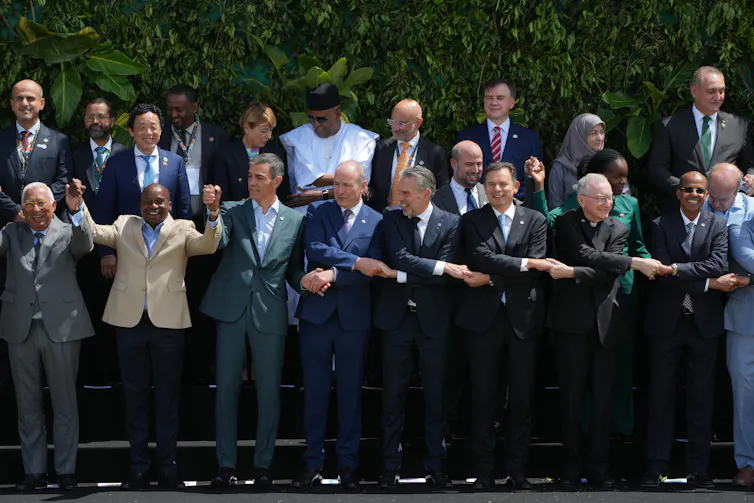
Global leaders attending the U.N. Climate Summit pose for a group photo and hold hands.
The U.N. climate change summits, like this one in Brazil in 2025, have offered a global forum for policymakers and business leaders on climate and sustainability issues. AP Photo/Fernando Llano

When companies must report carbon emissions using the same methodology, for example, or disclose labor conditions using identical categories, investors can compare performance, identify laggards and allocate capital accordingly. This push made comparisons possible and deception harder, although it still wasn’t foolproof. For example, a 2023 United Nations Environment Programme report on the fast-fashion industry found that many companies continue to make “vague and inflated” sustainability claims.

Second, there are no comprehensive frameworks in the U.S. that require businesses to judge how AI affects them in a material way and publicly disclose those impacts. Examples of AI-driven material impacts include whether algorithmic bias shapes business outcomes, or whether decisions on how to use AI systems carry significance for shareholders and the public.

Instead, AI governance remains dominated by the narrow inner circle of companies that build the AI systems, while affected communities rarely have a say in determining which AI impacts are material enough to warrant public attention. For example, Big Tech companies like Google, Microsoft, Apple, NVIDIA and others adhere to their own AI governance guidelines, with relatively little public input.

The development of sustainability principles offers some examples of how to build these frameworks. The EU’s Corporate Sustainability Reporting Directive requires over 50,000 companies to formally evaluate which sustainability topics are material to their stakeholders, and then disclose that information. These efforts try to ensure that accountability is clear across entire supply chains.

While nowhere nearly as comprehensive, U.S. regulations such as the 2010 Dodd-Frank financial reform and California’s law requiring reporting on statewide greenhouse gas emissions provide a similar blueprint that U.S. policymakers could build on if they chose.

A third problem is the general lack of third-party verification, making AI washing trivially easy. Effective disclosure means reporting all material impacts – not just cherry-picked successes.

In practice, AI audits can vary dramatically in rigor, scope and methodology. One auditor might conduct extensive testing across demographic groups, analyze decision-making and validate the quality of training data. Another might simply review documentation and accept company explanations at face value. Given the variety of AI auditing models out there, different auditors may use incompatible methodologies, making results impossible to compare. If companies adopted third-party accreditation systems to assess how they use AI, they would help ensure the accountability that self-reported claims cannot match.

By contrast, there was reasonable progress in this respect as companies adopted ESG principles. For example, institutions such as the Carbon Disclosure Project and Global Reporting Initiative have a network of partners that offer independent verification. These providers, certified under international standards, verify corporate sustainability data against rigorous criteria. That way, they provide the assurance that lets companies show the progress needed to unlock sustainable finance and mitigate legal risks. Third-party audits are far from perfect, but they offer a clear path for improvement.

The fourth principle is robust enforcement. Early ESG initiatives relied on reputational pressure and stakeholder goodwill – things that corporations routinely ignored when profits were at stake. When change came, it was because regulations established legal liability and financial penalties.

These consequences changed how corporations assess risk and continue to shape sustainability practices today. Volkswagen’s 2015 ‘Dieselgate’ scandal, for example, cost the company over US$30 billion in fines, settlements and criminal charges after U.S regulators found that the carmaker was cheating emissions tests. BP faced billions in penalties and liabilities for the 2010 Deepwater Horizon disaster, the biggest oil spill in the history of marine oil drilling operations.

The current enforcement gap in AI creates a predictable dynamic. The expected value of AI washing – like potential investment gains, competitive advantage, and market valuation increases – far exceeds the expected cost in terms of penalties and risk of detection. Until enforcement imposes consequences that exceed benefits, AI washing will persist as a rational business strategy rather than a risk to a business’s reputation.

Fortunately, investors are beginning to step up. The Federal Trade Commission, for example, launched Operation AI Comply in 2024, targeting deceptive AI claims, although this effort has been partially scaled back by the current Trump administration.

New standards for a new era

Until businesses address these four principles, AI washing will continue. Without standards and audits, even well-intentioned companies can’t know if their work meets adequate rigor. Without assessments of material impact, some groups of consumers or shareholders will be hurt. And without liability, even thorough auditors won’t be able to identify whether a business’s claims about AI are truthful.

These principles, applied broadly, also help explain why greenwashing persists. For example, the lack of universal reporting standards continues to leave some gaps, with data-quality issues persisting even as reporting frameworks emerged. More fundamentally, political buy-in for ESG has diminished significantly, particularly in the U.S., where over 150 bills were introduced across multiple states by 2023 to disincentivize firms from adopting ESG. Major financial institutions – including JP Morgan, State Street, BlackRock and PIMCO – have retreated from their earlier climate commitments amid political pressure as well as antitrust concerns.

This trend shows that even well designed accountability measures require durable political support to succeed. After all, corporate sustainability took more than 25 years to develop from an initial framework to mandatory standards, and it still remains a work in progress. AI, by contrast, is advancing exponentially in terms of its reach and societal impact. There may not be 25 years to catch up – but at least there are lessons from the recent past.

Suvrat Dhanorkar, Associate Professor of Operations Management, Georgia Institute of Technology

This article is republished from The Conversation under a Creative Commons license. Read the original article.

The Conversation