


On paper, New York State Comptroller is a sleepy job. No press secretary emerges from the office to spin the Sunday shows. No Twitter feuds, no viral moments. A recent poll found that 65% of New York Democrats have never heard of the man who has held the position for two decades.
What Thomas DiNapoli actually controls is another matter entirely. As sole trustee of the New York State Common Retirement Fund — the third-largest pension fund in the United States — he manages nearly $300 billion without a board, without a co-signer, and without, until very recently, a single Democratic opponent. For the first time since DiNapoli was handed the job in a backroom Albany deal in 2007, two challengers are making a case that the office has been asleep at the switch — and that New Yorkers are paying for it.
Fortune talked to both of them, Drew Warshaw and Raj Goyle, and the two longtime acquaintances, if not friends, had a clear message: the time for a change is now.
The irony is that they may be each other’s biggest obstacle. Both are running against the same 20-year incumbent. Both make nearly identical arguments about fees, fiduciary failure, and a $300 billion fund that has been pointed in the wrong direction. And both are drawing from the same pool of progressive Democrats who, for the first time in two decades, are paying attention to this race — with days left to decide.
Warshaw, 45, told Fortune that he’s running because “this is the way my brain works.” A former New York politico, holding positions in the New York Governor’s Office and the Port Authority, along with a career in business in renewable energy, Warshaw said his business school training was the motivating factor behind this campaign.
“No one in 20 years ever asked and answered this question: how has the third-largest investor in the United States of America performed? How’s he done? Like, no one measured it, no one quantified it.” After pulling the annual report of the pension fund, he got to the page that started listing all the investment managers and the fees associated with them. Then Warshaw decided to calculate all 664 names: the total fee bill for a single year was roughly $1 billion (technically, $1.1 billion for 2024 and $862 million for 2025).
“On the first day of Columbia Business School,” Warshaw said, “they tell you: it’s really hard to beat the market. It’s even harder to do it net of fees. It’s impossible to do it net of fees over a long period of time.”
DiNapoli’s office confirmed that its fund uses outside managers, “though not nearly as many as [Warshaw] fabricated,” and confirmed that the fund has paid out about $1 billion in fees, which it called “a low percentage and entirely in line among pension funds our size, another fact held up by independent reviews.” the Comptroller’s office noted that the state Dept. of Financial Services ranked New York’s investment expenses 33rd among 74 large public pension funds surveyed. “The number of managers we use has grown over time because the amount of money managed has doubled. And in today’s unpredictable financial markets, you must diversify and not put your eggs all in one basket – absolutely key to our success.”
Warshaw commissioned Stanford economist Ryan Cummings to run a 19-year backtest — using DiNapoli’s own stated benchmarks for each asset class, to make the comparison as conservative as possible. The conclusion: the fund underperformed its own benchmarks by 39%, and paid $11.3 billion in fees to generate that underperformance. Because New York law requires the pension to be fully funded every year regardless of investment returns, the gap was made up through property taxes and income taxes. The total cost to New York taxpayers, by Warshaw’s estimate, was $59.1 billion.
This study is not peer-reviewed and a spokesperson for DiNapoli told Fortune that it’s a “phony number based on embarrassingly bad math.” In fact, the Comptroller’s office argues, the fund’s investments returned 8.94% over the past decade and two separate, independent reviews — by the Texas-based tax consultancy Weaver and by the New York State DFS — have given it high marks for performance, asset allocation, competitive fees and ethical management.
DiNapoli’s office further referred Fortune to the Comptroller’s opinion column published on Syracuse.com, in which he argued that Warshaw’s analysis was “built on basic errors in math and an alarming lack of understanding of how investing and diversification works.” Warshaw noted that this response only extends a decade back, not to DiNapoli’s full tenure.
Goyle implicitly agreed with Warshaw but dismissed his efforts as obvious. “You don’t need footnotes and a white paper to document the fact that we should not be giving non-transparent locked up money to managers who don’t perform, period,” the 51-year-old told Fortune. Goyle said the “corrosive nature of fees” is well known.
The fix that Warshaw urges, and Goyle agree with, is to move the fund toward low-cost index investing, modeled on the model already in practice with Nevada’s state pension, which converted years ago and has quietly outperformed its actively managed peers ever since.
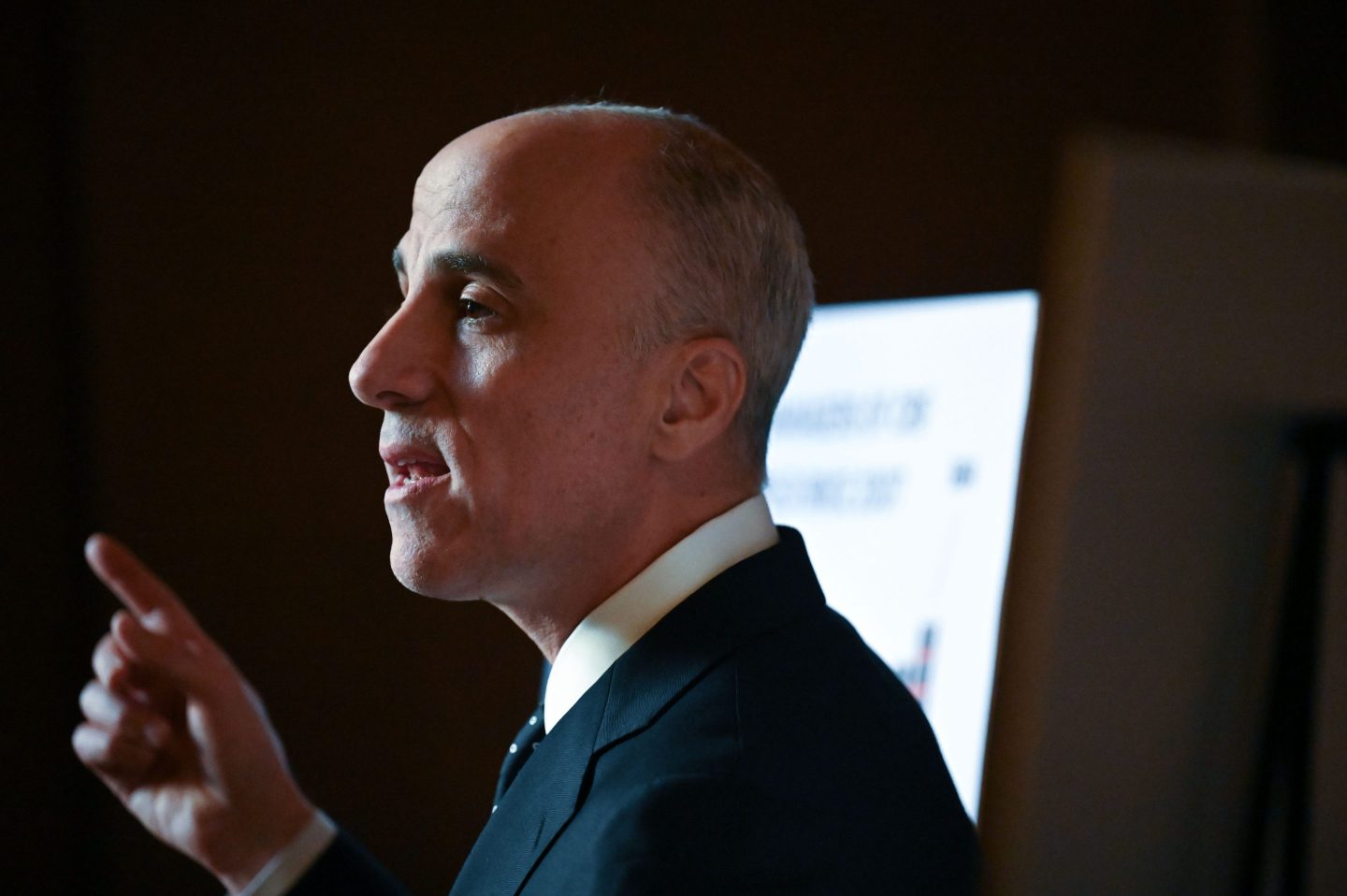
Will Waldron/Albany Times Union via Getty Images
DiNapoli often defends his tenure by noting the pension is one of the best-funded in the country. He’s right — and his challengers say that’s exactly the problem. In New York, full funding isn’t a sign of investment skill; it’s the law. When returns fall short, the state raises taxes to fill the gap.
“The pension fund is fully funded, but it’s the law,” Warshaw said, “and he [DiNapoli] brags and he says, ‘Oh, it’s one of the best-funded pension funds in the nation. And he’s right, it is. But he leaves out the part that it has to be.”
The sole trusteeship structure makes this accountability gap uniquely acute. Unlike California’s CalPERS or CalSTRS — which report to full boards — DiNapoli answers to no one. He is, as Warshaw puts it, both the fund manager and the board. “He reports to himself.” Only Connecticut shares this structure among the 50 states.
Goyle’s critique goes beyond investment returns into the question of how the office has been used — and who has benefited from it.
DiNapoli has received approximately $500,000 in contributions from law firms that subsequently received state contracts from his office. The arrangement drew scrutiny in a Times Union investigation, and to Goyle, the echo is unmistakable: pay-to-play contracting is precisely the corruption that sent DiNapoli’s predecessor Alan Hevesi to prison and created the vacancy that DiNapoli was appointed to fill in the first place.
Warshaw was careful to distinguish his critique from the populist Wall Street attacks that defined an earlier era of New York politics. “Eliot Spitzer called Wall Street corrupt,” he said. “I’m calling them unnecessary. That’s a far more existential critique.” DiNapoli’s $12 billion in fees, by that logic, isn’t a scandal — it’s a mistake.
Then there is the question of what the fund actually owns.
After the Sandy Hook massacre, DiNapoli announced with fanfare that he would freeze investments in gun manufacturers. He later sold the fund’s stakes in Smith & Wesson and Sturm Ruger. But a City & State investigation found that the fund simultaneously increased its position in Olin Corp., maker of Winchester rifles and ammunition — a company not on the restricted list because firearms are only part of its business. The fund also continued to hold tobacco stocks, private prison operators, and fossil fuel companies, most justified under the passive investment exemption: the restricted list, DiNapoli’s office has maintained, does not apply to index funds.
This is a tell, in Goyle’s opinion, who takes particular issue with New York State taxpayers investing in Palantir and SpaceX, two stocks that raise significant ethics issues. “I’m the son of immigrants,” said Goyle, whose parents moved from India to Rochester in Central New York in the early 1970s, according to his campaign website. “I’ve lived the immigrant experience, and he [Warshaw] grew up in a very different background and experience than I did.”
Goyle noted Palantir’s connections to ICE and criticized DiNapoli “falsely” claiming that he can’t divest from Palantir because of a stake in a passive index fund, when the fund is actively managed by the Comptroller’s office. As of March 31, filings show, the New York State Common Retirement Fund had cut its stake in Palantir by 0.16%, meaning New York taxpayers had $339 million invested in the company.
Goyle claimed that he’s also been “leading the charge on SpaceX,” which is a “great example of how DiNapoli is wasting his power right now.” The Comptroller should be sounding the alarm bell on “clear market manipulation” that’s eroding key investor protections, Goyle said, arguing that Elon Musk essentially bullied the Nasdaq into relaxing decades-long protections, shortening SpaceX’s index inclusion window from the typical 90-day seasoning period to just 15 days and limiting the float of available shares.
With SpaceX’s inclusion in the Nasdaq 100, Goyle explained, many millions of people will be forced to buy SpaceX shares, even as the small float allows “insiders” to “manipulate the stock.” Goyle said these are all “dangerous steps that the Nasdaq has taken,” and DiNapoli has been silent.
Fortune noted that a similar dynamic occurred when Tesla was accepted into the S&P 500, and the surge in investors buying the stock first made Musk into the world’s richest man. That dynamic is playing out again. “Absolutely,” said Goyle, adding that the “myth-making machine” around Musk is simply “astounding.” This matters for the Comptroller’s race, he said: “the market has now proven itself, in my view, unable to put guardrails and to follow best practices of fiduciary duty. And so this is the time for the public sector to step in and protect the average investor.”
When asked about the counter that Palantir and SpaceX are highly valued growth stocks that can make a lot of money for New Yorkers, Goyle insisted that it’s not all about that: “public pension funds mean that we have public values involved.”
DiNapoli co-authored a letter to Musk on May 13, along with New York City Comptroller Mark Levine and CalPERS CEO Marcie Frost, “to express our serious concerns with the reported novel and extreme governance structure and provisions” involved with SpaceX’s IPO. They requested a meeting with Musk and his advisers to discuss the “path to a structure consistent with the Company’s stature, its national-security role, and the fiduciary obligations of the long-term capital that will fund it.”
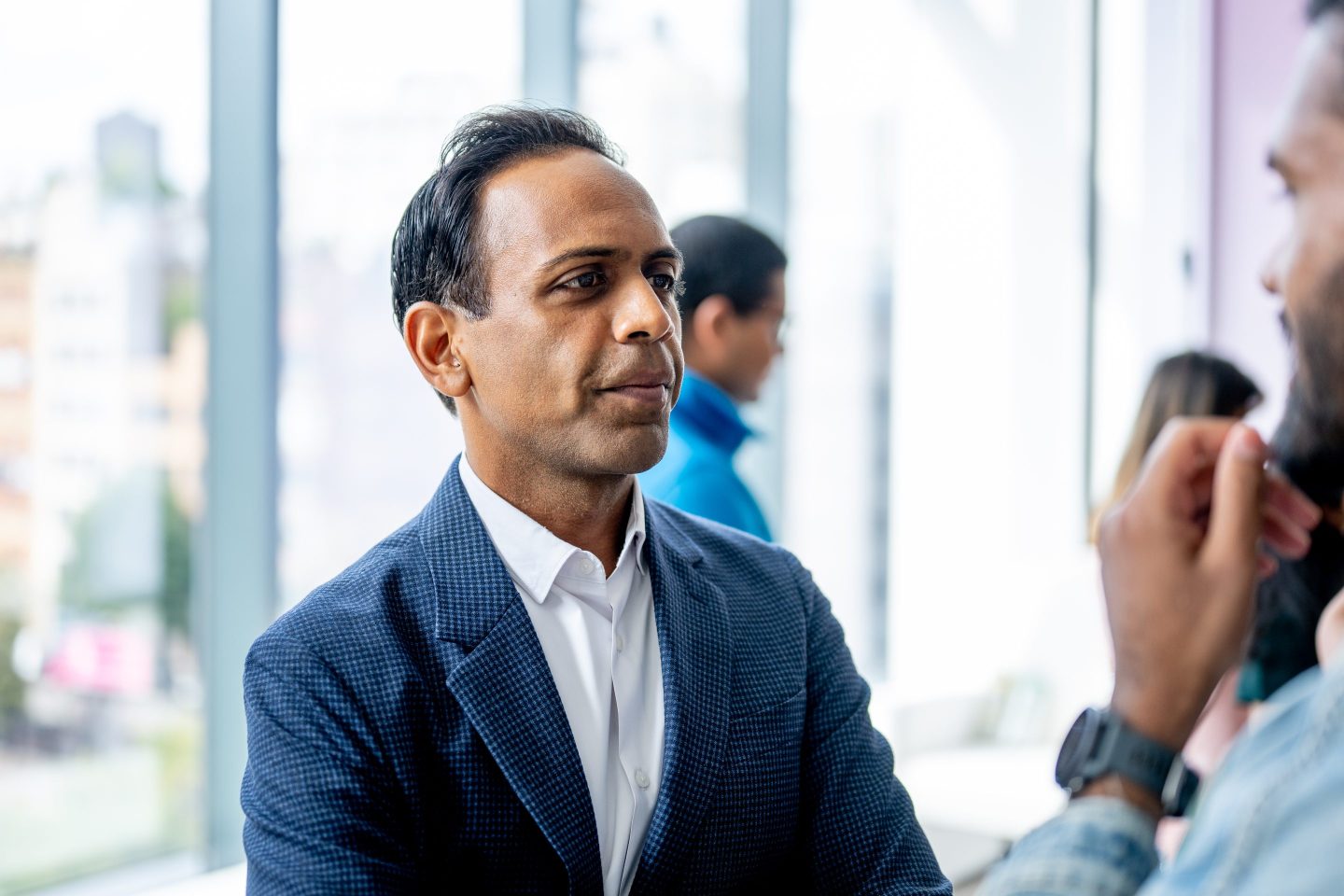
Roy Rochlin/Getty Images
Warshaw’s path to this race runs through the places where New York’s biggest problems actually live. He served as deputy to Eliot Spitzer’s chief of staff in Albany, was chief of staff at the Port Authority during the rebuilding of the World Trade Center, spent nearly a decade in renewable energy finance, and most recently served as co-CEO of Enterprise Community Partners, the largest affordable housing nonprofit in the country. He claimed he was never the run-for-office type before — more the operator behind the operator. What changed was watching the housing crisis worsen every year he spent trying to fix it from inside a nonprofit, while a single official sat on $300 billion two hours up the Thruway.
Savings, in Warshaw’s vision, would be put to work. He proposes redirecting a portion of the pension’s assets into the largest dedicated affordable housing investment fund in the country — a proposal he argues is not just morally defensible but financially obvious. The nonprofit he ran, Enterprise Community Partners, generated 8%-10% annual returns on its affordable housing investments, he claimed. The pension fund’s target return is 5.9% — though DiNapoli’s office notes the fund posted 11.94% in its most recent fiscal year, its strongest performance in years. “Don’t let the nonprofit fool you,” Warshaw said. “We put $2 billion to work every year. The math isn’t complicated.”
“The cavalry is not coming,” Warshaw said. “The cavalry is us.”
Goyle’s biography runs in a different direction entirely. Although he was born in upstate New York, he grew up in Wichita and became the first Indian American elected to the Kansas state legislature in 2006, fighting off a Koch-backed candidate to do so. “I’ve been fighting the Koch brothers ever since I was in fourth grade,” he told Fortune. “I’m running because I strongly believe we need better Democrats, Democrats who fight and who don’t fold.”
Goyle said he was one of Zohran Mamdani’s early supporters when he ran for assembly in 2020, and that the New York mayor has “resonated” because he “put his finger on the daily struggles of New Yorkers,” something that has “very little to do with ideology or a label from the political class.” The most exciting thing about Mamdani, he added, is that he has gotten people to “believe again” that the government can actually do things that make people’s lives better.
Goyle spent years at the ACLU as an immigration rights lawyer before pivoting to the private sector. In 2014, he co-founded Bodhala, a legal tech company whose entire product was exposing hidden billing waste in corporate legal spending — the same corrosive fee extraction he now says DiNapoli has allowed to fester in the pension fund for two decades. Bodhala grew into a national leader in legal business intelligence before being acquired by enterprise software firm Onit in 2021.
When Fortune noted that the anti-government waste argument is a common right-wing talking point, particularly beloved of Elon Musk, Goyle insisted there was no contradiction. “I hate inefficiency anywhere I find it,” he said. “And I believe this is what really troubles many people about politics generally, about the corporate sector. People don’t trust Wall Street [and] they shouldn’t, and when I’m comptroller, I will certainly very much energize the waste fraud and abuse audits to make sure that there isn’t a dollar that we’re spending that’s inefficient.”
The two challengers have a history — and it has gotten awkward on the trail. Goyle said he has met DiNapoli during the campaign but doesn’t know him well, but he knows Warshaw “very well personally.” When Fortune asked if they were friends, he said “Yes, we were,” but declined to say whether that still holds. Warshaw said they first met in Washington, DC, about 20 years ago, when they both worked at the progressive think tank the Center for American Progress, before Goyle moved back to Kansas and Warshaw moved back to New York.
Warshaw criticized Goyle’s progressive bona fides to Fortune, pointing out the conservative positions that Goyle took in office in Kansas, earning a strong rating from the NRA, for instance. Warshaw called it “bonkers.” Goyle fired back that Warshaw was aware of all of Goyle’s positions and supported his campaign, a claim Warshaw contests.
Goyle offered a pointed observation about what sets the two apart: “Drew started his career climbing the pole of Albany,” he said, claiming that he was the only person in the race who didn’t come from the culture of New York’s capital.
The race has grown openly competitive on the progressive endorsement circuit. Goyle’s campaign posted — then deleted — a video claiming the support of trans activist Evanna Vasquez, who had actually signed a letter backing Warshaw. When reached by City & State, Vasquez said clearly: “No, no, no — I am supporting Drew.” Goyle’s campaign apologized for the “miscommunication.” At the Spectrum News debate, Warshaw pulled an “ICE Out” T-shirt from beneath his dress shirt — a direct play on Goyle’s signature issue.
When asked whether he and Warshaw would still be friends after the primary, Goyle paused. “We’ll see,” he said. It was the most unguarded moment in an otherwise disciplined conversation.
DiNapoli was not elected to this job. He was appointed in January 2007 by then-Assembly Speaker Sheldon Silver — himself later convicted of corruption — after his predecessor Alan Hevesi resigned and went to prison. He has won five elections since, each time without a primary opponent.
“If you and I didn’t do our job for 20 years, we’d be fired,” Warshaw said. “This is the greatest story never told,” he continued, likening it to Robert Caro’s classic about New York politics and the midcentury statesman Robert Moses: “It reminds me of The Power Broker, but this guy’s incompetent instead.”
Whether or not either challenger wins, the argument they have injected into the race — that $6.9 trillion in public pension assets nationwide are quietly financing the very Wall Street complex that is pricing working Americans out of the economy — is unlikely to disappear.
“The great irony and the tragic circle here is that it’s working Americans who are actually funding their own destruction,” Warshaw said, “through no-name administrators … who are moving all this money to a middleman who we no longer need to expose ourselves to the growth of the economy.”
此内容由惯性聚合(RSS阅读器)自动聚合整理,仅供阅读参考。 原文来自 — 版权归原作者所有。